In the Muslim World

What does it mean being in the Muslim world? Does it mean that a society is more Islamic?  Does the percentage of Muslims make a difference? What about the percentage of women who cover and men who wear big beard and long thobes? What happened to all those traits we’d hear about in khutbas about the Ummah being an exemplary community, the best of peoples, etc…etc…

Well, the Muslim world isn’t this happy Muslim place where people are singing “Tala al badru wa’alayna” skipping down the streets giving salaams to their neighbors. No, the Muslim world is a place where a woman will get hit on and ripped off by an airport worker within 1/2 an hour of stepping on Muslim soil. The Muslim world is where a throng of people pass by an old lady struggling carrying her loaded bags and some random western woman offers to help. The Muslim world is where cars mow down pedestrians on the road and where everyone cusses each other out. The Muslim world is where men say disgusting things to hijab wearing women sweating profusely in the humid  air.

Being in the Muslim world means your landlord commands you to cover the toilet seat because there are jinn residing in the toilet and he accuses your roommate of practicing magic. It also means that he or his sons feel like they can come into your apartment at any time at night and take stuff out.

Being in the Muslim world means being thankful that you meet up with old college friends who will take care of you and make sure your stay is as comfortable as possible. It means you are thankful for the rare and random acts of generosity from those Muslims in the Muslim world who truly exemplify the beauty of Islam—Sadaqa and Karamah.

On Pictures, Hijab, and Forbidding evil

I decided to make this a blog entry, as opposed to remaining in commentary on my main page:

Assalamalikum wa rahmatulahi wa barakatu,
Am trying not to be rude but I just have to forbid the evil you should be following the rules of hijab on the internet.We don’t know who might be looking at them
secondly I think you should read the views of the scholors on taking Picture you can try checking it out on http://www.islamqa.com
BintAbdullah

My response:

Perhaps you can find a scholarly opinion on spending idle time online on blogs, which can be nothing but idle talk and distract you from higher acts of ‘ibada like reciting Qur’an, making sunnah prayers, performing dhikr, or giving charity or volunteering. Muslims love to find blame in others who may have different levels of practice. If I felt compelled to wear hijab because of what other musims, whether scholars or not, that would be committing shirk. I dont wear hijab in pictures because that would be misrepresenting myself and quite insincere. I don’t wear hijab in the pictures because I have chosen not to wear hijab in daily life outside of the masjid or prayers.

I also believe there is no compulsion in religion. But there are societies that impose hijab, meaning that women who are forced receive no reward for intending to please Allah by wearing hijab. Rather than comply to the law of the land or to social pressure due to culture. I don’t argue matters of religion, but I see it like this, to me my way and to you yours. Thanks for your concern….

Last year I read Michael Cook’s book on Forbidding the wrong. Very interesting read. Book provides evidence to show that modern Muslims are more preoccupied with telling other Muslims what to do, as opposed to earlier texts on forbidding the wrong. While it is clear that we should command the good and forbid the wrong, it was never really clear how or who had the authority to forbid the wrong. But clearly, some communities give their members a permit allowing them to tell anyone else how much they suck. Apparently, me not wearing hijab is a evil. It is the most obvious evil that can quickly be eradicated, as opposed to “honor” killings, banditry, kidnapping, drug running, killing of civilians, corruption, bribery, rape, harrassment, defamation, assault, prostitution, forced marriages, and false testimony. Those will take a lot of work. It is less difficult to cover up a woman’s sexuality, now that is a real social evil that is destabilizing. Compared to the threat of a collapsing order due women in public spaces uncovered, the other drama we are faced with must be small cookies.

Cross Dressing For Allah

So one of my friends asked me what did I think about the Red Mosque stand off. You know, the one where the pious Muslim leader tried to escape out the backdoor dressed as a woman. I’m not one to write too much about politics. I am also very careful about writing on events that I don’t understand. But who could ignore the dramatic events and the burqas. Umar Lee has made some very interesting comments on this piece in his blog. My response is delayed because I’ve been really swamped with my work and studies. But with the flurry of blog entries, here’s my two cents.

There is so much discussion about women’s dress, hijab, niqab, and burqa. A few years back, Michael Jackson made headlines by dressing in an abaya and veil and powdering his nose in a bathroom. Himesh Reshammiya pissed off a lot of Muslims in a shrine. Himesh and Michael were just trying to escape paparazzi. But there have been a growing number of stories where bank robbers and Muslim militants donned the burqa to escape police or military capture. In the case of the mosque standoff, I think I’d cut the brother some slack if he didn’t have such a hard core deen-or-die-rough-rider-pakistani-style rhetoric. So what’s up with that ready to die as a shaheed, but dressing up as a meek Muslimah? I’m really rusty on my Fiqh, but last I heard was that cross dressing was haram. In fact, I’ve read works by Muslim writers who condemn Muslim women for wearing jeans and pants like men. But maybe in this case they used ijtihad and came up with some ruling that it is okay to cross dress fi-subil-Allah.

Diary of a Tired Muslim Woman

So this is hell. I’d never have believed it. You remember all we were told about the torture-chambers, the fire and brimstone, the “burning marl.” Old wives’ tales! There’s no need for red-hot pokers. Hell is other people!

Jean-Paul Sartre

Yes I said it. I’m tired. Tired of the insanity. I am sort of speechless and really can’t articulate what I’m upset about. But the madness that is rampant in the world is disturbing. I don’t mean the kind of harmless insanity, but the diabolical, self-righteous insanity. It bothers me that some twisted leaders are using media to indoctrinate children and radicalize them. It is bad enough that they indoctrinate weak minded adult men. People are in denial about the cult of martyrdom that exists in some cultures. I haven’t been to Palestine, so I don’t know the extent of these attitudes in the occupied territories.

The show reminds me that ideologies that justify terrorism (and violence) is spreading in the Muslim world. Not to be mean or racist, but in the 90s many of us Muslims considered suicide bombings a tactic used by Palestinians for their nationalist cause. Every Muslim I knew considered terrorism un-Islamic. We refused to accept the fact that Muslim leaders were manipulating the religion to justify send young men out to die. Over time, the occurences increased and spread to places like the Philipines, Chechnya, London, India, Pakistan, Afghanistan, Egypt, Iraq, etc… I have to call this the mainstreaming of terrorism. And the acts are so widespread that I can’t buy into the lame conspiracy theories that deny that Muslims are committing atrocities.

The vast majority of Muslims do not agree with terrorism. And in fact, we are more in danger of terrorist violence than non-Muslims. If you look at the casualty figures, you’ll see that more Muslims are killed than anybody else. I’m just afraid that if we stand by silently, that the mainstreaming of terrorism will continue to spread. Terrorism is just one of the issues that wears me down. Violence against women, racism, sectarianism, ethnic violence, tribalism, exploitation, corruption, backwardness, injustice, political ineptitude, repression, oppression, marginalisation, isolation, etc…. all these social ills are exhausting.I’m not saying I’m out for the count a little fatigue can be good. But sometimes I feel like I need a breather from all the drama.

Islam and Hip Hop: Who’s Gonna Take the Weight?

Repost: After a walk down memory lane, I thought I’d repost this entry:
Gangstarr’s 1991 track must have dropped a seed. Three years after viewing this video on the daily on Rap city, there I was, as a Muslim. It was summer of 1994, in Atlanta. I was covered, rockin the head wrap and a printed wrap around skirt. I was so pumped when Guru hit the stage,One of my favorite memories…

Who’s Gonna Take the Weight
Intro:
“Knowledge is power, and knowledge can be the difference between life
or death…you should know the truth and the truth shall set you
free.”

Verse 1
I was raised like a Muslim
Prayin’ to the East
Nature of my life relates rhymes I release
like a cannon
Cuz I been plannin’ to be rammin’ what I wrote
straight on a plate down your throat
So digest as I suggest we take a good look
At who’s who while I’m readin’ from my good book
And let’s dig into every nook and every cranny
Set your mind free as I slam these thoughts
And just like a jammy goes pow [FX: Gunshots]
You’re gonna see what I’m sayin’ now
You can’t be sleepin’
cuz things are gettin’ crazy
You better stop being lazy
There’s many people frontin’
And many brothers droppin’
All because of dumb things, let me tell you somethin’
I’ve been through so much that I’m such
a maniac, but I still act out of faith
that we can get the shit together so I break
on fools with no rhymes skills messin’ up the flow
And people with no sense who be movin’ much too slow
And so, you will know the meaning of the Gang Starr
Guru with the mic and Premier raise the anchor
swiftly, as we embark on a journey
I had to get an attorney
I needed someone to defend my position
Decisions I made, cuz now it’s time to get paid
And ladies, these rhymes are like the keys to a dope car
Maybe a Lexus or a Jaguar
Still, all of that is just material
So won’t you dig the scenario
And just imagine if each one is teachin’ one
We’ll come together so that we become
A strong force, then we can stay on course
Find your direction through introspection
And for my people out there I got a question
Can we be the sole controllers of our fate?
Now who’s gonna take the weight?

Verse 2
The weight of the world is heavy on my mind
So as my feelings unwind I find
That some try to be down just cuz it’s trendy
Others fall victim to envy
But I’ll take the road less travelled
So I can see all my hopes and my dreams unravel
Relievin’ your stress, expressin’ my interest
In the situation that you’re facin’
That’s why I’m down with the Nation
Spirituality supports reality
We gotta fight with the right mentality
So we can gain what is rightfully ours
This is the meaning of the chain and the star
Land is power, so gimme forty acres
Let’s see how far I can take ya
Original invincible
That’s how I’m lookin’ at it
I use my rhymes like a Glock automatic
Any means necessary, I’m goin’ all out
Before the rains bring the nuclear fallout
So let me ask you, is it too late?
Ayo, who’s gonna take the weight?

A young brother noted in Umar Lee’s comments that hip hop taught him some negative things about street life. But for me, hip hop created an opening. It was not uncommon to turn on Rap City and see references to Nation of Islam, 5 percenters, Orthodox Islam, and Afrocentricity. I loved Tribe Called Quest, had a big crush on Ali Shaheed Muhammad. Rakim was the greatest Rapper alive. I was loyal to Poor Righteous Teachers who came from my hometown, Trenton. I thought that KMD’s peach fuzz was way too cute. Public Enemy enemy politicized me. Brand Nubian reminded me that I could throw out a Takbir and be gangsta too.

Mujahideen Ryder wrote about it in his blog entry, Islam: Hip-Hop’s Official Religion. Adisa Banjoko has written two erudite books on the ways Hip Hop artists engage with chess, holistic health, consciousness, and martial arts and address issues that face our communities called, Lyrical Swords.

So, now getting back to Guru’s lyrics.
Last night, as the conversation went on, I began to feel the weight. The burden of a conscious Black Muslim woman has to carry is real heavy. She acknowledged my situation and sadness relating to structural inequalities and systematic forms of oppression. Since these problems are global I felt the weight of the world bear down on me. But just escaping means that I’ll be part of the problem, but I’m trying to be part of the solution. But sometimes, I can’t handle the whole weight and my pessimism takes over. My sister pushed through all my negativity and gave me hope and solace. Her optimism is full of a positivity that grows from a sincere faith in Allah. She reminded me that he’s the light that shines through us and in us and makes us all beautiful. She carried the weight with me. I realized I can only be close to people in my life who are willing to take the weight.

Top Searches that People Used to Find My Site Today

Sometimes, I wonder what is the intention of the people who google “Why you shouldn’t marry a black woman”? Was the searcher a man? Was it a woman? Were they black? Were they joking? Or do they have beef with black women? What do they think of what I have to say? Or has gendered racism prevented them from valuing anything that I have to contribute?

When I think of the people who visit my site I wonder if they have been weighted down by the same issues that have made my life feel heavy? Do I help give voice to something that they had trouble articulating? Is my blog divisive? What about those readers that I challenge? How mad do I make them? Well, I don’t feel bad because I make someone angry when I express my own subjective position. I am angry, and there should be a whole bunch more people angry about injustice and deceit. I have always had my identity and my personal choices tested, questioned, and challenged. Learning can be painful, as many of my undergrad students will attest to. Students have their presuppositions challenged, they get tested and critiqued, they have to stay up late at night trying to make sense out of seemingly incomprehensible problem sets and dense readings. Maybe some of those who visit my site find something reflected back at them that they don’t like. Some may find a reflection that affirms the struggle they have been going through. Ultimately, I hope to give speak for the voice-less, the groups whose voices have been submerged by the dominant narrative.

Search Views
ethnic self hatred African American 2
jamerican muslimah blog 2
darfur african muslims 1
what is jerri curl weave 1
bi racial babies features 1
why you shouldn’t marry a black woman 1
islam depression single 1
sometimes your best isn’t good enough 1
tafilelt 1
men like light skinned women 1

Betty Shabazz

In December 2005, I went to a talk with Cornell West and Zaid Shakir on the legacy of Malcolm X and Martin Luther King. I have to give it up to the two brothers, they rocked the house. Malcom and Martin differed on many issues, but both were gunned down, becoming martyrs for the liberation of Black Americans (and thereby opening up the doors for so many others including women, immigrants, and other minorities). Whenever I think about race relations in the Muslim community, I think to myself, “What would brother Malcolm say about this?” For example, when I watched this Hajj documentary and a Black South African was dissed really hard by his South Asian South African brethren, I wondered: “What if brother Malcolm’s experience on Hajj had been the same? Would he have become an orthodox Muslim? What if those South Asian coloreds dissed Malcolm? Would he have been agnostic?” Afterall, it was his experience on Hajj that opened his heart to accepting European, Arab, South Asian, and South-east AsianMuslims as brothers. For so many of us, Malcolm X has been so influential. I’m glad that folks stopped rockin the X gear, because nothing about El Hajj Malik Shabazz was trendy.

malcolmbatch4b.jpg

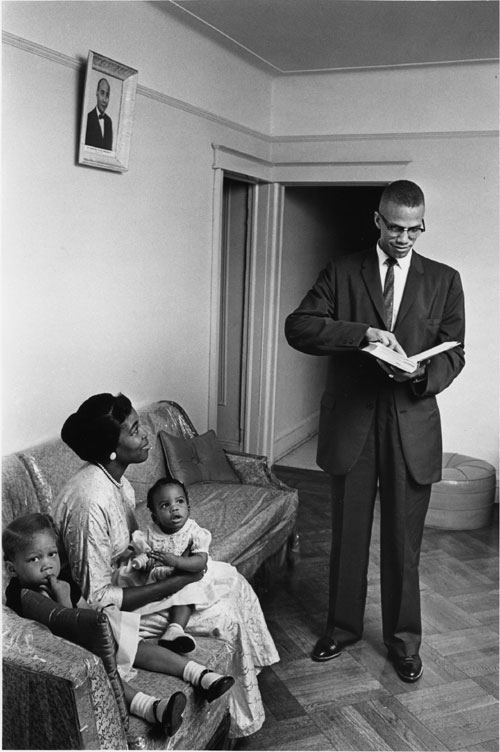
We often think about the men in the struggle, but how many of us consider the struggles of the women who stood beside them? When I first converted, I was always down for some liberation struggle. I was young, enthusiastic, and super idealistic. My friends used to call me Betty Shabazz. The tender scenes played out between Denzel Washington and Angela Bassett really moved me. If I imagined having a man as principled, dedicated, intelligent, and driven, then Betty Shabazz was the type of woman I wanted to be to support a Malcolm. Unfortunately, not too many brothers were on point like Malcolm. While I have so much respect for Malcolm X and Betty Shabazz, there is something really tragic about the Shabazz family.

I wonder how many of us know anything about her life? How many think about her struggles and the struggles of the Shabazz family. Here was the wife of one of Black America’s great heroes, the mother of his six daughters, Attallah, Qubilah, Ilyasah, Gamilah, and twins Malikah and Malaak. She went on to earn her PhD in education, was an educator and public speaker. She raised all six of those girls trying to instill in them Islamic values.

But I remember the downfall of Betty Shabazz. It was tied to revenge. I was devastated to hear her name smeared. There were accusations that she and her daughter, Qubilah, tried to hire a hitman to kill Louis Farakhan. Then there was the reconciliation between Farakhan and Betty Shabazz. Although Qubilah was never imprisoned she was ordered to undergoe drug treatment and counseling. Qubilah’s 12 year old son, Malcolm, went to live with Betty. On June 1, 1997 Malcolm lit a fire in her apartment. She died three weeks later on June 23, 1997. It is sad that her own grandson, Malcolm’s eponym was ultimately responsible.

Betty Shabazz is still my hero and a powerful example of what Black Muslim women should strive for: dignity, courage, and dedication. Her life and death reflects the struggle of so many Black women who have held it down to keep their families together and support the community.

Diseases of the Heart–Narcissism

I just read that today’s college students are more narcissistic than their earlier counterparts (Study: College Students More Narcissistic ). It reminds me of a talk that Dr. Robert Frager, a noted pyschologist and Sufi, gave last year about the diseases of the heart. During that lecture, I remember a deep fear sinking into the pit of my stomach. It was not for me, even though I have a whole bunch of personal work, but for a friend that I no longer speak to. Frager mentioned that a person with a diseased heart hates criticism even when the criticism is to help them actualize the person they are truly meant to be. Frager also stated that this type of person is afraid of intimacy and therefore cannot get close anyone. After hearing this talk, I really wanted to be there for my friend. I really wanted to have a real conversation about what I learned. But it never happened. Which is best because I probably would have been attacked regardless of my intentions. It makes me sad, because I truly believe in that person and believe that they can make a world of difference if they stopped surrounding themselves by people who only gave them adulation and ignored their shortcomings. We are often able to see the flaws in others, but rarely in ourselves. Yet I am one of those hyper self-critical people; I am aware of my flaws, but find it difficult to overcome them. I know narcissism when I see it, because I’ve developed antibodies for it. And one only has such antibodies if they have been afflicted with this pathology at one point or another. I state this humbly. There is no benefit in me being self-righteous.

Narcissism

use their looks to get what they want, is able to plan and work towards goals successfully, loves themself, optimistic, sparkling, achiever, self promoting, self assured, success driven, thinks they can charm anyone, ambitious, elegant, thinks they are better looking than most people (which they may or may not be), believes that they are special, more a leader than a follower, believes that other people are envious of them, loves to win awards, fits in most places, seductive, purposeful, believes in success through appearances, assertive, goal oriented, would love to have buildings and monuments named after them, believes they deserve all the good things they have, likes to be popular

Narcissism – Global Advanced Trait Descriptions

NARCISSISM (n. sing.)

A pattern of traits and behaviours which signify infatuation and obsession with one’s self to the exclusion of all others and the egotistic and ruthless pursuit of one’s gratification, dominance and ambition.

Narcissism is named after the ancient Greek myth of Narcissus who was a handsome Greek youth who rejected the desperate advances of the nymph Echo. In punishment of his cruelty, he was doomed to fall in love with his own reflection in a pool of water. Unable to consummate his love, he pined away and changed into the flower that bears his name to this very day.

WHAT IS NPD (Narcissistic Personality Disorder)?

The Narcissistic Personality Disorder (NPD) has been recognized as a seperate mental health disorder in the third edition of the Diagnostic and Statistics Manual (DSM) in 1980. Its diagnostic criteria and their interpretation have undergone a major revision in the DSM III-R (1987) and were substantially revamped in the DSM IV in 1994. The European ICD-10 basically contains identical language.

An all-pervasive pattern of grandiosity (in fantasy or behaviour), need for admiration or adulation and lack of empathy, usually beginning by early adulthood and present in various contexts. Five (or more) of the following criteria must be met:

Feels grandiose and self-importance (e.g., exaggerates achievements and talents to the point of lying, demands to be recognized as superior without commensurate achievements)

Is obsessed with fantasies of unlimited success, fame, fearsome power or omnipotence, unequalled brilliance (the cerebral narcissist), bodily beauty or sexual performance (the somatic narcissist), or ideal, everlasting, all-conquering love or passion

Firmaly convinced that he or she is unique and, being special, can only be understood by, should only be treated by, or associate with, other special or unique, or high-status people (or institutions)

Requires excessive admiration, adulation, attention and affirmation -or, failing that, wishes to be feared and to be notorious (narcissistic supply).

Feels entitled. Expects unreasonable or special and favourable priority treatment. Demands automatic and full compliance with his or her expectations

Is “interpersonally exploitative”, i.e., uses others to achieve his or her own ends
Devoid of empathy. Is unable or unwilling to identify with or acknowledge the feelings and needs of others

Constantly envious of others or believes that they feel the same about him or her
Arrogant, haughty behaviours or attitudes coupled with rage when frustrated, contradicted, or confronted.

The language in the criteria above is based on or summarized from:

American Psychiatric Association. (1994). Diagnostic and statistical manual of mental disorders, fourth edition (DSM IV). Washington, DC: American Psychiatric Association.

Sam Vaknin. (1999). Malignant Self Love – Narcissism Revisited, first edition. Prague and Skopje: Narcissus Publication. (“Malignant Self Love – Narcissism Revisited” http://www.geocities.com/vaksam/faq1.html )

More Data About Pathological Narcissists

Most narcissists (75%) are men.
NPD (=the Narcissistic Personality Disorder) is one of a “family” of personality disorders (formerly known as “Cluster B”). Other members: Borderline PD, Antisocial PD and Histrionic PD.
NPD is often diagnosed with other mental health disorders (“co-morbidity”) – or with substance abuse, or impulsive and reckless behaviours (“dual diagnosis”).
NPD is new (1980) mental health category in the Diagnostic and Statistics Manual (DSM).
There is only scant research regarding narcissism. But what there is has not demonstrated any ethnic, social, cultural, economic, genetic, or professional predilection to NPD.
It is estimated that 0.7-1% of the general population suffer from NPD.
Pathological narcissism was first described in detail by Freud. Other major contributors are: Klein, Horney, Kohut, Kernberg, Millon, Roningstam, Gunderson, Hare.
The onset of narcissism is in infancy, childhood and early adolescence. It is commonly attributed to childhood abuse and trauma inflicted by parents, authority figures, or even peers.
There is a whole range of narcissistic reactions – from the mild, reactive and transient to the permanent personality disorder.
Narcissists are either “Cerebral” (derive their narcissistic supply from their intelligence or academic achievements) – or “Somatic” (derive their narcissistic supply from their physique, exercise, physical or sexual prowess and “conquests”).
Narcissists are either “Classic” – see definition below – or they are “Compensatory”, or “Inverted” – see definitions here: “The Inverted Narcissist” – http://www.geocities.com/vaksam/faq66.html
NPD is treated in talk therapy (psychodynamic or cognitive-behavioural). The prognosis for an adult narcissist is poor, though his adaptation to life and to others can improve with treatment. Medication is applied to side-effects and behaviours (such as mood or affect disorders and obsession-compulsion) – usually with some success.

The narcissistic individuals that I know usually have a hubris whirling around them. There are many narcissists who are attractive, and use their looks and charm to manipulate others. Then there many narcissists that are highly attractive individuals, not in the physical sense, but have alluring qualities that appeal to others in a non-sexual way. They draw people to them because they are purpose driven and charismatic. They wouldn’t want to live their lives any other way. They like to be in the center of action–making things happen. Some of us get sucked in because we want to help, but they are selling a pipe dream that is corrupted by their own misguidance. Sometimes we can navigate their social pathologies and get something done, but often their larger than life egos get in the way. Mental illness and diseases of the heart are unlike other diseases. You can’t contract them. But I have never seen a narcissist cured. It is especially tragic to see Muslim narcissists because our traditions have diagnosed this disease and have a treatment to help treat those who are afflicted.

Some narcissists are humbled, but it is usually in old age, maybe after a stroke or something, but that is after leaving a whole path of destruction in their wake. They cause a world of hurt and have little empathy for those they leave damaged. They don’t recognize that they are sick, nor do the people who are loyal to them and condone their behavior. Those who are hurt by narcissists need to recognize that the perpetrators are truly sick individuals. Instead of being angry, we should feel sorry for them and their self delusions.

It is important for all of us to understand this disorder because narcissists are usually quick to place themselves in positions of leadership or power in our communities.

Al-Bukhari and Muslim have reported on the authority ofAbdullah ibn Umar that the Messenger of Allah (saw) said: “Truly, Allah will not take away knowledge by snatching it away from people, but by taking away the lives of the people of knowledge one by one until none of them survive. Then the people will adopt ignorant ones as their leaders. They will be asked to deliver judgements and they will give them without knowledge, with the result that they will go astray and lead others astray.”

When ‘Ubadah ibn as-Samit was asked about this hadith he said: If you want, I will tell you what the highest knowledge is, which raises people in rank: it is humility.”

He said this because there are two types of knowledge. The first produces its fruit in the heart. It is knowledge of Allah, the Exalted – His Names, His Attributes, and
His Acts – which commands fear, respect, exaltation, love, supplication and reliance on Him. this is the beneficial type of knowledge. As ibn Mas’ud said: “they will recite the Qur’an, but it will not go beyond their throats. The Qur’an is only
beneficial when it reaches the heart and is firmly planted in it.”

Some communities are able to isolate the narcissists. And other narcissists display behavior that is so transgressive and destructive that everyone has enough sense not to place them in positions of power. Still narcissists often have a circle of followers. They may be the dissenters in a community, raising a ruckus for whatever reason. Sometimes, they are productive and can be useful vehicles for doing good works. Though if not reigned in, they can reverse all those positive gains. Often, those that are under direct influence of these sick individuals are left hurt and feel manipulated. Sometimes the machinations of a narcissist can have ruinous effects and be detrimental to the mental stability of those who try to help them and their causes. In their pain, the victims develop other diseases of the heart:depression and despair or jealousy and envy.

Umar bin Al-Khattab, Radi-Allahu unhu, narrates: I heard Allah’s Apostle saying, “The reward of deeds depends upon the intentions. And every person will get the reward according to what he has intended.”

It is important that we recognize the diseases of the heart, such as narcissism, as they manifest themselves in our communities. Narcissists often warp shari’ah to suit their own purposes by bending the rules and apply them according to their whims. They participate in events or do certain things (frequenting the masjid, giving talks, hosting events, leading ‘movements’) to win adulation and respect from members of the community as opposed to doing it from the goodness of their own hearts.

They do shocking things just to be in the center of attention. And because they are our brothers and sisters, we often have a high toleration for them. It is important to recognize narcissism as a disease and not try to make sense of the absurdities and inconsistencies that exist in their lives. We can’t rationalize the irrational. We’ll drive ourselves crazy trying to make sense of their madness. Instead, we just have to chalk it up to the disease and then move on.

I am writing this because I believe each one of us has been affected by someone who is narcissitic. We may have loved ones, a father, brother, son, mother, sister, aunt, uncle, cousin, friend, husband, or wife, who is one. If you don’t know of one, then you should really assess your own behavior and see if you have narcissistic traits. Here’s the Online NPA test . If you find yourself rating high on the test, perhaps you should do some serious work on purifying your heart and curing yourself of this debilitating disease. So, whether you are Sunni, Shi’i, Sufi, or Salafi, and even for those who are not Muslim, there is something that we can learn from tassawuf, purification of the heart.

The Resolution, 2007

I have contemplated doing the New Years Resolution thing. It is a nice ritual, but we often fall short and slip back into our vices within months, if not weeks. One New Years Resolution I had was to be good to myself. I haven’t done a very good job, but I have been treating myself better than I have in the past few years. Or maybe I’m feeling less beat up because of a complete turn around in my academic career. 2006 was a rough year for me, career-wise and personally. Today I ran into a professor who has been supportive of me work and continually encouraged me to keep fighting the good fight. He said that something must be wrong, because I looked happy. I looked happier than I had in the past two years. I think happiness is relative. But I’m going to try to be happy. And when times aren’t happy, I’m going to embrace the hardship, loneliness, and pain. Riding through those will make me stronger and during those times, I will draw closer to the Creator.

What lies ahead for me during 2007 seems like a scary and seemingly impossible journey. My journey will span a year or two and will take me to Egypt. Going to Egypt for so long is a big leap for me, but I’m committed to going. It is something that I knew I would have to do since 2002 when I decided to take this path. Going abroad is essential for my career as a researcher and scholar. Historians of Africa pride themselves with the emphasis on fieldwork. I will earn my stripes as a legitimate scholar. Going out into the field means living amongst the people you are studying for extensive times. Historians of Africa are in many ways similar to anthropologists. Years ago, anthropologists spent years, sometimes 4-5 years in the field. Great historians like Jan Vansina and Steven Feierman spent years in the field and are both trained as anthropologists and historians. They became fluent in the languages and cultural repertoire of their subject populations. (But for me, I am a member of the community that I am studying. For anyone that hasn’t noticed: I am of African descent and I am Muslim. So my research directly relates to my identity meaning that I have more of a stake in my work. I am transformed by my work and my identity transforms the meaning of my work. )The average Africanist spends 10 years getting their degree. Becoming an Africanist often entails language training in another European language besides English, such as French and German and an African language. We draw on various disciplines and sources to reconstruct past lives and events. We use ethnographic studies, collect oral data through interviews or collecting poetry, oral histories, epics, stories, and songs. We visit archives set up by colonial and state governments. A historian of Islamic Africa requires the skill sets of an Orientalist scholar who can master Arabic texts, European languages for colonial and state archives, and a ethnographic skills of an anthropologist. Stanford provides funding for 5 years. There is university funding for the 6th year. Fortunately for me, my research subjects speak modern standard Arabic. My research focuses on race in Muslim societies and I will be examining a communityh of West Africans in Cairo. I am taking a leave of absence for language training and research, which means my degree can take 7-8 years.

But who wants to be in their early thirties, during the prime of my life abroad surrounded by strangers? I’m not really happy with what that means in my life right now. Often, I think about what I’m putting on hold to go there. It extends my studies. It prevents me from establishing roots or real connections here. It in many ways leaves me vulnerable and alone. Being a woman in the Middle East is not very easy. There is less freedom to move, more chaos, cultural misunderstandings, and increased vulnerability. Then, there are all the people who see me as a walking visa, a ticket out. Sure, I have a few friends that live in Cairo, but I’m going to be far away from my family and people who have looked after me for years. I’m also trying to brace for a new flavor of racism, the Middle Eastern type. Sometimes, when I think about the journey ahead, I already feel the homesickness. I can imagine the loneliness, since I remember how alone I felt in Morocco at times. I can also feel the culture shock coming on. On the other hand, a huge part of me is relieved to be leaving the Bay Area, this isolated pocket community. I’m tired of the weird incestuous nature of both the graduate and Muslim community here. I’m restless and want to do something and be exceptional. I want to master Arabic, which I have been studying for almost four years. I want to pay my dues as an Africanist and maximize my field experience. I want to be around spiritual and good-hearted people. Sometimes I don’t mind the break from the struggles of being black in America. But really, I want to be around people who make me want to be a better person. Here, I find myself agitated, but not stirred, shaken, but not moved. I would like to surround myself by exceptional people who inspire me. Maybe there will be people like that in Egypt. The people I know who are there are good people. I hope there are more like them.

My mixed feelings about traveling and living abroad really reflect my acknowledgment of the benefits and sacrifices of undertaking this endeavor. I still have a long road to go to finish my degree and many obstacles ahead. In order to finish in that time, I must write and research expeditiously. I must be focused. I have to focus my energies, doing away with frivolity and nonsense. This is why I have extricated myself from chaotic and distressing situations and relationships. I must be good to myself and follow some of my unwritten New Years resolutions in order to take on this task.

I don’t think I’m going to find what I’m looking for in Egypt. But I do think that I’m going to have one piece of the puzzle figured out. Then it will be on to figure out the next stage. But everything I’m doing right now is preparing me for that. When I come back, I will be different. But I’ll also come back hungrier to finish my Ph.D. and ready to do the damn thing. Cairo is more real to me in my dreams. Sometimes those dreams feel more real than my reality here. Today, I spoke with a jewelry vendor. She said that I spoke of Egypt like I’m already there. While Summer is still far away, I’m there somewhere in Cairo.

What To Do When Muslims Behave Badly

By behaving badly, I don’t mean Muslims not praying or transgressing personal morality. I mean things that violate someone else’s humanity and dignity. You know, things like genocide, terrorism, enslavement, child abuse, and violence against women. How do Muslims come to terms with the atrocities committed by other Muslims?

Should their actions cause a crisis of faith? Should we reflect upon our core beliefs to understand why the trans-Saharan slave trade occurred, why genocide is going on in Darfur, why there is still the enslavement of blacks in Mauritania, why female genital mutilation is praticed in many parts of the Muslim world inluding Egypt, Somalia, Sudan, and in some parts of the Levant and Iraq? Or should we Muslims try to defend our faith and seek the core spiritual truths. Do we explain that these actions were due to cultural practices, even though the perpetrators may sincerely believe that they are doing some actions in the name of the faith? How do we come to terms with the fact that religious ideology is used to justify all sorts of brutality?

My understanding of these issues have been shaped by my training as a Western scholar. But there is the part of me whose identity is tied up with the cultural religious complex called Islam. Although I try not to let my faith blind me from seeing historical realities, my identity shapes how I understand those realities. I have read several articles that make broad generalizations in their critiques of Muslim/African encounters and Arab/African encounters. Often Arab and Muslim are depicted as synonomous. Right now, Arabs are the only ethnic group that it seems generally okay to say vehemently racist things abou them. Many Arabs are Muslim, but clearly not all Muslims are Arabs. In fact the majority of Muslims come from Indonesia. Few people have bad things to say about Indonesians. But I digress.

I am in a society that is largely hostile to both my race and my religious beliefs and practices. Our communities tend to circle their wagons and in this defensive position we are less likely to be introspective or reform driven. Instead, any criticism from outsiders is taken as an attempt invalidate our beliefs and identity. But this does not mean that we should focus on defending our beliefs and cultural practices against important critiques. The truth of the matter is that Muslim women are still not able to secure the rights accorded them in the Shariah. There is a huge difference between High Culture, popular culture. Doctrine and ideology does not determine the actions of individuals. Instead, a full range of overlapping and conflicting interests can drive why individuals and groups choose to do certain things. What I think is important is to expose how individuals manipulate the naivete of their followers. It is important to look at the political economy of any movement. It is essential to look at the material motivations, as well as consider whether or not spiritual beliefs were sincere. And just because someone is sincere in their beliefs, that does not mean that they are not misguided. This is why it is important to move beyond the Us/Them mentality. The Us/Them mentality is really the thing that allows us to behave badly against other human beings. Anyways, that’s my thoughts for now. This meditation will continue…