Betty Shabazz

In December 2005, I went to a talk with Cornell West and Zaid Shakir on the legacy of Malcolm X and Martin Luther King. I have to give it up to the two brothers, they rocked the house. Malcom and Martin differed on many issues, but both were gunned down, becoming martyrs for the liberation of Black Americans (and thereby opening up the doors for so many others including women, immigrants, and other minorities). Whenever I think about race relations in the Muslim community, I think to myself, “What would brother Malcolm say about this?” For example, when I watched this Hajj documentary and a Black South African was dissed really hard by his South Asian South African brethren, I wondered: “What if brother Malcolm’s experience on Hajj had been the same? Would he have become an orthodox Muslim? What if those South Asian coloreds dissed Malcolm? Would he have been agnostic?” Afterall, it was his experience on Hajj that opened his heart to accepting European, Arab, South Asian, and South-east AsianMuslims as brothers. For so many of us, Malcolm X has been so influential. I’m glad that folks stopped rockin the X gear, because nothing about El Hajj Malik Shabazz was trendy.

malcolmbatch4b.jpg

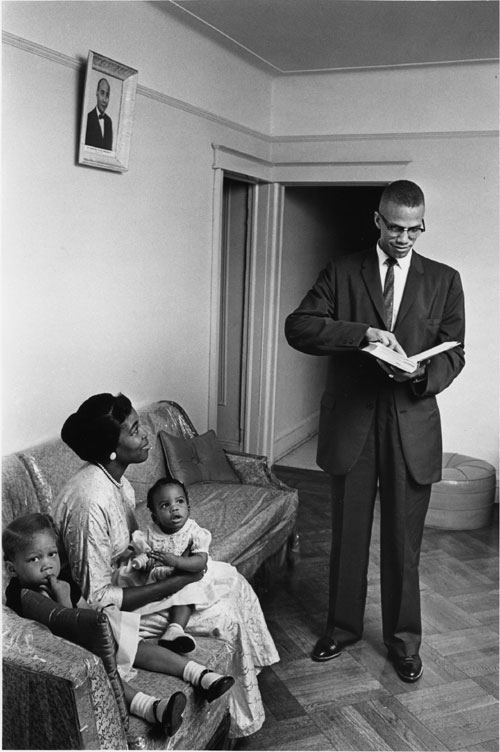
We often think about the men in the struggle, but how many of us consider the struggles of the women who stood beside them? When I first converted, I was always down for some liberation struggle. I was young, enthusiastic, and super idealistic. My friends used to call me Betty Shabazz. The tender scenes played out between Denzel Washington and Angela Bassett really moved me. If I imagined having a man as principled, dedicated, intelligent, and driven, then Betty Shabazz was the type of woman I wanted to be to support a Malcolm. Unfortunately, not too many brothers were on point like Malcolm. While I have so much respect for Malcolm X and Betty Shabazz, there is something really tragic about the Shabazz family.

I wonder how many of us know anything about her life? How many think about her struggles and the struggles of the Shabazz family. Here was the wife of one of Black America’s great heroes, the mother of his six daughters, Attallah, Qubilah, Ilyasah, Gamilah, and twins Malikah and Malaak. She went on to earn her PhD in education, was an educator and public speaker. She raised all six of those girls trying to instill in them Islamic values.

But I remember the downfall of Betty Shabazz. It was tied to revenge. I was devastated to hear her name smeared. There were accusations that she and her daughter, Qubilah, tried to hire a hitman to kill Louis Farakhan. Then there was the reconciliation between Farakhan and Betty Shabazz. Although Qubilah was never imprisoned she was ordered to undergoe drug treatment and counseling. Qubilah’s 12 year old son, Malcolm, went to live with Betty. On June 1, 1997 Malcolm lit a fire in her apartment. She died three weeks later on June 23, 1997. It is sad that her own grandson, Malcolm’s eponym was ultimately responsible.

Betty Shabazz is still my hero and a powerful example of what Black Muslim women should strive for: dignity, courage, and dedication. Her life and death reflects the struggle of so many Black women who have held it down to keep their families together and support the community.

On the Desirability of Brown Babies

I was a bit inspired to write this blog after reading Umar Lee’s blog, On Being a White Muslim in America . I also read a few blogs where the authors stated that black women wanted to have babies by white or Arab men in order to have light skinned and curly headed babies. Sure, I know some ignorant black women who have said similar things. But for the most par, my friends are conscious and wouldn’t spout of some nonenense like that. On the other hand, I have heard a few educated black men say that they want to marry a mixed girl because mixed girls are prettier. I have also heard a few black say that they wanted to marry someone white, Asian, or Latina so they would have pretty babies. As one author stated in the comments, it was often hoodrats who stated that they desired a non-black baby’s daddy in order to have babies with good hair. But more than blackpeople, I have heard these statements from members outside of Black American community. In fact, I hear about the desirability for pretty-brown-mixed-babies from liberal white, Asian, Arab, South Asian, and Pacific Islander women. So, if we are going to analyze and critique the ethnic self-hatred of some African women and Black American women, we must analyze and critique the reasons why some women want to adopt African babies or have bi-racial babies who do not look anything like them.
Is it ethnic self-hatred? Is it admiration for African features? Is it a vision of a racial utopia where we are all shades of brown? Or is it something else. I would argue that some really problematic constructs underly America’s fascination with mixed babies.

Keep in mind, I am not saying that all people involved in interracial relationships hold these views. But there are some tendencies that are problematic. I am not saying that mixed people are not attractive. I think all groups and ethnicities are beautiful in their own light, including multi-racial babies. And being in a multi-cultural environment, I enjoy seeing little blonde babies and little Asian babies, as well as little chocolate drop babies, and the curly headed brown babies running around. However, I just find it problematic when you assume that multi-racial children are more attractive than mono-racial babies. And while this might sound liberal and progressive, especially if you are a White Anglo-Saxon Protestant who is rejecting white supremacy, it is still supporting white supremacy because you imply that an African person is only beautiful if their genese are diluted with European, Asian, or Meditterranean genetics. This is problematic in a European dominated society with European standards of beauty. It has had disastrous effects in the Black American community. And it is the reason why we celebrate Beyonce, as opposed to Kelly. For those of us who are phenotypically Africa, these notions are especially harmful, as they affect our self image. But my focus is not on why African women and women of African descent (Black American, Black Latina, and Carribbean) and their responses to European standards of beauty in a global order that is dominated by Europe and the West. I am talking about women, and perhaps some men, who are not members of the African Diaspora who want to have ethnic babies–especially black babies. I see it as part of fetishization and there is something about fetishizing black-ness that is deeply disturbing. Then on top of the fetishization, the celebration of those who are not-quite-black or nearly-white over their darker skinned counterparts.

I live in California, the Bay Area that is. There is a lot more racial mixing and there really isn’t a middle class black community anywhere in sight of Northern California. So my experiences reflect the product of my environment. In California mixed families and bi-racial people are common. More often than not,it is the mother who is non-black and a black father. Few of my black friends were single mothers, but many of my non-black friends eventually did have mixed babies out of wed lock and at young ages. I often see white, Asian, Latina, etc. women (and teenage mothers) pushing a stroller with either a clearly bi-racial child or an ambiguous child. I have pretty good ambiguously black radar because so many people in my family are light skinned, multi-racial, and racially ambiguous. Sometimes it is the subtleties that you notice, but I digress. I grew up in a terribly racist elementary school. I was subject to a lot of racial discrimination because I was the only black girl in my school. But now when I look back, there were a few mixed children in my class who just passed. They were not subject to the daily enslaught of racist jokes and cruelties such as “let’s play segregation today.” On the other hand, my brother’s experiences in Santa Clara were different because many of the white and Mexican American girls pursued him. Black men were cool, they were the athletes, the dancers, the popular kids. But for black girls in integrated environments, it tends to be a lot harder. We are often overlooked by our black male counterparts and the non-black men will not take a second look at us.

Now that black is in, a lot of women who are not black want little curly headed brown babies. Someone noted that in Belgium and Amsterdam, there are European women who get pregnant by African men and raise their children on their own. I don’t know much about this phenomena, but I thought it was interesting. But this leads me to reflect on the kind of ideologies that non-black mothers tell their children. Some of the ideas the ideas are really messed up. Some believe in the racial essentialisms. For instance, one bi-racial man told me that because he was black and white he reflected the merging of two distant strands of humanity. This made him more powerful than either because he was a bridge between the two races. Of course, this is bullshit. In fact, there is more of a genetic range in East Africa than anywhere in the world. In fact, European and Asian lines are really a small recent branch off of a long and ancient family tree. Some bi-racial families like to tell their children that they are extra special (as if Black Americans are ethnically or racially pure) and that they bi-racial people saviors to the world. Some claim that racial mixing is the solution to the world’s problems. But they often fail to look at the case of Brazil to see that social stratification and racism exts there, despite official policies that encouraged racial mixing. All one has to look at how white the government looks like to this date. Some of the racial essentialisms serve to create dangerous color hierarchy that only serves to reaffirm white supremacy. They try to teach their children that the world is color-blind, but many fail to teach their children the complexities of their heritage (especially the Black heritage that has been silent in historical record). The desirability of having brown babies often has little to do with affirming this rich heritage or linking up with the struggle of people of African descent.

At times, it has to do with the ways individuals would like to construct themselves and the fantasies that they have about the black “other.” It can be a way of rejecting white privilege. A white woman with a brown baby is not accepted into white elite circles. Nor are Asian women accepted in their communities and Latina women are often ostracized by their friends, families, and associates. Many are disowned for dating or marrying outside their race (On the other hand it is rare for black families to disown their sons or daughters. And they often raise multi-racial children and treat them well). Having brown babies can serve as a way of advancing an agenda or affirming a new constructed ethnic identity. They can participate in black culture because they now have a rightful place as mother of a black child. However, many women who only date black men and have brown babies would not change their own ethnicity. They do not want to be black women at all. They comletely enjoy their privileged place as desired/objectified other in a community that is so rife with self hatred. In fact, many non-black women feel superior, while at the same time, they often resent black women. I have heard several non-black women talk completely disparaging of black women, our looks, our hair, our body shape, our attitudes, and intelligence. (I am sure that many are regretful that they disclosed to me their off the cuff thoughts. But they have been extremely insightful). This is especially the case when they are competing for the attentions of a black man, or trying to bolster themselves up when comparing themselves to their partners’ exes. I have always wondered why some of my friends and associates felt that confortable saying such statements to me. Perhaps they were looking for me to validate their views. And I take responsbility for not challenging them on their wack statements. It seems as if many non-black women who are into urban/hip hop/black culture hope to raise new brown/black women who will accept their authenticity and be color blind. Having brown babies seems to be a complex social phenomena that I think we have only begun to unpack. We should look at what’s going on to understand how colorism is being reproduced in our community and how the ultimately can have devastating effects on those who are phenotypically Black.

Hip Hop and Culture Vultures

First, let us define culture vulture. This is the definition that I found in the Urban Dictionary:

1. culture vulture
4 up, 3 down
Someone who steals traits, language and/or fashion from another ethnic or social group in order to create their own identity.

Todd just bought himself a Fubu track suit and changed his name to Tyrone. He is such a culture vulture!

by shaniqua2 sacramento Dec 27, 2006 email it
2. Culture Vulture
12 up, 15 down
A scavenger, circling the media, looking for scraps of originality to add to their conceit. They sport eclectic styles and tastes, always recognisable as having been borrowed without adaption or refinement from elsewhere.

David Bowie is probably the best example of a successful culture vulture.

That website was put together by a Culture Vulture

For those of us into Animal Planet or any Wild Animal Kingdom show, we have seen images of these scavengers.They are often the harbingers of bad things about to happen: a sick, weak, or dying animal. They move in once the animal is dead and don’t mind taking their fill of something that is dead and decaying. Fortunately, the many cultures of the African Diaspora are always re-inventing and re-creating, so that the vultures always have fresh meat to feed off of.

My home girl just brought up this issue up in her blog. Her blog really hits home for me, because I feel as if I just “be.” But I was also a B-girl, a back packer, a houser, and breaker. Ultimately, I don’t have to prove credentials to show how my culture influenced the way I lived my life. Having a young mom, I grew up with music all around me. I was a child born in the mid 70s, and my household was alive with disco, R&B, Funkadelic, Soul, and Hip Hop. James Brown was always playing, as well as George Clinton, Bootsy Collins, Earth Wind and Fire, and Marvin Gaye and so many other. My Uncle Booker-T had mad skills spitting game. Rhyming was a way they spit game. And growing up, we knew smooth talking hustlers and artists. I knew rapping from the brothas spitting game, melodic and rythmic. My dad also was a musician and he played the drums and kill some Congos. My mom and aunts used to throw basement parties (you know the kind with the red or blue light). My mom, aunts, uncles, and their friends would wake me and my cousin up to demonstrate our skills. They’d hoot and holla as we worked it out. Yeah, me and my cousin Corey partying with the grown folks. Many of the songs that are remixed today, I grew up with and they are the soundtrack of my life.

But hip hop had a special appeal. As a little kid, I followed my older brother’s footsteps trying to do everything he did. And I remember him sifting through records trying to find the hottest tracks. We shared rooms, and I remember him getting mad at me when I made a mix tape that included scratches. He had the biggest boom box and the freshest gear. Whatever kicks he rocked, I wanted some too. His boys had a brea dancing crew and they used to perform at Great America. In the mea time, I had a crew of other neighborhood rug rats and we’d pull out our cardboard too. My signature finale move was the suicide. Now that I think about it, I was probably really wack. In the early 80s, my brother used to import records from the East Coast. I can even remember getting the latest Roxanne diss album (why was there so many Roxannes), to BDP, Run DMC, and Rakim. I saw the evolution of hip hop to rap, bass music, and knew all the West Coast flavors. Sometimes when we’d travel to New Jersey we’d visit friends and family from New York.

In the early 90s, I was back at it when breaking made its come back. I remember growing up in Cali and my Filipino classmate saying that Filipinos break better than black people. And of course, I was floored. I could never understand how they could beat out in their Honda Civics, but never bob their head. Me, we wer always bobbin, good music always moves me. Another time, I went to a hip hop show and the artists noted I was the only black girl in the crowd. It was eerie… There weren’t any dance crews in the area that seemed black girl friendly. So, it would be me in the garage with my neighbor Levar on some cardboard. But it was kind of hard to pop and lock while everyone stared at my breasts (even though I wore the baggiest clothes and turtle necks).

For years, I lived hip hop. I was that hip hop Muslim girl in the South Bay. I wore my Adidas with dresses and full hijab. From working on college radio, freestyling, writing, even demonstrating to the music production class the old school 808 and 626 beat machines. It was hot with the boom-clap-boom boom boom-clap. But eventually I felt let down by the whole scene and the way it was co-opted. Years later I still feel hip hop and those hold school joints still move me.
As I write, I hear the women of hip hop play in my head (Miss Melody, One of the many Roxannes, McLyte, JJFad,…) Every once in a while I’ll dance. And I have been known to break fools off. But I forego floor manuevers and acrobatics because I’m way too old and am likely to hurt myself.

The discussion of hip hop reminds me of this MTV True Life documentary that had the nerve to air during Black History Month. Half the documentary was about a Latina sorority breaking into the Black stepping world. Even though the young woman’s attitude was emblematic of the ways non-blacks feel about any of our cultural productions, I’m not going to talk about stepping. I’m going to talk about one for of Black music, dance, language, and style–that cultural complex that we know was hip hop. I want to begin my analysis of culture vultures and critique this pattern of mimicking the cultural expression of subaltern groups. I think that they are particularly detrimental because they co-opt of the arts and culture of a dispossessed people. There are people who wish to control the discourse on black music and culture rendering it something that is no longer Black culture, but more of an urban style or something that they can consume.

I have a serious problem with those who wish to divorce the black cultural production of black from its social/political/cutural/economic context. In the name of a trend, they then adopt it as their own. And often they profess to be better at producing given culture better than the members of the original community that created it. Sometimes they even create their own sub-culture, while maintaining their privilege as members of the dominant culture. The culture that they have adopted is more like an accessory, a way of enhancing their individuality because they see their own culture as homogenous and bland.

I’m not really mad at culture vultures. You see, the co-optation of Black culture for various reasons is not anything new. But rather, it is a pattern that is repeated where ever people of the African Diaspora exist: South America, North Africa, the Carribbean, Central America, and even parts of the African continent that is dominated by Europeans or those of Mediterranean descent.

Here is one example of the problems with such forms:
Black South Americans started Tango, which began with the Buenos Aires, Argentina and Uraguay. Oh yeah, you didn’t know there were black people in Argentina.To me that is the biggest historical mystery: what happened to the tens of thousands of Africans? Well, predominately European dominant group co-opted Tango from the black Argentinians before they tried to eliminate the black population and make Argentina the little Europe of South America (by importing Spanish Basques, Italians, and Germans to the country).

My list of other musical and dance forms that began with African slaves or exlaves that have been co-opted by the dominant groups of a given society:
Samba
Merengue
Rumba
Salsa
Swing
Capoeira

As in Latin America, these cultural forms become national cultures and part of the national pride. The suffering of the people who invented these cultural forms, and the creative ways that they came up with to assert their humanity, find relief, build community, and celebrate life becomes lost. Instead, those who co-opt these expressions often misunderstand the experiences of the people they are imitating.
In a discussion about Jazz, an astute author wrote:

The “white Negroes” of the 1920s projected their own desires onto black Americans, most frequently through music.

In much the same way, individuals who co-opt hip hop project their own desires, insecurities, constructions onto black Americans. There is a strange relationship of power: one of admiration and envy. In their mind, they struggle for authenticity and seek for others to validate their experience of the black sub-culture. Most black people, including myself, are happy that people enjoy our cultural forms. But there are many people of AFrican descent who want to feel as if they have their own culture without it being co-opted and commodified.

So now that I have spent an inordinate amount of time reflecting on how these musical forms were so much part of my life and the way I was raised. I want to providea brief timeline of non-black folks imitating and co-oting Black cultural exprssion in North America:

Early 19th century-mid 20th century
Minstrel Shows
Black Face Minstrelsy

1920s-30s
Jazz
Jazz in Black and White


1950s and 1960s
The Blues

White Blues Artists

1950s-
Rock n roll

Rock n Roll Timeline

And now Hip hop….

The history of Hip Hop
Davy D’s Short History of Hip Hop

I still have more reflecting to do on this topic. This is by no means comprehensive. And I’m sure that there are many people who will be pissed off by my analysis. I suggest you study some cultural theory, the history of black cultural expression, black history, and then get back at me. Make sure your intellectual game is tight though…

5 Stages of Being Single in Your Thirties

In her 1969 book, On Death and Dying, Swiss-born psychiatrist Elizabeth Kubler-Ross outlined the five stages of grief of someone who is dying:
• Denial and isolation: “This is not happening to me.”
advertisement
• Anger: “How dare God do this to me.”
• Bargaining: “Just let me live to see my son graduate.”
• Depression: “I can’t bear to face going through this, putting my family through this.”
• Acceptance: “I’m ready, I don’t want to struggle anymore.”

The list was praised and criticized by grief experts. Some said the stages got people expressing their emotions; others said the stages were too rigid.

I thought these stages are adaptable to some of us sisters who’re still single in our thirties:
• Denial and isolation: “This is not happening to me. The most perfect guy in the whole universe will come rescue me.”
• Anger: “All men suck!”
• Bargaining: “hmmm maybe I’ll settle for this trifling brotha that’s in my face right now. Even though he is shiftless right now, we can work through our issues”
• Depression: “I can’t bear to going through this, I’ll be one of those crazy ladies with tons of cats.”
• Acceptance: “I’m ready, I don’t want to struggle anymore…if it happens it happens.”

I Don’t Need a Man?

So the other day, I was building with this brotha about relationships. He said he encountered time and again sistas saying that they don’t need a man. He went on to say that a lot of brothas are really put off by black women who go around screaming out this mantra, “I DON’T NEED A MAN!” Black women frequently put it in their profiles in online dating sites even. My mom’s single friends say it all the time, “I can do bad by myself, I don’t need a man.” The brotha bascially said, black men don’t want to hear “I don’t need you.”

I thought about the “I don’t need a man” theme and the brothas’ reaction to it. I replied, “Perhaps these sistas are tryna show they are independent.” (Destiny’s Child song theme song played in my mind’s soundtrack at the exact moment.) I myself heard a lot of brothas say that they like independent women. I was thinking maybe all these women can’t be salty. I dunno, I think 90% are salty 10% are trying to show that self reliance is positive thing. We then talked about how men want to be needed. I said that most men do not want a woman who is dependent upon them. We’re living in an entirely different time when gender roles are shifting, but women are stuck in a quagmire.

Say for instance, if I truly need you…then I am dependent upon you for my livelihood, my sustenance, my shelter, etc… Housewives are so out of style right now. I’m sure I’d scare a bunch of brothas off if I said “All I want to do is have babies, bake pies, and clean house.” But on the best case scenario, I need you once we have reached a level of commitment and partnership. Nobody wants to start out dating with a sistas asking for a joint bank account. If we are just dating and getting to know each other, it is highly likely that I don’t need you. I’ve got here so far without having you as an integral part of my life.

This sort of gets me thinking…This weekend, my roommate and I moved. We had two days to get everything together. Not one of the brothas offered to help. My girls came through and we made it happen. Friday night, we all hung, packed, watched movies, laughed, talked about serious issues. Saturday, two of my girls came with their big trucks and we packed, lifted, pulled, pushed, and cleared out our old apartment. Sunday, we tied up lose ends, relocated to our new pad. It was definitely about some estrogen enhanced power. And last night, my roommate and I bought, hauled, and assembled our furniture. I was building with this brotha at the tale end of the job. And he said even though not one man stepped up to help out, they’d be real quick to come over when the job was done. Yeah, our spot is about to be real nice…

I remember I had some friends who would get guys to do a lot of stuff for them. Men would come over to fix this, move that, buy this, toss that. You know, “the handy man can.” Not that I’m patting myself on the back. I’m just pointing out an example of not needing a man to make things happen. I’m not saying that it wouldn’t have been nice to have some help. That stuff was heavy, for reals. But the world didn’t stop because men were scarce. That doesn’t mean that I wouldn’t have wanted some brothas to help us out. It would have been nice to know that they were thinking about us struggling with our heavy load. My back hurts right now from lifting stuff. sigh…

I saw how my mother had to do so much by herself. So I didn’t have to hear no mantra about not needing a man. That doesn’t mean that I don’t want one. On the other hand, I sort of know what the brotha was talking the knee jerk reaction when you hear that phrase. Some men don’t want to feel like they need a woman at all. So, they do everything to create walls in order to not develop intimacy. They tell themselves, “I got my boys, I don’t need a woman.” But some women have just as much to offer as the homeboys. TI myself like to feel like I’m needed. And I’m not talking about cooking or ironing clothes. I’m talking about insight, advice, solace, and real assistance whenever there is a struggled. But then again, I don’t want a helpless man who can’t make decisions on his own. But then again, I don’t think anybody really needs me (well, I don’t have any dependents just yet). Instead, I want my contribution to be appreciated. The same, I hope someone can contribute to my life.

Do I need you? No, I want you but at this stage I’m not ready to rely upon you. Because I do not rely on you, a toxic relationship is even more detrimental. A bad relationship has few redeeming qualities. Especially if you have not helped me in any way. This is why my tolerance for nonsense is very low. But because I do not rely upon you, your contribution is even more appreciated. I see you as an enhancement to my life. Because I want you, desiring you is more stuff of dreams and hopes. I find that more magical….

Exotic

Okay, before I forgot… I have another random rant about Sunday.

So, this young brotha came up to me. He was like, “What country are you from?”
I was like, “Huh?”
He said, “Where are you from?”
I said, “I’m from here.”
He said, “You have that exotic look.You look like you’re from Trinidad or something you got that curly hair.”
I was like, “No I’m American.”
“Are you mixed with something?”
Mind whirling wondering if I should rattle off a catalog of my family tree. But my sense coming to me, I said, “No, I’m Black.”
He said, “Just regular Black?…Well you have that good hair.”
I said, “There’s no such thing as good hair.” And shook my head. I couldn’t school this brotha on how ridiculous that whole exchange was.

I’m sure if I told the brotha I was from the Islands that would have made me ten times finer. Oh, better yet let’s say Brazil. I bet if I started speaking Spanish and called him papi it would have upped my sexy. Hmmm, what if I said I was mixed. Would that increase my premium? Naw folks I’m claimin regular ole Negro/Black/African American. This raises the question: What does it mean to be black in America? What does a black woman look like? Last time I checked she came in all shades from porcelein white to ebony black with all hair textures and lengths, and eye color from blue to black. Why is it that anyone who falls outside of some phenotypical norm must be from somewhere else. I know it is nearly 4 am in the morning. But Black people, wake up!! And everyone else too Dammit.

It’s Real Dammit

My mind is sorta fried after a marathon writing and revising session. Still have a ton of data to add to my research, but it is coming along. So, I decided I’m going to write about some superficial stuff, but it has been on my mind.

I posted a picture on facebook showing a look I used to have. I was going through this phase, listening to lots of electronica, feeling all alternative. I was also bored with my hair which at the time I wore straight more often than curly and decided to go with bangs. Being that I’m obsessed with eyebrows, I couldn’t bring myself to cover them with bangs so I went with short bangs. The first day at work, they looked strange. But my co-worker who was a washed up musician in an Ohio industrial band (He even went on a double date with Trent Resnor to a Prince concert. How cool is that) sorta peeped the look and was like, “Hey that’s a cool Betty Paige Look.” But it wasn’t banging, so I went back and cut them shorter till I achieved this ultra cool retro look. Black people didn’t get it, but a lot of other people liked it. But having short bangs was annoying when I wanted to go natural. I had to wear a head band.

So, I posted this pic with my Betty paige bangs from when I was an undergrad. And at this gathering, my home boy was like, “I have a question, in that pic with the Betty Paige bangs was that a wig?” This was suprising coming from him. One time at this BBQ, another brotha who was staring at my big hair asked me if it was real. And my home boy was like, “Of course its real.” But this time with the bangs, he was like, it doesn’t look real.

Since I was in junior high, I’ve had a lot of negative attention about my hair. When I graduated, I was teased as I walked the stage. They were like, “BUSH! Busshhhhhhhhhh” I remember going to a track meet during my freshman year, the two rival schools with the biggest track teams, and a chorus of guys began singing, “Ewwwwwww is it really your hair? Is it really a weave? Is it really your hair?” Hair? Weave? Hair? Weave?” Do you remember that song? Anyways, it was totally humiliating, because I tried to do everything to make my hair look more real. I eventually cut off almost all of my hair. But as it grew out, it just looked like a mop. It just sorta looked like a short wig. Oh well.

A few years later when it had all grown back, I had some girls who had beef with me say, “She thinks she’s all that because she has all that hair.” Some girls tried to jump my best friend and cut off all her hair. Its crazy like that sometimes.

When I wore my hair natural, people thought I had a Jerri curl. I went back to straight because the curl wasn’t crackin then. When I had my hair staight other females would go up to my friends and ask them what was up with my wig. Some people said because it wasn’t straight straight, like bone straight that it looked fake. So, I would spend hours flat ironing my hair to make it thinner, smoother, less rattier looking. I became obsessive about my hair being bone straight.

One day, I realized how ridiculous it was. I was in a period of transition and knew I wanted to practice Islam. People saw me go through this transition. And some brotha said, “No, don’t cover your hair you are the only black girl that has long hair!!” Of course, I thought that was crazy and I had friends who had big heads of hair to hold it down for the sistas. Me, I was committed to the cause. No more questions about fake hair for the 5 years that I covered.

So five years later, when I decided to uncover my hair was like waist length. So, I was kinda freaked out. And I wasn’t really used to lots of male attention, so that was extra wierd. Within a few months, the questions came again. Somebody said the other day that any black woman who has long hair is suspect. Ain’t that something? I’m not knockin sistas for rockin weaves. White girls do it too, they just aren’t suspected as much as sistas. But on the subject of realness, I have had a number of things questioned. Things that are me, but people tend to call into question.

Are those your real nails?
Is that all your hair?
Are those your boobs or did you get a boob job?
And couple of times, people asked me if I had contacts because my eyes are brown and not black.

I have had people comment on my nails and say that I am vain. People comment on my display of gratuitious cleavage. People, i can’t wear half tank tops, blouses, and tops in stores because I’ll look like a stripper. But I’m not going to hide them by appearing overweight. This is my hair my crazy hair that sheds all over the place. NO, it’s not a french manicure, but the way my nails just grow. So don’t try to lecture me about nail polish and wudu. My great grandmother was a wet nurse and these mammary glands are inherited. I don’t feel like I need to be self conscious about what was given natural. It just bothers me when I have to constantly justify just being the way I am.

And if people can look through the superficial things that have come into question, they’ll see me: Just me…trying to be real, trying to enjoy being real.

Wedding Bells

I went to a beautiful wedding this weekend. A classmate of mine married her boyfriend of six years. They are an amazing couple, perfect fit. It was a dream wedding, the kind you see in movies. Everything was well done, with the kind of class and attention to minute details that only the affluent could buy. My friend has told me about some of the snide comments other grad students made about her background. Sure, her father is a wealthy lawyer who’s worked some high profile cases. And sure her new husband comes from a wealthy shipping family. But they are not the Onassis family, dammit!. A lot of graduate students take on this air of poverty, as if they become the long suffering proletariat. Though this was not a proletariat wedding, I have an admiration for my friend’s realness. She also has a sharp mind and a great sense of humor. She’s also not full of the pretensions that mark a lot of academics. Though they envy the world of my friend’s parents and in-laws, almost all of them come from privileged backgrounds. Their parents are lawyers, doctors, professors, and business men. They all exist in a world that seems to operate parrallel my own. When you see the mating habit and partnering customs of your peers, nothing hits home more than the trials and tribulations of being a single (and trying hard not to be bitter) black woman.

As I was cleaning up my hard drive, I came across some scraps of articles I pasted into a word document:

“African-American men are much more likely than white or Hispanic men to engage in polygamous relationships, the scholars found. About 21 percent of the African-American men had at least two partners at the time of the survey, compared with 6 percent of men overall in Cook County.”
“Furthermore, the researchers found that polygamy is more common among better educated black men, who presumably have more income. As a result, the number of men available for stable marriages in the African-American community is reduced, leading to the large differences in marriage rates between African-Americans and whites, the researchers pointed out. About 57 percent of black men have been married, compared with about 72 percent of white men, according to census figures.

from article: “Urban areas organized in well developed partnering markets,” University of Chicago research shows
http://www-news.uchicago.edu/releases/04/040109.sex-market.shtml

“African Americans marry at a significantly lower rate than other racial groups in the United States. The federal Centers for Disease Control and Prevention reports that by the age of 30, 81 percent of white women and 77 percent of Hispanics and Asians will marry, but only 52 percent of black women will do so.”
from: “Marriage rate low in black community”
http://www.suntimes.com/special_sections/marriage/day2/cst-nws-black09.html

The numbers of “Blacks who marry whites is still small, just 6 pecent of b lack men and 2 percent of b lack women. “source unknown

This data are like bombs leaving lots of food for thought. There was a movie that came out in January that sent a message to black women which basically told us that our problem is that we aren’t open to dating outside our race. I know a number of black women who don’t, but then again I know a number of black women that have never had a man who isn’t black approach them romantically. Maybe they missed the signals. I also know from experience that black women dating outside their race is looked upon disapprovingly (even at times by black men who themselves are in interracial relationships).

Last year, there was a discussion about serial polygamy organized by the Black Graduate students. I bounced out of that meeting because for some polygamy was a theoretical issue, but I had dealt with that on a real level. I don’t know that stats for how many black Muslim do it, but it is a rather common phenomena, much like our high divorce rates. (These viewpoints are mainly on sunni Muslims, as I don’t know much about the marriage and divorce rates in the Nation of Islam) A number of my second generation immigrant Muslim friends commented on the instability of marriages in the African American Muslim community. They also have noted the tendency for out in the open polygamous relationships among African American Muslim men. Brothers are real quick to be like, “I divorce thee, I divorce thee, I divorce thee!! Three strikes you’re OOOOOOOOOOUUUUUUUUTTTTTT!!” My friend’s husband divorced her three times, and then she had to get married to someone else and then they got back together. He married someone else on the side, then divorced her, but then somehow after their third child they got back together again and are living abroad. Last thing I heard was that they were happy.

Well black women, maybe you found a group who has worse stats than you. Black Muslim women, yeah. We’re like 2 percent the population. Muslims do heavy recruiting in the prisons, meaning that brothas who are unable to secure stable jobs are over represented. And if you’re married to one who is doing well for himself and is attractive, chances are that there will be sistas out there willing to fill in three of the empty slots (he is allowed four under Shariah after all). Also, Muslims do not recognize a marriage of a Muslim woman to a non-Muslim man. But a Muslim man can marry a Christian or Jewish woman. Not fair? Who said life is fair, the issue is how you navigate the constraints, disparities, and inequalities. Sigh, I guess I shouldn’t complain about the statistics. I am one of the lucky 52 percent thirty year olds. I got married. Sure, I am divorced but the cup is half full, right?

(Disclaimer: This is not to say that all African American Muslim men are naturally inclined towards polygamy. There are some really great families out there and really great husbands. The only problem is that suitable mates for an educated sista are in low supply. )

Like Water for Chocolate

I am not normally a big fan of holidays, but I was sad to hear that my mother wasn’t cooking anything for fourth of July. I love my mother’s cooking. Her recipe for potato salad is simple but so scrumptious. Her chicken and beef ribs are crazy delicious, marinated slow cooked. She makes homemade barbecue sauce, I can almost smell it simmering over the stove. She’s been stressed out lately and cooking a lot less and the meals have been less extravagant.

Everybody loves their momma’s cooking. But I’m telling you my momma and grandma cook some screaming food. I, myself, have spun off into my own realm of ethnic food. While my grandma has that good ole Georgia style of cooking, my mother adopted some influences from her loved ones and neighbors. There are still some smells, tastes and textures that bring me joy. I grew up eating a mixture of soul food and West Indian flavors. Greens, salt fish and shredded cucumbers, plantains, slow cooked pot roasts, black eyed peas, fresh fish, fried chicken, curried goat, red beans and rice, pallau, macaroni and cheese, rich sauces, spicy crab boils, candied yams, sweet potato pie, barbecues and chicken dumpling soup. Each dish has a special memory of home.

Some things I learned to master, with my own flair. When I lived at home, each one of us became my mother’s apprentice in the kitchen. She would tell me her cooking secrets, add this, brown that, thicken this, stir that in. As a kid, I would experiment in the kitchen, but it wasn’t until I was about 12 that I really started to put an effort into learning how to cook.

Before my sister was born, my mother had just me and my brother. But she would cook up a feast on holidays. I think she cooked to remind herself of her mother, sisters, and brother who were still in New Jersey. Certain things we craved from New Jersey, things I remembered by smell and taste decades before. Like Hoagies and cheesesteak sandwiches. But mom’s cooking was always around in abundance during Thanksgiving and Christmas. No one cared about the holiday itself. My brother always begrudgingly left his room and ate. We always had leftovers for days. But every year I learned more about my mother’s techniques. She spent hours in that kitchen sauteeing, simmering, basting, mixing, braising, and baking. When I became Muslim, I had to alter the family secrets. I couldn’t cook with the pork, I found smoked turkey, turkey sausage, beef bacon. I learned to make the soul food that reminded me of holidays when our small family came together.

When I went over friends’ houses, they introduced me to new dishes and types of food. I fell in love with mid-eastern food and experimented nearly daily on the family that I worked for as a nanny. At the same time, I fell in love with Creole food and the flavors of New Orleans. I cooked for friends and family, gatherings, and all of those smells and tastes are part of my memories.

I read “Like Water for Chocolate” and the passion that went into each prepared dish in that novel. I think of the sweet passion and love that went into some of my best culinary creations. I haven’t been able to replicate those same tastes and textures because I haven’t been able to put my whole soul into preparing a dish. I remember in my early twenties, after preparing a dish with love, he looked over the table and said, “This reminds me of my grandma.” Single and living by myself, I stopped cooking like that. Food was a communal thing. Loved ones had to be there when I cooked. I had to see the enjoyment on their face as they enjoyed the textures and complexity that went into each dish I prepared.

This year, I had been bragging about my culinary skills, but began worrying that my skills were slipping. I remember practicing one day, in preparation that I would be called on it. In a poorly equipped kitchen, I attempted to reclaim my glory. Not my best work, but not bad either. Like my momma’s, he said. But, I’m going to go visit mine this summer and work on making some dishes like my momma’s.

Dark Heritage

Yesterday was surprisingly gloomy for a June. I woke up in this introspective, my mind whirling full of thoughts that wouldnt go away. There were so many issues unresolved and unexplored. These were things that have come up in random conversations, as me and my girls ramble in long conversations that meander on random tangents:

My faith,my race, my skin tone, my relationships, my family, my privilege, my oppression, all that I achieved, every failed endeavor, lost opportunities, my conditioning process in academia, my personal connections, my isolation, my memories, all that I have forgotten, holding on, letting go, everything that I have disclosed, all that I cant say…

My mood shifted into a deep melancholy as I prepared myself for my errands, my heart beat extra hard against my constricted chest. A memory, I let out two sobs, pulled myself together and I went about my day.

Sometimes I feel as if my chest is pulling away from my heart. I become slightly light headed and feel as if my mind disconnect from my body. It is hard to keep balanced. This is when I want to sit something out. Or my longing for a particular state is becoming unbearable. Other times, I feel as if my chest is constricting my heart. And each beat is painful and exhausting. I try to ride this out, breathmeditatework through my thoughts. Sometimes I just sleep it off, drift off into a world of dreams with the hope that my subconscious will work it out. With every difficulty comes ease.

A lot of it comes from stress. But often it is rage against the injustice of a global caste-structure, a pervasive world view that has seeped insidiously into so many mindsets.

Sometimes I feel a primordial ache. I know I inherited some of these feelings while I was in my mothers womb. When I met my father 18 years after my parents divorce, he told me that he knew when I was conceived. He said, Were going to make a baby. I was a love child. My parents fell in love at first sight. They were married for several years and divorced after a series of tragedies and violent conflicts. My father always loved my mother, but was unable to truly love my mother, till the day he died. My mother told me she was very sad when she carried me. She also spent a lot of time reading and thinking. Her sadness and fear was a product of a so many forces, a society that circumscribed her, a community that rendered her without a voice, her love for a broken and wounded man who self-medicated and inflicted his rage on her, her constant striving despite all the obstacles to take care of her son and daughter while making way for her third child. With my brother, she hustled and was always on the move to make a living as a teenage expectant mother; my sister who passed, she was deeply spiritual; with my youngest sister she was emotional. We all carried my mothers imprint.

I think this sadness passed on generation after generation in our mothers womb, our grandmother, her mother, on back These women in my family tell me stories of the rapes and murder at the hands of officials; kidnapped child; death and violations by neighbors, strangers, and friends; the exploitation of professionals and civil servants; the beatings and abandonment by the men they love; the betrayal of their sisters and neighbors; the loss of children to the prison industrial complex or drugs; then all the secrets that have been left unspoken….