Worst Vacation Spots in the World

Long time no see folks. Just to get back in the spirit of writing, I decided to post a random entry. I’ve been feeling kind of anti-Philadelphia, looking at picturesque views of California forests and San Franscisco streets, wondering when will I ever be able to take a vacation. It doesn’t help that I have friends living abroad and other friends who are travelling. I live vicariously through my friends especially now because, believe me, it looks like my future vacaction will be a loooooooooong time from now. Out of all the wonderful places I can imagine visiting, there are several that are on the bottom of my list for vacation spots. Thinking about these places makes me feel nice and safe in one of America’s most dangerous cities.

Chernobyl Ukraine

Dangerous radiation levels and an abandoned city, Pripryat. Chernobyl in Ukraine tops my list of undesirable travel destinations.

Kabul, Afghanistan

Suicide bombings, Taliban need I say more?

Bogota Columbia

Kidnapping, drug trade related violence, no thank you.

Baghdad Iraq

Inside or outside the green zone, my anxiety levels would be way to high.

Jerusalem or Bethleham

Checkpoints, strip searches (I’m Muslim), gawking stares (I’m black), high alert for terrorism, I think I’ll pass.

Islamabad, Pakistan

Escalating suicide bombings, anti-American protests, Taliban, okay I’m done.

Kigali Rwanda

Depressing….

Spending Priorities

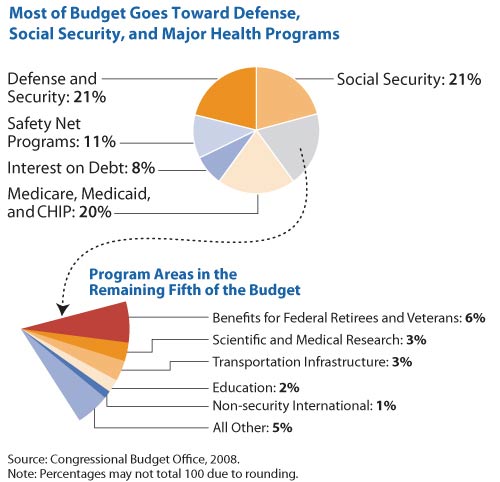
In light of today’s article, Social Security Fund Will be Drained by 2037, I’ve been thinking about our spending priorities.

This pie chart is insightful, considering the backlash against the Health Care Bill. There is little outcry about military spending. When will that run out? Whatever side one may fall on in the political spectrum, it is clear that our government is doing little to invest in the future. The 5% total going towards education and scientific and technological innovation makes that most evident. The question of education raises a number of important issues. The reality is that we don’t have a constitutional right to an education. Education is really the domain of the states, with education funds coming from local property taxes. This, within itself, leads to social inequality and injustices against women like Kelly Williams-Bolar. She broke the rules in order to ensure their children quality education and registered her kids at her father’s address. Now she is a convicted felon and her career is destroyed. Education is becoming less and less of a priority on both a state and federal level. Five states spend more on prisons than higher education. As the New York Times Article, Prison Spending Outpaces All but Medicaid, points out:

One in every 31 adults, or 7.3 million Americans, is in prison, on parole or probation, at a cost to the states of $47 billion in 2008, according to a new study.

Criminal correction spending is outpacing budget growth in education, transportation and public assistance, based on state and federal data. Only Medicaid spending grew faster than state corrections spending, which quadrupled in the past two decades, according to the report Monday by the Pew Center on the States, the first breakdown of spending in confinement and supervision in the past seven years.

I don’t think that either Party has the puzzle solved. We definitely need to get our spending priorities right and invest in improving our country. Otherwise, it is clear where we’re going.

Black and White


image by Luke Chueh

black adj \ˈblak\
Definition of BLACK

1 a : of the color black
b (1) : very dark in color (2) : having a very deep or low register a bass with a black voice (3) : heavy, serious the play was a black intrigue

2 a : having dark skin, hair, and eyes : swarthy the black Irish
b (1) often capitalized : of or relating to any of various population groups having dark pigmentation of the skin black Americans (2) : of or relating to the African-American people or their culture black literature a black college black pride black studies (3) : typical or representative of the most readily perceived characteristics of black culture trying to sound black tried to play blacker jazz

3: dressed in black

4: dirty, soiled hands black with grime

5 a : characterized by the absence of light a black night
b : reflecting or transmitting little or no light black water
c : served without milk or cream black coffee

6 a : thoroughly sinister or evil : wicked a black deed
b : indicative of condemnation or discredit got a black mark for being late

7: connected with or invoking the supernatural and especially the devil black magic

8 a : very sad, gloomy, or calamitous black despair
b : marked by the occurrence of disaster black Friday

9 : characterized by hostility or angry discontent : sullen

10 chiefly British : subject to boycott by trade-union members as employing or favoring nonunion workers or as operating under conditions considered unfair by the trade union

11 a of propaganda : conducted so as to appear to originate within an enemy country and designed to weaken enemy morale
b : characterized by or connected with the use of black propaganda black radio

12 : characterized by grim, distorted, or grotesque satire black humor

13 : of or relating to covert intelligence operations black government programs
— black·ish adjective
— black·ly adverb
— black·ness noun

Synonyms: ebony, pitch-black, pitch-dark, pitchy, raven, sable
Antonyms: white

white adj \ˈhwīt, ˈwīt\
whit·erwhit·est
Definition of WHITE

1 a : free from color
b : of the color of new snow or milk; specifically : of the color white
c : light or pallid in color white hair lips white with fear
d : lustrous pale gray : silvery; also : made of silver

2 a : being a member of a group or race characterized by light pigmentation of the skin
b : of, relating to, characteristic of, or consisting of white people or their culture
c [from the former stereotypical association of good character with northern European descent] : marked by upright fairness that’s mighty white of you

3: free from spot or blemish: as
a (1) : free from moral impurity : innocent (2) : marked by the wearing of white by the woman as a symbol of purity a white wedding
b : unmarked by writing or printing
c : not intended to cause harm a white lie white magic
d : favorable, fortunate one of the white days of his life — Sir Walter Scott

4 a : wearing or habited in white
b : marked by the presence of snow : snowy a white Christmas

5a : heated to the point of whiteness
b : notably ardent : passionate white fury

6 a : conservative or reactionary in political outlook and action
b : instigated or carried out by reactionary forces as a counterrevolutionary measure a white terror

7 : of, relating to, or constituting a musical tone quality characterized by a controlled pure sound, a lack of warmth and color, and a lack of resonance

8 : consisting of a wide range of frequencies —used of light, sound, and electromagnetic radiation
— whit·ish adjective

One day my bi-racial niece came home after visiting the other side of her family. They told her she wasn’t black, but Black AND White. My mom took out a panda bear and said, “No, this is Black and White.” This was one of many long standing conversations we’ve had in our family about mixed, multi-cultural, and Black identities. It is challenging sometimes because many of us still hold onto the one drop rule, while our multi-ethnic family members may not identify as Black, but mixed. My mother raised me with a strong Black identity while at the same time encouraging me to embrace our Caribbean, European, and Native American roots. But some members of my family don’t feel comfortable with the subject of race. They don’t want to be asked, “What are you?” They dodge the question. Unlike my racially ambiguous family members, most people assume I’m Black.Throughout my life I’ve had a range of racialized experiences from experiencing anti-black racism to being accepted by certain groups because I wasn’t too black. Sometimes people probe my background. Sometimes my ethnicity was a subject of debate. Maybe I was from “exotic” land or I had one non-Black parent. Recently some students asked me whether I am mixed or not. And I dodge the question, not wanting to reify some assumptions about Black features. I respond, “No I’m not mixed. But Black American is a multi-ethnic category, most of us are at least 20% white.” As Black Americans are becoming increasingly mixed, I wonder what label will work. We’ve gone from Negro, Colored, Afro-American, Black and African American. But what happens when those labels don’t apply, but the historical legacy still remains? Maybe one day, we’ll find a name that sticks, one without negative connotations.

FOUR STATEMENTS BAM CONVERTS MAKE THAT UNDERMINE THEIR FINANCIAL SECURITY

Sorry for the long delay. It is not just that teaching is overwhelming, but I avoid writing when I feel negative about the current condition of the American Muslim community. I can’t even begin to talk about the abysmal state of Muslims abroad. I know there are hopeful stories and inspiring people, but sometimes I’m left speechless. I didn’t want to sound like a whining Muslim; on the flip side, I didn’t want to sound like a braggart by publicly taking stock of my accomplishments. My reticence is beside the point of this article. So, I’m going to go just for it and make a major splash back into blogging. I can foresee this causing some major problems, however I will refrain from wasting time in back and forth debating. I just have to speak my mind because we have to address our dire condition.

I see many bright young African American Muslims struggle finding their place in the community. Often, our place in a community is determined by how others see our contribution. Our Ummah is not color blind, nor is it class blind. And many of our immigrant brothers and sisters come from societies where class plays perhaps a larger role than ethnicity. So our relative position on the social economic scale factors into the respect that our brethren afford us. So, if we, as a community, are a destitute group, we will have little clout in the discussion on Islam in America. In our brethren’s minds, we are bringing nothing to the table. Many Black American Muslims are struggling economically, unable to finish school or find financial security. The common perception is that most African American Muslims come from impoverished backgrounds or are ex-cons struggling with reintegration in society. But this is not solely the case.

Contrary to popular perception, it is not only White American Muslims who have everything to lose by converting. Many Black American converts who come from Middle Class backgrounds are financially worse off than their parents. Many Muslim American converts, in reality, have made personal, economic, and career choices that have undermined their financial security. There are even second generation Black American Muslims who are worse off than their convert parents. But without an honest look, we may be doomed to repeat the same mistakes. First, we should understand that several of the people who were promised paradise were wealthy. There is nothing wrong with wealth, in and of itself. What matters is how we use it. Islam is not the new socialism. And perhaps some people read or misread Ali Shariati. Two, we should understand that secular education is important in our upward mobility. In fact, education is the primary reason why Muslims immigrated to America. So why should indigenous Muslims give up on America’s promise and become ineffectual? Why is it so few Black American Muslims are attending college for professional, advanced degrees, growing businesses, or finding financial security? And importantly, why have so many Black American Muslim initiatives faltered?
After almost 20 years, some of us are looking back at the choices we made in our personal lives and communities? What led us to make certain choices in our education and professional development? Where did we let others down? Where did we let ourselves down? What resources did we have to achieve important milestones in life? What networks and social ties did we fail to tap into? What sacrifices have we made in becoming Muslim. Did we make any misguided decisions? How can we repair the damage and create a better future for children and ourselves?

I developed a list to begin to explore these questions. This list is not to argue whether something is haram or not, but to discuss the influence of certain religious positions on our lives. What sacrifices are converts making that have a detrimental effect on our financial security? In the next few weeks, I plan on tackling some of these issues. I will show the fatwas that Western Muslims have received from scholars abroad. I will then try to find alternative positions that allow for some flexibility, or endeavors that, at minimum, try to address the challenges we all face in this society.

1. Don’t Deal non-Muslims (Kuffar), even Your Family and Childhood Friends.
This faulty thinking leads many young Muslims astray and alienates their family. Not only do we fail to listen to our family’s advice, thinking that they don’t have our best interest at heart, but we don’t build stronger ties of interdependence. You are not supposed to break family ties, but maintain them whether or not you share the same religion. How you treat your family and friends can have a huge impact on the so many people’s perception of Islam. But self-isolating ourselves can lead our family and friends to think we joined a Jonestown style al-Qaeda group. Importantly, while there are generous Muslims who are willing to provide a lending hand, your family is bound to sacrifice much more, offer you a place to live, or take care of you if your health falters.

Not only do they no longer have social networks that they can tap into such as fraternities, lodges, and professional organizations for contacts, but their old college and friendship networks become frayed due to lifestyle choices that our religions demands (i.e. no cocktail receptions or happy hour networking parties and mixers for networking events). Sometimes their classmates just don’t relate. Converts may even suffer strained relationships with their immediate and extended family. This can lead to them losing family financial support in school, marriage ceremonies, or business endeavors.

Second, we fail to form solid alliances with non-Muslims to achieve the greater good. Without a relationship of reciprocity, we find ourselves isolated an alone. Third, we often hire incompetent Muslims and foster paternalism. Some Muslims have an “I only patronize Muslims” policy. Meaning that they hire Muslim contractors who do shoddy jobs or rip them off. Out of aversion to taking your co-religionist to a kaffir court, many Muslims will just eat the loss, as opposed to making these businesses accountable. Also, our fear of backbiting will also keep us from slandering that Muslim who did a poor job or did us dirty by reporting them to the Better Business Bureau.

2. Your Education Will Corrupt You.
Basically, the only real education is sacred knowledge. Time and time again I have heard tales of bright Muslims not encouraged to finish school, but become students of knowledge. You can end up in a dusty place for a few months or wander aimlessly for a about a year. Unlike some of your Arab and Desi American friends who spend their year abroad, you likely did #1 and your family probably won’t help you out and get back on your feet. Honestly, we do need more scholars of Islam, and to be honest, Muftis and Fuqaha with a strong knowledge of minority fiqh and American society. However, does the community need thousands of young men and women with the equivalent of an elementary degree from a Muslim institution of learning abroad?

The irony is that many converts are discouraged from completing their secular education by foreign scholars and immigrants who are largely educated with college degrees. Immigrant children go to college. They become doctors, engineers, business professionals, executives, and doctors. Most African Americans don’t come from families with enough money to foot college tuition. Nor do many of us get a full on scholarship. The primary way that many African Americans finance their education is to take a student loan. And look online at the fatwa’s. Student loans are haram. The immigrant Muslim community in America is largely affluent. So, many have an option of not taking student loans. Very few Muslim organizations offer scholarships to off set the education costs. And Muslim lending institutions are primarily geared towards wealthy Muslim purchasing homes, not student loans. So, many Muslims shut the door to education
The reality is that we need men and women who have the skills and capital to help build our communities. We need skilled labor, infrastructure building, and strategic planning from people who are trained and educated. A higher education can help alleviate some of the greatest challenges our community faces. It will lead to better earnings, which will lead to stable living. Stable living leads to viable marriages, which will help build better neighborhoods. With the rubber stamp of “denial” Black American Muslims are left to flounder, unable to become contributing members of their community and society.

3. Don’t Plan Your Family or Get to Know Your Future Spouse, Because Allah is the Best of Planners
Black American Muslims suffer some of the worst divorce rates. Perhaps we should thank Allah that many of the marriages are religious, and not civil marriages, because if we knew the real statistics, we’d lose our minds. My rough estimate would be that 75% or more of African American marriages end up in divorce. The sad thing is that many of these broken marriages produce children who become scarred in the process.
Many converts have an idealized version of stranger marriages, arranged marriages, and even the marriage match. Depending on if the Muslim comes from a cultish community or not, he or she may be pressured into making an insane marriage choice. I have heard of a college age young woman pressed to marry a recently released ex-con. I have heard of a teenage girl forced to marry Middle Aged destitute man only to be a divorcee by the time she’s 17. I have heard of young men pressed to marry women they don’t know and have 3 kids by the time he realizes that his wife is mentally deranged. There are lots of crazy anecdotes. Many American Muslims marry really young, derailing their emotional and financial development. My young students are all proponents for youth marriages; however if they knew the challenges that they would face, they’d think twice.

Converts also come with our own cultural norms, which are contrary to the American Muslim norms of love and relationships, and emotional baggage. Some communities have a sit down. Others may organize marriage meet and greet, or even large conventions. There are online matrimonials, myspace, facebook, etc. But more often than not, the process of meeting someone is a nightmare. American Muslims have not yet developed the network to create opportunities for single Muslims getting to know each other. Also that baggage. It is impossible to just throw away our notions of love and marriage. Americans are used to a honeymoon period of dating and getting to know each other. Those wonderful memories of courtship and fun times create, at minimum, some nostalgia about those romantic moments. Even more destructive than our notions of love and romance is the greatest baggage African American converts bring into their Islam. And that is their promiscuity. This stems from our own insecurities, notions of manhood or femininity, and egos tied to sexual conquests. Few of us grew up with two happy, married parents. So, we don’t even know what to look for in a spouse. Many American Muslim marriages suffer from intimacy problems and love doesn’t always develop between the couple.

Muslims are sometimes discouraged form practicing birth control. With a tanking marriage and 7,8, 9, 10 kids, there are some serious financial implications.

4. Don’t Focus on the Dunyah, but the Hereafter.
Many see wealth building or social climbing as a worldly endeavor and they begin to make irrational economic decisions. There are two roots to this version of Black American asceticism: the first, stemming from the Black American protest tradition and the second stemming from abroad. In the protest tradition, middle Class values of education and career are White values. Some Black American Muslims transfer the notions of whiteness or “the man” into the unbelievers, “kuffar.” The motivation to reject this world and take on a life of poverty becomes a political choice, tied closely to identity politics. The second root of the Black American aversion towards higher education or professional careers is a foreign import. Some forthcoming studies show how the imposition of these ideas is both unintentional and intentional. Basically, some scholars who have little understanding of the social, economic, and historical condition of Black Americans discourage them from taking the one path to social mobility. These two factors combine to drive many African American Muslims into a faulty notion of asceticism. This form of asceticism, rejecting “worldly education” and “worldly careers,” is often a detriment to many Black American families.

The other problem with this statement is that it channels some of the most talented and charismatic, but maybe not so pious, members of our community into becoming religious professionals. Islam becomes the new hustle. Many of our brightest minds go into careers such as imam, public speaker, religious scholars, or teacher at an Islamic school, when maybe they would have been better as professionals, who donated their wealth and fundraising ability to create community centers and institutions. Instead of giving to the community, they are drawing an income from the community. Further, if we, as a community, discouraged our members from attaining a college degree, then we will have board members with no education, management, or organizational skills. Finally, while non-profit work is honorable, many Muslim non-profits pay a pittance. I’ve heard of Muslims going six weeks without pay from Islamic Institutions.

This list is not limited to African American converts. I know that other converts, and even children of immigrants, who get caught in this cycle. I hope that by bringing up these points we can begin to address these problems and come with some solutions. I work full-time in the Muslim community, and I may be rough and gruff sometimes, but I am solution oriented. My goal is to empower us to work for a positive change. Just like everyone else, I am tired of bemoaning the fate of Muslims in America. It is time we do something about it. While I think I have a few good ideas, I know many of you have many more. So, let’s get to work!

An Open Letter to ABC’s 20/20 regarding “Islam: Questions and Answers” Season 31, Episode 3

After an enlightening email exchange on the Middle East Islamic Studies email listserve, Maytha and I collaborated to produce this letter with the intent on delivering it to the show’s producers. We took into account many of the great points listed brought up by the scholars and academics in the email exchange. Maytha and I took into account some of the many thoughtful suggestions from a number of folks who signed the letter. Insha’Allah, we can get a group going similar to Muslimah Media Watch and have some scholar-activists willing to critique, discuss, and explore media depictions. The iPetition version of the letter below is located here.

An Open Letter to ABC’s 20/20 regarding “Islam: Questions and Answers” Season 31, Episode 3
October 19, 2010

We applaud ABC’s 20/20 for producing the program “Islam: Questions and Answers,” which attempted to address the American public’s curiosity about Islam and show the true face of Islam in America. However, as scholars, activists, educators, and community leaders, we are concerned about the ways in which this program misrepresented Muslim Americans. We would like to address three major areas where your program inaccurately depicted Islam in America: first, by continually asserting that moderate Muslims do not speak up; second, by overlooking the contributions of African American Muslims; and finally, allowing women who have complete antipathy towards Islam (Pamela Gellar and Ayaan Hirsi) to speak for Muslim women. The producers and researchers may have been well meaning; however the program’s insensitivity and lack of nuance alienated many American Muslims and perpetuated many misconceptions about American Muslims. Our aim is to address these three areas and provide some recommendations for more accurate coverage of American Muslims in the future.

1. First, the show continually asked, “Why don’t we hear or see more mainstream, peaceful Muslims speaking up?” or “Where are the moderate voices?”
* It is problematic to divide Muslims into binary categories of “moderate” and “radical.” Would the same categorical statement be made about the socio-political orientation of followers of different religious faiths and other ethnic groups? How would the mainstream reaction to your program be had you produced a segment titled “Where are all the moderate Christians?” or “Where are all the moderate Latino Americans?” The framing of these questions and methodology of answering these questions highlights an acceptability of a bigoted stance on Muslims that is rarely acknowledged.
* Muslim Americans are constantly blamed for not speaking up. However the media bears some responsibility. Muslims continually speak out and do positive things for American society, but this does not make it in the news. Every major national Muslim American organization has condemned acts of terror. American Muslim scholars and leaders hold conferences, talks, and lectures devoted to the topic of “Forging an American Muslim identity.”
* Where is the media when peaceful Muslims gather, participate in the American political process, and protest terrorism, violence, and hatred?
* At one point, a discussant posits a recommendation “They need to have a million man march on Washington,” while conveniently ignoring that the Million Man March was actually led by a self-proclaimed Muslim, Louis Farrakhan, leader of the Nation of Islam.
* On September 25, 2009, Islam on Capitol Hill gathered an estimated 8,000 to pray Friday prayers.  And on October 15, 2010 thousands of Muslims once again convened on Capitol Hill to demonstrate their belief in American democracy and promote religious freedom, however, there were few media outlets at the DC event.
* Muslim Congressmen Keith Ellison wrote an Op-ed, “Should We Fear Islam?” in the Washington Post, speaking to the first point made in this section. Ellison and Muslim Congressman Andre Carson were also completely absent from the program, which brings us to an important issue of accurate portrayal of American Muslims.

2. The program re-inscribes Islam as a foreign religion by focusing on Arab and South Asian immigrant communities in the US, at the expense of African American Muslim communities.

* Your program excluded African American Muslims in the narrative of Islam in America and conflated Arab with Muslim. African Americans make up the largest percentage of Muslims in America, and yet your program visited Dearborn, MI, Patterson, NJ, and even Egypt to speak with Arabs who compose the third largest group of Muslims in the US.
* The Nation’s first capitol is also a city with a rich and long history of Muslims. There was a community of orthodox Black American and Caribbean American Muslims from the 1920s. Philadelphia is also a city with a high concentration of Muslims, a Muslim chief of police, Muslims who work in city government, etc.
* With the over-exposure of Arab Muslims, your program even failed to mention that Arab American Muslims are in the minority in Arab American communities. Most Arab Americans are Christian.
* The program did a poor job discussing, engaging with and highlighting the diverse community of Muslims.
* Low figure for Muslims (2-3 million?), and no breakdown of the demographics.
* It has also come to our attention that a number of “moderate” Muslims were in fact interviewed for this program, including most notably Dalia Mogahed, White House Advisor and Executive Director of the Gallup Center for Muslim Studies, yet their interviews were not aired. The exclusion of her voice, amongst others, and the inclusion of alarmist voices such as Ms. Geller’s is troubling and reduced the caliber, professionalism, and honest journalism that is expected of programs such as 20/20. It leaves us to question whether the issue at hand was a lack of cultural competence of our community or a desire for a certain bent that feeds into many of the vitriolic stereotypes of Muslims in post 9/11 America.
* No discussion of converts.
* The program even failed to show celebrated athletes (NFL, NBA, soccer players and boxers), politicians and historical figures who are Muslim and African American.

3.  Finally, the segment, “Does Islam oppress women?” did a great disservice to Muslim women.

* While we appreciate the inclusion of one Muslim voice, Irshad Manji, she herself is not a scholar on Islam and is also considered adversarial by many Muslims.
* Instead two polemical figures who are vehement in their anti-Islam stance, Ayaan Hirsi and Pamela Gellar received undue attention.
* Your program failed to include any Muslim scholars such as Amina Wadud, Ingrid Mattson (a Canadian scholar who recently ended her term as ISNA president), or Dr. Aminah Beverly McCloud to speak in this segment. Their and other scholars’ absence is an indication of an asymmetric representation of oppositional views.
* Perhaps these scholars would have shed light on Muslim women’s contributions through history such as Islam’s first convert, Khadija al-Kubra, the Prophet Muhammad’s wife, who was also his employer before marrying. One of the first Sufi saints was a woman, Rabia al-’Adawiyya al-Qaysiyya (Rabia al-Basri) or Nana Asma’u a West African educator and reformer.

In order to explore our rich diversity, we have provided some recommendations to improve your coverage of American Muslims below:

1. Explore the long history of Muslims in the US, a history of residency and settlement that predates the formation of America as a country. As one example of many, American born Nawawi scholar Dr. Umar Faruq Abd-Allah has written extensively on this subject.
2.  Include broader segments of the American Muslim community to ensure that each major race and ethnic group, South Asian American, African American, and Arab American, is represented in your programs.  
3. Attend Muslim American events, banquets and conferences like the prayer on Capitol Hill, MPAC, CAIR’s functions, etc. Do not just focus on sensationalism, but cover American Muslims during Ramadan or Eid al-Adha (the end of Hajj).
4. We ask your researchers and staff to be more careful in their selection of “experts.” Make distinctions between socio-politics and Islamic scholarship. None of the women you interviewed in the question on the oppression of women in Islam had training in Islamic scholarship on covering or the hijab. We can help provide a list of scholars and experts who would be happy to lend their expertise.
5. Consider diversifying your staff, researchers and interns with knowledge, expertise, and experience in various communities may yield better results.

In summation, your program provided a rare opportunity to provide accurate coverage of Muslims and clear up misconceptions. As acknowledged at the onset of your program, the controversy surrounding the Park 51 community center elicited a renewed curiosity in Islam. We were pleased with the inclusion of Edina Lekovic’s (MPAC) and Eboo Patel’s (Interfaith YouthCore) comments, Reza Aslan’s explanation of the definition of “fatwa,” and Faiza Ali’s (CAIR-NY) elucidation of the hijab’s complex historical place in cultural and religious practice, “coerced headcoverings are tribal.”  However, while we note that your program was a step in the right direction, its lack of attention to detail, and excess attention to individuals with no scholarly background, noticeably decreased the value of what your program could have and should have earned. It is apparent that the producers cut corners, did not research and were not curious to find other sources, and as a result, the piece suffered.
In light of the suggestions and criticisms we have made—ones we hope are constructive and practical—let us iterate once more that we appreciate your initiative to educate Americans about Islam. We hope you will air more programs in the years to come about Islam in America. It would be a great service to this country.
Please also note the signatories of this letter. We have the best interest of 20/20 in mind, as well as the American people in general, and would look forward to lending our services and resources in the future. Please do not hesitate to contact, and we look forward to a response to this letter.”

Sincerely,

Maytha Alhassen
Doctoral Student
American Studies & Ethnicity
University of Southern California

Margari Hill
High School Teacher,
Al-Aqsa Islamic Academy

Musings on Black Suffering

This article, Two State Supreme Court Justices stun listeners with race comments,” got me thinking. How do we explain the continual cycle of poverty and crime without essentializing an entire group? It reminds me of an opinion piece by Orlando Patterson, “Black Culture to Blame? Poverty of the Mind”, we avoid cultural explanations, even though anthropologists march off to other countries to study exotic culture. I find that many activists often refer to racial inequality to explain poverty, incarceration, low literacy, and teen pregnancy rates. Very rarely do they address the effects of the moral decline in the Black community. Often radical groups differ in their approach from say the black nationalism of proto-Islamic movements, which were conservative in nature. Many Black uplift movements were critical of the moral state of Black people, but still infused with love for the community. We have to ask ourselves difficult questions. How do our own personal choices shape our lives? Going further, one might ask why is it that certain things are now acceptable in our community? What cultural, social, and economic factors shape our proclivities?

The problem is, that many Black folks, Muslim included, are very comfortable in their bad habits and even worse choices. During the Jim Crow era, it was a bit harder for Black Americans to abide by Middle Class morals and values. There are many reasons, such as the exploitation of Black women’s sexuality, but most are outside the scope of this short piece. While the cultural revolution of the 60s may have “liberated” many Americans from the cultural mores and standards of their forebearers, the Black community is more vulnerable to the negative outcomes of these social changes. Women entered the workforce, but Black women were always in the workforce, as domestics and low wage earners. Women could leave unhappy marriages. The car allowed for greater mobility. Nuclear families relocated to urban areas far outside the reach of extended family networks. The Pill allowed for sex without risk of pregnancy. Even with the morning after pill still women and girls have unplanned pregnancies and abortions. While there is more candid talk about drug abuse and alcoholism, but little prevention. Black Americans have fewer resources, and therefore it is harder to recover from the break-up of the family, separation from extended family, substance abuse, teen delinquency, and college recidivism. Often, our Black youth have one shot to get it right, whereas somebody from a privileged family with financial resources can rebound from their mistakes.

I don’t want to sound self-righteous. But the reality is, we can’t change “the system,” but we can reform ourselves. We can acknowledge the institutional racism and its legacy on the psyche of Black Americans. That legacy still affects Black American Muslims as they struggle for their identity and place in the Ummah and American society. And while Islam has reformed many Black Americans, I have seen too much ghetto Islam where the same problems that plague the Black community are in the masjid: Sisters discovering their husbands were crackheads, serial marriages where women are exchanged, brawls in masajid, drug dealers, turf wars in masajid, etc. The imams from abroad don’t even know what to do with us Black Americans.

Teaching at a Muslim school with a large Black student population, I am worried about Black American Muslim youth. Honestly, I don’t worry about the Arab students because they have family and social networks that help mediate the problems. The boys will eventually find jobs or work at the family business. Families can easily find a spouse for the girls, as long as they sweep past scandals under the rug. But for the Black American Muslims, there is less of an extended family network to serve as a safety net following a crisis. I worry about my Black American boys and their futures. For a number of reasons, many have chosen other options rather than attending a Muslim school. So, there are only a few left by the time they hit 10th grade. Those that are left, I see how many of my Black male students don’t take anything seriously. They have that non-chalant attitude about their work. And the reality is, they have full knowledge of the consequences of their choices. Everybody tells them, their parents, their relatives, their teachers, and friends. But there is something enticing about rebelling and not caring. I hear the stories of our youth all around this city. They trickle down. How this graduate ended up an un-wed mother. How this one ended up locked up. I pray at that one’s janazah. I’ve been to too many janazahs. You don’t want to ask anymore, “How did they pass?” We will protest unjust cops killing one of our own. When is Philly going to take to the streets and speak out against the gangs saying, “We had enough!”

Just like the problems in the Muslim world: where Muslims blow each other up at mosques, at checkpoints, at wedding parties, on roads, in hotels. Just like the rampant corruption that eats away at the very foundation of social and political stability. Just like the nepotism that breed incompetence and economic stagnancy. Racism and neocolonialism are big problems in the world. But we are 10 times more destructive to ourselves. We are doing the job for those that hate us and see us as sub-human. We suffer because we are self deluded and arrogant. We will have to keep learning our lesson until we get it right. We suffer because we don’t try to change what is within us and pray that Allah will change our condition.

I try my best to stay optimistic…but we have many trials ahead of us.

Islam on Capitol Hill

Are you going? I am and so is our future.
Let us pray that America will support us in this day as we display our hopes and dreams for this country of ours. We are American, we pray that God guides all of us, that other Americans will join us in living out this country’s ideals. This year the organizers will feature the voice of American Islam’s future, our children. Today I listened to my students share their touching stories, thoughtful analysis, and hopeful messages. At times, we were moved to tears. This day will mean so much for them. They stepped up and amazed us. Congratulations to all the participants in the speech contest. We are proud of all of you. Masha’Allah!

The Truth Is…

I’m glad that the Time Square Bomber failed and was sentenced today. But I’m a little scared.

He clearly admitted his guilt in the plot to kill civilians. One can’t claim some conspiracy theory, he doesn’t claim he was framed, instead during his sentencing he issued a threat:

“Brace yourselves, because the war with Muslims has just begun,” 31-year-old Faisal Shahzad told a federal judge. “Consider me the first droplet of the blood that will follow.”

Faisal Shahzad believes that killing civilians is self-defense. He, and other Muslims who target unarmed civilians in order to exact revenge for America’s military occupation of Iraq, Afghanistan, support of Israel, and dictatorships in South Asia and the MIddle East, have some ideological underpinning that must be addressed. Sadly, our scholars just ignored this issue for so many years, sticking their heads in the sand. The truth is, we need to wake up and face the elephant in the room. We don’t have just one elephant, we got a few. Well, enough that we have a circus show going or maybe even a zoo.

I remember in the 90s, suicide bombings were fairly rare. In fact, many people then saw terrorism as something that came out of the nationalist cause in Palestine. Muslims I knew disowned terrorism, “It has nothing to do with Islam.” Now, we have seen Muslims use terrorism, targeting civilians, in the Philippines, Chechnya, Afghanistan, Africa, Algeria, Morocco, Indonesia, etc. The reality is that it has to do with Islam, somebody’s interpretation of Islam. Somebody came up with a novel idea that it was okay to target civilians.

Our scholars need to face this stuff head on. I don’t think every Muslim in America is responsible, but the scholars who refused to deal with dangerous ideologies do have to bear some responsibility. Now, certain ideas spread like poison branches throughout the globe. Sadly, it is the Islamophobes that are pointing it out, all the while conflating Islam with identity movements. They seized the opportunity because we failed to take stock. Muslims who take the Middle Way, the Path of Moderation, now must face a two-front battle. Without being reactionary or self-loathing, we need to address the ideological roots of extremism. We have to have courage because we may be shouted down, threatened, or ostracized for not sounding sympathetic to this cause or that cause. We may be despised by the Right because we won’t give up our Muslimness. As a Muslim, I stick to my principles and condemn all forms of injustice, whether it is from our own or not. And the terror that Shahzad is trying to strike in our hearts is indeed a great injustice.

Black Palestinians

Hat tip to May for the video and to Sahar for the article:

I had an interesting conversation with my 10th grade class. I learned of the diverse heritage of some of my Black students, two sisters had a Moroccan Berber grandmother who migrated to America in the 60s. And we had an interesting conversation about the origins of Berbers in Morocco and Algeria. My Palestinian student said he saw a number of Black Palestinians.

Rami Nashishibi wrote a thoughtful article on the African Palestinian Connection recalling his experience with the African Palestinian Communicy:

…Throughout my stay, I spent most of my free time around the Al-Aqsa Compound and with the Palestinian Africans, learning more about their history and lives.

Currently some forty African Palestinian families live inside the old city, many of whom reside within 50 feet of the center. Upon talking with Adam, the center’s young director, one gets a sense of how proud the community is of its identity. “Many of our ancestors were pious Muslims who came from across Africa to defend Al-Aqsa from military conquest,” I was told by Adam and others in the center. “They stayed and married and their children grew up here. “We are as Palestinian as anyone else but we also remember and our proud of where are great grandfathers came from and sometimes visit or stay in touch with our other family members in Africa.” Aside from the various wars which brought Muslims from Africa to safeguard the sanctity of its Muslim Holy Sites, other Africans settled in Palestine after spiritual pilgrimages to the land’s various holy sites, including of course the Al Aqsa Mosque.

Many Palestinian Africans have heroically managed to retain their presence in this incredibly important and highly symbolic space even while the oppressive closure policies of the Israelis makes life increasingly difficult in all kinds of ways….

What really struck me was the final paragraph of his article where he argues that Arab Americans should acknowledge the African heritage in their cultures:

As an American Muslim who has spent more than a decade organizing or living on Chicago’s South Side, I can’t help but feel that the larger Palestinian American community has not celebrated the African part of our identity in the way that we should. Failing to do this has prevented segments of the Palestinian community from making more of a connection to the African American legacy and its struggles against institutionalized racism and white supremacy. Making that connection is imperative, particularly during opportune moments like Black History Month. Most African Americans residing in urban communities only interact with Palestinians through the presence of liquor stores or other exploitative businesses and a growing number of community activists have emerged as increasingly resentful of their presence. By embracing and celebrating their own African heritage during Black History Month, Palestinian and other Arab Muslims may grow to make more meaningful connections to the larger African American community, its rich legacy and its on-going struggles.

Check out the article and video.