Why Black History?

I wrote the article below,  “Why Black History?” to commemorate Black History Month. You can read the full article and other great articles and references at  SuhaibWebb.com.

49_13

O mankind, indeed We have created you from male and female and made you peoples and tribes that you may know one another. Indeed, the most noble of you in the sight of Allah is the most righteous of you. Indeed, Allah is Knowing and Acquainted.

49:13 Quran Sahih International

Black History Month is observed in the United States, Canada, and the United Kingdom to remember important events and people  of the African diaspora. In North America, we observe it in February and the United Kingdom during the month of  October. In 1926, the noted African American historian, Carter G. Woodson (d. 1950), began  “Negro History Week.” He selected  the second week in February in order to coincide with the birthdays of Abraham Lincoln and Frederick Douglass. Woodson felt that scholars ignored his people’s history and other cultures. Much of his work was intended to foster understanding between the races. Joan Novelli writes, “Woodson believed that if whites learned of blacks’ contributions to American history and humanity, this awareness would engender respect.”[1] This reminds me of Surah 13 in Hujarat, where Allah (s.w.t.) tells us that He created us as different peoples and tribes so that we may know another. Racial equality and intercultural dialogue are moral imperatives based on Holy Scripture and Prophetic traditions.  Black history month is an opportunity for us to get to know the rich legacy of Africans and their contributions to their societies, our ummah, and humanity. Importantly, Muslim Americans should commemorate Black history because it is our history.


Black history month is not about nationalism. The Quran acknowledges heritage and lineage, but it emphasizes that nobility is not inherited. The most noble are those who cultivate piety. This is the essence of Islam’s egalitarian message. Black history month is an education initiative intended to combat racism. Even during the time of our Noble Prophet (s.a.w.), anti-Black and anti-African racism was a problem. It still plagues Muslim societies and our own communities in North America. One way that we can combat racism is by educating ourselves, and others, about the contributions of various peoples to our ummah, society, and humanity in general. February  is an opportunity to eradicate ignorance and combat prejudice against African and their descendants.


Black History Month is an importunity to instill self-worth in our youth. When I was in elementary school, two factors played a role in my low self worth: first, the lack of education about my people’s history and contributions to society; and second, school bullies who made fun of me and called me a slave and the “n” word. Today, in many Islamic schools, young people are still called “abeed” by their classmates. Abeed is the Arabic word for slave and it is the equivalent to calling someone the n-word.[2] When I was in elementary school, I thought that all my people were was slaves. I did do not know of the many contributions Black Americans have made to this society, whether in the sciences, business, or institutions. Although I was in the Gifted and Talented Education program, I felt like I was incapable of achieving anything. It wasn’t until middle school that I began to learn about the Civil Rights Movement and the contributions that my people made.  It allowed me to imagine possibilities for myself. I could become a medical pioneer who saves lives like Charles Drew, a millionaire like Madam C.J. Walker, or a poet like Phillis Wheatley. I saw myself in those stories and I began to dream big. These stories about black scientists, inventors, explorers, doctors, and leaders can provide examples of how people triumph over adversity.


During Black History Month, I learned about Martin Luther King and, of course, Malcolm X. For many converts, regardless of race,  Autobiography of Malcolm X played a role in their interest in Islam. Without Black History Month, I wouldn’t have learned  about Malcolm X and it is unlikely that I would have learned much about Islam. Watching Eyes on the Prize in middle school helped me understand the Civil Rights Movement.  The Civil Rights Movement help end institutional racism encoded in segregation laws. It also create opportunities for Americans of all colors. For example, an outcome of the Civil Rights Movement was the 1965 Immigration Act, which  ended immigration quotas of  non-Europeans.[3] This is what allowed South Asian, Middle Eastern, Arab, North African, and African Muslims to immigrate in greater numbers and establish Muslim communities. We now have one of the most diverse religious communities in the country.


Black History Month is an opportunity to learn about the history of Muslims in America. Often, Muslim Americans see themselves as recent transplants with roots only a few decades long. Many Muslim Americans are first or second generation immigrants, but Muslims have had a long presence in America. It is estimated that 10 to 15  percent of the slaves brought to the New World were Muslim.[4]   While Muslim slaves were not able to pass on their religion to their descendants, the historic memory is significant. Many Black Americans look to this past as they reclaim some part of their identity ,which was erased under the brutal system of chattel slavery. Likewise, Muslims from all backgrounds can relate to the stories of Muslim who were enslaved, such as Ibrahim Abdur Rahman and Omar Ibn Said.[5] There was also Bilali, who led a community of Muslims on the Sapelo Islands during  the 19th century. [6] If we look at our history in North America, we can feel more at home knowing our presence dates back hundreds of years.


Black history if also part of Islamic history.  The 31st Chapter of the Quran is named after Luqman the Wise, who is said to be from Africa.[7] The first hijrah was to Abyssinia.  Five times a day, we hear the call to prayer and remember the first muezzin Bilal.  Islam has been in East Africa from the time of its founding and has had a presence in sub-Saharan Africa for over 1000 years. Just recently, King Mansa Musa of the Mali Empire was named richest person of all time.[8] There are also important Africans who stand out in the history of Islamic civilizations in the Middle East and Indian sub-Continent. Al-Jahiz, was a champion of Arabic and demonstrated that it is a possible to write beautiful prose in Arabic. There was also Malik Ambar who ruled the  Deccan Sultanate, a rival to the Mughal Empire.[9] Many people do not know of the complex connections between East Africa, the Arabian Peninsula, and India nor are they familiar with the trade routes that connected sub-Saharan Africa to the Mediterranean. Black history can be our opportunity to explore the culture and history  of Afro-Arabs , Afro-Turks, or Siddis of India. By embracing our interconnectedness, we Muslims have a rare opportunity as Muslims to participate in Black history.


Interconnectedness is the strength of our community. In the borrowing and blending, and acknowledging what we have to offer, we can understand how our lives intersect.  We can take this opportunity to look for lessons in this past. We can also use this window of opportunity to begin a real process of getting to know each other’s histories and engendering a greater respect and appreciation for all peoples in our ummah.


[1] Joan Novelli  “The History Behind Black History Month”   Teaching Tolerance, 2007  Retrieved February 12,  from 2013http://www.tolerance.org/article/history-behind-black-history-month


[2] Anyone arguing that it no longer has negative meaning, must remember that the n-word was used common place in America also. See Huckleberry Finn.

[3] Devin Love-Andrews Immigration Act of 1965 Webchron: The Web Chronology Project retrieved from internet February 12, 2013

http://www.thenagain.info/webchron/usa/immigrationact.html

[4] Islam in America retrieved February 12, 2013 from http://www.pbs.org/opb/historydetectives/feature/islam-in-america/

[5] John Franklin “Omar Ibn Said” Documenting the American South  retrieved February 12, 2013 http://docsouth.unc.edu/nc/omarsaid/menu.html; Yusra Owais, “African Muslims: A Rich Legacy”  Suhaib Webb February 26, 2011 retrieved February 12 2013 from  http://www.suhaibwebb.com/personaldvlpt/character/african-muslims-in-america-a-rich-legacy/

[6] Ray Crook “Bilali-The Old Man of Sapelo Island: Between Africa and Georgia” 40-55 Wadabagei: A Journal of the Caribbean and its Diasporas Vol. 10 No. 2 Spring/Summer, 2007 retrieved from http://www.utc.edu/Faculty/Nick-Honerkamp/Bilali%20the%20Old%20Man%20of%20Sapelo%20Island,%202007.pdf

[7] Margari Aziza Hill “Luqman the Wise” August 18, 2010 retrieved February 12, 2013 from  https://azizaizmargari.wordpress.com/2010/08/18/rediscovering-luqman-the-wis/

[8] Erik Oritz “King Mansa Musa Named Richest Person of All Time” The Daily News February 18, 2013 http://www.nydailynews.com/news/world/king-mansa-musa-named-richest-history-article-1.1186261

[9]A. Rangarajana “Malik Ambar: Military guru of the Marathas” The Hindu October 18, 2008  retrieved February 12, 2013 from http://www.hindu.com/mag/2008/10/12/stories/2008101250220700.htm

Nana Asma’u: A Spark Who Continues to Illuminate

Nana Asma'u-1

Living as a Muslim minority in the West, I have often felt frustrated by religious intolerance, but also from a community  that does not fully honor the rights that are accorded to women in Islam or provide many outlets for women to become scholars. This was the case in late 18th century West Africa, in what is now modern day Northern Nigeria, when  Uthman Dan Fodio criticized oppressive customs and encouraged female education. Nana Asma’u bint Uthman Dan Fodio was a product of her father’s commitment to quality Islamic education for women. She became a legend in her own right and through her writings and education movement, ‘Yan Taru, she has inspired countless women for generations.


As a Nigerian with dual American and British citizenship, researcher Rukayat Modupe Yakub is aware of the legacy of Nana Asma’u. Rukayat points outs, “For so many Muslims Nana Asma’u is still unknown, but for those who are familiar with her she was an educator, writer and poet who was passionate about education, For this reason you find schools in places like Nigeria named after her.” In addition to her poetry and education movement, Nana Asm’au is also considered an Islamic leader who was known for her ability to mediate political disagreements. She was fluent in Arabic, Hausa, and the Tamasheq language of the Tuareg. Like her father  and brothers Muhammad Bello and Abdullahi, Nana Asma’u was a prolific writer who left a tremendous literary legacy. She wrote to keep her father’s memory alive in the minds of the people and in support of her brother Muhammad Bello’s  Caliphate. At 27, she was given the task of organizing her father’s corpus of works, all while overseeing a household of several hundred people and ensuring that they were provided for.


Jean Boyd gained access to her works in 1975 and later wrote The Caliph’s Sister, which provides a detailed biography of Nana Asma’u’s life and legacy. Jean Boyd collaborated with Beverly Mack to compile her poetry and religious treatises in Collected Works of Nana Asma’u, Daughter of Usman dan Fodio (1793-1864). The book compiles her impressive body of poems and treatises in Arabic, the Fula language, and Hausa. Beverly Mack and Jean Boyd also co-wrote a book which analyzes the social and political function of many of her poems titled One Woman’s Jihad: Nana Asma’u, Scholar and Scribe. 


Rukayat says that Nana Asma’u continues to serve as an important inspiration because “She was involved in social work and had political clout, she was a mother and wife, sister of the head of state, daughter of a legendary a political and spiritual leader, she could have had any life she wanted but she choose to be of service.” Around 1830, Nana Asma’u trained a group of women to travel around the Sokoto Caliphate to educate women. Each woman in this cadre held the title jaji  (leader of the caravan) to designate their role as female leaders.


One hundred and eighty years later, Dylia bin Hamadi Camara is one such Jaji who explains, “We have the name of all the jajis before me so mine comes after a long line of the unbroken chain of scholarship and service to women, children and the Ummah at large.” Jaji Dylia explains that the methodology of learning that Nana Asma’u develop still educates men, women, and children. In the United States, the ‘Yan Taru Education Foundation and Charitable trust has chapters in Pennsylvania, Texas, Alabama, Georgia, and California with 33 women in intensive training and intensive seminars and classes which are open to the public.* Teachers like Jaji Dylia travel internationally and use email, teleconferencing, and text messaging to educate their students on classical Islam. Preparing for a trip to Guinea, Dylia stated her next goal is to translate Nana Asma’u’s teachings into French because the Francophone world has largely been unaware of this rich legacy. My hope is that we begin to learn more and more about the named and unnamed women who have been responsible for educating our ummah. They have passed on a rich legacy, one that reminds me that even when faced with the greatest challenges, we  as women can be brilliant and provide guiding lights for others.  

You can read find other stories of inspirational Muslim women, along with this one,  in   the February edition SISTERS magazine 
*Jaji Dylia updated us and told us that Yan Taru trust has chapters in Baltimore, Pittsburgh, Los Angeles, Sacramento, Oakland , Florida and Massachusetts. She also has some students in Toronto who are not Yan Taru. She is currently in Benin, where she also has students.
To date, Dylia translated Tanbeeh l Ghafileen  and prays that Allah grants her the himma to translate even more in the future, insha’Allah.


Engaging Submission within the Black American Muslim Marriage

Some of the most hostile discussions I’ve witnessed have been between Black men and women during their discussions about relationships.  It gets heated. It gets nasty. It gets dirty. Black American Muslims often get into heated conversations about gender roles, power struggles, and family instability. Black dysfunction is a sore topic and often people blame the strong black woman, the independent black woman, the mouthy and insubordinate Black woman for the break down of the Black family, and therefore community. That, as well as the men who don’t know how to be men. So, many find the answer within Islamic traditions, texts, and 1400 years of scholarship. This is the idealized version of an Islamic marriage where men are protectors and maintainers and women are devoutly obedient.

We don’t have statistics for success rates of Black American Muslim marriages, largely due to the number of Islamic marriages that are not registered with the state. In a major urban center, one counselor who does pre-marriage counseling told my husband that about 75% of the marriages end in failure. Has the advice we’ve been given worked in the past few decades? Will it work, even if everyone tries to comply with the traditional gender norms of the obedient wife and husband who protects and provides?  Our expectations  are not always grounded in our cultural, economic, and social realities. The truth is, most of us enter our marriages with poor relationship and communication skills. Instead, we talk about rights and obligations. As for skills, we tend to overlook that.

I know I’m going to get some push back, but I had some thoughts about infantile notions of marriage within the Black American Muslim community.  I think the notion that an adult Muslim women must obey their husbands, shut their mouths, provide sex, and cook food is a gross simplification of the formula for creating a happy husband. I’ve heard a number of Muslims cite works such as “The Submissive Wife” or “Fascinating Woman,”  advocating mythic submission based on the Bible without acknowledging some of the nuance in these books, and some of the problems. They are just proof that women should obey and stop complaining.   They catalogue gendered emotional needs, without considering that not everyone is the same.  For example, on the notion of respect. Both men and women want to be respected. A healthy marriage is built upon mutual respect and love.  One cannot disregard and disrespect the feelings of a partner without expecting a build up of resentment. And how does that resentment get expressed? Either through passive aggressive behavior or confrontational behavior.

Sometimes we tend to look at a hadith or Quranic verse and think that we have the entire prescription for a social problem. But without context, we may not understand the kulliyat (big picture). The other point that becomes important is that perhaps Muslims need to look beyond rights and rules and look towards ethics, or rather a way of being in the world that embodies the sunnah of our Prophet (s.a.w.) .  While I am not qualified as a mufassir (commentator of Quran), I am aware that some authoritative scholars have interpreted verse 4:34 in various ways, including in a way that does not entail that a woman has to obey her husband’s commands, but God’s commands. Many scholars have qualified what is allowed in with the “beat them” with a “lightly” in parenthesis, to others who have looked to the seerah (prophetic biography) to outright prohibit wife beating. The reality is that there are Muslim traditionalists who will still uphold the right of a husband to hit his wife with a miswak (a tooth brush), and even some Black American Muslims who would argue that a smart mouthed woman could get a back hand to the face.   I have even sat in a Arabic khutbah where the immigrant imam did say that a man can hit his wife, just not in the face. But the  majority of American Muslim scholars are against domestic violence. I personally cannot even entertain the idea of wife beating as part of a healthy marriage, let alone a right that would help foster love and mutual devotion.

I think that some men are taught that their spouses only  respect them if the wife is immediately compliant. At the same time, this expectation leaves many intelligent women who may have legitimate reservations also feeling disrespected by their partners. Men are not the only ones who need respect. Everyone wants respect.  We feel respected when someone listens to us and takes our feelings into consideration.  So, while the Quran acknowledges the degree that men have over women, it does not mean that they always wield their privilege over their wives in a way that belittles them, infantalizes them, and emotionally harms them. If you really like your spouse as a person, would you treat them in a way that makes them feel like a child or treat them in a way that you wouldn’t treat an animal?

This raises the question as to something being allowed in Islam, but not necessarily being the best thing to do. Commanding someone and making demands, from a point of privilege and entitlement can breed a lot of ill feelings. Just as a woman may find that an indirect approach  to her husband will yield success, a man may find out that asking his wife, “Do  you mind making dinner?” may leave open some space for her to say that she feels ill that day, she is tired after a long day of work and maybe take-out would be best. But the demand for dinner may leave a woman feeling a yoke of oppression, as opposed to the husband appreciating the home cooked meal, rather then feeling entitled.

While some people choose to conform to the idea of an obedient, subservient, and submissive wife, some of us choose to have an engaged surrender, or submission. And there are happy marriages where the wife is an equal partner and the husband does not feel his manhood threatened by his wife telling him something is a bad idea or to occasionally pick up take out. In fact, one of the most pious women I know has a marriage built on a model of mutual respect and consultation.


Advice to Converts to Islam and those new to discovering their faith

bridge

“We’ll cross some bridges when we get to them…”

القرآن
۞ قَالَتِ الْأَعْرَابُ آمَنَّا ۖ قُلْ لَمْ تُؤْمِنُوا وَلَٰكِنْ قُولُوا أَسْلَمْنَا وَلَمَّا يَدْخُلِ الْإِيمَانُ فِي قُلُوبِكُمْ ۖ وَإِنْ تُطِيعُوا اللَّهَ وَرَسُولَهُ لَا يَلِتْكُمْ مِنْ أَعْمَالِكُمْ شَيْئًا ۚ إِنَّ اللَّهَ غَفُورٌ رَحِيمٌ
Al-Quran 49:14

THE BEDOUIN say, “We have attained to faith.” Say [unto them, O Muhammad]: “You have not [yet] attained to faith; you should [rather] say, ‘We have [outwardly] surrendered’ – for [true] faith has not yet entered your hearts.1 But if you [truly] pay heed unto God and His Apostle, He will not let the least of your deeds2 go to waste: for, behold, God is much-forgiving, a dispenser of grace.”
–Translation by Muhammad Asad

So, you are full of zeal and excitement. Everybody wants you to pray for them because your slate has just been wiped clean. This is your rebirth, your new start.  It is not just a new chapter, but a new book, and in fact a new series. Now the community has a vested interest in your success. You have just crossed a bridge to find that you are not only in a new land, but a new world and possibly an alternate universe.   This faith has so many layers and oceans so deep that you feel you can implode from all the pressure.   There are the prayers, the rules, the regulations, the language, the culture,  the disciplines to master,  the 1400 years of scholarship to study. Everyone is telling you this or that and you’re trying to figure it all out. You feel like you’re in a vacuum. It is all mind blowing.

My advice is to take your time, because you have a long road ahead.  I’ve seen some converts full of anxiety because of all the things they needed to learn. You’ll cross some bridges when you get to them. And some of us were once full of zeal,  so super excited to discover this tradition, and  so excited to proclaim that we believe. But the verse quoted above is to point out that like the Bedouin, we should rather accept that developing faith is a difficult journey. Rather, we should say that we submit to God’s will. By obeying God and the guidance given to His Messenger (s.a.w.), faith can enter our hearts. In some ways, this is bringing us back to a certain humility about our relationship with our Lord. In this stage of newness and zeal, we can be easily mislead into some destructive things. Remember, many people are misguided and will capitalize on your naiveté in their own misadventures. I’ve learned a lot from my mistakes and the mistakes that others have made. I’m still learning.

So here is a brief list of some pitfalls to avoid. The  list is in no particular order.

  1. If you are in college, stay in college. Do not drop out of school, travel to some dusty village to learn the basics of your faith. You can learn a lot of stuff by reputable online classes and institutions or by attending a class at your local Muslim community center. Complete school. Do not listen to somebody who is slanging oils on the street corner or a privileged kid who has had his college bankrolled by affluent parents tell you to drop out because of student loans. Those same people will not be able to support you when you are unemployed.
  2. If you have a job, do not quit. Unless  you are a stripper or bartender, but even then, you probably need to make a gradual transition to halal gains. But if you work in corporate America, do not let some zealot make you feel guilty because you work for “the man.”
  3. Your parents have known you for nearly two decades  or more by one name. Do not force them to call you by your new Muslim name, especially one they cannot pronounce. It will weird them out.
  4. Don’t start debating your family members and chastising them about their “mushrik,” “kafir” faith. It is better to live by example and if they have questions answer them to the best of your ability. But maintain respect for your family ties.
  5. Don’t dress like you’re going to a costume party. Even if you choose to wear hijab (which has nothing to do with Middle Eastern culture), you may want to start out with western-style modest clothes. But if you  wear shalwar kameezes or long all black chador as a woman  or pajama outfits or what appears to be man gowns as a guy, your parents will think you’ve joined some commune or have gone all Lawrence of Arabia on them.
  6. Don’t act like you’ve joined a cult. Maintain ties with your non-Muslim friends and family. It may also be a good idea to keep saying praises and thanks to God in English. If you get all weird and stop talking to people, your family may want to send a specialist deprogram you.
  7. Don’t take it all on. Pace your learning so that your practice matches your knowledge.  This is not a race. Don’t know or feel like you have to memorize the Quran and become a muhaddith tomorrow. Look for creative ways to contribute to your community that doesn’t overburden you, but gives you a sense of place.
  8. Avoid hypercritical analysis of everything around you. Just because you found God, doesn’t mean that the whole world has gone to pot. The Prophet (s.a.w.) said that people’s faith ebbs and flows. Just because you’re on a spiritual high now and willing to give up all your material possessions and become a dervish, doesn’t mean that in 15 years all you’ll be thinking about is how you’ll finance your kids’ braces.
  9. Don’t adopt delusions of grandeur. Chances are, you are not the Mahdi or savior for all Muslims. There were a lot of people who came before you and many  who will come after you that wanted to challenge the established order. It is not your job to start the Caliphate. In fact, you may find yourself frustrated by dealing the board of your local masjid and your own break away group will probably run our of funds before you can kick start your movement. But,  you can do your part to help make the world a better place, by being a good person with a moral compass.
  10. Avoid rushing into marital decisions. Nothing will freak out your parents more than a stranger marriage. But above all, it can be very damaging to you as a new Muslim. Some people will rush to marry a new shahadah because you don’t know anything.  Take your time to develop yourself both as a Muslim and as a human being. You should be prepared to take on all the religious and real world responsibilities of being a Muslim partner. Also, you should make sure that your potential partner knows his/her responsibilities and is willing to be a supportive partner.  You want this decision to be one of the best decisions you’ll ever make and it will determine the course and direction that your Islam will take. Even if you became Muslim through the process of marriage, you need to take ownership of your faith and your religious development.

Well, that is my list of ten. I am sure there are many others. Feel free to offer your advice in the comments.

Gun Violence and the Philadelphia Muslim Community

Philly Muslims kill each ova
Are Philly Muslims involved in gun violence? How many Muslims are getting killed? How many Muslims in Philly have had friends and family members killed? What is the impact of street violence on the lives of Philly Muslims and their families? I need your help in answering these questions and help in creating some solutions.

I am doing some preliminary research on gun violence and the Philadelphia Muslim community. I am looking for respondents in the Philadelphia metropolitan area. You can also be a commuter from Jersey or Delaware or from the Philadelphia area and living elsewhere. Please take five minutes to fill out this important groundbreaking work.

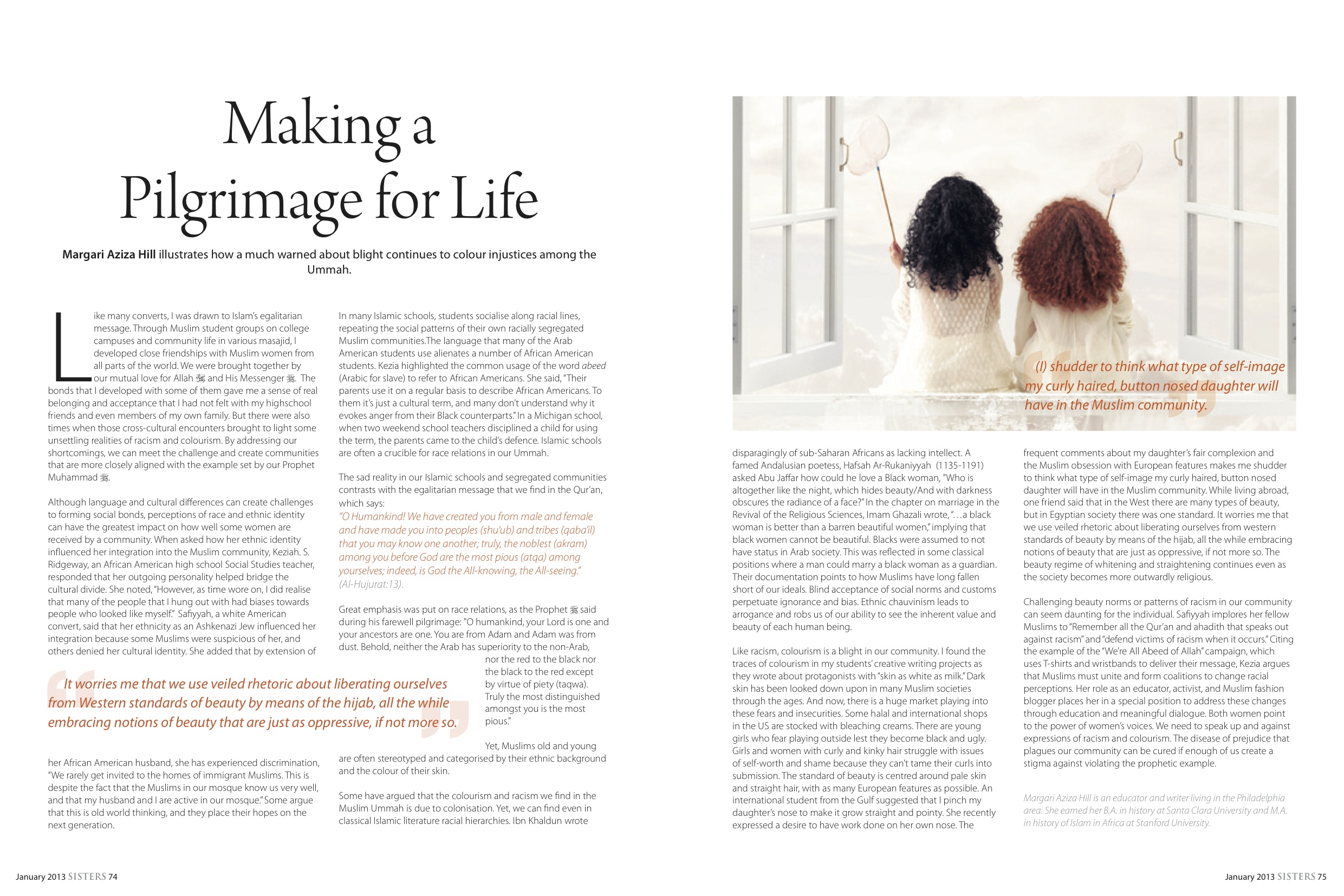
Pilgrimage for Life

Pilgrimage for life
Like many converts, I was drawn to Islam’s egalitarian message. Through Muslim student groups on college campuses and community life in various masajid,  I developed close friendships with Muslim women from all parts of the world. We were brought together by our mutual love for Allah and His Messenger.  The bonds that I developed with some of them gave me a sense of real belonging and acceptance that I had not felt with my high school friends and even member of my own family. But there were also  times when those cross cultural encounters brought to light some unsettling realities of racism and colorism. But by addressing our shortcomings we can meet the challenge and create communities that are more closely aligned with the example set by our Prophet Muhammad (peace and blessings be upon him).

Although language and cultural differences can create challenges to forming social bonds, perceptions of race and ethnic identity can have the greatest impact on how well some women are received by a community.  When asked how her ethnic identity influenced her integration into the Muslim community, Keziah. S. Ridgeway, an African American  high School Social Studies teacher, responded that her outgoing personality helped bridge the cultural divide. She noted, “however, as time wore on I did realize that many of the people that I hung out with had biases towards people who looked like myself.”  Safiyyah, a white American convert, said that her ethnicity as an Ashkenazi Jew influenced her integration because some Muslims were suspicious of her and others denied her cultural identity. She added that by extension of her African American husband, she has experienced discrimination. “We rarely get invited to the homes of immigrant Muslims. This is despite the fact that the Muslims in our mosque know us very well, and that my husband and I are active in our mosque.” Some argue that this is old world thinking and they place their hopes on the next generation.

In many Islamic schools, students socialize along racial lines,   repeating the social patterns of their own racially segregated Muslim communities. The language that many of the Arab American students use alienates a number of African American students. Kezia highlighted the common usage of the word abeed (Arabic for slave) to refer to African Americans. She said,  “their parents use it on a regular basis to describe African Americans. To them it’s just a cultural term and many don’t understand why it evokes anger from their Black counterparts.” In a Michigan school, when two weekend school teachers disciplined a child for using the term, the parents came to the child’s defense. Islamic schools are often a crucible for race relations in our ummah.

The sad reality in our Islamic schools and segregated communities contrasts with the egalitarian message that we find in the Qur’an, which says:

“O Humankind! We have created you from male and female and have made you into peoples (shu‘ub) and tribes (qaba’il) that you may know one another; truly, the noblest (akram) among you before God are the most pious (atqa) among yourselves; indeed, is God the All-knowing, the All-seeing.” (49:13).

The Prophet (PBUH) said during his farewell pilgrimage:

Oh humankind, your Lord is one and your ancestors are one. You are from Adam and Adam was from dust. Behold, neither the Arab has superiority to the non-Arab, nor the red to the black nor the black to the red except by virtue of piety (taqwa). Truly the most distinguished amongst you is the most pious

Yet, Muslims old and young are often stereotyped and categorized by their ethnic background and color of their skin.

Some have argued that the colorism and racism we find in the Muslim ummah is due to colonization. Yet, we can find even in classical Islamic literature racial hierarchies. Ibn Khaldun wrote disparaging of sub-Saharan Africans as lacking intellect. A famed Andalusian poetess, Hafsah Ar-Rukaniyyah  (1190-1191) asked Abu Jaffar how could he love a Black woman, ”Who is altogether like the night, which hides beauty/
And with darkness obscures the radiance of a face?” In the chapter on marriage in the Revival of the Religious Sciences,  Imam Ghazali wrote, “a black woman is better than a barren beautiful women,” implying that black women cannot be beautiful. Blacks were assumed to not have status in Arab society. This was reflected in some classical positions where a man could marry a black woman as a guardian. Their documentation  points to how Muslims fall short of our ideals. Blind acceptance of social norms and customs perpetuate ignorance and bias. Ethnic chauvinism leads to arrogance and robs us of our ability to see the inherent value and beauty of each human being.

Like racism, colorism is a blight in our community.  I found the traces of colorism in my students’ creative writing projects as they wrote about protagonists with skin as white as milk. Dark skin has been looked down upon in many Muslim societies through the ages. And now, there is a huge market playing into fears and insecurities.  Some halal and international markets in the US are stocked with bleaching cream. There are young girls who fear playing outside lest they become black and ugly.   Girls and women with curly and kinky hair struggle with issues of self worth and shame because they can’t tame their curls into submission. The standard of beauty is centered around pale skin and straight hair, with as European features as possible. An international student from the Gulf suggested that I pinch my daughter’s nose to make it grow straight and pointy. She recently expressed a desire to have work done on her own nose.  The frequent comments about my daughter’s fair complexion and the Muslim obsession with European features makes me shudder to think about what type of self image will my curly haired, button nosed daughter have in the Muslim community. While living in abroad, one friend said that in the West there are many types of beauty, but in Egyptian society there was one standard. It worries me that we use veiled rhetoric about liberating ourselves from western standards of beauty with hijab, all the while embracing notions of beauty that are just as oppressive, if not more. The beauty regime of whitening and straightening continues even as the society becomes more outwardly religious.

Challenging beauty norms or patterns of racism in our community can seem daunting for the individual.  Muslim womanSafiyyah said to “Remember all the Qur’an and ahadith that speaks out against racism” and “defend victims of racism when it occurs.” Citing the example of the “We’re All Abeed of Allah” campaign, which uses T-shirts and wristbands to deliver their message, Kezia argued that Muslims must unite and form coalitions to change racial perceptions. Her role as an educator, activist,  and Muslim fashion blogger places her in a special position to address these changes through education and meaningful dialogue.  Both women point the power of women’s voices. We need to speak up and against expressions racism and colorism. The disease of prejudice that plagues our community can be cured if enough of us create a stigma against violating the prophetic example.

You can read the full article and other thoughtful pieces at Sisters Magazine  January 2013 edition “All the Colours of the Ummah”

On Children Dying

Sometimes, the most emotionally vulnerable of us human being succumbs to evil and commits an atrocity. Every day we see in the news stories of children who are killed, kidnapped, sexually abused. We see news stories of children caught in conflict, whose innocence could not shield them from the madness of adults. And often, we try to make sense of this world and have children in hopes that they will be safe from harm. But rarely do we ever hear of children so sweet targeted for their innocence. Most of us have expressed empathy and have been sympathetic. I looked at the definition and found these.

Definition of EMPATHY

1: the imaginative projection of a subjective state into an object so that the object appears to be infused with it
2: the action of understanding, being aware of, being sensitive to, and vicariously experiencing the feelings, thoughts, and experience of another of either the past or present without having the feelings, thoughts, and experience fully communicated in an objectively explicit manner; also: the capacity for this

Definition of SYMPATHY

a: an affinity, association, or relationship between persons or things wherein whatever affects one similarly affects the other b: mutual or parallel susceptibility or a condition brought about by itc: unity or harmony in action or effect <every part is in complete sympathy with the scheme as a whole — Edwin Benson>
a: inclination to think or feel alike : emotional or intellectual accord <in sympathy with their goals> b: feeling of loyalty : tendency to favor or support<republican sympathies>
a: the act or capacity of entering into or sharing the feelings or interests of another b: the feeling or mental state brought about by such sensitivity <have sympathy for the poor>
: the correlation existing between bodies capable of communicating their vibrational energy to one another through some medium

Initially, I thought empathy had a deeper meaning. But in some ways, I found the definition 1a of sympathy encapsulates the collective mourning we all went into. I found that some people lacked empathy and used it as an opportunity to make political statements. They seemed unsympathetic towards the loss that many of those parents must have felt, and by proxy many of us who are horrified by the thought of innocents cut down because they were innocent. The massacre speaks to a fear that every parent has. And for me, it reminded me of the trauma my family faced when my sister died. I spent all weekend thinking about my mother who lost a child and my brother who survived a tragic accident.

I don’t remember everything, but flashes here and there come back to me. Now more often than not, I have memories of the memories. Every once in awhile my mother reminds me about the events that my brother wont speak about. I don’t even know the exact dates, but my world fell apart somewhere between four and five years old.  Muslim aren’t supposed to believe in omens, but something ominous happened. I see it through my mother’s eyes, as she watched my older sister Melissa go into hysterics over a bird flying into the house. My sister knew the omen foretold death. But none of us would know the scale at that time.

My older brother and sister are my half siblings.  Most people in my mother’s family didn’t like my father and knowing how he treated my mother at times, I could understand why. My mother recounted recently that no one wanted to babysit us when my father’s parents died shortly after that bird visited us. So,  all three of us kids got ready to take the 10 hour drive with my mom, dad, and their friend (I can’t remember his name and I’m writing this story off the top of my head). I remember knowing how sad my sister was as my mother combed her hair. Funny how those things stick with you.

When we were alone, she asked me to keep a secret. I promised. Then she said, “God told me I’m going to die.” Children are terrible at keeping secrets. But this one I kept. Hours later…in the darkness…flashing lights…tears. When my mom found me I was  thrown out the car, like my brother and sister, and landed on the road. But I landed on a pile of coats with only a few scratches. She said I kept repeating, “I knew this was going to happen. I knew it.” My brother was thrown the farthest. But my sister had the most extensive injuries, including a broken hip.

The hospital to me was this bright place and I remember my sister’s calm.  My sister taught me about God. Maybe I thought he changed his mind, because I don’t remember being sad. I used to remember more 20 years ago and damn the memories fade.  I remember wanting her jello. She had to have surgery because they put her in traction with a broken hip. My mother said just as they were closing her up, she went into cardiac arrest. Her lung was pierced by a broken rib, something that likely contributed to her death. It was all preventable,  There was a malpractice suit, a shady lawyer, and a small compensation for every year that she died. Years later, there was some controversy in the family because after my mother left my father, my father signed for the money. Whether he smoked it, shot it up, or my uncle. Somebody used it. No one knows whatever happened to the trust fund.

After my sister’s death. I stayed with my father’s sister and she spoiled me. My aunt was a smart woman and my father said that she favored Oprah Winfrey. She just finished her Ph.D. in psychology, but hadn’t walked stage. I flew back home and entertained the whole flight with my Shirley Temple routine (I was such a ham then).  My aunt Pattie told my mom that she never had to worry about me, that I’d be okay. My mom took it literally through most of my life, even when I wasn’t okay. But looking back, I think she was right. Shortly after I took that flight back home,  she was preparing for a trip.  No one thought twice when they didn’t hear from her in days. But she had diabetes and had died. She had been dead for days when they found her.

So, between four and five I knew death and dying. Sadness used to over take me. And over the years, my brother became angry and those things unspoken bottled up inside of him. Melissa was much closer to my brother, who had to be about 11. We all had survivor’s guilt somehow. My mom said our family friend who was behind the wheel never got over it. When I finally reunited with my father after 18 years, he cried about what happened. One of the rare times I’ve seen my mom cry was when I was in my 20s. She began to talk about that dark time and how she was so numb, but had to pick up the pieces. She left my abusive dad and we moved to California where a long lost aunt lived.

Almost a decade later, my brother lost his temper in an argument with my mom and over turned a table. To blow off some steam he went fishing with his friend Henry.  That night my mother dreamed that  Melissa was sitting outside.  My mother tried to get her to come inside. My dreams were also disturbed that night. Henry and my brother never made it to their destination. A drunk driver hit them head on and for hours they held on to life until they were finally rescued. We rushed to Santa Cruz hospital and my mother losing another child, a young adult this time. Henry passed, but my brother held on even after going into cardiac arrest several times. I was in ICU for so long and in the hospital for months. He picked up his shattered life because he had a daughter to live for. Years later, I heard that fear in his voice one time when we thought were losing my niece, when she stopped breathing and turned blue. We live near a fire station and they came within minutes to resuscitate her. In her teens, I remember a doctor telling my brother to make sure he had life insurance policy for her because she had a condition that could result in her death.  No one wants to hear that fear in someone’s voice, the fear and sadness of a parent losing their child. My niece pulled through and is healthy. She has a beautiful daughter now, named Melissa.

When my daughter was first born, I’d wake up in a panic if she was sleeping to still. I spent the whole first year afraid of SIDS. Becoming a mother has made me much more prone to irrational and rational fears. No mother wants to bury her own child. My sister was just a year older than many of the children who were murdered last Friday. I can’t imagine the pain and loss my mother felt when she put her daughter in that small casket. Twenty parents are laying a piece of themselves in the ground in tiny caskets. And losing a loved one hollows you out, leaving a void far larger than the hole they dig for their caskets.

My mom always felt a bit empty after losing Melissa. I think that’s why she was so happy to have my youngest sister some 8 years later. My mother once related to me about an evening when Melissa told her to look at the stars. Melissa said with amazement, that’s how many descendants of Abraham there are. Through my sister, I fell in love with those old Testament stories. I’ve always found meaning in my sister’s life, as she is the one who taught me to love God. And I spent my young life trying to find a spiritual home and a place that allowed me to find comfort in Melissa’s narrative. I found that in Islam, where children are considered innocent and when they die, they go to paradise. I always knew she was called to be with God. Even during my darkest times, I could not deny that my sister foretold her own death. I could not escape the peace she made with that. I could not deny the unseen world that always seemed to exist beneath the surface. All those precious children who are taken from us are not ours, but God’s. I don’t feel sadness about where they are now, but how terrible their last moments were. I feel sad for the parents who can’t hold them and see them grow. We are left picking up the pieces and numb, wondering how do we make this a better world.


It has been a long time and plans for the site

I know it has been forever. While my blog has been silent, but mind has been active. I’ve also had my hands quite full, freelance editing, teaching part time, and being new mom to a lovely one year old. I just started writing again, but I hope to move my writing in a new direction, focusing on essays and reportage. I submitted a few articles to Sister’s magazine on two of my passions, race relations and the history of Islam in Africa. Both deal with gender, so you get the theme. Being an educator, you are exposed to a lot of stuff you want to write about, but can’t. It means you have to broach subjects with a lot of tact. So, the instead of the old sledgehammer approach, I must put some velvet gloves on the iron fist. Working with people, you see their humanity. At the same time, you can see how systems reproduce inequality and how short sightedness and ineptitude can undermine the most promising of institutions. Above all, you see that most of us mean well and are trying the best we know how. A year and a half ago, I talked about a series of articles I intend on writing. I still want to work on those. It will realistically take a lot longer. At the same time, I realize that I have to look at writing as part of my self care, as a way to nourish my mind and refine all those jumbled thoughts in my head. I hope you will be patient with me as I build up my writing chops again.

Politically Incorrect pre-Ramadan post

Before Ramadan begins, I want to get something off my chest. Whether we like to admit it or not, we all have felt excluded at some point during Ramadan.  However, there are some things that should be left unsaid about our friendships, especially during Ramadan. For example, if you hear that one of your friends is getting together with a some other folks, you shouldn’t say, “Why wasn’t I invited?” Here is where you should give your co-religionists 75 excuses, as opposed to harboring ill feelings during this blessed month. Besides, how many get togethers have you organized without inviting your whole address book? If you really want to hang out with said friend, invite them for an iftar. Maintain contact throughout the year, build closer bonds, and next year they will remember you. Stop worrying about whether or not you were included. There could have been  a myriad of reasons why you weren’t invited this time around: budgetary concerns of the host (it is expensive and the economy sucks); numbers (room may be full to capacity); crowd (it may not be your scene); organizer (perhaps the host is not even your friend or the event was to bring together certain people for a specific purpose); perhaps you don’t extend invitations yourself; perhaps they just forgot.  Ramadan is not a time to harbor bad feelings or develop envy over someone getting invited to an event that you were not invited to.

Contrary to our family’s face, our social world is very limited. As a recent transplant and new mother it can be isolating and challenging. There have been many a Ramadan when I received a scarce invitation outside the community events that are open to the public. The daily iftars at Stanford were great. I didn’t have to worry about stuff like that. But here, in Philadelphia, at my first public iftar, I felt like I was just an object in all the sisters’ way.  I didn’t feel very welcomed, so I understand.  Outside of a handful of friends that I run into at public functions, I get the warm smile and the I-recognize-you-and-and-your-husband-but-I’m-too-busy-to-talk-to-you interactions from most. During my first year in Philadelphia, we received two invitations to people’s homes. One ended badly when a guest turned out to be confrontational because many guests weren’t in his particular sect. My second Ramadan, we didn’t receive many personal invites either. Those that did invite us were recent transplants to the Philadelphia. My third Ramadan was similar, even as I was very heavily pregnant and majorly tired, I think some people complained about last year when we didn’t invite them. And once again, not many personal invites outside the usual transplants and public events.

A lot of people we know and have been close to have not invited us over to their homes for whatever reason. At times do I feel left out when they write about their functions and close ties in public forums like facebook? Yes. But do I put it in perspective and keep on moving? I try to and focus on what I can do to not feel so isolated while not breaking my bank or neglecting myself or my family. I know that Ramadan is not about being part of the in crowd or showing up at the who’s who event to eat up all of somebody else’s food. Nor is it about creating popularity contests. These are things we shouldn’t bother ourselves with because we should be focused on higher things. Okay, breath deep, now to focus on my pre-Ramadan jitters! Stay blessed all!

My Obligatory Tenth Anniversary of 9/11 Post

Out of the Shadows of 9/11: Professor Hussein Rashid on faith’s role in social change from Kellie Picallo on Vimeo.

I haven’t written much the past ten years about my thoughts on 9/11.  In truth, the day marks a day of loss in a much different day. The first anniversary of 9/11 was the day my father died. I hadn’t seen him in 18 years with intermittent phone calls. But we reunited in 2000 only to drift apart again.  This is by no means a comparison to the those who lost loved ones the year before. But, I remember listening to a radio program on my way to my second year back at Santa Clara University. And the program reminded me that I needed to reconnect with loved ones. Since school hadn’t started, I worked pretty much full-time hours in the Dean of Student Affairs office. At some point of the day, I felt a profound sadness. This upped my anxiety and I couldn’t wait to get home to get on the phone and locate my father.   But when I got home, I heard a voice mail from my father’s cousin telling me to call her. I knew then that it was over, no second chances, I would never have a relationship with my father. He was gone.

My father was a Vietnam Vet who as awarded a purple heart. He suffered post-traumatic stress syndrome, which profoundly affected him and those who loved him. Even during my parents’ marriage, he could not hold it together and his life spiraled into an out of control cycle of drug abuse, unemployment, and domestic violence. My mother eventually left. I have heard that he had been to VA hospitals and some treatment programs. He never remarried and I was his only child. My cousin told me that the day he died, he spoke of my mother and me and said he wanted to contact me.

When he died, my father had no burial arrangements and I had no money as I was a struggling student. He stayed in the morgue for over a week as his family tried to figure out how to bury him. So, my cousins had to erase my existence saying that he had no next of kin on the forms. He was cremated and my cousins drove his remains to his home town of Columbus Ohio. Eventually, my cousin was able to hire someone to get my father recognized as a veteran who served his country so that he could have a dignified burial. I had to leave before he had a proper military burial. He was finally laid to rest a bit over a week after I left Ohio, but they mailed me the flag that they used on the coffin.  To this day it remains folded in an immaculate triangle, in a case my mother bought. While it is at my mother’s house, that flag is my one possession that I take most pride in. That flag is a testament of his service to our country, the friends he lost, the wounds received, and the price he paid. Yes, Vietnam was a senseless war, but it wasn’t his choosing. Still he paid a price, and ultimately our family did too. But this post is not about me feeling sorry for my family because of his PTSD, rather it is to point out that as a daughter of a veteran, as the descendant of people who sacrificed so much in this country, that no one can deny my Americaness.

When I met my father again for the first time after 18 years, he knew I was Muslim. He said he studied Islam and respected the religion. He respect my choice, as do my other family members. I have a number of family members who have served their country. And while we have different political views, they would never deny my right to belong in America. And never as a Muslim have I felt like I didn’t belong in this country. It was my birthright. And it is the right of other American Muslims to be able to grieve, live, and love in this country.

September of 2001 was an exciting year for me, as I finally picked up the pieces of my life and was going back to school. I knew I wanted to write, but figured I’d become a technical writer working on software training manuals and that I’d write fiction on the side. At that time, I was still trying to figure out my place in the American Muslim community. I identified as a Muslim, but I had no idea how that would ultimately manifest itself in my life. I didn’t wear hijab at the time and the only identifying feature of my religion was the  Arabic “Allah” necklace I wore around neck. But frequently I talked about my faith if people were curious. School hadn’t started, so I still had my regular 9 to 5 hours at MicroCenter. And as I turned on the radio, I thought I was hearing a joke. I changed stations because it wasn’t funny. But it was more reporting of the attacks. I could barely make sense of it, the towers, airplanes grounded, we were under attack.  As I passed the airport,  I didn’t see a single plane in the sky. Just a clear blue sky.  It was eerie because for some reason I tended to live near the landing and take off path and could always see airplanes in the sky. But it was just clear, empty blue sky. I didn’t know if any other cities were being hit. I didn’t know what was happening as I was stuck in my car and could only move forward to get to my job. I got to work and my co-workers and I were transfixed. Some of the guys tried to make some jokes and made an off color joke about our Arab co-worker parachuting out. I can’t even remember the rest of the day. All I remember was feeling doubly vulnerable as an American under attack and as a Muslim who would receive the backlash from those who would blame all Muslims. I wondered what types of wars would come of the attack and I feared the worst.

The tragedy touched me in different ways. A former co-worker’s mother had been in the vicinity and escaped the World Trade Center, someone I knew told me he had been in an adjacent building, Deora Bodley a 20 year old junior who died on Flight 93 would have graduated with me from Santa Clara University. There were memorials for Deora and several vigils. Someone even pointed out Deora’s boyfriend, who looked so broken and still in mourning.  During my first week of classes, 9/11 was all that people wanted to discuss. I was often the only Muslim, I would try to help my classmates and professors understand the socio-political situation in Muslim majority nations. I tried to explain the grievances that extremist Muslims had. I was well versed since that literature circulated widely and easily as different groups tried to radicalize us young Muslim student . I often thank God that I turned away from justifying certain actions early on and became more grounded in 1997 as I studied under Hamza Yusuf. And some of our more radical MSA members were finally able to see the logical outcome of their rhetoric and they too turned away from their extremist views. But many of us Muslims were all concerned that we had not provided a counter balance to extremist ideologies and there was a call “Where are the moderate Muslims?”

9/11 was my wake up call and ultimately it made me embrace my faith even more. I couldn’t be an invisible American Muslim, a Muslim of convenience. Under the encouragement Professor Gelber, I decided on a career in academia. Maybe my plans were lofty, to explore the history of Muslim societies and look for institutions and practices that were not reactionary but positive. I believed that by drawing on our historical and cultural legacy, that we Muslims could transform our communities and societies. I wanted to be a bridge, bringing together both sides of my identity. Bridges were needed as I saw my country become increasingly polarized. In retrospect, when you compare what has happened in Afghanistan and Iraq, American Muslims have had it so easy. But there was increased pressure for us to become public. Maybe I was lulled into a sense of comfort because I attended a Catholic University, which was anti-war and pro-interfaith dialogue. But praise God, we American Muslims didn’t receive much of a backlash. Yes, there were hate crimes, a burning of an Arab Christian Church, a random murder of a South Asian Fremont woman, some beatings, increased surveillance, etc.

Ten years later, it seems like America has become even more uncomfortable with American Muslims.   While I feel profound loss when I see the horrors of those events and often cry when I read or watch the personal accounts of people who lost a loved one, I also feel as if I am not allowed to mourn (at least not publicly).  Ten years later, people want me to apologize for 9/11, assume I have some agenda to take over this country, and spew hate and misconceptions about me and my co-religionists. I see the hate posted in the comments section of news articles. I have seen protest after protest against Muslim houses of worship. I have heard some people deny that my faith is even a religion. I fear that this country has gone down the path that the terrorists wanted us to go. Their actions were meant to provoke military aggression, to stir up fear and hatred, and to drive a wedge between peoples. Despite all the hatred, there are those like myself, whether immigrants, children  and grand-children of immigrants or converts or children and grandchildren of converts, who are committed to both our faith and country and see no contradiction in being American and Muslim.

While no one carries the sins of another, many of us American Muslims know that we bear an even greater responsibility now to be better neighbors and citizens than those who would deny others’ constitutional rights. We will be better than those who spew hate and try to intimidate others. I am glad that many Muslims are embracing and asserting their Americaness, when we were too timid to do so because we were once so steeped in anti-establishment rhetoric, in the anti-neo colonial discourse, or ethnic isolationism to feel like we could fully participate. When we can fully embrace our Americaness, we will not only be able to make a contribution, but we can also participate in the our constitutional rights and even spirit of protest to make this country better. We have a new generation of Muslims serving in this society, giving humanitarian aid, educating, healing, building, creating, even defending it in armed service.  I think back to my father’s flag and how that will eventually pass on to my children.  And I don’t mind working harder to contribute something to my community and society. Many of my American co-religionists feel the same. And we do this because this is where our future lies, were our children and children’s children will be buried. We do this, not because we are rabid nationalists or ethnic chauvanists, but because America is our home and part of who we are.