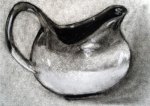
Adventures in the Life of a Failed Artist

For years, I spent most of my time in thinking, writing, rethinking, spending free time in heady enterprises like deep conversations. But drawing allows me to rest my mind a bit and focus on a shadow, a bright speck of light, a curve of a line, or where two silhouettes intersect. Last Spring, I took an 8 week course at the UCAL. It was an enjoyable experience where I got to use a different part of my brain for once. In some ways, my new artist utensils remind me of opportunities lost and my own personal failures. Maybe this was a gift I that I let flounder and sadly I have to chalk it up to circumstance. Back then, gifted Black girls were never tracked to be artists or even deep thinkers. We were groomed to be engineers, by becoming funneled into programs like MESA.  Distracted, overwhelmed and the on the receiving end of my non-Black classmates discrimination in Physics and Trig, I knew I was destined to become a piss poor engineer.  I slipped into delinquency, high school fights, and general despair. Plus my mother thought I’d be a terrible teacher because I was impatient. I went from the who’s who list to the who’s who of students with multiple talents that didn’t live up to expectations.

School was a miserable place for me, ever since I moved from Trenton and began kindgergarten in a predominantly white schools in the South Bay. But I was curious and loved to write and draw. Ever since I was a toddler, I used to sketch and draw in my mother’s address books. My drawing and story telling in brought me to the attention of my fourth grade teacher. I don’t know if my mother still has the story I wrote, but it was my take on the “Lord of the Flies,” basically the survival techniques of a young Black girl on a desert Island. My teacher recommended that I get tested and following those results I got to escape the dreary loneliness of Kathryn Hughes Elementary school into a world where we played with different shapes and and embarked on odd and nonsensical projects. It didn’t matter that my classmates were socially awkward because they were nerds. I thought I went to this special place because I was different, Black and didn’t think like everybody else. I didn’t think I was so smart, just odd like the other students at GATE. Over time, my teachers expected me to achieve and often accused me of wasting my potential.

I can remember some of those drawings I did from second to sixth grade. I remember the picture I drew of what I hoped I would become when I grew up. I drew my long hair perfectly feathered like Heather Locklear’s on T.J. Hooker. Even though I had my father’s flat nose, I constantly drew an adult me with an aquiline nose with a strong bridge like my mother’s. I remember thinking back resenting my pictures that I drew and how they reflected the low self image I developed after moving into multi-ethnic Santa Clara where Black was a slim majority.

I continued to write stories and draw pictures, often pictures of people’s photographs from time to time. I’ve often regretted that my artistic talents were never really developed. I was tracked so early in high school and I struggled under the weight of science requirements for university admissions and the petty and sometimes deadly violence at a high school that was more like a volatile mix of working class Mexican Americans, Blacks, whites, bloods, mormons, nortenos, rogues, vietnamese gangs, republicans, stoners, jocks, track athletes, and debutantes. I was able to squeeze in one elective art class and an AP art history class. Eventually my college hopes dwindled, and I ended up finishing my last year at a continuation school only to walk triumphantly with my high school class.

I continued to draw things on my own during my community college years, but after a brief stint of being a hardcore Muslim, I burned all my pictures of people and animals. I didn’t pick up a pencil or a pen for years. Nearly a decade later, I took another art class as a return student at Santa Clara University in 2003. It was mostly still life. And my only Black American teacher there noted my work as I captured light and darks on a still life featuring a pineapple. With the help of a some engineering tips, my final project of a japanese garden turned out near perfect. I still consider it my best work to date. Sadly, most of my early work was lost between moves and the instability of being a wayfaring graduate student.

I don’t know why it is so hard for me to pick up the charcoal on my own. There’s something about a structured class and a place where you can let the dust fly everywhere without worrying about it staining the white walls and sullying the vacuumed carpet. I know I will never be a great artist, I think that window closed a long time ago somewhere when I was sketching distorted pictures of my classmates on junior high notebooks. But I enjoy it nonetheless. I hope you rediscover a love and reignite an old flame. You only fail if you never try,

Addressing a Real Social Need: Milati Islami

Addiction is a real problem, and believe me it is not limited to just converts and indigenous Muslims ( those whose families did not immigrate from Muslim majority societies).   Addiction is not limited to substance abuse, we have people with gambling addictions, sex addictions, shopping addictions, etc… Many Muslim communities have failed to develop programs to specifically address substance abuse, which is a real big problem that we often sweep under the rug.

I brought this up after reading about the Guantanomo guard,Terry Holdbrooks, who converted to Islam. He fell into a spiral of alcoholism that led to hospitalization after his experiences at Guantanomo, which included his conversion. At the time of the article, he had recently quit drinking and began attending classes at the mosque. I didn’t read anything about any treatment programs, no 12 steps, nothing, nor counseling sessions to deal with the emotional or psychological problems that plagued him. To me, it highlighted the assumptions that people make when you take shahadah or clean up your life after years of hard partying in your youth (I’ve known plenty of Muslim binge drinkers on college campuses).  Often Muslims are wracked with pyschological trauma from their past, and the emotional guilt from a fall from grace. When you take shahada, your sins are wiped clean. But your mind is not a clean slate, nor are your proclivities reset.   While there are many programs to provide services to inmates, and MANA is working on reentry programs, I still wonder if the assumption is that ex-convicts who had substance abuse problems and drug related offenses will be able to resist temptation once they are out in the the world of temptation. Reentry is not just about finding the brothers jobs and wives (in fact one brother did chastise the sisters at one MANA meeting for not stepping up and marrying the ex-cons).

Addiction is devastating on the individual, their family, and the entire community. It also creates an atmosphere of distrust. I remember years ago, a  Syrian family I knew  in the South Bay had spent a considerable amount of resources trying to help a new Muslim get his life together. They lent him money and tried to help him start a painting business. After some months, he began smoking crack and his life spun out of control. After being burned by that experience, they were less inclined to help converts. Another sister told me her previous husband was a crack head, it just took her a couple months after their marriage to learn of his addiction. And by that time it was too late, she was already pregnant. Well, crack addicted men aren’t the best father figures. On the other hand, I know of a success case, a former addict committed to a life of sobriety, found Islam, and is achieving great things including the highest level of education that one can attain. I appreciated the candor of this individual who openly talks about recovery. That candor is not something you see a lot of in the Muslim community. Instead, we try to hide it behind a veil of piety. And beneath that veil of piety is the heavy weight of self-loathing and fear of being discovered. My hope is that we  invest in our human capital, that we address our realities in America. Addiction, mental illness, and overall spiritual nihilism are things that our community should be equipped to address with trained counselors and skilled imams.  I am pleased to see that the Muslim community in Philadelphia  addressing this.

In the Name Of Allah, The Beneficent, the Merciful …
ATTENTION : BROTHERS and SISTERS
from
Millati Islami Groups of Phila.
{12 Step Recovery}

Millati Islami is a Twelve Step recovery program for
persons that experience problems associated with
addiction. The steps and traditions of Millati Islami
are based upon Islamic principles. With the traditional
Twelve Step program some principles have proven to be
in accord with our Islamic way of life. When Islamic
principles are included, they have proven to further
enhance the recovery process.

Come Join Us!
MONDAY MEETING

Time: 7:00 PM to 8:30 PM
@ The New Africa Center
4243 Lancaster Avenue
Philadelphia. PA

WEDNESDAY MEETING

Time: 7:00 PM to 8:30 PM
@ The Quba Institute
4637 Lancaster Avenue
Philadelphia, PA

FRIDAY MEETING
Time: 7:00 PM to 8:30 PM
@ Masjidullah, Inc.
7700 Ogontz Avenue
Philadelphia, PA

For More Information Contact:

Bro. Ameen Abdur-Rasheed: 215-514-6692
Bro. Abdur-Rahim Burton:347-578-0250
Bro. Naim Uqdah: 215-651-8501
Sis. Noor Doumbia: 267-261-3763
Sis. Hadiyah Najee-Ullah: 215-868-5286
Sis Miriam Sheppard: 215-873-3232

Comment Policy

This is a moderated blog. I will not approve comments that are anti-Islamic/anti-Black/anti-woman/anti-American/anti-anything diatribes, especially those that are full of falsehoods and misconceptions. I do not have time to debunk nonsense or argue with people who are convinced by their own self perpetuated ignorance. Nor is this blog a site for you to proselytize or promote your false universals here. Thank you and like Roxanne Shante said, “have a nice day!”

The Mahr (Bride Gift)

is a common problem for Black American Muslim women. Many never see it, especially if it something of any substance besides three surahs (short chapters of the Quran) and a iron ring. These same brothers will be the first to tell a sister off for going to “kafr” courts for spousal or child support. Brothers when you get married, you enter into a contract. That is not a debt that can be forgiven, it is not something that Muslim women (who are often left vulnerable by the traditional roles they take) can write off as an expense as some uncollectable debt. Sure, you can bust out that “I owe you one on youm al qiyama.” But is that one you can have hanging over your head? I think it is time that we develop a database for all masajid and community members to know if they can trust going into any business with a brother who refuses to pay an outstanding mahr to a sister he divorced. Also, sisters going into a marriage need to know if they their prospective has some outstanding debt, knowing she’ll likely be in the same wack situation.

Working While Muslim in America: The ‘Id shut Out

Last year, at Stanford my Arabic instructor at the time, who happened to be an Arab Muslim, didn’t think it was appropriate to cancel class. I remember being stuck in traffic coming from the ‘id prayers, stressed out about making it back to Palo Alto in time. Two of my sistah-sisters who rode with me were in the same predicament. I apologized for making them late and deep inside regretted my foul mood. After I finally found a parking space, I had to rush to locate the Arabic reading materials just before class started. This Arabic was supposed to be a class linked to Stanford’s burgeoning Islamic Studies program, yet there were no accommodations for Muslim students or faculty. Yet, on Yom Kippur even some of the most secular and liberal professors and students were notoriously absent and classes were canceled. Right now, I’m reeling over a boss who just shut out ‘id. It’s especially annoying knowing how much they value those Turkey Days and weeks off during X-mas break. It is experiences like these that make you feel out of place as a Muslim in America. Your boss or your professor can say: Screw you practicing Muslim, nobody cares about you or your holiday. It makes me question things, when enlightened places of America’s elite institutions of higher learning like UPenn and Stanford do little to create a space where Muslims can celebrate a day that is really holy for us, and not just a secularized day where we just buy stuff or eat stuff.

Psychological and Religious Ramifications of 9-11 on Muslims

I received this message from a listserv that I’m on. I think this is a worthwhile project on a subject that really needs to be studied. Please consider giving your 30 minutes to help the production of knowledge on the American Muslim community:

Brother/sister as salamu alaikum,
My name is Hisham Abu Raiya, PhD., a postdoctoral fellow in psychology
at the Counseling and Behavioral Health Services at New York University.
Drs. Kenneth Pargament and Annette Mahoney, well-known researchers in
this field of the psychology of religion, and I are currently conducting
a study that explores the psychological and religious ramifications of
the events that followed the September 11 attacks on Muslims living in
the United States. For the sake of this study, we are looking for Muslim
individuals living in the United States who are willing to complete a
survey that includes questions about the stressors they faced after the
September 11 attacks and their religious methods of coping with these
stressors. We are writing to ask you to complete our survey, which will
take about 30 minutes of your time. Your responses on the survey will
remain confidential and you will not be asked to provide any identifying
information. If you are interested in participating, you can access the
survey at:

http://psych.bgsu.edu/911survey.htm

Your help will contribute significantly in understanding the
psychological and religious ramifications of the September 11 attacks on
Muslims in the United States, and will be extremely appreciated.
Sincerely,
Hisham

Hisham Abu Raiya, PhD.
Psychology Fellow
NYU Student Health Center
Counseling & Behavioral Health Services
726 Broadway, Suite 471
New York, NY 10003
Phone: 212-998-4774
Homepage: www.hishamaburaiya.com

Triple Minority: Black Muslim Women in America

I’m giving a talk at the end of this month on the experiences of Black Muslim women in America. Insha’Allah, I plan on outlining the historical development of Islam in the Black American community and Black women’s roles in the American Muslim community. Much of my talk will draw heavily from two works: Carolyn Moxley Rouse’s Engaged Surrender and  Jamillah Karim’s American Muslim Women. I believe are great follow-ups to Sherman Jackson’s work, Islam and the Blackamerican. They are intriguing ethographic works offering insight into both the experiences of Black Muslim women, the challenges they face in gendered spaces that privilege men over women and in a society that often views them with pitiful contempt. They complicate notions that Muslim women are buying into their own oppression, by showing how becoming Muslim was an empowering act that challenged the racism, sexism, and classism in American soceity. I really liked how both studies shed  light on the ways in which Black Muslim women participate in  Quranic exegesis and interpret Islamic beliefs and practices.At the same time neither study glosses over the challenges many Black women face within the Muslim community and society at large. What is more important is that these studies provide so much  more insight into the actual workings of communities than a study from the top up. For anybody interested in the history and the current condition of Black American Muslims, you should really read these works. In fact, you should encourage more studies about Muslim women. I hope that there is somebody with the training and sensitivity of these authors to do an in depth study of the Black Muslim women within the Salafi movement. I do think that there should be work done on how masculinity is constructed in the American masajid.

One of the ironic things about working on women in Muslim communities, is that you can easily find yourself marginalized. Even creating a space for women in the masjid can be a double edged sword, as I discovered when I gave a recent talk. Many of the women wanted to have a women only event. As a result, my husband was excluded from coming. I attend many of his talks and sermons to support him. He felt it was unfortunate that he couldn’t support me. I knew of another couple where the husband had wanted to come hear my talk. It is likely that the wife decided to not attend because she would have been by herself. When I first learned that my talk on the Spirituality of Muslim women was women only, I became mortified. First, because the times I have attended masajid in Philadelphia I have often received an icy reception. There are no warm welcomes, or even a friendly curiosity over a new face in even a small community. Usually it is a polite ignore, which I find disconcerting, especially coming from California where I met most of my friends through random encounters at events. Second, the idea of women only talk reinforced the problem that I was just highlighting about the lack of women’s voices in Islamic scholarship. I noted that on campus topics focusing on women and family issues  were poorly attended by Muslim men. But a women only event meant that no man would know about Muslim women’s spirituality. Why should they care? Most have mothers, wives, sisters, daughters, and associates. Perhaps knowledge the can offer understanding or even inspire a bit more respect for our spiritual journey. I do believe that people are well intentioned, but I became flustered when somebody approached me as they were attempting to develop women only programming. Imam Anwar, on the other hand, is working to create an environment that both allows for women to carve out a space safe from the male gaze and a platform for women to be heard in their community. Just because I am a woman does not mean that I deal with women only topics and even if I do begin to write about Muslim women, I believe those issues should be of interest to the broader Muslim community.

Sometimes I am at a loss for words. There were times when I first began researching for my lecture that I was frustrated and even saddened by the condition of women’s scholarship I read those books relating to the struggles that each woman faced, personally moved when those scholars gave voice to the struggles I experienced. This is why I started blogging and why I was so relieved to find a community of Black Muslim bloggers to engage in these discussions with. Through this discourse I even found my soul mate.

I’m reading a lot of blogs by Muslim American women in general, and Black American Muslim women in particular to gain insight into life experiences that may reflect my own or differ in multiple ways.  In an effort to get a better sense of the issues that Black Muslim Women face in America, I am making a general call for input. I am developing a non-scientific survey to get a sense of what are our primary concerns. Is it discrimination in the broader society as Muslims, within the Black Muslim community as women, within the broader Muslim community as Black women? Are we concerned about marriage, raising children, economic disparities, losing our children to drugs and gang violence, lack of resources, access to Islamic education? In the meantime, feel free to comment and let me know your greatest concerns.  Believe me, my talk will also high light many of the rewards of being Muslim in America. If you don’t want to focus on the negative, please feel free to write what you want people to know about you.

Gloomy Day and Collective Guilt

Summer turned out to be rather lackluster, with a lot of rain, lots of overcast days, and an intense heat wave that rose up and gave us the smack down at the cusp of Ramadan. Just as September rolled in, the weather seemed to turn immediately into Autumn school day dreariness. After Fajr,  I had a cough that rattled in my chest and constantly interrupted my sleep for about an hour. After my post-Fajr nap I tried to take it easy and read. I closed most of the windows, finished reading the ethonographic book, American Muslim women.  When I took a break, I decided to watch a movie online. I decided to finish a film I began watching about childhood innocence. The only problem was that it was The Boy in the Striped Pajamas, a film that felt like it was either a tragic joke or a tragic train wreck ready to happen. My husband wasn’t interested in watching it the first time with me. Like me, he had misgivings about films like Valkyrie that try to show the “good German” who resisted Nazi hegemony in Germany. I began to wonder if this film was like Schindler’s List, which shows some of the horrors of the Holocaust, while at the same time absolving some Germans of the collective guilt. A Jewish friend of mine noted that in the 80s, that a number of times he had strange encounters from white Christians seeking to become absolved from guilt of letting it happen. I’ve that happen a few times myself from well meaning white co-workers. Put on the spot, I tried to come up with a thoughtful answer. But we joked, “What if I did say: ‘No, I don’t forgive you or your people!'” Some say that the election of Barack Obama helped a lot of White Americans feel absolved from their  collective guilt. So, I figured that this film was maybe an attempt to show the human side of Hitler youth to show that friendship can overcame race hatred and even mass genocide. We’re just people and that’s all that matters, right?

The well meaning book and film did its best to humanize a monstrous chapter in Western history. I was moved to tears during the gassing scene. Even though I was by myself, words slipped out of my mouth conveying my horror. The music and cinematography was supposed to emphasize the  German mother and sister’s anguish over the loss of their son. But there was nobody left to grieve for little Schmuel.  I feel kind of guilty that part of me  wished that it was based on true events. Can anybody absolve me of my guilt over having feelings of revenge and retribution over injustices?

The practical spirituality of Muslim women

I promised that today I’d post the notes from a Ramadan lecture for women that I gave yesterday at Quba Institute:

When I was asked to give this talk on a spiritual theme, I knew I was going to get myself in trouble. First for talking about tasawwuf and talking about women in Islam. Being from the Bay Area, California you have a lot of people talking about spirituality, being spiritual and not religious, a lot of New Age groups, including Muslims and those who claim to be Sufis but not Muslim and Muslims who claim to be Sufi, but do not follow Shariah. When I first became Muslim and put on hijab, a young woman of Middle Eastern background came up to me and told me that she was spiritual and focused on the inner aspects of the faith, while I was focusing on the outward. This is a false dichotomy. Even in the English language, there is no clear line that separates spiritual development and outward religious practices:

Main Entry: 1spir•i•tu•al
1 : of, relating to, consisting of, or affecting the spirit : incorporeal 
2 of or relating to sacred matters b : ecclesiastical rather than lay or temporal 
3 : concerned with religious values
4 : related or joined in spirit 
5 a : of or relating to supernatural beings or phenomena

Main Entry: mys•ti•cal
1 a : having a spiritual meaning or reality that is neither apparent to the senses nor obvious to the intelligence b : involving or having the nature of an individual’s direct subjective communion with God or ultimate reality 
2 : mysterious, unintelligible

Islamic spirituality or mysticism is often portrayed as something outside the bounds of Islam. Orientalists have often focused on mystical Islam, a term we often called Sufism, as something distinct from Sunni Islam. Muslim reformers have rightfully critiqued some practices of popular mysticism that entail practices of shirk (associating partners with Allah) and bida’ (innovation), which entails privileging practices or concepts over the sunnah with the assumption that one can outdo the Prophet (s.a.w.). Muslims have used the term Sufi to talk about those who practice tasawwuf, a science focused on purifying the heart. While there are practices popular Sufism that fall outside the bounds of Sunni Islam, the science itself is deeply embedded in our rich Islamic heritage. Imam Ghazali points us to the wholistic purpose of tasawwuf. In his work Ayuhal Walad, he says:

If you read or pursue knowledge, your knowledge should reform your heart and purify your soul; if you had one week to live you would of course not occupy yourself studying the science of jurisprudence ,… morality and scholastic theology and the like because these sciences would not help you. You would rather engage yourself in monitoring the state of your heart and in apprehending the characteristics of your soul, shunning attachment to the world, purifying your soul from the blameworthy characteristics, occupying yourself with the love and worship of Allah and adopting praiseworthy characteristics.

The second issue I had in preparing this lecture involved the lack of classical and historical sources about Muslim women scholars, in what Rkia Cornell calls, “The Veiled Tradition. This raises the question: Why aren’t there many women’s voices in Muslim scholarship? There are many possible answers to this question. Muslim women are less socially visible than Muslim men, as Rkia Cornell points out, and they run a greater risk of being overlooked in historical record. Medieval Muslim men did not hold women in high regard due to their patriarchal cultural values. The source could be from outside of Middle Eastern Cultures, classical Muslim scholarship inherited from the Greek tradition a disdain towards women. Some Greek thinkers even doubted that women had souls. And there could be some more positive reasons for why Women’s works are hard to come by. Women were busy doing, rather than engaging in polemics and public behavior. Finally, Muslim men were held to universal standard, male scholars did not enhance gender differences. So they saw no need to develop separate manuals for women. Now that we acknowledged a void, we do have to acknowledge the sources that we do have for gaining an understanding of Muslim women’s spirituality: the Quran, Hadith Literature, Preserved Poetry written by women, and Biographical Dictionaries (i.e Muhammad Ibn Sa’d (148/764-230/845); Abu ‘Abd Ar-Rahman As-Sulami (d. 1021); and ad-Din Abu Al-Faraj Ibn al-Jawzi Sifat Al Safwa (d. 597/1201)

While there is not distinction between Muslim men and women’s spiritual potential, Muslim women have developed distinct spiritual practices due to their role in their respective societies and communities. The agency of Muslim women in interpreting and applying the universal principles of the Quran and sunnah is often veiled because women were often focused more on embodying the Tradition rather than writing or engaging in public debate about it and the social institutions of seclusion that sought to keep women’s identity private in order to preserve their honor. I will first explore concepts of womanhood in the English and Arabic language and link those up with some important terminology on spiritual practices found with Sufi traditions. I will then explore the primary examples that we have for understanding the relationship women should have with their Lord. I then hope to tie these concepts and examples to begin to think about how we can inculcate these spiritual values.

Since this talk is about Muslim women, and the feminine perspective on spiritual practices, I think it is important to discuss how we are defining women and the feminine. I believe it is important to understand Womanhood and the Concept of Niswa in Islam.

Main Entry: 1fe•male
Function: adjective
1 a (1) : of, relating to, or being the sex that bears young or produces eggs (2) : pistillate b (1) : composed of members of the female sex (2) : characteristic of girls or women 2 : having some quality (as gentleness) associated with the female sex

Main Entry: 1fem•i•nine
Function: adjective
1 : female 1a(1)
2 : characteristic of or appropriate or unique to women 3 : of, relating to, or constituting the gender that ordinarily includes most words or grammatical forms referring to females

Main Entry: wom•an
1 a : an adult female person b : a woman belonging to a particular category (as by birth, residence, membership, or occupation) —usually used in combination 
2 : womankind 
3 : distinctively feminine nature : womanliness
4 : a woman who is a servant or personal attendant

Main Entry: wom•an•hood
1 a : the state of being a woman b : the distinguishing character or qualities of a woman or of womankind

The Arabic word corresponding to woman is Imra’ah Arabic Synonyms of Imrah/ the indefinite of al-Mar’ah. A few Arabic terms with corresponding masculine nouns will be important for this talk: Imra’ah/mara’ (woman/man) –>Muru’ (manliness) and Niswah/Fatuwwa (womanhood/young manliness)
Muru’:

“In abstinence from things unlawful or in chastity of manners, and having some art or trade; or in abstaining from doing secretly what one would be ashamed to do openly; or in the habit of doing what is approved; and shunning what is held base; in preserving the soul from filthy actions; and what disgraces in the estimation of men; or in good manners, and guarding the tongue, and shunning impudence; or in a quality of mind by preserving which a man is made to persevere in good manners and habits.”

The Toa of Islam, 266.

Jahili Arabs didn’t inculcate muru’a for transcendent values or for Allah, they did it to save face. This was transformed in Islam.

Futuwwa:
Means young manliness; It comes from the word fata, meaning young and encompasses the meaning of chivalrous young man.

  • Servitude and constant remembrance of God
  • Seeking company of good people (good fellowship) and hospitality
  • Being introspective
  • Focus on remembering one’s own defects
  • Guarding one’s soul against all temptations

There are two sources for futuwwa in the Quran: Abraham (Willing to sacrifice his son and established hospitality) and the people of the Cave. Women can be practitioners of futuwwa, the term itself is gender neutralSulami uses the term niswa/niswan as the counterpart to fita/fityan. The later denoting groups of young men who practice futuwwa. Niswah is about perfecting the complete person, not just about perfecting essentialized feminine traits. Insan al-Kamil- perfect human is the highest spiritual state. The complete person manifest masculine traits: brave, courageous, chivalrous, detached and feminine traits: gentle, intimacy, merciful, devoted. Insan is not gender specific. Who are the examples of those who have come into full Niswan? We have, according ot our tradtions, four perfect women: Mariam, Asiya, Khadija, and Fatima. We can look to women mentioned in the Quran. We also have the examples set by the Mothers of the Believers and the righteous women throughout history who followed their examples.

The most important source for understanding the relationship women should have with Allah subhan wa ta’ala is the Quran. What most scholars agree upon is that the Quran holds women as spiritual equals to men.

“Whoever does wrong will be recompensed accordingly. And whoever does good, male or female, as long as they are believers, they will enter Gardens, provided for therein without stint.” [6] Al-Qur’an 40:40

“The believing men and women are supportive and protective friends unto each other. They enjoin the right, forbid the wrong, establish regular prayer, pay the poor due, and are dutifully obedient to God and His Messenger. They will receive the Mercy of God. Surely, God is Almighty, Wise.” Al-Qur’an 9:75

Women are also mentioned in the Quran. One example is the comparison between wicked women and righteous women, Nuh and Lot’s wives in comparison to Mariam and Asiya 66:10-12. I know I am so much like my mother, I think I am becoming more like a carbon copy each day. So as Muslim women, we need spiritual mothers to model ourselves after. And we have them, as outlined in Surat al- Ahzab 33:6

“The Prophet is closer to the believers than their own selves, and his wives are their mothers”

I looked at the biographies of the Mothers of the Believers and saw some common traits: charity, fasting, praying at night, sacrifice. These were the same virtues I  consistently found in account of the women in Sulami’s work on Sufi women and Aisha Bewley’s Biographical diction.

Khadijah bint Khuwailid

1. Was the first to believe
2. One of the four perfect women
3. “The best of women in the world are Mary and Khadeejah” (27)
4. traits: endured hardship, spent her wealth to help Muslims

Aisha bint Abu Bakr

1. Endured poverty, hunger, and hardships
2. Endured slander
3. Submitted her case to Allah
4. Allah’ answer in Surat Yusuf 12:18; Answer Surat An-Nur 24:11
5. Scholar of Islamic jurisprudence with knowledge of hadith
6. Science of jurisprudence, medicine, and poetry
7. Narrated 2210 Ahadith, 297 were reported Sahih

Sawdah bint Zam’ah

1. Known for her good humor
2. Spent all her money on the poor and needy
3. Fasted frequently, prayed at night, sincere belieer

Umm Habeebah bint Abu Sufyan

1. Became Muslim despite her father’s, Abu Sufyan, opposition
2. Migrated with her husband, when he apostasized, she left him
3. Accepted the Prophet’s (s.a.w.) proposal
4. Before her death, she sought forgiveness from her co-wife

Umm Salamah

1. An early convert, subjected to torment by leaders of the Quraish
2. Migrated with Abu Salama
3. Known for her God fearing nature, strict adherence to her religion, frequent worshipping
4. Eagerness to please her Lord and His Messenger

Juwairiya bint al-Harish

1. Her marriage to the Prophet freed a hundred people from Banu Al-Mustaliq; she was a blessing to her people, Aisha reported
2. She spent long hours worshipping Allah

Hafsah bint ‘Umar

1. Memorized the Quran by heart
2. Good friends with Aisha

Zainab bint Khazaimah

1. When her husband died in the Battle of Uhud, she did not give into depression, but continued to treat the injured and caring for them
2. Known as the Mother of the Needy

Safiyya bint Huyay

1. Captive on the day of Khaibar
2. Was loyal to Muhammad and became a sincere believer
3. Loyal to companions, helped Uthman when they held layed siege to his house

Zainab bint Jahsh

1. Aisha reported “I have never seen anyone better in religion, more God-fearing, more honest in speech, nor better in maintaining the ties of kinship, nor more generous in giving charity, nor more self sacrificing in the performance of charitable deeds and those deeds which bring one closer to Allah the Almighty, the All Powerful than Zainab.”
2. Worked with her hands and gave proceeds to charity

Maimoonah bint Harith

1. Known for her piety, purity, devotion to worship and abstemiousness
2. Standing in prayer at night and fasting
3. Narrated 46 Hadith
4. Muhammad testified to her and her sisters’ faith, “The sisters are believers: Maimoonah, Umm al-Fadl, and Asma’”

And let us not forget Fatimah (May Allah be pleased with her). She, like Khadijah, deserve their own lectures. One story is particularly touching and should provide us insight into how we should respond to hardships. When she complained to her father, the Messenger of Allah, of the fatigue she experienced through hard work, he said, “I will give you something better than that which you ask.” He told her to say 33 times each: alhumdulllah, Subhan Allah, Allahu Akbar. This to me is so profound. When faced with problems, we should find comfort in remembrance of our Lord.


The next part of my lecture involves historical women and the example they set for us in understanding women’s spiritual practices.

Sayidna Nafeesah
Nafisah bint al Hassan ibn Zaid, ibn al-Hassan ibn Abu Talib (145/762)
Her great grandfather was the Prophet’s (s.a.w.) grandson, Hassan. Nafisah was married to Ishaq Ibn Ja’far, a renowned scholar. Nafisah was a cholar in her own right, where many scholars read under her and attended her classes. Imam Shafi’ visited her, he sometimes prayed at her place and she prayed with him. She memorized Quran at an early age, studied Hadith. She spoke truth to power, chastising Ahmad Ibn Tulun for his injustice on behalf of the peple. Nafsiah spent long hours in night worship and fasted often.

Many of the examples that I have used are from Aisha Bewley’s biographical dictionary of Muslim women, but more importantly from Sulami’s biographical dictionary of Sufi women. Much of his work focuses on practical spiritual practices of the Sufis. One of the great things about this work is that Sulami shows how women on the spiritual path sometimes rebuked their male counterparts.  Rkia Cornell points out how often in this genre it is a woman is given the task of pointing out the overblown ego of Sufi masters for their spiritual pride. Most Sufi men responded to the criticism with humility. After reviewing the biographies of the Mothers of the Believers and biographical entries on spiritual women, I saw three themes: they frequently fasted in the day time, prayed at night, and gave in charity. They also had humility in their own spiritual practices and often thought of the hereafter and the Day of Reckoning.

Traits of the spiritual women mentioned in biographical dictionaries:
Spiritual states, love of Allah, praying during the day and fasting at night, Ecstatic states, devotion, acstecism, performed a lot of dhikr, attending dhikr circles, Gnostic, organizing dhikr circles, scrupulousness, strong himma, Hafiz al Quran, known for reflection, known for zuhd, taqwa and righteousness, did not leave the house for decades, they were mothers, daughters, wives, transmitted hadith, sayings, recited Awrad (pl. wird), in constant state of fear and taqwa, majnun with love for Allah, performed miracles as signs of Baraka or Karama

Rabi’ah al-‘Adiwiyya- many students of Sufism have read at least one of her poems.

Fatimah of Nishapur 143-144

Lalla Mimuna: a Black woman who asked the captain of a ship to teach her the prayer when she could not remember the words, she ran after him and walked on water.

Mumina bin Bahlul– Ahmad Ibn Abi l-Hawari reported, “There is something that my heart is preocupppied with.” He asked, “What is that?”She replied.“ I want to acknowledge the blessing of Allah in every glance , or to acknowledge my incapacity to be grateful for the blessing in every glance. Ahmad Ibn Abi l-Hawari told her “You desire what minds are not guided towards.”

Jahanara- eldest daughter of the Mughal emperor Shah Jahan and Mumtaz Mahall. She was a amember of the Qadiriyya tariqa and wrote a number of texts including a book of tasawwuf called Risala-i Sahibiyya and a biography of of Shaykh Chisti . She composed poetry and studied Quran. She was a patron for many poets and writers and completed a mosque under her patronage. (85)

Nana Asma’u- daughter of ‘Uthman Dan Fodio and Muhammad Bello’s sister. She was a scholar in her own right and created an education reform for women in her society.

Conclusion: Practical Spirituality for the Everyday woman
Within Traditional Islamic Literature, man is used normative. However, some scholars have argued that few people have the right to call themselves real men. But what does woman mean? Depends on who is defining it. Many of the classical Sufi treatises didn’t hold women in high esteem. Women were associated with the dunya. They were also considered deficient due to intellect or that aspects of their ibadat were interrupted do to their menses. But the reality is that women are one of the beloved things of our messenger (s.a.w):

“Three things of this world of yours were made lovable to me: women, perfume and the coolness of my eye was placed in the ritual prayer.”

There were four perfect women, meaning that this state is possible. We should all strive to overcome our shortcomings and perfect our character. How do we do that? By inculcating ‘Abudiyyah, the idea of servitude. Ta’abbud means making oneself a slave. Sulami considers this the essence of women’s Sufis. Sufi women are inspired by their servitude and their methods are distinguished from men. Ibn ‘Ata’  writes that “Ubudiyya is a combination of four traits: to be true to one’s covenants, to preserve moral rectitude, to be satisfied with whatever one finds, and to patiently bear what has been lost.” According to Imam Ghazali “‘Ubudiyya (becoming a servant of Allah)comprises three things: The first: the careful observance of the command of the sacred law; the second: satisfaction with decree, fate and the dispensation of Allah the Exalted; Third: forgoing pleasing yourself in order to seek the pleasure of Allah the Exalted. “Service (khidma) is also related to Adab (appropriate actions), related to service (khidma). Imam Ghazali says that “Whosever is steadfast and makes his manners and morals beautiful in dealing with people and treats them with forbearance is a Sufi.”

As wives, mothers, daughters, sisters, neighbors, friends we can think about service to others, we can give charity with our time and wealth. Let us not forget the important charity of smiling. Another important characterstic as Muslims is that we should develop hospitality:

Volume 8, Book 76, Number 482:
Narrated Abu Huraira: Allah’s Apostle said, “Whoever believes in Allah and the Last Day should talk what is good or keep quiet, and whoever believes in Allah and the Last Day should not hurt (or insult) his neighbor; and whoever believes in Allah and the Last Day, should entertain his guest generously.”

Developing our character we move closer to the state of complete personhood, complete womanhood, Insan al-Kamil. This is what Sulami calls Niswan. We can come into Niswan as a spiritual woman through reflecting on our Lord’s Bounty by being grateful and finding good in each day. We also have to work on purifying our intentions constant. We should avoid hypocritical showing off, Riya’. This is one of the spiritual benefits of being a woman and for our female scholars. Few women are rock star scholars, instead they are hidden gems bolstering our communities. Still, we can fall prey to Imam Ghazali says: “Riya is born of exalting mankind. Perceive people as subjected to the power of the Exalted and consider them as inanimate objects in their inability to attain contentment and misery.” We also should constantly perform Tawbah (seeking forgiveness), asking Allah to forgive us for our shortcomings and help us overcome them. As spiritual women, we should follow the examples of our spiritual mothers and focus on understanding True reality (al-Haqq), that Allah is Transcendent and the Ultimate Reality. We have to deeply reflect on Allah as the True Power and conider the imminence of the Day of our reckoning when we will be held accountable for our actions.

Insha’Allah we can continue the dialog as we give voice to our experiences as Spiritual women. Any good from this lecture comes from Allah and any faults are my own. I would like to thank Quba institute and the community for the warm welcome I received. It was a humbling experience and I hope that we provide a space for the many hidden gems in our community to shine. Please make du’a that Allah keeps us guided and purifies our intentions. Ameen.

…………….
Sources:
Abdul Ahad. The Honorable Wives of the Prophet. Darussalam, Houston, TX, 2004.

Bewley, Aisha. Muslim Women: A Biographical Dictionary. TaHa publishers, London 2004.

Boyd, Jean. The Caliph’s Sister. Frank Cass and Co. Ltd. London, 1989.

Al-Ghazali, Imam Abu Hamid. Dear Belovd Son. Translated by Kamal el-Helbawy. Awakening Publications. UK, 2000.

Ibn Sa’d, Abu ‘Abdullah Muhammad. The Women of Madina. Translated by Aisha Bewley.TaHa Publishers London 2006.

Ibn Mandhur. Lisan al-Arab.

Murata, Sachiko, The Tao of Islam : a sourcebook on gender relationships in Islamic thought. Albany, NY : State University of New York Press, c1992.

Parkinson, Dilworth. Using Arabic Synonyms. Cambridge University Press. New York, 2006

Sulami, Muhammad Ibn al-Husayn. Early Sufi Women: Dhikr an-niswa al-muta’abbidat as-Sufiyyat. Translated by
Rkia Cornell, Fons Vitae, 1999.

Wadud-Muhsin, Amina. Quran and Woman. Penerbit Fajar Bakti Sdn. BhD, Kuala Lumpur, 1994.

Wehr, Hans. The Dictionary of Modern Written Arabic. Ed. By J. Milton Cowan. Soken Language Service, Urana IL, 1994