
Hat tip to Racialicious for the update. The 17 year old who was punched in the face while interfering with an arrest has apologized to the officer. You can read about it here.
Category Archives: Uncategorized
The Ignorance that Begets Overconfidence and its Ramification on the Ummah
In the modern world the stupid are cocksure while the intelligent are full of doubt.
Bertrand Russell
Early this morning I read Errol Morris’s New York Times Opinion Piece, The Anosogosic’s Dilemma, an intriguing article which sheds light on a groundbreaking study that shows how sheer incompetence leads to overconfidence [1]. Morris highlights how sheer incompetence can lead to overconfidence, what many now call the Dunning-Kruger effect. David Dunning, one of the study’s authors, writes, “If you’re incompetent, you can’t know you’re incompetent.” The scientific explanation of this phenomena opens up so many possibilities for explaining many of the struggles both my husband and I have face as intellectuals who are committed to educating and empowering both the Black American and Muslim communities.
Daniel Hawes explains that the Dunning-Kruger effect is, ” a cognitive bias in which people perform poorly on a task, but lack the meta-cognitive capacity to properly evaluate their performance. As a result, such people remain unaware of their incompetence and accordingly fail to take any self-improvement measures that might rid them of their incompetence.”[2] The Widipedia article on the Dunning-Kruger Effect, outlines their hypothesis on the way typical humans assess a skill as follows:
- Incompetent individuals tend to overestimate their own level of skill.
- Incompetent individuals fail to recognize genuine skill in others.
- Incompetent individuals fail to recognize the extremity of their inadequacy.
- If they can be trained to substantially improve their own skill level, these individuals can recognize and acknowledge their own previous lack of skill. [3]
In their Study, Dunning and Kruger cite numerous psychological studies which show how the incompetent are less able to gauge their own skill set than their more skilled peers. They write, for example, “high school students tend to see themselves as having more ability in leadership, getting along with others, and written expression than their peers….Mediocre students are less accurate than other students at evaluating their course performance….Unskilled readers are less able to assess their text comprehension than are more skilled readers.”[4] The reality is, most people see themselves as above average. And this is a cognitive bias, which has some negative ramifications on our self improvement and can lead to continual bickering and debates as we discount expert opinion.
The Dunning-Kruger effect explains my observations of the the debates and struggles over legitimacy in the Muslim community. I found that the less informed a person was, the more he/she was absolutely sure of their opinions. I never knew there was a name for the inability of incompetent people to recognize their own incompetence, but it is called the Dunning-Kruger Effect.
The more I learn, the more I learn how little I know.
Socrates
Strangely, my quest for mastering Arabic illustrated the inverse effect of gaining knowledge only to learn how little I knew. After nearly five years of studying Arabic, I was in Egypt to shore up my skills. However, I felt as if my progress was stalling. Whenever I spoke, I could hear the mistakes roll out of my mouth. I constantly self corrected in mid-sentence and my conversations felt even more stilted. I thought I hit a wall, partly due to the quality of programs I had previously enrolled in. Even as I studied in some of the most prestigious and rigorous programs, I became much more self conscious about my language than I was two years before. Back then, I spoke with much more confidence. My dear friend and roommate at the time, who was earning an MA in Teaching Arabic as a Foreign Language, reminded me that it was a good thing. My language was improving, as evidenced by the awareness of my mistakes. My other teachers reminded me that my growing self-consciousness in language was a good sign. I was aware of the grammar mistakes that I made even as I spoke them. Earlier, I was not able to distinguish the nuances of language, so this was a clear sign in my development. My self-consciousness contrasted with some newbie students who were so self-assured that they’d master the language in less than half the time only to become frustrated that they couldn’t hold a conversation after a year of study.
The more you know, the less you understand.
Lao-Tse
In addition to language, I found that my student of the history of Muslim societies opened up huge chasms of questions. When I got to graduate school I found it increasingly hard to write a definitive essay about anything. It wasn’t just reading post-modern literature, and its refusal to acknowledge that there was truth in the world, that confused me. Well, Foucault and Derrida’s difficult language did befuddle me and plenty of incoherent texts perplexed me. But even more than the boring theoretical texts, it was the inverse effect of specialization on my sense of mastery of any particular subject. I found each exploration to be like peeling an onion, layer after layer. One could never get to the bottom of it all.
I remember a Muslim artist who was cocky enough to tell me, “I can know just as someone with a doctorate by just watching documentaries.” I jockingly agreed acknowledging the increasingly narrowing specialization that made it difficult to make one’s study relevant. I was self-effacing about what I knew in order to diffuse the potential the battle of wills. The reality was that the Dunning-Kruger effect had inflated his sense of his own ability to grasp the Humanities, let alone Social Sciences. The self-assured Muslim man made the assertion in an effort to put me and my knowledge in place. And I had learned from many negative encounters with lay people with strong opinions and little backing that it could turn ugly really quick if I weigh in with my expertise. You can find the dismissal of scholars, and especially anyone who has been trained in Western institutions, in most public discussions. Some people will even accused scholarly people as “asserting privilege” as part of some ruling class and “silencing voices.” While that is sometimes the case, often this language is meant to dismiss a valid argument made by someone like myself who did not come from a privileged background and was a non-traditional student. The Dunning-Kruger effect can explain many of the exasperating interactions I’ve had as a student, a teacher, public intellectual and mentor.
Ignorance more frequently begets confidence than does knowledge.
Charles Darwin
As a student of history, I found that many lay people would often assert they knew more about a particular subject than most experts. And of course, most people would assert that they knew more about a particular subject than I did, especially when it came to Islamic history, Middle East history and politics, and African history. This was especially the case when it came to non-Muslims telling me about the history of Muslims. Often I sit and nod silently as I get mini-lectures from someone who watch too much history channel. Gaining a graduate degree has been an ultimate lesson in humility.
While in the social field I avoided heavy handed intellectual discussions, I made my splash in the blogosphere in defense of a friend who was getting slammed on Umar Lee’s Blog. I remember those early discussions where I would openly tell people they didn’t know what they were talking about and couldn’t see me until they read up. I’d give them a list of books read before they could discuss any further, knowing full well that they wouldn’t read them. It was harsh, but I wrote that stuff with sincerity. And it was some vindication for all the crap I had to go through dealing with people who would become resentful, talk me down, or become passive aggressive once they knew I was a Stanford grad student. Over time, my approach became less heavy handed. I had sharpened my writing chops enough in the blogosphere. But over time, I didn’t enjoy the fitnah or the intellectual smack down. But still the Dunning-Kruger effect pops up time and time again.
In a recent blog entry, A Basic Primer on Sunnah, Marc Manely posted a selection of Sherman Jackson’s book, Towards Empowering The Common Muslim,. Someone posted the following well meaning comment that illustrates my point:
May Allah bless you in your effort to help Muslims new and old in better understanding the Sunnah of our beloved Prophet {PBUH}. But I am feeling that to much emphasis is put into what the scholars say {which might be a little to hard to digest for new muslims} and not what the Quraan and The Prophet {PBUH} have to say on the necessity of not only following his {PBUH} sunnah but obeying The Prophet, which is initself is a requirement to attain Allahs pleasure, which would be pointed out if the whole the verse was quoted and not only part of it.
Secondly, a better understanding of following his sunnah or in this case his behaviour would be to explain the series of verses that this particular verse is in and also why it was revealed.
Within this quote is a basic assumption that an untrained layman can fully understand the Qur’an and Hadith without the aid of scholars. There is also an assumption that scholars are not following a consistent methodology to unravel the meaning of a verse or hadith in an effort to understand what Allah intends in that revelation. Often Muslims in the West have a rugged individualist approach to Islam, without understanding the intertextual nature of the Quran and Sunnah. Last year, as I tried to organize a halaqah, a sister told me she felt that tafsir was not necessary because the Qur’an was straight forward. The sister did not understand tafsir as a legitimate Islamic science. For her, reading the Qur’an’s English translation was straight forward. But the thing is, the translation is not the Qur’an. The Qur’an is the reading in Arabic. But even with Arabic, can we go back to understand something written 1400 years ago and understand it without the aid of generations of scholars? Without coming to terms withe the layers of meaning, in addition to bridges that help us arrive at the text, we will probably be lost.
Finally, I’d like to get into how lay people with too much confidence in what they think they know who involve themselves polemics. These are the same people who were offended by the “Pledge of Mutual Respect” which states:
Likewise, detailed discussions in matters of theology are the specific domain of trained specialists, and proceed on the basis of well-defined principles and methodologies, which are beyond the knowledge of the generality of Muslims. Our forebears in faith, with all the dedication, brilliance and sincerity clearly manifested in their works, have debated and discussed abstruse and complex issues of creed and practice, and have failed in most instances to convince their opponents of the veracity and accuracy of their positions. The average Muslim is only responsible for knowing the basics of creed as they relate to a simple belief in Allah, His Angels, Scriptures, the Prophets and Messengers, the Last Day, and the Divine Decree.
Some claimed that this pledge was meant to silence average Muslims. Instead, it was to let the unskilled and ignorant know that they should not quibble about that which they don’t understand. And that includes myself, I can’t argue about Kalam, Islamic theology because my training is limited. The pledge goes on to do the following:
- Urge Muslims in the West, especially our youth, to leave off unproductive and divisive discussions of involved theological issues that are the proper domain of trained specialists, and we especially discourage participation in those internet chat rooms, campus discussion groups, and other forums that only serve to create ill-will among many Muslims, while fostering a divisive, sectarian spirit;
- Urge all teachers to instruct their students, especially those attending intensive programs, to respect the diverse nature of our communities and to refrain from aggressive challenges to local scholars, especially those known for their learning and piety;
- Urge our brothers and sisters in faith to concentrate on enriching their lives by deepening their practice of Islam through properly learning the basics of the faith, adopting a consistent regimen of Qur’anic recitation, endeavoring to remember and invoke Allah in the morning and evening, learning the basics of jurisprudence, attempting to engage in voluntary fasting as much as possible, studying the Prophetic biography on a consistent basis, studying the etiquettes that guide our interactions with our fellow Muslims, and the performance of other beneficial religious acts, to the extent practical for their circumstances [5]
Ignorance is breeding overconfidence, and overconfidence is nothing short of arrogance. And I have found that some of the most ignorant people are the most boisterous in causing problems both within and outside of the Muslim community. Before the accusations of intellectual elitism go flying, I want to emphasize the importance of public scholarship and empowering the common Muslim. “The rather odd element of the Dunning-Kruger effect is that the incompetent don’t become aware of it until they become more competent. The key is education.”[6] My overall goal is to increase the Islamic literacy of average Muslims in order for us to be aware of our own shortcomings in knowledge. By doing so, we can rectify the situation. We can also increase humility. Once we have gained a greater competence in our Deen, we will see where our gaps lie. I think that through education, many lay Muslims will avoid disputations. We will also have better etiquette in doing so. Further, by educating ourselves, and becoming aware of our own shortfalls in knowledge, we can work towards solving discord and respect the rights of our our brothers and sisters. Through education initiatives in the Muslim community, such as the Alim program, Madinah Institute, Zaytuna Institute, The Madinah Way, Maghrib Institute, etc, we are slowly reversing the disastrous consequences that the Dunning-Kruger effect has had on our community.
Notes:
1.Errol Morris, “The Anosognosic’s Dilemma: Something’s Wrong but You’ll Never Know What It Is (Part 1)” New York Times. June 20, 2010.
2. Daniel Hawes, “When Ignorance Begets Confidence: The Classic Dunning-Kruger Effect” Psychology Today Published June 6, 2010 Retrieved June 21, 2010
3. “Dunning-Kruger Effect” Wikipedia. Last modified June 18, 2010 Retreived June 21, 2010
4. Justin Kruger and David Dunning, “Unskilled and Unaware of It: How Difficulties in Recognizing One’s Own Incompetence Lead to Inflated
Self-Assessments”Psychology, 2009, 1, 30-46
6. Daniel Keogh, “The Dunning-Kruger Effect.” The Science Show May 8, 2010
See also:
Katherine A. Burson, Richard P. Larrick, and Joshua Klayman”Skilled or Unskilled, but Still Unaware of It: How Perceptions of Difficulty Drive Miscalibration in Relative Comparisons”Journal of Personality and Social Psychology 2006, Vol. 90, No. 1, 60–77
1001 Inventions Our Heritage and Our Future
Hat tip to Noura who gave me a heads up on 10001 Inventions when we were discussing the camp curriculum. I really wish we had an exhibit like this in the states. I think it would go over well in Philadelphia, with such a large Muslim population. In addition, it could do well in helping bridge the divide between Muslims and non-Muslims and dispel myths and stereotypes.
Ben Kingsley, the default Muslim in so many films, starred in the award winning short film “1001 inventions and the Library of Secrets. I like him better as Ibn Jazay over Nizam any old day.

While Persian, Arab, South Asian, and many Muslim actors were excluded from this Hollywood film, Muslims have done a lot in history besides protest Danish cartoons.
It is nice to feel part of that rich intellectual heritage dating back 1400 years. Although people believe that Muslim societies are basically stagnant and that most Muslims are anti-science, the reality is that there are many Muslims involved in scientific development. Many of the American Muslim are highly trained professionals with degrees in medicine or engineering. There are brilliant Muslims working in the sciences, from genetics to sub-atomic physics. We even have some Nobel Laureates, such as Ahmed Zewail, who won a prize in chemistry and Muslims involved in developing travel in space such as Kerim Kerimov and Fouk al Baz.
I believe our children’s understanding Muslim cultural and intellectual heritage, as well as our continual contributions to today’s society, will have the similar effect on their self esteem as when I learned about Black American inventors in Junior High. When I was in elementary school, I used to feel that the only thing that Black people contributed to American society was menial work and slavery. I remember the day one of my teachers brought up Black History and pointed me out in class, “Margari do you have any ancestors who were slaves?” I felt that sinking feeling, a sense of shame. That year the little white boys began to tease me calling me “slave!” The question constantly ran through my head, “If I came from nothing, how am I going to be something?” Then I learned about George Washington Carver, Granville T. Woods, Elijah McCoy, and Charles Drew.

It opened up so many possibilities. Some time in High School I decided my ultimate education goal was to earn a PhD. I just never thought I’d be in the humanities.
While many immigrant Muslims encourage their children to go into the hard sciences, American Muslims often decide to study sacred knowledge or worse become rappers or performers. In fact, we’re encouraged to either go on the lecture or tour circuit by our brothers and sisters who have family obligations and expectations to keep them on that more stable career track. The other problem is that many Black Americans are anti-intellectual and believe that their children will be corrupted at “kafir” institutions. This is why we have to begin rethinking what does it mean to live authentic lives as Muslims. You will find that many of the greatest Muslim thinkers mastered several disciplines, worked for their governments or public institutions (even if they acknowledged that there were problems), and had their own independent means. Muslims were innovative and creative in the arts and sciences. My hope is that we inspire some of our young Black American Muslims to become doctors and engineers. Many of my students are thinking about careers in medicine, but most of my Black American girls only want to go as far as nursing. Why not researchers? Why no chemists? Why not doctors? It has a lot to do with our imagination about the possibilities for the future. My goal as a teacher is for my students to discover their strengths and explore the possibilities. It is hard work, but definitely worth it.
Planting Seeds
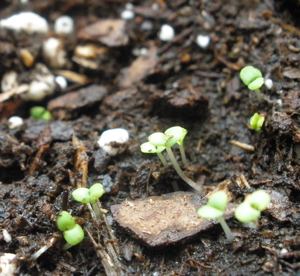
Seedlings June 18, 2010, planted June 15, 2010
This morning I noticed my herb garden is beginning to germinate. I was so delighted by the discovery. Transplanting plants provides immediate gratification, but planting seeds is much more rewarding. My little concrete garden is growing well and developing. Each day I pray I don’t kill my potted plants and houseplants, hoping I won’t drown them or let them dry out. Each morning I wake up pleasantly surprised that my flowers continue to bloom and my plants are taking root. As I care for the seedlings, I have much more time to reflect on the process of growth and development. Its hard to imagine my husband at 6’5″ starting out as a single fertilized cell. But each one of us came from such humble origins and those seeds are reminders. It’s really a miracle how I got here, that I’m still standing here. I am grateful for the little signs of Allah’s creations.
As I plan the curriculum for summer camp, we’re thinking about a science class featuring gardening, nature walks, and visits to the museums. Children often enjoy watching their classroom gardens grow. Children as seeds is an obvious metaphor. Everything we do in life requires cultivation and care. Finding our strength requires patience and diligence. I have my seeds and transplants for the fall. I look forward to the fall harvest and what I’ll learn about life between now and then.
Can We Rally for the Girl who Got Punched in the Face?
Activists are outraged by a Seattle Police officer punching a 17 year old girl in the face. If you haven’t seen the this, here it is:
Yes, it is was a brutal punch. You could see her neck snap back from the impact. I’m totally against men hitting women. But was there some basis for his actions? The video clip doesn’t tell the whole story. It is much more complicated. Please watch the full video and keep in mind what is our legal obligation as citizens when facing the force of the state, the police.
I’m going to lose some friends now. But let me preface this with my own perspective on police brutality. It’s a sensitive subject in my family because my uncle was shot and killed by police. My brother would get pulled over and hauled off to jail for nothing less than playing music loud in his car or having tinted windows. He’s been roughed up a few times also. My husband has been held at gunpoint, because he’s fit the description. Most black people have the %$#@ the police attitude. While this attitude may come from some negative interactions, it also comes from some dubious behavior. How many brothas and sistas have a bag a weed on them (if not worse), drive without insurance, or have some equipment of some questionable legal status in their ride or house? While there are many law abiding Black folks, if you’re doing something illegal you’re going to not be good friends with the police. Unfortunately, many Black people are treated as suspects due to racial profiling. So the over-all combination of mutual suspicion and animosity is bad.
I’m 100% against racial profiling. I think that police should be held accountable for their actions, especially in cases like Oscar Grant. But I don’t have the $&#@ the police attitude. I’ve been home during a home invasion and the suspect attacked the police officer who came in response. My mom’s friend came to the officer’s aid when the suspect attacked the police officer. The cop pressed the panic button and it ultimately took 5 cops to subdue the suspect. Turns out the suspect was high on PCP or something like that. I’ve known someone who attempted to harm themselves with a razor blade, and the cops pulled out their guns and subdued the person, pressing their face into the searing hot concrete. This person was out of their mind, and there was no way the police were going to endanger themselves for someone in a psychotic spell. I’ve seen people arrested numerous times, but I’ve never seen anybody try to get away from the police or insult the police. That’s called resisting arrest. I’ve never seen anybody put their hands on the police to help a friend get away. That’s called assaulting a police officer.
Who tries to get away from a cop who’s going to give you a jay walking ticket? Why would your friend not take something like this seriously, but instead try to rush the police officer? Is this a street fight?
Should this incident be investigated? Yes. But should we rally around this incident to fight police brutality? Al Sharpton may jump on it. But we will do Black people a big disservice if we start marching for ignorant teenagers who don’t know that if you fight a police officer, you may get punched in the face or something much worse.
I was going to write a long article, but David Spates says it all (with some funny twists on expletives) in his Vlog.
Finding My Truth in Fiction

By the time I reached graduate school in 2004, my love of reading was not only dead, but putrified. The weight of five to ten books a week provides enough pressure to kill that joy. But to think of it, the joy of reading fiction died a slow and painful death from 1993 to 2003 during my long years trying to finish my undergraduate degree. From 1998 to 2001, I was too preoccupied with getting out of my rut as a college drop out to think about imagining the past, present, future, or alternative worlds through someone else’s eyes. As a waitress I worked double shifts and I was lucky if I had two days a week off. As a temp and admin assistant in various companies in Silicon Valley, I was often studying non-fiction books, even some motivational and popular psychology books. As a telephone operator and retail sales associate in a computer store, I was just too saturated with techno mumbo jumbo to pick up a good piece of literature. When started school in 2001, I spent most of my time playing catch up with the privileged kids at Santa Clara. I couldn’t relax and enjoy something like a book because that was too indulgent. There were no lazy Sundays reading, just crazy weekends trying to start a project far in advance or figure out how to get to graduate school. I did read novels while in school, but those were for required reading for courses. Usually I had just a night to read them. There was never time to enjoy them when I had to plow through so much material.
Since I’ve been free from indentured servitude, I have had a chance to read for my own personal enrichment. I’ve even enjoyed reading and re-reading books I’ve assigned my students in 10th, 11th, and 12th grade literature. To balance life out, I started new hobbies and revisited old ones–such as reading. Now that I have a few week off before another summer camp, I have a few weeks to indulge. Then we have about a month break till school starts again. But it will be Ramadan and I am going to focus on Quran, seerah, and Islamic texts. Now I can take a bit of a break, close my lap top, leave Hulu or netflix to turn pages.
I began reading again last year, it was an awkward slow start with Chung Kuo. Too bad all the novel’s females were merely receptacles for sperm. I couldn’t get past the first few chapters. I read Paul of Dune, but was really irked by the trend in science fiction writers to basically annihilate all people of color. In Chung Kuo, Chinese ruled the world, and of course, a white protagonist seemed bent on bringing it down. Why should I be interested in their white washed futuristic universe where I can’t possibly exist? Of if I did, I was part of what Tolkien describes as the swarthy masses. My husband reminds me that sci-fi and fantasy books, are just that–fantasy. And many white authors’ fantasies seem to be a world where there are no brown people. Likewise, the vampire books remind us that to be tragic and sexy, you have to be really really really pale. My husband took a writing course, where his classmate described a young white woman’s breasts being dragged in the forest as white and pure like bleating sheep or some nonsense like that. My husband pointed out that if the young author ascribed a value of innocence and purity to her whiteness. He asked him how would he describe a young woman’s purity if she had been a woman of color. This is in 2010, and I’ve already had my fill of classic literature in which the beauty of a woman rests on the absolute lack of melanin in her “pure” and “fair” skin. While I have steered away from Fantasy and Sci-fi, as an English teacher I can’t steer away from the English canon. That is why I’m trying to balance out the so-called classics with authors who I share some mutual history, religious, and commonality. Maybe even some of the authors affirm who I am, reflecting some of my truths as opposed to obliterating my humanity. That’s why I’m leaning more towards African American writers like Octavia Butler and writers from Muslim societies like Orhan Pamuk.
Currently Reading
- Their Eyes are Watching God
- The Road to Mecca
Books I’ve enjoyed reading with my students this past year
- Othello
- Anthem
- The Crucible
- Beloved
- Fahrenheit 451
- The Count of Monte Cristo
- The Bread Givers
- Taming of the Shrew
- MacBeth
- MidSummer Night’s Dream
- Things Fall Apart
- Hamlet
Books I’ve recently read on my own
- The Translator
- The Yaqoubian Building
- Paul of Dune
- The Kite Runner
- Dracula
- Cold Mountain
- The Road
- Angela’s Ashes
Summer Hit Reading List by Muslim Authors
- Bensalem Himmich. The Polymath
- G. Willow Wilson. Butterfly Mosque
- Ilyasah Shabazz. Growing Up X
- Radwa Ashour. Granada
- Alaa Al Aswani. Chicago
- Amin Alouf. Samarkand
- Orhan Pamuk. The Black Book
- Orhan Pamuk. My Name is Red
- Leila Aboulela. Minaret
I look forward to reading more fiction by Muslim writers. Note that I call it Muslim fiction, rather than Islamic. There is a growing area of Islamic literature, where the purpose is to edify religious values. But Muslim fiction, may or may not do so. Often there is a cynicism and challenge to authority (especially religious authority), as opposed to the ideals of Islamic fiction. I find both forms of fiction extremely valuable and they speak truth to the experiences of the authors. I recognize however that there is a gap in the literature. Surveying the list of American Muslim fiction, I realize that there is a dearth of material written about the experience of Black American Muslims. A lifetime ago, I was a creative writing major in community college. I wanted to tell stories that weren’t told. So I wrote stories about two graduate students in different countries uncovering a multi-generational family history in Andalusia and Morocco. I wrote about an intercultural friendship between two women that opens the door for one of the women to begin a courtship with the other’s brother. I wrote about an unrequited love. I wrote about women who were beautiful in hijab. I wrote…I wrote…. and I wrote. One day I gave up writing, because I didn’t think I’d ever make it to the places I imagined. Looking back after so many years have passed, I realize that have been to so many of those places. And the places I want to go are within reach. Perhaps I should remind myself of the parable of the sower. Some of my students are talented writers. I hope to encourage the future generation of writers, as well as inspire myself to begin weaving my own complex tapestries of thought. Maybe together, we can spin tales that reflect our world view, build on our experiences, and speak to our hopes. Maybe we can find truth in our fiction, participating in a cultural production that says “We are here and we’ve done something beautiful.” We just have to sow those seeds so that one day they can bear fruit.
Imitation of Life
If only to crystalize it,
Shattering that mustard seed
with so many promises
That leave only a bitter taste.
Dissolved in a sea of hostility
The buoyancy of being invisible
While searching for meaning
In the irrelevance of one who relinquished
This imitation of life.
Inspired by:
Rima Fakih and the Issue of Muslim Heritage
It’s taken me a while to make a statement on the issue. Out of the many reasons why, the one that stands out the most is that American Muslims tend to condemn non-practicing Muslims. Although the numbers of practicing Muslims is lower than we’d like to admit, many American Muslims are not willing to admit that a woman without hijab also has a place in our community. And often, they can represent our community in different ways, then say a practicing Muslim woman who wears full hijab and doesn’t mix with men.
 From Mis-Represented to Miss USA: Muslims Applaud Rima Fakih, 2010 Pageant Winner
Muslims in America woke up to some happy news today – the new Miss USA is Muslim! Rima Fakih of Dearborn, Michigan, is a Lebanese immigrant whose family celebrates both Muslim and Christian faiths, according to the Associated Press. Last night, she made history by winning the Miss USA 2010 crown.
“What a breath of fresh air for the Arab American community, to have Rima Fakih named Miss USA 2010,” said Linda Sarsour, Director of the Arab American Association of New York, to elan. “This is only a testament that Arab and Muslim American women too are strong, intelligent, beautiful and competitive.”
“This is historic,” said Imad Hamad, regional director of the American-Arab Anti-Discrimination Committee to the Detroit Free Press. “This shows the greatness of America, how everyone can have a chance to make it.”
So many people were obsessed about Rima as a new Muslim celebrity who could open up discussions about Islam. But I wonder why the Arab community never backed some prominent women in the media who also have Muslim heritage. I have some important questions: What if Rima Fikah came from an African American Muslim family in some place like Philly? Would the American public, let alone the Muslim community, have been so forgiving about the pole dance? Would altMuslimah and Muslimah Media watch feature articles saying that her victory was a sign that Muslims were part of America too or that she could open up discussions about Islam? Could these women of African descent and Muslim heritage create a chance for discussion about Islam and American Muslim’s place in this society?

Do we buy Eve’s albums and celebrate her as the first lady of Muslims in Hip Hop? Did we watch her show or bring her up in discussions with friends to show them that Muslims are just like everybody else?

Did we watch and support Fatima Siad who made it to 3rd place in cycle 10 of America’s Next Top Model? She was born in Mogadishu, Somalia. Did this start off discussions about the diversity of the immigrant Muslim community?

Or what about an even more famous Somali American? Do we consider her status as super model as a sign that Americans accept Muslims?

Do we Love that Girl! Who has Afro-Panamanian and Indo-Trinidadians descent? Does her family history spark an interest in the Indian diaspora and the role of Islam in the Caribbean, in addition to Caribbean Americans?
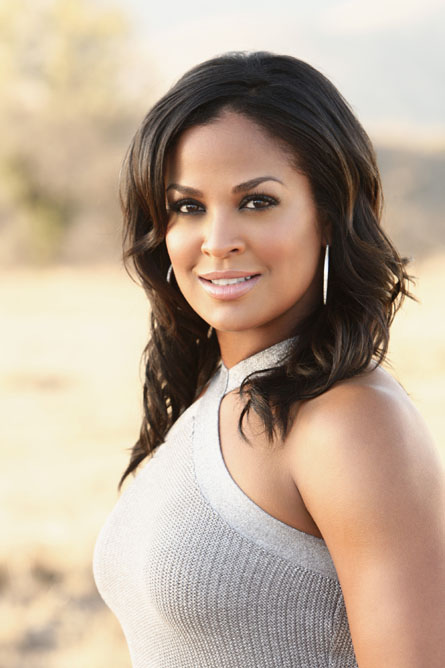
Do we watch and support Laila Ali, in her professional Boxing matches? Better yet, did we vote for her on Dancing with the Stars? She the daughter of one of the most iconic figures of African American Muslims, Muhammad Ali. But yet, do we see her strides in sports as reflecting a type of Muslim feminism?
I had two problems with the discourse on Rima Fakih and Miss USA: first, my Arab peers who expected me to celebrate this as a Muslim victory that demonstrates we Muslims are part of America too; and second, the Muslims who expected me to be angry because a Muslimah should not parade around in a bikini. Both stances assumes one thing, that being born into a Muslim family means that you are Muslim. And it also sends a stronger message, that all Arab issues are synonymous with Muslim issues. Often we are too broad in accepting every thing that people with Muslim heritage do as reflecting Islam in general. This is especially the case when it comes to Arab, Pakistani, or Indian Muslims. The women featured above are not seen as reflective of the state of Islam in America.
Wellness, Reconnecting with the Natural World, and Spiritual Rejuvenation
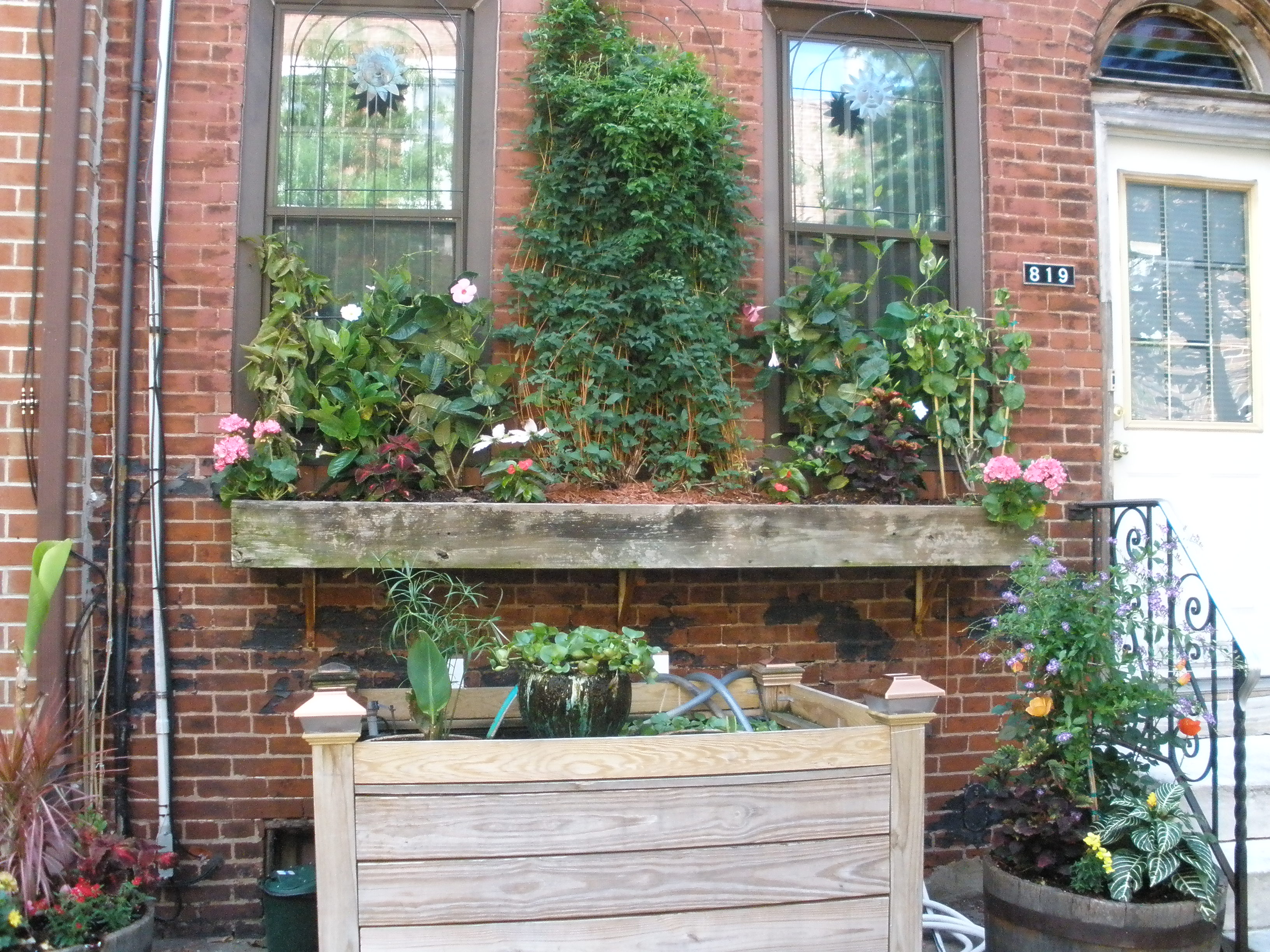
A street side garden near the Italian Market in Philadelphia
A physical and spiritual health crisis is brewing within the Black American community. Even Black American Muslims feel the effects of the urban condition and poverty, as well as materialism and a culture geared towards immediate gratification. What better way to feel gratified than eating? Even with our dietary restrictions and moral strictures, hypertension, diabetes, heart disease, and obesity are disproportionately taking younger and younger lives. Much of it comes from what we consume and how much we consume, in this culture of consumerism. In recent discussions at home, my husband and I have been discussing our relationship with the natural world, our relationship with food, and well-being food. He’s given a recent Khutbah on the Importance of Food and What Lies Beyond it. In it, he makes it clear that our relationship with food has spiritual dimensions. By eating healthy and incorporating daily activities, such as maintaining even a small garden or planting a tree, we can reconnect with ourselves and our natural world.
Muslim organizations are beginning to embrace this concept. At the school where I teach, the principal required all upper school students to write an essay on “Going Green” for a scholarship contest held by a Muslim organization. I read all of my students’ papers and so many of them were inspiring. I became even more conscious of the everyday decisions I make that affect the environment and my health. The winning paper, written by a young man in the 10th grade, was an excellent essay on eating locally grown organic non-processed food. He made a striking case for how eating locally grown food is more beneficial for the environment than processed food. Processed food is grown with chemicals that seep into our water system, in addition to being packaged and shipped, requiring petroleum for the plastics that wrap it and fuel to move it. Our industrial food complex is reeking havoc on the environment, just as it is ruining the health of so many Americans. I’ve known several people my age who have suffered from Diabetes and Hypertension. And the dietary changes they have to make include reducing red meat and eating low-fat foods and fresh vegetables.
You would think that obesity and diet related diseases would be the bastion of wealthy people who could afford to splurge on rich food. But it is not. The wealthy can afford healthy food much in the same way they can book vacations, go on retreats or hikes to rejuvenate both physically and spiritually. One of the first places we see inequality is in food access. Affluent neighborhoods have a plethora of food choices and with healthy restaurants. In gentrified neighborhoods you will always find a Wholefoods, Trader Joe’s, and your weekend Farmers Markets. In poorer neighborhoods, you will find sub-par produce, and often a lack of grocery stores. Farmers markets and the Mennonites don’t really make it deep into places like North Philly. Instead, you will find bodegas or corner stores full of highly processed junk food. But healthy eating, urban gardens, organic produce, and wholesome living are not just for tree hugging hippies or urban hipsters.
While privileged members of our society have greater access, there are religious leaders and social justice activists who are fighting for urban renewal and healthy food access. The tradition of diet and health has long roots in religious revival movements. My mother grew up Seventh Day Adventist,. She recalls going to camps where they adhered to vegetarianism and kosher dietary laws. The Nation of Islam also emphasized healthy eating and moderations. I remember picking up a copy of the NOI publication, How to Eat to Live. Black American Orthodox Muslims also have a long tradition in diet, health, and wellness. In the 20th century, such as the Izzidine village, emphasized self sustainable rural communities based on agriculture. Many of those who moved back to the urban environment continued to develop urban gardens that fed the local community. Muslim leaders continue to emphasize health and wellness as duties because “our bodies have rights over us.” They encourage eating halal food, as well as eating in moderation for our spiritual well being. Tied to taking care of our bodies because it has rights over us is our role as vicegerent of this Earth.
But sometimes in urban environments, it is hard to remember our vicegerency because we can’t see our link with nature and our food chain. However, some people are looking to rejuvenate the city with flower and vegetable gardens. I’ve passed by gardening clubs where members grow fruits and vegetables on their small high yield plots. Some gardens are so productive that they help stock pantries of soup kitchens. And many city dwellers are turning their backyards into produce centers. In fact, Urban gardening is about as hip walking spastic toy dogs. Not far from where we live is a communal garden full of hipsters who bring their own spades and shovels to reconnect with nature on weekends.
Even I’ve begun gardening in our small patio backyard. I didn’t start in order to jump on the bandwagon. But rather to reconnect with the natural world, which seems light years away from South Philly. I also wanted to connect with my heritage, my mother’s rural roots in New Jersey. It wasn’t until the great migration that thousands of Black Americans migrated from the rural south to Northern cities. And my grandmother’s roots in Georgia. My grandmother maintained a vegetable garden, as well as my mother.
While I haven’t started a vegetable garden yet, for over a year I talked about getting a house plant so that we’d have something green in our apartment. Every time my husband brought home flowers, I’d brighten up. Now he smiles when he finds me in the backyard toiling away. I’ve nursed some marigolds without potting them for over two weeks. With the three-day weekend, I had an opportunity to take my garden to the next level. So I dragged my husband, who’s always supportive of whatever endeavor I take on, through the Italian market, to Walmart, and the Urban Jungle store in search of the supplies I needed to create our own little back yard paradise.
I woke up this morning to see if I killed any of those little plants. And with a sigh of relief I saw them bright and cherry. But later in the afternoon, I had to rescue my wilting Salvias from the prostrating heat. I really understood our relationship with nature as I saw the leaves begin to stretch out with life again and the stems stand up straight with pride just a half hour after my efforts at watering and adding more soil to my pots. I felt a bit of wonder as I saw a butterfly float into my backyard and dance around from flower to flower. Perhaps it may not have found its way to my patio had it not seen the flowers. Perhaps I could draw more butterflies. Better yet, I’m thinking I could hang a bird feeder as a next step.
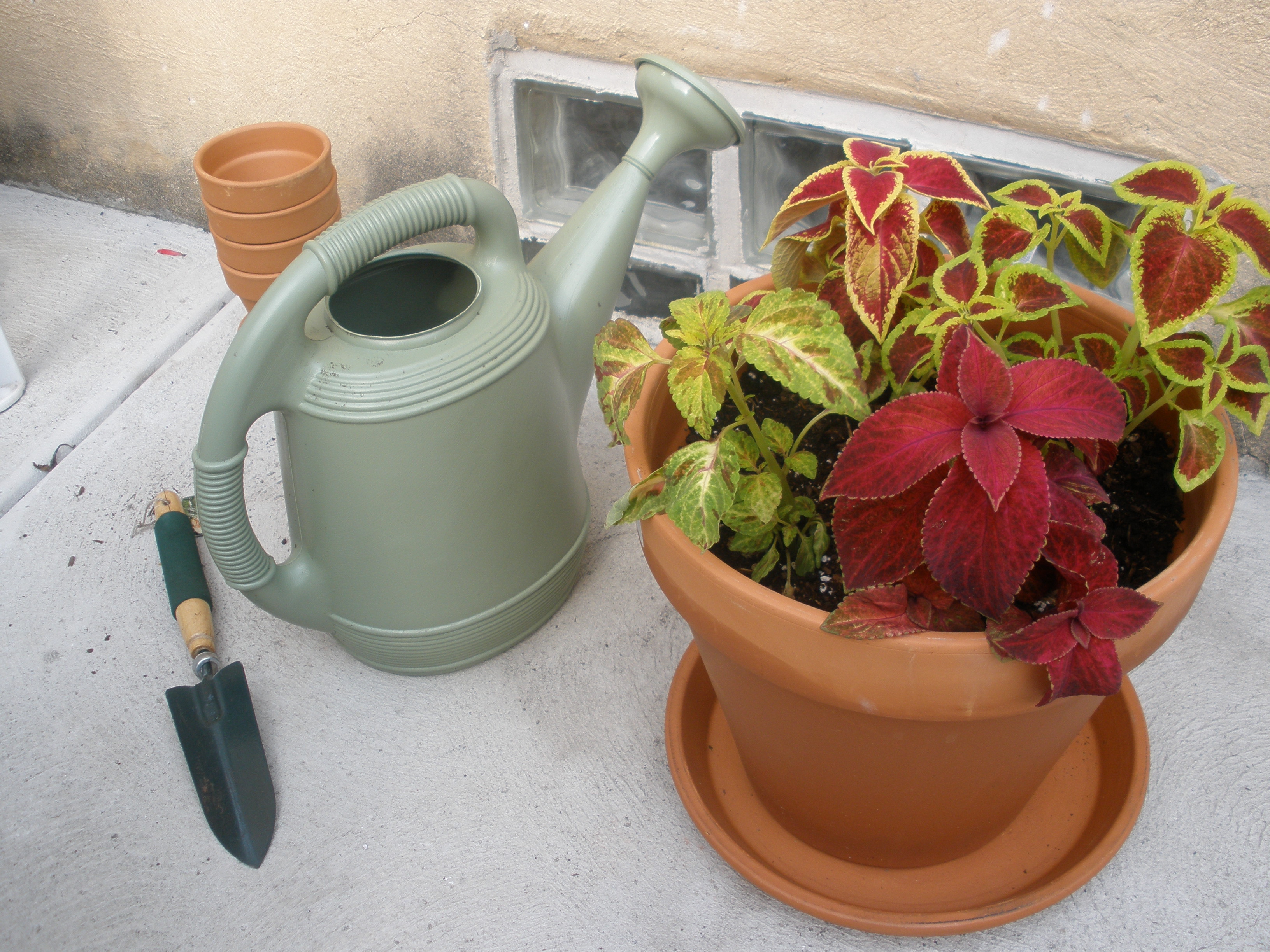
Recently I looked up the vegetables that are ideal to begin planting in June. I’m going to get my seeds and start. Perhaps this Fall, we can enjoy our first harvest. It’s a small step. But it goes a long way in helping me appreciate the difficult journey our food makes to our mouth. Our lifestyle has led to us being alienated from ourselves and disconnected with our natural world. Thus, we abuse our bodies with unhealthy food, our bodies atrophy from inactivity, and we are blocked from seeing the many beautiful signs of Allah through his creation. Having something alive and growing around us reminds us of Allah’s wonders, even if we can’t hike at Yosemite every weekend. Perhaps with my little garden I can be more mindful of Allah’s mercy and my “bismillah” before each meal will be said with more meaning and sincerity.

UMM Qur’an Summer Camp 2010

One thing Philly does well is summer camp for Muslim kids. I know several people who are involved with organizing camps and children’s classes. I’m really excited to be involved with this one. I have so much to learn from the other teachers and I look forward to working with the youth camp counselors. I will keep you posted.
 Margari Aziza