
Please take a moment to fill out my survey for a piece I want to write on perceptions of women’s leadership in the mosque.
Category Archives: Uncategorized
Self Inventory- al-Muhasabah
 I sat on a conference panel a few months back where we talked about the current state and future of the American Muslim community. As one of the speakers offered commentary focusing on institutions, my mind sparked. There was so much focus on institutions, but yet people weren’t instituting Islam. People were focused on edifices, but there was little edifying Islam in our daily lives. When my time came to speak, I focused on character building. Our communities seem to lack not only ethos, but ethics. There is too much dissension within our leadership, and many of them are not trained in basic leadership skills. Everybody wants to be a leader, but few people want to be good followers. And people within the community don’t know how to work well with others to support our mutual goals. This includes within our families, because our interpersonal skills are so lacking that we are destructive. Combined, the instability of our families and constant political fighting, have created an environment where Muslims are not getting the guidance and resources they need to be successful. Many Muslim leaders have good intentions and I have seen some great strides in institutional building, but at the same time I see recurrent problems that are not adequately addressed.
As Muslims, we are taught to focus on two aspects of our devotional lives: 1. the laundry list approach to developing practices and habits or 2. increasing our intellectual knowledge through both exoteric and esoteric books, lectures, and articles. We assume that using both approaches we can better ourselves. Often, we are puzzled by why things go wrong. How can we, as outwardly devout people, end up falling so short of our lofty goals? The truth is that we are missing pieces of the puzzle. There is a strong disconnect between our own spiritual aspirations and how we move about in the world for many of us. And that is what jams up so many of us. Imam Ghazali writes:
O disciple, how many nights have you spent rehearsing your learning, reading books, and depriving yourself of sleep? I do not know what the motive was in this–if it was winning the goods of the world, the allure of its vanities, getting its honours, and vainglory to the debit of your associates and peers, woe to you and woe again! But if your objective in it was the revival of the Prophet’s Law (God bless him and give him peace), the cultivation of our character and breaking the ‘soul that inciteth to evil,’ blessing upon you and blessing again!” (14) [1]
Because many of us are not self-aware, but reactionary, we don’t truly cultivate our character or battle our inner demons. Instead, we look to others for our affirmation, hence the cycle of expectations, entitlement, and ego. Many of us do not reflect at the end of the day, thinking about why something made us angry or sad. Nor do we question why we do things that are hurtful to either ourselves or someone around us. Rarely do we look at our motivations for certain actions, therefore we hardly ever check our intentions. And that is a dangerous thing because actions are but by intention. This is why we need to constantly assess ourselves.
Ramadan is a perfect time for assessing our relationship with our Creator. In order to be truly honest with ourselves, we have to lift certain veils that block us from being able to look in the mirror. Unfortunately, many of us are busy blaming others, remaining trapped in resentment, or feeling entitled, which causes us not to take an unflinching look at ourselves. One of the first steps entails forgiving others, or at least not letting the pain rule us, and taking ownership for how we have wronged ourselves, others, and our Creator. We need to be able to honestly assess our strengths and weaknesses as individuals and develop real strategies that draw on our strengths for overcoming our personal blockages. And since that is difficult, and many of us don’t have mentors, guides, and sheikhs who really know us, we have to sort of muddle through. Despite our lack of resources, I think that it is possible to draw on an Islamic tradition of al-Muhasabah or self-inventory, modern psychology, and a bit of self-help to begin that process. I will use self-inventory and self-assessment interchangeably. First let us look at the definition of self-assessment
self-assessment n
1. an evaluation of one’s own abilities and failings
2. (Economics, Accounting & Finance / Banking & Finance) Finance a system to enable taxpayers to assess their own tax liabilities [3]
In an article, Al-Muhasabah on being honest with oneself, the author states:
Self-criticism seems like a fairly straightforward concept. The activity that makes it possible, however-namely, honesty with oneself-is exceedingly hard to come by, for it requires admission of our wrongdoings whenever such actions escape us. It means acknowledgement within ourselves that we have committed a sin, whether against our own souls or others, be it our Creator or anyone or anything in creation. For most of us, such a confession is an incredibly tough thing to do. [2]
I think this is really helpful, but only focusing on our wrongs can be demoralizing. I have used self-assessments in the classroom and often they focus on finding strengths. In fact, there are many kinds of self assessments and personal inventories. The most common ones we will find are career and personal interest inventories and the second most common are those we find in motivation literature. There are two aspects of self-inventory, taking an assessment of our character flaws and acknowledging our wrongs and mistakes. A few readers might be familiar with the rigorous self inventory process of programs like Alcoholics Anonymous [4]. I do suggest looking at the moral inventory list because it is a useful tool. Only through acknowledgement of our wrongs, can we perform true tauba (repentance) and make changes. But, in many ways our sins are merely symptoms of an illness. And since most of us don’t have a guide, we have to do some serious self diagnosis. This is where we can use tools to do a real self inventory. The most powerful tool a believer has in the path to Ihsan (Perfecting Faith) is self inventory. It is important to remember a few principles when it comes to self inventory:
1. Honesty- we must be fully honest and not delude ourselves when we are taking self inventory. We cannot make excuses for our actions or try to sugar coat things.
2. Faith- while acknowledging our flaws, we should have faith that our Lord will forgive our sins and shortcomings. .
3. Hope- We have to accept that we are human and these shortcomings are part of our nature, yet we can overcome them with help from God
One of the reasons why a personal inventory is important, even if you have a spiritual guide, is that only the individual has access to his or her own heart, memories, and thoughts. Confession is not part of Islam, as each person is accountable for his or her actions and no one else can expiate sins. In addition, exposing one’s sins can cause greater harm than good. Finally, the self reckoning is a personal journey and it is dangerous for our souls to take pride in the steps we are making towards improvement. Many people put on an act for others, especially if we admire them and want to impress them. Would I want to tell someone I admire that deep inside I am a fickle person, easily flattered and easily hurt by criticism? Imam Ghazali writes, “travel on this path should be by way of self-exertion, severing the ego’s appetite and killings its passions with the sword of discipline, and not by way of and useless statements” (24) [1]While someone can observe from the outside and see certain character defects and strengths, they are unlikely to know the full contours. The guide can be just that, a guide on our journey. Each individual must exert themselves, with determination, to walk that path.
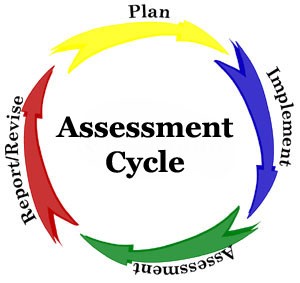
I believe that our development will become apparent to those around us, especially those we love. It will improve the quality of our lives, help us adjust to challenges, and allow us to come closer to our Creator. I do think it is worth it to look for means to honestly assess ourselves, come up with strategies to deal with our weaknesses, implement them, and assess our progress constantly. If we do that in a continual cycle, with honesty, faith, and hope, we can be more successful in both this life and the hereafter.
But don’t just take my word for it, I included a really nice video that deals with this subject below:
Resources:
[1] Al-Ghazali Letter to a Disciple. Islamic TExts Society, Cambridge UK, 2005
[2] http://www.aljumuah.com/straight-talk/40-al-muhasabah-on-being-honest-with-oneself
[3] Dictionary.com
[4] http://www.rc-rc.info/Content/MoralInventoryChecklist3p.pdf
How to Help Somalia
I’m not going to put up the requisite starving children picture on this blog. As a child of the 80s, I remember how the pictures of starving children in East Africa left a largely negative impact on the perception of Ethiopians and Somalis. Instead, I am just going to write something brief as a reminder of what we can do.
2011 has truly been a traumatic year, not that we forgot Haiti in 2010, but this is a devastating humanitarian crisis. I am especially disturbed by how the extremist group Al-Shabaab is not allowing a number of aid organizations in to help, dismissing claims that there is a famine. Famine or drought, people are dying and people need help. But there are organizations that are getting in there, such as Islamic Relief and the Red Crescent, trying to address some of the immediate needs. The Huffington Post also has a page up outlining some organizations to help Somalia. Many of us understand that much of the aid we give in the developing world only provide bandaid solutions. I pray that our society begins to invest in innovation, encouraging our most brilliant minds to tackle the social, political, economic, and environmental problems that have contributed to this crisis. But right now, we have festering wounds that must be treated immediately. Let us clean up these wounds and apply the bandages so we can save lives. I hope more of us become inspired to be committed long term solutions for the dealing with our greatest challenges. And for those of us whose life’s purpose takes us elsewhere, please don’t forget that we are one family and that we cannot affirm our own humanity if we turn our backs to the suffering of others.
Feeding America and Fidya for Ramadan

“Alms are for the poor and the needy; and those employed to administer (the funds); for those whose hearts have been (recently) reconciled (to truth); for those in bondage and in debt; in the cause of Allah; and for the wayfarer: (thus is it) ordained by Allah, and Allah is full of knowledge and wisdom.” (Al-Qur’an, 9: 60)
Whether they assume that state agencies will take care of America’s poor or the poor in America are not deserving of charity, giving to charitable organizations in America is often not the top of the list in many national Muslim organizations. Many Muslims think that in America, Land of the Plenty, that people are not starving. But according to Feeding America, there are over 50 million Americans who suffer from hunger, that is 1 in 6 adults and 1 in 4 children. Many people often blame those who have found themselves reduced to begging in the street or finding a cot in shelters for their condition. This is the land of opportunity, right? However, natural disasters like Hurricane Katrina and the recent wave of tornadoes, in addition to the tanking economy, have shown that people have been reduced to poverty through forces outside their control. Islamic Relief has some America-based programs, but I have only seen a few mosque sponsored soup kitchens and food pantries. This is a most unfortunate situation that serves to undermine us as a community and, I believe, our faith. This is especially important when we think about the chapter 107 of the Quran Ma’un (Alms or Small kindness):
Seest thou one who denies the Judgment (to come)?
Then such is the (man) who repulses the orphan (with harshness),
And encourages not the feeding of the indigent.
So woe to the worshippers
Who are neglectful of their prayers,
Those who (want but) to be seen (of men),
But refuse (to supply) (even) neighbourly needs.
Suhaib Webb has a powerful tafsir (explanation) of this chapter in “Explanation of Surah al-Ma’un,” showing how this small chapter is packed with so much meaning. It shows how our actions towards the poor is really a reflection of our state of faith. How can we truly believe in the Day of Recompense, when we face human wretchedness and do nothing to alleviate suffering? We do it all the time, as we are desensitized to it or fear that giving will decrease our wealth. And we hold on to our wallets and pocketbooks, forgetting that the money have is not really our own, but a loan from God. He gives sustainance, and if we have true faith we wouldn’t worry about giving Him back what He is due by offering charity.
Other well meaning Muslims ignore poverty in America because of, what I believe, are misplaced priorities. Many Muslims say that people overseas are suffering more, so they are more deserving. Yet, the order of giving charity is first to our families, neighbors, and then to needy. What good is our religion, if we are not able to affect those closest to us? And, importantly, what kind of message are we sending our American neighbors about our commitment to being contributing members of our community and good citizens? How are we handing someone da’wah pamphlets, yet refusing to give them a helping hand? Many Americans see our community as parasitic, enjoying the economic benefits of this society while working to undermine it. And sad to say, the anti-establishment rhetoric of some Muslims in America has served to support those perceptions. The us-versus-them rhetoric has also led many to turn their backs on suffering Americans. Or the insular ethnic communities with an emphasis to ties back home has also caused many of us to ignore the immediate needs of our neighbors, whether Muslim or non-Muslim. And so, we are seen by our neighbors building our masajid, but not making any positive impact on society. At best, we become tolerated, but not welcome neighbors, at worst we are seen as an existential threat to America. We have to take ownership of how neglectful we have been in providing a positive example.
Surah Ma’un reminds us that are neglectful of our prayers because we ignore feeding the poor, the orphans, and being kind to our neighbors in need. This is especially important during Ramadan. While our fast is for God alone, we have an increase in public acts of worship, with mosques filling up to capacity. There are more opportunities for showing off because of the supererogatory taraweh prayers each night. While I am in 100% support of those who spend time in the mosque and believe this is a great opportunity rejuvenate our faith, we have to make sure we are not just doing things for show. And how does this Surah Ma’un show the correlation? By doing kind acts we can avoid falling into the category of hypocrites or those who deny the Day of Recompense.
Further, our charity as Muslims should increase and it should be to alleviate suffering, not just to feed ourselves. While paying for an iftar is a commendable thing, as we get reward for feeding a fasting person, we should not limit our charity to that. We should take care of the orphans, feed the needy, and do kind acts for those around us. In essence, we should have some social impact. The Muslim footprint should especially be felt during Ramadan in this society. There is so much evidence that shows that Ramadan is not just about fasting.
Evidence for this can be seen in what serves as expiation for those who are unable to fast. For those who are unable to fast, those who have a chronic disease or are elderly, it is important to pay the compensation, fidya, for missed days. The Hidaya Foundation writes on their page:
- The price of Fidya for each day of missed fasts is either to feed a poor person two meals in a day, or to give whole wheat, which is enough to feed a poor person twice in a day (1/2 Saa per Hanafi school of thought, or 1 Saa per Shaafi and other schools of thought). (1 Sa = 3 Kilograms approx.)
-
The Fidya price for one who has to pay it should be calculated based on the local prices of whole wheat in the place the person resides.
- The price for Fidya in the USA is $3.50 by the Hanafi school of thought, and $7.00 according to the Shaafi and other schools of thought.
Scholars have disagreed on whether or not fidya applies for someone who either broke a fast for a certain period or missed a day because of menses, pregnancy, nursing, or 40 days after childbirth, but does not fall into the category of the elderly or individual has a chronic disease and therefore can no longer fast. Faraz Rabbani explains in Who can pay my fidya +make up fasts, “In the Hanafi school, there is no fidya for delayed making up of missed fasts. Rather, one simply makes up the missed fasts themselves–and it is recommended to hasten to do so. [ Shurunbulali, Maraqi al-Falah; Ibn Abidin, Radd al-Muhtar.” Other schools take a different opinion, saying that for those who can one day make up a fast, should still pay the fidya for each day they missed. Shaykh Hamza Karamali answers in Payment (fidya) for not making up days from last Ramadan:
According to the Shafi`i school, if one does not fast some days during Ramadan, it is obligatory to make up these missed fasts before the next Ramadan arrives, regardless of whether these fasts were missed with a valid excuse (e.g. menstruation, travel, sickness, etc.) or without a valid excuse. If one does not make them up before the next Ramadan, one is sinful and must pay a “mudd” (a volumetric measure defined below) of food to someone poor (faqeer) or short of money (miskeen) in addition to making up the missed fasts (I`anatu’l-Talibin, 2.242;Tuhfat al-Muhtaj, 3.445-446).
…
A “mudd” is the amount one can hold in both hands when cupped together. It is estimated in the Reliance as 0.51 liters (Reliance, i1.33). The type of food one gives varies from place to place. One must pay whatever food is considered the main staple in the area where one lives. This could be wheat, barley, rice or something else (al-Minhaj al-Qawim + al-Hawashi al-Madaniyya, 2.194).…
Feeding (it`am) a poor person, as Imam Bajuri (Allah have mercy on him) explains in the section on expiating (kaffara) for fast days that one has invalidated, means giving him ownership (tamleek) of the food. It is not sufficient to cook the food and then invite him to one’s house for lunch or dinner (Hashiyat al-Bajuri, 1.319). Rather, the poor person must be given possession of the food (e.g. a bag of wheat) and then he can do what he wants with it (e.g. eat it, sell it, give it away to someone else, give it back to you and ask you to cook it for him, etc.). As such, it would not be sufficient to invite the people to a feast. One would have to give them the actual staple food.
A number of women I talked to, to be on the safe side are giving the fidya for the days that they cannot fast with the intention of one day making up the days. However one mistake many of us often make is by sponsoring an iftar or inviting a friend over for dinner with the idea that we are fulfilling the fidya. Regardless of the price, it is clear that the qualification for who gets the fidya should be someone who is qualified to be a recipient of zakat. The poor and the needy are people who cannot pay zakat themselves because they don’t have enough money. And I think these technicalities are important to remember as we are nearing the Blessed month of Ramadan. Are we feeding the poor, helping organizations that distribute money to the poor, helping new converts (for that is what it means of “those reconciled [to truth]),” helping those crippled by debt, giving to God’s cause, or taking care of the travelers? For those of us who need expiation for missed fasts or whether we want to simply increase our charity, our kindness should not just be based on geo-politics or ethnic ties. This Ramadan, we should move our focus away from lavish feasts at iftars and work towards alleviating suffering and hunger locally and globally.
**Update **
Islamic Relief USA inaugurated a summer food service program to feed working class children in Maryland healthy meals. You can read more about it here. Good job Islamic Relief! We need more of this.
A Virtuous Life

Why is it that every khutbah, every lecture, and every conference plays out more like a pep rally where we are mere spectators and fans, instead of the players who should be training and practicing for the big game? And we keep wondering why our team is losing. That’s because none of us are in shape, we can’t decode the playbook, worse, we don’t know how to land that shot. Okay, I’ll stop the sports metaphor because I was never good at team sports. The whole point is that our community life is not necessarily helping us truly transform, improving our conduct and living good, wholesome, and happy lives. What constitutes happiness and a good life is an ancient question and people have come up with different answers. But the most consistent in their views have been philosophers and religious thinkers. Even during the ancient period, both have agreed that living a good life entails living a life of virtue. A virtuous life is not just about the ability to follow a rule book or perform rhetorical dexterity to find legal loopholes to justify our means to that end. The dominant approach that Muslims have taken towards virtue is the rule book or laundry list approach. However, this approach is often self-defeating, making us focus on the virtue without exploring what’s wrong with us. This is the same approach that Muslims take to the sunnah, where we focus on traditions and practices that appeal to us, hoping to be cured of certain ills. Often, we are treating mere symptoms, rather than curing the disease. It is time we begin a holistic approach to bettering ourselves, treating both the symptoms and eradicating the diseases that are destroying the quality of our own lives and our community life overall. Moral and personal development should be the focus of living a virtuous life or good life. Living a good life is based on universal principles that we find in Islam, as well as many other faiths. There are many tools to achieve that end, many found in Islam, but also wisdom that we can draw from ancient sages, philosophers, and even insights from our own society. We should not ignore any tool that can help us with personal mastery.
While many Muslims are concerned with righteousness, we seem to be confused about what does that truly mean. And this is why we should begin to think about virtue and ethics to understand the big picture or (كلٌيات). Before we begin throwing around the term virtue and ethics, let’s first look at what do these terms mean:
vir·tue [vur-choo] –noun
1. moral excellence; goodness; righteousness.
2. conformity of one’s life and conduct to moral and ethical principles; uprightness; rectitude.
3. chastity; virginity: to lose one’s virtue.eth·ics [eth-iks] –plural noun
1.( used with a singular or plural verb ) a system of moral principles: the ethics of a culture.
2.the rules of conduct recognized in respect to a particular class of human actions or a particular group, culture, etc.: medical ethics; Christian ethics.
3.moral principles, as of an individual: His ethics forbade betrayal of a confide

As I stated earlier, religious thinkers and philosophers have mulled over virtue and ethics for thousands of years. Socrates dedicated the latter part of his life to the investigation the development of moral character. Plato recounts a dialogue that Socrates had with Meno about the nature of virtue. Meno asks Socrates whether virtue can be taught, whether it is something that someone can practice, or whether it is something that someone is born with. Socrates believed that there was a link between virtue and knowledge. Only, he believed that people aren’t taught things, they simply remember what their soul had forgotten. If this gets confusing, just remember that Socrates believed that the soul was immortal and that people were born over and over again. Therefore, they just had to remember what they knew before. But, let’s ignore this part of his philosophy and focus on his idea that in order for someone to be virtuous, that person has to have sufficient knowledge. Two arguments that back this up are as follows:
- All rational desires are focused on what is good; therefore if one knows what is good, he or she not act contrary.
- If one has non-rational desires, but knowledge is sufficient to overcome them, so if one is knowledgeable of goodness, he will not act irrationally. [7]
Socrates believes that no rational person would act in a way that was harmful to his/herself. Maybe people are mistaken in their knowledge? I guess Socrates didn’t account for atrocities like the Holocaust or Rwandan genocide. Harming someone else destroys our own humanity. So moving on to the next group of Hellenistic thinkers. The Stoics were sort of the inheritors of Socratic views on rational thought and virtue. They believed that human beings by nature were rational animals, and therefore it was natural to live “the life acording to reason.” Virtue was excellence and according to the divine law of the cosmos. John Stobaeus the following as stoic goals in life:
- Zeno: living in agreement
- Cleanthes: living in agreement with nature
- Chrysippus: to live according to the experience of the things that happen by nature
- Diogenes: to be reasonable in the selection and rejection of natural things
- Archedemus: to live completing all the appropriate acts
- Antipater: to live invariably selecting natural things and rejecting unnatural things
Stobeaus goes on to define the four main virtues of the stoics:
Prudence: (concerns appropriate acts) knowledge of what one is to do and not to do and what is neither
Temperance: (concerning human impulses) knowledge of what is to be chosen and avoided and what is neither
Justice: (concerning distributions) knowledge of the distribution of proper value to each person
Courage: (concerning standing firm) knowledge of what is terrible and what is not terrible and what is neither. [8]
These are all reasonable enough and can be found in many traditions, but who would like to live like a stoic, unaffected by passions or hardships? I suppose a lot of people, which is the appeal of Zen Buddhism for many people. Without going in uncharted waters (at least for me), let’s move on to the lineage of philosophy and ethics within Muslim traditions.

Socratic thought profoundly influenced medieval Muslim philosophers, the Muatazilites. But I won’t go into the controversies surrounding their philosophical school, especially in their argument that one can derive God’s laws without revelation. Instead, I bring them up to point out that in using their Greek influenced dialectical methods, scholars like Imam Ghazali were able to safeguard and in many ways revive Islam. The strength of Islamic institutions and thought was in applying universal Islamic principles to local institutions or cultural forms to produce something that was relevant in societies across the globe and over 1400 years. But since Imam Ghazali was so successful in shutting down the philosophers that very few Muslims have ventured back in the territory of exploring virtue through reason, and not just solely from revelation and hadith traditions. The unfortunate consequence is that we are back to the laundry list approach to dealing with virtue in Islam. We are a community concerned with ethics, but without an ethical system.
A few western scholars have approached Azhari scholars over the need to consider ethical systems. Some of the traditional scholars were amenable to this idea, but perhaps we all lack the training in performing the task. That doesn’t mean that we can develop the requisite skills, especially with some effort. I think this would be a fruitful direction to go in because over the past few years, I have often wondered how is that many religious people can do things that are harmful to themselves and others, but still consider themselves moral and receive no censure by the religious community. In many conversations with friends, peers, and loved ones, the answer came to the lack of a consistent ethical system. The basic assumption is that if something is allowed in Islam that it is the right thing to do at any given point in time. People often overlook the question of whether something was right in one given circumstance could be wrong in another, and what guiding principles should we draw upon to determine a proper course of action. The salad bar approach to the religion undermines holistic development and moral consistency. Further, many adherents have used Islam to justify their own shortcomings, in effect deluding themselves with self righteousness. This is how we have people hiding behind, beneath, and under the guise of religion.
Recalling Socrates, I do think that even though many Muslims rejected the Greek influence in Muatazilite thought, they still seem to be influenced by his intellectualism. Tariq Ramadan writes:
Islamic literature is full of injunctions about the centrality of an education based on ethics and proper ends. Individual responsibility, when it comes to communicating, learning and teaching is central to the Islamic message. Muslims are expected to be “witnesses to their message before people”, which means speaking in a decent way, preventing cheating and corruption, and respecting the environment. [9]
Muslims are obsessed with knowledge and knowing. We love books, classes, lectures, debates, pamphlets, websites, forums, podcasts and blogs that make us feel knowledgeable. The assumption is that correct knowledge leads to better practice. The problem is that true knowledge is not just limited to thought or reason. But knowing how to act sometimes takes practice and constant strength training.

If you want to really know how to play basketball, you can’t just read a bunch of books. You have to get on the court, practice making shots, until your hand-eye coordination has figured out how to make that perfect arch to land the shot. At first, you must be very conscious of each action, how to dribble, how to pass, rebound, and with time things come natural. So, while Socrates believed that knowledge was the key to virtue, virtue actually comes from something you practice over and over again until you get it right. Of course, knowledge is essential, but one has to inculcate that knowledge so that we embody it. Action is essential in applying that knowledge. This is why Muslims perform salat, fast, go on hajj and are reminded to constantly perform remembrance. These actions reinforce the declaration of faith. And we do all of those things to achieve one important goal, pleasing our Lord.
You must be aware of the goal you are aiming, so that when you miss the shot you understand what you did wrong. If you have no knowledge of your goal and are unreflective, then you will keep making that same bad shot over and over. I admit, I slipped back into the sports metaphor and, honestly, I was never good at basketball. I’m a sore sport, but I have trained and gotten in shape for different reasons. Over the years, I have some modicum of self-discipline because of my deep commitment to self-development. I believe in setting goals. As Muslims, we should be aware of what our true goal is, and that is to be successful in this life and the hereafter. Outside of Imam Ghazali’s account of his spiritual crisis, I haven’t found too many detailed stories of how individual Muslims conquered their own shortcomings. So, I turn to my own cultural context to see who has developed systems of personal development, especially focusing on moral development.

Benjamin Franklin comes to mind not because I live in Philadelphia and there are statues of him everywhere, but rather because he created a self improvement program long before the self-help craze of the late 20th century. Franklin’s list of virtues and his efforts to gain mastery over them are an interesting case study. Franklin listed thirteen virtues that he considered to be the most important and they are as follows:
1 . Temperance. Eat not to . not to Elevation.
2. Silence. Speak not but what may benefit others or yourself.Avoid trifling Conversation.
3. Order. Let all your Things have their Places. Let each Part of your Business have its Time.
4. Resolution. Resolve to perform what you ought.Perform without fail what you resolve.
5. Frugality. Make no Expense but to do good to others or yourself: i.e. Waste nothing.
6. Industry. Lose no Time. Be always employ’d in something useful. Cut off all unnecessary Actions.
7. Sincerity. Use no hurtful Deceit. Think innocently and justly; and, if you speak, speak accordingly.
8. Justice. Wrong none, by doing Injuries or omitting the Benefits that are your Duty.
9. Moderation. Avoid Extremes. Forbear resenting Injuries so much as you think they deserve.
10. Cleanliness. Tolerate no Uncleanness in Body, Clothes or Habitation.
11 . Tranquillity.Be not disturbed at Trifles, or at Accidents common or unavoidable.
12. Chastity. Rarely use Venery but for Health or Offspring; Never to Dullness, Weakness, or the Injury of your own or another’s Peace or Reputation.
13. Humility. Imitate Jesus and Socrates.
The thing that made Franklin so important in this area was his effort at tracking his progress on these virtues, with the aim of mastering each one. I think it is important to note how self-reflexive he was in this process. This was all about personal accountability. At the end of the day, he’d do an inventory of his actions. If he violated one of the virtues, he checked it off. Initially, he had a lot of check marks. But over time, the check marks became fewer and fewer. Eventually he gave up the keeping a daily log, but he continued the path of self-improvement throughout his life. For some, this may seem a bit OCD. But for others, it may be a useful tool in taking inventory of ourselves. There are even people today who have a similar chart on their iPhones. You can download the chart and some people have incorporated similar charts in self-help programs.
Now this takes us to the self-help industry. According to wikipedia, “the self-improvement industry, inclusive of books, seminars, audio and video products, and personal coaching, is said to constitute a 2.48-billion dollars-a-year industry [5]. Samuel Smiles coined the term “self-help” in 1882, in his book, Self-Help [4] While there are many controversies surrounding the self-help industry, and many valid critiques including the psycho-babble and placebo effect of some of the more dubious methods such as subliminal programming, there is great merit to self-improvement. People can transform themselves. One of the most powerful self-help programs, is Alcoholics Anonymous. The thing that I find very telling of their success can be found in the original Twelve Steps:
- We admitted we were powerless over alcohol—that our lives had become unmanageable.
- Came to believe that a Power greater than ourselves could restore us to sanity.
- Made a decision to turn our will and our lives over to the care of God as we understood Him.
- Made a searching and fearless moral inventory of ourselves.
- Admitted to God, to ourselves, and to another human being the exact nature of our wrongs.
- Were entirely ready to have God remove all these defects of character.
- Humbly asked Him to remove our shortcomings.
- Made a list of all persons we had harmed, and became willing to make amends to them all.
- Made direct amends to such people wherever possible, except when to do so would injure them or others.
- Continued to take personal inventory and when we were wrong promptly admitted it.
- Sought through prayer and meditation to improve our conscious contact with God as we understood Him, praying only for knowledge of His will for us and the power to carry that out.
- Having had a spiritual awakening as the result of these steps, we tried to carry this message to alcoholics, and to practice these principles in all our affairs. [6]
First, the admit that they don’t have control over the urges, they turn to a higher power for help, they take a serious inventory of their own shortcoming, repent and try to make amends to those whom they hurt. Importantly, through the constant process of prayer and correcting wrongs, AA members can have a spiritual awakening. In many ways this is a process of repentance that can be found in Islam: leaving the wrong action, making sincere repentance to our Lord for sinning against ourselves and Him, and asking forgiveness of another person if we harmed him or her. Repentance is a great blessing in Islam, it is an opportunity to experience Allah’s Grace and Mercy. Many people have achieved spiritual awakenings after a fall from grace.
Still a believer is not to be content with cyclical sinning. We are all taught the three stations of faith: submission ( Ihsan إسلام), belief (Iman إمان), and finally perfecting faith (Ihsan إحسان). Only through self-improvement and refining can an individual achieve Ihsan. Ihsan is the highest state of faith, where we live our lives knowing God can see us, even though we cannot see Him. This type of consciousness keeps us on our best behavior. But to have this consciousness at all times, we have to go through spiritual and moral development. In Islam, the method of spiritual development is called Purification of the heart, some calling it Tazkiyyah and others calling it Tasawwuf. Without going into the controversies surrounding Sufi/Salafi polemics, let us just note that the term tazkiyya has Quranic roots meaning to purify. Tasawwuf is a term that came later and is often associated with institutional developments in mystical brotherhoods. Still, the purpose was the same, to purify and improve the moral and spiritual standing of the adherent.
There are a great many virtues listed in the Quran. As pointed out earlier, many Muslims have created a laundry list of Islamic virtues. There is no shortage of literature on traits that Muslims should exemplify. And these are are beautiful and useful in improving ourselves. Muslim scholars are also concerned with what keeps Muslims from improving their station. Scholars, such as ibn Jawziyya and Imam Ghazali, have listed out several impediments to that refining process through tazkiyya or tasawwuf:
- Neglect or forgetfulness
- Submitting to one’s own passions (Nafs or Hawa)
- Shaytan
- Bad company or evil environment
- Arrogance or self-delusion
- Love of the material world
- Despair
Or they can be found in the four poisons of the heart.
- Excessive Talking
- Unrestrained glances
- Too much food
- Keeping Bad Company [3]
Sometimes that list of Muslim virtues is so long that an individual can feel very overwhelmed. Or we may think that avoiding one of the poisons or overcoming one of the impediments will cure us from a spiritual or emotional ailment. The list approach may blind us from looking at what is really wrong with ourselves. This is why I felt that it may be appropriate to try to consider some patterns that can give us a big picture approach. The Quran tells us:
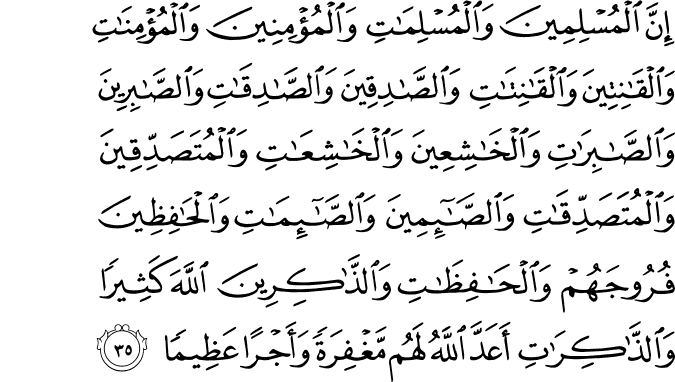
Indeed, the Muslim men and Muslim women, the believing men and believing women, the obedient men and obedient women, the truthful men and truthful women, the patient men and patient women, the humble men and humble women, the charitable men and charitable women, the fasting men and fasting women, the men who guard their private parts and the women who do so, and the men who remember Allah often and the women who do so – for them Allah has prepared forgiveness and a great reward. [33:35]
This verse from Surah Ahzab is a good place to start in trying to find key virtues: belief, obedience, truthfulness, patience, humility, charity, abstinence and moderation, chastity, and mindfulness of God. I also began searching in the Quran to find the names of people who God is pleased with and who are successful. The most common names I found are:
مؤمنون Mu’minun- Those who believe
صابرون Sabirun- Those who are steadfast/patient
صالحون Salihun- Those who are righteous
مخلصون Mukhlisun- Those who are sincere
محصنون muhsinun- Those who are good-doers
متقون Mutaqun- Those who have taqwa (scrupulousness)
خشعون Khashi’un- Those who are humble
Who wouldn’t want to be among those whom the Creator is pleased with? Who wouldn’t want to be forgiven and receive a great reward from our Lord? I believe in the coherence of the Quran and the importance of coherence in our lives. This is why I think that it is important that we look beyond the laundry list approach and focus on the key virtues outlined in the Quran. These virtues can be guiding lights in determining our course of action, leading us to live richer, fuller and happier lives. This is why it is important to explore each of these terms, to consider how they can guide us not just to a moralistic life, but a virtuous life. Some of the explorations may lead to dead ends, but with patience, dialogue, and careful consideration, they may lead to something fruitful. I hope you join me in this journey, as my aim is to explore virtue in Islam in search of an ethical system.
References:
[1] http://www.fordham.edu/halsall/mod/franklin-virtue.html
[2] http://www.islamic.pwp.blueyonder.co.uk/Tazkiyyah/station_of_muraqabah.htm
[3] http://www.islamic.pwp.blueyonder.co.uk/Tazkiyyah/four_poisons_of_the_heart.htm
[4] http://www.fordham.edu/halsall/mod/1882smiles.html
[5] http://en.wikipedia.org/wiki/Self-help
[6] http://en.wikipedia.org/wiki/Twelve-step_program
[7]http://personal.ecu.edu/mccartyr/ancient/athens/Socrates.htm
[8]http://philosophy.ucdavis.edu/mattey/phi143/stoaeth.htm
[9] http://www.guardian.co.uk/commentisfree/belief/2010/feb/23/ethics-citizenship-islam
Worst Vacation Spots in the World
Long time no see folks. Just to get back in the spirit of writing, I decided to post a random entry. I’ve been feeling kind of anti-Philadelphia, looking at picturesque views of California forests and San Franscisco streets, wondering when will I ever be able to take a vacation. It doesn’t help that I have friends living abroad and other friends who are travelling. I live vicariously through my friends especially now because, believe me, it looks like my future vacaction will be a loooooooooong time from now. Out of all the wonderful places I can imagine visiting, there are several that are on the bottom of my list for vacation spots. Thinking about these places makes me feel nice and safe in one of America’s most dangerous cities.
Chernobyl Ukraine

Dangerous radiation levels and an abandoned city, Pripryat. Chernobyl in Ukraine tops my list of undesirable travel destinations.
Kabul, Afghanistan

Suicide bombings, Taliban need I say more?
Bogota Columbia

Kidnapping, drug trade related violence, no thank you.
Baghdad Iraq

Inside or outside the green zone, my anxiety levels would be way to high.
Jerusalem or Bethleham

Checkpoints, strip searches (I’m Muslim), gawking stares (I’m black), high alert for terrorism, I think I’ll pass.
Islamabad, Pakistan

Escalating suicide bombings, anti-American protests, Taliban, okay I’m done.
Kigali Rwanda

Depressing….
Black and White

image by Luke Chuehblack adj \ˈblak\
Definition of BLACK1 a : of the color black
b (1) : very dark in color (2) : having a very deep or low register a bass with a black voice (3) : heavy, serious the play was a black intrigue2 a : having dark skin, hair, and eyes : swarthy the black Irish
b (1) often capitalized : of or relating to any of various population groups having dark pigmentation of the skin black Americans (2) : of or relating to the African-American people or their culture black literature a black college black pride black studies (3) : typical or representative of the most readily perceived characteristics of black culture trying to sound black tried to play blacker jazz3: dressed in black
4: dirty, soiled hands black with grime
5 a : characterized by the absence of light a black night
b : reflecting or transmitting little or no light black water
c : served without milk or cream black coffee6 a : thoroughly sinister or evil : wicked a black deed
b : indicative of condemnation or discredit got a black mark for being late7: connected with or invoking the supernatural and especially the devil black magic
8 a : very sad, gloomy, or calamitous black despair
b : marked by the occurrence of disaster black Friday9 : characterized by hostility or angry discontent : sullen
10 chiefly British : subject to boycott by trade-union members as employing or favoring nonunion workers or as operating under conditions considered unfair by the trade union
11 a of propaganda : conducted so as to appear to originate within an enemy country and designed to weaken enemy morale
b : characterized by or connected with the use of black propaganda black radio12 : characterized by grim, distorted, or grotesque satire black humor
13 : of or relating to covert intelligence operations black government programs
— black·ish adjective
— black·ly adverb
— black·ness nounSynonyms: ebony, pitch-black, pitch-dark, pitchy, raven, sable
Antonyms: white
white adj \ˈhwīt, ˈwīt\
whit·erwhit·est
Definition of WHITE1 a : free from color
b : of the color of new snow or milk; specifically : of the color white
c : light or pallid in color white hair lips white with fear
d : lustrous pale gray : silvery; also : made of silver2 a : being a member of a group or race characterized by light pigmentation of the skin
b : of, relating to, characteristic of, or consisting of white people or their culture
c [from the former stereotypical association of good character with northern European descent] : marked by upright fairness that’s mighty white of you3: free from spot or blemish: as
a (1) : free from moral impurity : innocent (2) : marked by the wearing of white by the woman as a symbol of purity a white wedding
b : unmarked by writing or printing
c : not intended to cause harm a white lie white magic
d : favorable, fortunate one of the white days of his life — Sir Walter Scott4 a : wearing or habited in white
b : marked by the presence of snow : snowy a white Christmas5a : heated to the point of whiteness
b : notably ardent : passionate white fury6 a : conservative or reactionary in political outlook and action
b : instigated or carried out by reactionary forces as a counterrevolutionary measure a white terror7 : of, relating to, or constituting a musical tone quality characterized by a controlled pure sound, a lack of warmth and color, and a lack of resonance
8 : consisting of a wide range of frequencies —used of light, sound, and electromagnetic radiation
— whit·ish adjective
One day my bi-racial niece came home after visiting the other side of her family. They told her she wasn’t black, but Black AND White. My mom took out a panda bear and said, “No, this is Black and White.” This was one of many long standing conversations we’ve had in our family about mixed, multi-cultural, and Black identities. It is challenging sometimes because many of us still hold onto the one drop rule, while our multi-ethnic family members may not identify as Black, but mixed. My mother raised me with a strong Black identity while at the same time encouraging me to embrace our Caribbean, European, and Native American roots. But some members of my family don’t feel comfortable with the subject of race. They don’t want to be asked, “What are you?” They dodge the question. Unlike my racially ambiguous family members, most people assume I’m Black.Throughout my life I’ve had a range of racialized experiences from experiencing anti-black racism to being accepted by certain groups because I wasn’t too black. Sometimes people probe my background. Sometimes my ethnicity was a subject of debate. Maybe I was from “exotic” land or I had one non-Black parent. Recently some students asked me whether I am mixed or not. And I dodge the question, not wanting to reify some assumptions about Black features. I respond, “No I’m not mixed. But Black American is a multi-ethnic category, most of us are at least 20% white.” As Black Americans are becoming increasingly mixed, I wonder what label will work. We’ve gone from Negro, Colored, Afro-American, Black and African American. But what happens when those labels don’t apply, but the historical legacy still remains? Maybe one day, we’ll find a name that sticks, one without negative connotations.
An Open Letter to ABC’s 20/20 regarding “Islam: Questions and Answers” Season 31, Episode 3
After an enlightening email exchange on the Middle East Islamic Studies email listserve, Maytha and I collaborated to produce this letter with the intent on delivering it to the show’s producers. We took into account many of the great points listed brought up by the scholars and academics in the email exchange. Maytha and I took into account some of the many thoughtful suggestions from a number of folks who signed the letter. Insha’Allah, we can get a group going similar to Muslimah Media Watch and have some scholar-activists willing to critique, discuss, and explore media depictions. The iPetition version of the letter below is located here.
An Open Letter to ABC’s 20/20 regarding “Islam: Questions and Answers” Season 31, Episode 3
October 19, 2010We applaud ABC’s 20/20 for producing the program “Islam: Questions and Answers,” which attempted to address the American public’s curiosity about Islam and show the true face of Islam in America. However, as scholars, activists, educators, and community leaders, we are concerned about the ways in which this program misrepresented Muslim Americans. We would like to address three major areas where your program inaccurately depicted Islam in America: first, by continually asserting that moderate Muslims do not speak up; second, by overlooking the contributions of African American Muslims; and finally, allowing women who have complete antipathy towards Islam (Pamela Gellar and Ayaan Hirsi) to speak for Muslim women. The producers and researchers may have been well meaning; however the program’s insensitivity and lack of nuance alienated many American Muslims and perpetuated many misconceptions about American Muslims. Our aim is to address these three areas and provide some recommendations for more accurate coverage of American Muslims in the future.
1. First, the show continually asked, “Why don’t we hear or see more mainstream, peaceful Muslims speaking up?” or “Where are the moderate voices?”
* It is problematic to divide Muslims into binary categories of “moderate” and “radical.” Would the same categorical statement be made about the socio-political orientation of followers of different religious faiths and other ethnic groups? How would the mainstream reaction to your program be had you produced a segment titled “Where are all the moderate Christians?” or “Where are all the moderate Latino Americans?” The framing of these questions and methodology of answering these questions highlights an acceptability of a bigoted stance on Muslims that is rarely acknowledged.
* Muslim Americans are constantly blamed for not speaking up. However the media bears some responsibility. Muslims continually speak out and do positive things for American society, but this does not make it in the news. Every major national Muslim American organization has condemned acts of terror. American Muslim scholars and leaders hold conferences, talks, and lectures devoted to the topic of “Forging an American Muslim identity.”
* Where is the media when peaceful Muslims gather, participate in the American political process, and protest terrorism, violence, and hatred?
* At one point, a discussant posits a recommendation “They need to have a million man march on Washington,” while conveniently ignoring that the Million Man March was actually led by a self-proclaimed Muslim, Louis Farrakhan, leader of the Nation of Islam.
* On September 25, 2009, Islam on Capitol Hill gathered an estimated 8,000 to pray Friday prayers. And on October 15, 2010 thousands of Muslims once again convened on Capitol Hill to demonstrate their belief in American democracy and promote religious freedom, however, there were few media outlets at the DC event.
* Muslim Congressmen Keith Ellison wrote an Op-ed, “Should We Fear Islam?” in the Washington Post, speaking to the first point made in this section. Ellison and Muslim Congressman Andre Carson were also completely absent from the program, which brings us to an important issue of accurate portrayal of American Muslims.2. The program re-inscribes Islam as a foreign religion by focusing on Arab and South Asian immigrant communities in the US, at the expense of African American Muslim communities.
* Your program excluded African American Muslims in the narrative of Islam in America and conflated Arab with Muslim. African Americans make up the largest percentage of Muslims in America, and yet your program visited Dearborn, MI, Patterson, NJ, and even Egypt to speak with Arabs who compose the third largest group of Muslims in the US.
* The Nation’s first capitol is also a city with a rich and long history of Muslims. There was a community of orthodox Black American and Caribbean American Muslims from the 1920s. Philadelphia is also a city with a high concentration of Muslims, a Muslim chief of police, Muslims who work in city government, etc.
* With the over-exposure of Arab Muslims, your program even failed to mention that Arab American Muslims are in the minority in Arab American communities. Most Arab Americans are Christian.
* The program did a poor job discussing, engaging with and highlighting the diverse community of Muslims.
* Low figure for Muslims (2-3 million?), and no breakdown of the demographics.
* It has also come to our attention that a number of “moderate” Muslims were in fact interviewed for this program, including most notably Dalia Mogahed, White House Advisor and Executive Director of the Gallup Center for Muslim Studies, yet their interviews were not aired. The exclusion of her voice, amongst others, and the inclusion of alarmist voices such as Ms. Geller’s is troubling and reduced the caliber, professionalism, and honest journalism that is expected of programs such as 20/20. It leaves us to question whether the issue at hand was a lack of cultural competence of our community or a desire for a certain bent that feeds into many of the vitriolic stereotypes of Muslims in post 9/11 America.
* No discussion of converts.
* The program even failed to show celebrated athletes (NFL, NBA, soccer players and boxers), politicians and historical figures who are Muslim and African American.3. Finally, the segment, “Does Islam oppress women?” did a great disservice to Muslim women.
* While we appreciate the inclusion of one Muslim voice, Irshad Manji, she herself is not a scholar on Islam and is also considered adversarial by many Muslims.
* Instead two polemical figures who are vehement in their anti-Islam stance, Ayaan Hirsi and Pamela Gellar received undue attention.
* Your program failed to include any Muslim scholars such as Amina Wadud, Ingrid Mattson (a Canadian scholar who recently ended her term as ISNA president), or Dr. Aminah Beverly McCloud to speak in this segment. Their and other scholars’ absence is an indication of an asymmetric representation of oppositional views.
* Perhaps these scholars would have shed light on Muslim women’s contributions through history such as Islam’s first convert, Khadija al-Kubra, the Prophet Muhammad’s wife, who was also his employer before marrying. One of the first Sufi saints was a woman, Rabia al-’Adawiyya al-Qaysiyya (Rabia al-Basri) or Nana Asma’u a West African educator and reformer.In order to explore our rich diversity, we have provided some recommendations to improve your coverage of American Muslims below:
1. Explore the long history of Muslims in the US, a history of residency and settlement that predates the formation of America as a country. As one example of many, American born Nawawi scholar Dr. Umar Faruq Abd-Allah has written extensively on this subject.
2. Include broader segments of the American Muslim community to ensure that each major race and ethnic group, South Asian American, African American, and Arab American, is represented in your programs.
3. Attend Muslim American events, banquets and conferences like the prayer on Capitol Hill, MPAC, CAIR’s functions, etc. Do not just focus on sensationalism, but cover American Muslims during Ramadan or Eid al-Adha (the end of Hajj).
4. We ask your researchers and staff to be more careful in their selection of “experts.” Make distinctions between socio-politics and Islamic scholarship. None of the women you interviewed in the question on the oppression of women in Islam had training in Islamic scholarship on covering or the hijab. We can help provide a list of scholars and experts who would be happy to lend their expertise.
5. Consider diversifying your staff, researchers and interns with knowledge, expertise, and experience in various communities may yield better results.In summation, your program provided a rare opportunity to provide accurate coverage of Muslims and clear up misconceptions. As acknowledged at the onset of your program, the controversy surrounding the Park 51 community center elicited a renewed curiosity in Islam. We were pleased with the inclusion of Edina Lekovic’s (MPAC) and Eboo Patel’s (Interfaith YouthCore) comments, Reza Aslan’s explanation of the definition of “fatwa,” and Faiza Ali’s (CAIR-NY) elucidation of the hijab’s complex historical place in cultural and religious practice, “coerced headcoverings are tribal.” However, while we note that your program was a step in the right direction, its lack of attention to detail, and excess attention to individuals with no scholarly background, noticeably decreased the value of what your program could have and should have earned. It is apparent that the producers cut corners, did not research and were not curious to find other sources, and as a result, the piece suffered.
In light of the suggestions and criticisms we have made—ones we hope are constructive and practical—let us iterate once more that we appreciate your initiative to educate Americans about Islam. We hope you will air more programs in the years to come about Islam in America. It would be a great service to this country.
Please also note the signatories of this letter. We have the best interest of 20/20 in mind, as well as the American people in general, and would look forward to lending our services and resources in the future. Please do not hesitate to contact, and we look forward to a response to this letter.”Sincerely,
Maytha Alhassen
Doctoral Student
American Studies & Ethnicity
University of Southern CaliforniaMargari Hill
High School Teacher,
Al-Aqsa Islamic Academy
Musings on Black Suffering
This article, Two State Supreme Court Justices stun listeners with race comments,” got me thinking. How do we explain the continual cycle of poverty and crime without essentializing an entire group? It reminds me of an opinion piece by Orlando Patterson, “Black Culture to Blame? Poverty of the Mind”, we avoid cultural explanations, even though anthropologists march off to other countries to study exotic culture. I find that many activists often refer to racial inequality to explain poverty, incarceration, low literacy, and teen pregnancy rates. Very rarely do they address the effects of the moral decline in the Black community. Often radical groups differ in their approach from say the black nationalism of proto-Islamic movements, which were conservative in nature. Many Black uplift movements were critical of the moral state of Black people, but still infused with love for the community. We have to ask ourselves difficult questions. How do our own personal choices shape our lives? Going further, one might ask why is it that certain things are now acceptable in our community? What cultural, social, and economic factors shape our proclivities?
The problem is, that many Black folks, Muslim included, are very comfortable in their bad habits and even worse choices. During the Jim Crow era, it was a bit harder for Black Americans to abide by Middle Class morals and values. There are many reasons, such as the exploitation of Black women’s sexuality, but most are outside the scope of this short piece. While the cultural revolution of the 60s may have “liberated” many Americans from the cultural mores and standards of their forebearers, the Black community is more vulnerable to the negative outcomes of these social changes. Women entered the workforce, but Black women were always in the workforce, as domestics and low wage earners. Women could leave unhappy marriages. The car allowed for greater mobility. Nuclear families relocated to urban areas far outside the reach of extended family networks. The Pill allowed for sex without risk of pregnancy. Even with the morning after pill still women and girls have unplanned pregnancies and abortions. While there is more candid talk about drug abuse and alcoholism, but little prevention. Black Americans have fewer resources, and therefore it is harder to recover from the break-up of the family, separation from extended family, substance abuse, teen delinquency, and college recidivism. Often, our Black youth have one shot to get it right, whereas somebody from a privileged family with financial resources can rebound from their mistakes.
I don’t want to sound self-righteous. But the reality is, we can’t change “the system,” but we can reform ourselves. We can acknowledge the institutional racism and its legacy on the psyche of Black Americans. That legacy still affects Black American Muslims as they struggle for their identity and place in the Ummah and American society. And while Islam has reformed many Black Americans, I have seen too much ghetto Islam where the same problems that plague the Black community are in the masjid: Sisters discovering their husbands were crackheads, serial marriages where women are exchanged, brawls in masajid, drug dealers, turf wars in masajid, etc. The imams from abroad don’t even know what to do with us Black Americans.
Teaching at a Muslim school with a large Black student population, I am worried about Black American Muslim youth. Honestly, I don’t worry about the Arab students because they have family and social networks that help mediate the problems. The boys will eventually find jobs or work at the family business. Families can easily find a spouse for the girls, as long as they sweep past scandals under the rug. But for the Black American Muslims, there is less of an extended family network to serve as a safety net following a crisis. I worry about my Black American boys and their futures. For a number of reasons, many have chosen other options rather than attending a Muslim school. So, there are only a few left by the time they hit 10th grade. Those that are left, I see how many of my Black male students don’t take anything seriously. They have that non-chalant attitude about their work. And the reality is, they have full knowledge of the consequences of their choices. Everybody tells them, their parents, their relatives, their teachers, and friends. But there is something enticing about rebelling and not caring. I hear the stories of our youth all around this city. They trickle down. How this graduate ended up an un-wed mother. How this one ended up locked up. I pray at that one’s janazah. I’ve been to too many janazahs. You don’t want to ask anymore, “How did they pass?” We will protest unjust cops killing one of our own. When is Philly going to take to the streets and speak out against the gangs saying, “We had enough!”
Just like the problems in the Muslim world: where Muslims blow each other up at mosques, at checkpoints, at wedding parties, on roads, in hotels. Just like the rampant corruption that eats away at the very foundation of social and political stability. Just like the nepotism that breed incompetence and economic stagnancy. Racism and neocolonialism are big problems in the world. But we are 10 times more destructive to ourselves. We are doing the job for those that hate us and see us as sub-human. We suffer because we are self deluded and arrogant. We will have to keep learning our lesson until we get it right. We suffer because we don’t try to change what is within us and pray that Allah will change our condition.
I try my best to stay optimistic…but we have many trials ahead of us.
What the?
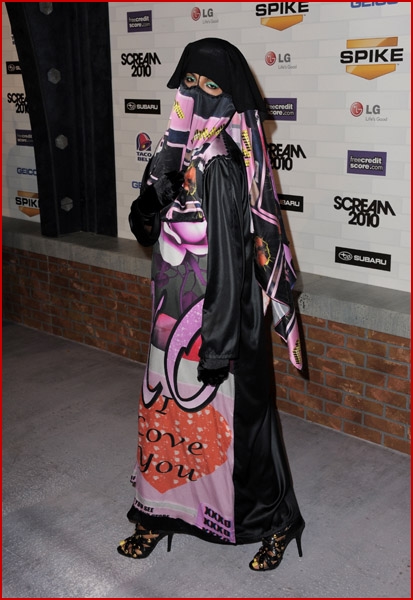
M.I.A. Burqa. What is the statement that she’s trying to make?
 Margari Aziza