The Black Knight: ‘Antar and the Arab Epic

antar-document-4a.jpg
I was doing a little research on a course I’m trying to develop on Muslim societies, slavery and race when I came across an intriguing story. As I was looking for some pre-Islamic literature I stumbled across a familiar, but long overlooked historical character–‘Antar Ibn Shadad. Because I tend to be rather long winded, I thought this brief bio would suffice:

Antara (äntär’ä) [key], fl. 600, Arab warrior and poet, celebrated in his own day as a hero because he rose from slave birth to be a tribal chief. His poetry is represented by one poem in the Muallaqat. His greatness gave rise to many legends over the centuries, and he became the hero of the popular Arabic epic Sirat Antar. In it he represents the ideal of a Bedouin chief, rich, generous, brave, and kind. His name also appears as Antar.

There I found this very thorough book by Peter Heath, analyzing Antar’s epic, Thirsty Sword : Sirat Antar & the Arabic Popular Epic. And H.T. Norris has a translation of the epic itself. I love classic epics, but his story was significant because both race and slavery overlapped. His mother was a Black slavewoman and his father a Bedouin who refused to acknowledge him. Since I have long been interested in Afro-Arabs, this rediscovery of Antar really excited me. I haven’t really found the epic in Arabic literature in Africa, but then again I haven’t looked too hard. But what I found so interesting is the fact that his story resonated for so many Muslims over the centuries. ‘Antar’s was told and retold in Arabic, Farsi, and Urdu.

I became intrigued. While being careful not to insert my own projections, I began to think about the meaning of a mixed race young man, the son of a Black slave woman and Bedouin chieftain raising to become the model of Arab masculinity. It raised so many questions for me, many of them I will continue to explore in my own studies. Here is a translation of his poetry. Reminder for the readers, the English does it no justice

MOALLAKA

The poets have muddied all the little fountains.

Yet do not my strong eyes know you, far house?

O dwelling of Abla in the valley of Gawa,
Speak to me, for my camel and I salute you.

My camel is as tall as a tower, and I make him stand
And give my aching heart to the wind of the desert.

O erstwhile dwelling of Abla in the valley of Gawa;
And my tribe in the valleys of Hazn and Samna
And in the valley of Motethalem!

Salute to the old ruins, the lonely ruins
Since Oum El Aythan gathered and went away.

Now is the dwelling of Abla
In a valley of men who roar like lions.
It will be hard to come to you, O daughter of Makhram.

* * * * *

Abla is a green rush
That feeds beside the water.

But they have taken her to Oneiza
And my tribe feeds in lazy Ghailam valley.

They fixed the going, and the camels
Waked in the night and evilly prepared.

I was afraid when I saw the camels
Standing ready among the tents
And eating grain to make them swift.

I counted forty-two milk camels,
Black as the wings of a black crow.

White and purple are the lilies of the valley,
But Abla is a branch of flowers.

Who will guide me to the dwelling of Abla?
Grayson, David One Hundred and Twenty Asiatic Love Poems

As I read the poems and more and more of Antar’s life and the prolific renderings of his epic, I began to wonder why his story was largely ignored by many Muslims in the West. I have some idea, but I’ll refrain for now. I spoke with a few Muslims and none of them had heard of him. Many Black American Muslims had heard of Jahiz, but why not ‘Antar? Sure he was born in the Jahiliyya time, but there were many stories from ancient times that were retold. I began to wonder if it was some vast conspiracy. Was I thinking along the lines of a renegade Cheikh Anta Diop student? I began to conjure up some grand Arab conspiracy to conceal their African influences in Arab culture, at least by making sure none of us heard of ‘Antar? But then again, translations of the epic have been around, as well as his verses in the Mu’allaqat.

But last week something happened to further dismiss my conspiratorial hypothesis. After I watched the second half of the Arabic version of “The Message” couldn’t bring myself to sleep. So I flipped through the channels at 1:30 in the morning. I stumbled across a few characters who were surprisingly brown. Some were clearly Arab in brown make-up. But one was a man of clear African descent and dignified bearing.

antar-actor-sans-makeup.jpg

As I watched, it dawned on me that this was THE story. I saw ‘Antar and ‘Ablah’s romance unfold. I was so excited. It was was serious production with a number of Arab Ramadan serial heavy hitters. And this was the first time I had seen Faisal Ahmad as the lead character, ‘Antar.

Kuwaiti Times reported:

KUWAIT: Historical TV soap operas are popular and have many audiences as they are valuable pieces of art work. These TV soaps are carried out by more than one country, hence making these show multinational shows. Two of the most popular historical TV soaps broadcasted during this Ramadan were ‘Khalid Bin Al-Waleed’ and ‘Antara Bin Shadad’.

Ghassan Zakariya wrote the serial and Rami Hanna directed it. I’ve been trying to catch the show, to watch it unfold. I’m not saying that it is perfect. I have my own critiques. I’ve been researching the show, trying to find out more about the lead actor, trying to get a sense of the mainstream reaction. So far, the reviews in Arab speaking message boards have been favorable. People in general like Faisal Ahmad.

For me, it is a first time seeing an Afro-Arab take center stage. Earlier productions in the Middle East used Arab actors in Blackface, like these pictured below:
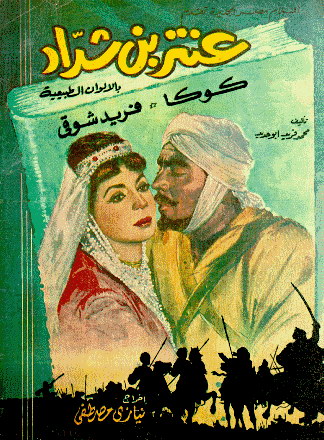
1116596174.jpg

3anter_ebn_shdad.jpg
As Umm Adam warned, we should not impose our western categories on other people. But clearly, the serial demonstrates a construction of blackness and slave status. IAt the same time, it shows how ‘Antar heroic journey was about overcoming anyone’s negative opinion of his slave heritage to become the model of chivalry and courage. I am going to continue to watch this show. Despite its shortcomings–especially the unfortunate Blackface Arabs (knowing that they could have found more Afro Arabs–such as Sudanese actors) and the unnatural make-up for the Black characters, I think the series is worthwhile viewing. For those who don’t have satellite television and can’t get the Algerian station, the epic is still available. It is part of the literary heritage of the Arab and Muslim world after all. And to me seeing someone like ‘Antar as an archetype is important for many of us who are descendants of slaves. There is nothing to be ashamed about, through courage and and good character we become noble. For that, we should continue to tell his story.

History and Memory: Black Muslims in America

Abdur Rahman Muhammad has written a five part series under the controversial title, “Why Blackamerican Muslims Don’t stand for justice?”  I find this series significant for its historical value,  especially since there are very few works outside of Aminah Beverly McCloud’s book African American Islam that have taken a critical look at the intellectual trends of African American Muslims and their relationship to the immigrant community.  

Part One

Part Two

Part Three

Part Four 

Part Five

 What I like about the series is that it is a solid attempt at explaining the causes for the lack of civic engagement of many African American Muslims since the 90s. Abdur Rahman has a good understanding of the complicated trends. I find his nuanced understanding expecially important in light of some disturbing simplistic generalizaitons, ahistorical explanations, and false assumptions recent bloggers have made. Recently, some Muslims have written me asking if their views are representative of the Black American Muslim community. I do not think so. But with that in mind, I think it is extremely important that scholars begin to study sociological, cultural, and historical processes in the American Muslim community. Many of us discuss trends based off of anecdotal evidence. We don’t know marriage statistics and with so many informal marriages we don’t know. I know as a student organizer, many of us failed to keep a record of our activities. We should have libraries preserving our impressions, thoughts, ideas, and plans. We should have qualified scholars that can analyze speeches and texts. Now more than ever we need a historical approaches to understanding Islamic movements, especially in America.I became Muslim in the early 90s, with little understanding of what had been established and the major shifts in leadership that were underway. If you don’t know where you’ve been, how do you know how you got where to where you’re at? I think there are many lessons that we can learn from history. It is just as important to understand the history of Islam in America as a whole, and that will require many studies and various approaches. I personally think   we can discover important insights to understand Muslim communities  in  multi-cultural societies and global Muslim networks by looking at the history of Islam in America. 

Why you all in my grill?

07_10_2006_1842.jpg
The majority of women wear hijab in Kuwait. And there is a significant portion of women who wear the face veil. I am often dazzled by hijab fashions in Kuwait. I try not to stare, but I am intrigued by the whole face veiling. I find that face veil does not preclude sexual attractiveness, since a lot of niqabis wear tons of eye make-up and are dowsed in so much perfume. Some of their abayas are form fitting and attention getting also. I’ve already mentioned the ‘ho shoes. Don’t get me started on designer bags and the cat-walking in the malls. Maybe niqab is not about modesty, but about anonymity.
I think this really hit home today. As we left the Friday Souq two stylishly dressed, and presumably young, niqabi ladies were sitting on a bench. They spotted us and broke their neck to follow us as we made our way out the market. It must have been the English, plus the group of seven brown people running amok. Normally staring people look away when you look back at them. I looked up and stared back at them. Neither one broke their gaze. I said in English, assuming a greater than 50% chance that they’d understand me. “I guess niqab allows you to stare at people.”

I have noticed that niqabis will just stare you down–hard. They had the advantage tonight. They were anonymous and we were not. I noticed that niqabis stare down men too. For me, niqab isn’t something new. I have friends who have worn niqab in the states for years. I’ve even tried it on for kicks. But I have not seen as many niqabis as I see here. Nor have I seen the levels flash that is often associated with khaliji style veiling. In my short stay in Egypt, I saw black enveloped and brightly robed niqabis, alongside the many veiled women. In Morocco, I saw the traditionally dressed women in jallabas, with their veils tucked just under their nose. During my stay in Fes, I came to dread encountering them on the street. No matter how smartly dressed, how neat their jallabas were, they’d hit us up for money. If we didn’t have that, they’d take our cokes, if we didn’t have that, they’d take our water. Nothing like a crowd of niqabis begging harrassing you. After awhile, I scoped out the street before heading down the block I saw a old school niqabi lady chillin on a stoop someqhere, I went to the next block. I’d cross the street sometimes.

As a non-niqabi, when I see a striking person, I tend to lower my gaze. I may look a few times just to gain an imprint in my mind. But as for looking at men, as a I follow the proper decorum. I tend to lower my gaze. One, I’m not trying to catch eye contact. Two, I tend to be kind of shy in public. I’ve never been one to stare down a man. Well, not on the street at least. And I won’t talk about the few times when I did try to those come hither looks. But that’s not going down in the Middle East. I lower my gaze. I know enough Arab men to know that one mistaken look and some random dude on the street may think I have the hots for him. I mean, I could have had something in my eye. Maybe his dishdash was blinded my vision in its crispy whiteness. I could have been trying to identify my surroundings or trying to judge the distance between me and him so I don’t run into a pole or something.

I was walking with a friend who wears niqab. After we passed by two Kuwaiti men, she murmured, “I see you two Kuwaiti men looking at me friend.” I told her I didn’t see them looking because I was staring at the ground. She said something like, “Hey I’m wearing niqab and I can look at them dead up in their face.” Maybe this niqab thing is not so bad after all. You can be a bit bolder in your use of public space. I might try this niqab thing. While donning it I can stare at who I want when I want. All the while I can pretend I’m the most beautiful girl in the world. Ahhhhhhhhh, next purchase Kuwait!!

Sagging

I followed this curious news headline the other day:
Several U.S. cities snapping over baggy pants. It seems that the logic is that if they prevent sagging, they will reduce crime.
I am still suprised to see that sagging is still in, being that it really rose in the late 80s and early 90s. Looking back embarrassingly on my own high school years and fads. I admit that I sagged on occassion. The next generation have taken sagging to new lenghts. But I think it is pretty pathetic to see a 40 year old man dressed like a teenager. But, then again, who am I to enforce dress codes? The truth is that by banning sagging in libraries, parks, and municipal buildings, you are preventing a lot of good kids (who just happen to sag) from using public services and staying out of trouble. I am really tired of bandaid solutions to real social ills in underserved communities. If they really want to address youth crime, they need to consider economic development, job training, after school and conflict resolution programs. Importantly, I think that they developing services that deal with the emotional and spiritual void that our youth are experiencing due to collapsing communities and families and the traumatic life experiences that no young person should have had to witness witness.

When Life isn’t Fair…

I don’t think I’ve passed by a single pharmacy or beauty supply section in any corner store or hypermarket without encountering some skin lightening creams, soaps, powders, lotions, or treatments. It makes me acutely aware of one thing in the Middle East, South Asia, and North Africa—Black is NOT beautiful for many of these communities. There are skin lightening creams in the states, for sure. I remember on my way back from abroad, I stopped by a Queens shop to get my eyebrows threaded and henna. The lady next to me stopped in to get some brightening. She went in the back of the salon and underwent the uncomfortable chemical process. She happily walked out the salon a hint of a shade lighter. Several times I’ve seen flyers featuring skin brightening/whitening treatments at halal stores in the Bay Area. During the year I took a summer class in Berkeley, I discovered an Indian owned spa/salon right on the halfway mark between my dorms and Cal. I grew up with sistas who used to slather on Black and White creame everyday. My family never thought there was anything wrong with being brown. In fact, my mother used to put my sister in the sun when she was a little in hopes that her porcelein white skin would pick up a little tan. It took years before my sister tanned, as opposed to just burn and freckle. Now she has a peachy complexion of a southern California girl. The other day, she said her friend told her she was still to pale. It was funny to have that conversation considering the recent controversy over a skin bleaching product. Normally skin lightening creams have been marketed to women. But it took a campaign designed to appeal to men that finally drew controversy. Shahrukh Khan endorsed “Fair and Handsome,” a bleaching creme designed for men. The BBC reported on the criticism he received in an article titled, Beyond the Pale?

But there are many in blogistan who have written insightful posts about colorism and skin bleaching. Two of my favorite entries are “Ultra Brown” and The Right Shade. In addition to recent coverage of the controversy, I pulled up a few articles about the health risks of skin bleaching. I was suprised to see the prevalence of bleaching creams in Africa’s most populous nation. The article, Whitening Skin Can Be Deadlyreveals:

So, the prevalent medical evidence of high levels of mercury poisoning among women of Saudi, African, Asian and Mexican backgrounds reflects a common and prevailing belief that whiter skin has greater currency and appeal.

The article, African women risk all in quest for lighter skin colour, reports:

In Nigeria, where the use of skin-lightening creams is widespread, an estimated 77 per cent of women use them. In Senegal, the figure is 52 per cent, in South Africa 35 percent and in Mali 25 per cent.

Researchers in South Africa have pointed out that, “Society has a significant impact on the misuse of skin-lightening agents. It is known that during slavery years, light-skinned people were often given preferable treatment…and in modern times, studies have indicated that the majority of black men prefer light-skinned women as partners, girlfriends or wives.”

I walk past those pale women in black abayas who look like they never stepped outside in the sun a day in their lives. They add to their achievement by caking on the finest, whitest face powder.I wonder how they see me. And sometimes I see the disdain in their eyes. Even in societies where you see all sorts of shades, milky moon white to rich mohaganey browns, I find those bleaching creams offend me. They send a not so subtle message, that life is so much better when you’re fair. But you cannot be fair enough. Each time I see those creams, I feel like it is taking a jab at me and the beautiful brown people that I love so much.

Good-byes

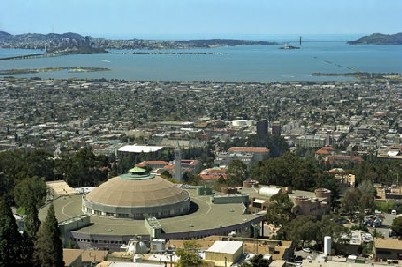
This week-end, I drove with a friend to the Grizzley Peak. I said my good-bye to this chapter of my life, good-bye to friends, good-bye to the Bay Area.Tonight is my last night in California. This time tomorrow, I’ll be on the first leg of my journey. It hasn’t been easy saying good-bye. The past three days have been full of tears.
berkeley_lab_view.jpg

I will be returning to my home town before I go abroad. There will be a family reunion and I’ll know more about where I come from. But what do I know of any place? I know that even though I have never belonged or felt at home here in California, that it is beautiful. I’ll really miss so many parts of Northern California. Time was too short to soak it up and really enjoy it before leaving.

I have anticipated and feared this moment for the past eight months. It became all more real four months ago. My anxieties even creeped into my dreams. But there was no question as to whether I was going to take this journey. The only question was how. The how still unfolds. What do I return to is still unanswered.

So many of the relationships I have forged in the past few years have changed and a number have ended. I have no idea what will happen over the next year. I let go of old resentments and hurts so that I can be open to new experiences. I try to hold on to feelings of love and gratitude, rather than the fear and anxiety. I am tired, I am sad, I am excited, I am grateful. I have a few more things to do, and then there will be closure. I have a few more strings to tie and long list of prayers to make during my travels. My friends have kept me alive this long, and their love still carries me. I will keep them in my prayers. They say the prayers of a traveller are always answered.

London

Two foiled car bombs and a flaming car rammed into an airport terminal. Hundred could have been killed this weekend. It is frightening that it didn’t take police work to foil these attacks. Instead, they were botched only because of the grace of God. I wish someone could have swayed the people from these impotent tactics. I wish someone could have channeled the angry men and women’s energy to do something productive with their lives. They imagine that they are doing something for a greater cause. If only our leaders found a way to speak to their malcontent, but they do little to better the lives of the poor and suffering. If only they lived for others, rather tha

The events in London seems like an incredible stroke of luck (or rather what we Muslims call Qadr). Unforunately, terrorists are more successful in Iraq. While we think about all the lives that have been saved, we should be reminded that the most vulnerable people are the Muslim civilians living and residing in the Muslim world.

DARVO

Short Definition

DARVO refers to a reaction perpetrators of wrong doing, particularly sexual offenders, may display in response to being held accountable for their behavior. DARVO stands for “Deny, Attack, and Reverse Victim and Offender.” The perpetrator or offender may Deny the behavior, Attack the individual doing the confronting, and Reverse the roles of Victim and Offender such that the perpetrator assumes the victim role and turns the true victim into an alleged offender. This occurs, for instance, when an actually guilty perpetrator assumes the role of “falsely accused” and attacks the accuser’s credibility or even blames the accuser of being the perpetrator of a false accusation.

See: http://dynamic.uoregon.edu/~jjf/defineDARVO.html

I think this is a brilliant description a typical reaction. I notice it in arguments when one person in a relationship has a grievance. Okay, to make things clear I will create a DARVO scenario, let’s call one person A and the other person B.

-A has done something hurtful or abusive to B
-B confronts A in order to resolve the issue.
-A denies B’s accusations. A calls B crazy for even bringing this subject up. A accuses B of making things up or imagining things.
-A then becomes angry and attacks B’s credibility or points out B’s shortcomings. -A then feels victimized by B because B’s confrontation makes A feel exposed.
-A then accuses B of being abusive person for raising this issue, criticizing A’s behavior, or making false accusations.

Clearly, A does not want to be the guilty party. A is like many of us when we deflect our guilt and justify our actions. Who wants to hear that they are a bad bad person? B’s issues are still unresolved nor has A reformed their hurtful behavior. Instead A is involved in the blame game. Perpetrator make themselves into victims in order to justify their actions, no matter how abusive, exploitative, or heinous. Cheaters ofen use the DARVO action, especially when their partner catches them in an embarrassing lie. Perpetrators of domestic violence use DARVO and it gets real ugly.

I came upon this site that explained Darvo, from my good friend Kali Tal. I think she pointed out that DARVO reponse is typical when confronting sexist and racist behavior. Now, racists feel as if they are attacked, they use DARVO tactics to make a claim that anti-racists are impinging upon their freedom. DARVO is another power trip for an oppressor or abuser. I think DARVO applies to many relationshps. But it is especially problematic when the perpetrator holds most of the power, whether in a family or work relationship.

On the Desirability of Brown Babies

I was a bit inspired to write this blog after reading Umar Lee’s blog, On Being a White Muslim in America . I also read a few blogs where the authors stated that black women wanted to have babies by white or Arab men in order to have light skinned and curly headed babies. Sure, I know some ignorant black women who have said similar things. But for the most par, my friends are conscious and wouldn’t spout of some nonenense like that. On the other hand, I have heard a few educated black men say that they want to marry a mixed girl because mixed girls are prettier. I have also heard a few black say that they wanted to marry someone white, Asian, or Latina so they would have pretty babies. As one author stated in the comments, it was often hoodrats who stated that they desired a non-black baby’s daddy in order to have babies with good hair. But more than blackpeople, I have heard these statements from members outside of Black American community. In fact, I hear about the desirability for pretty-brown-mixed-babies from liberal white, Asian, Arab, South Asian, and Pacific Islander women. So, if we are going to analyze and critique the ethnic self-hatred of some African women and Black American women, we must analyze and critique the reasons why some women want to adopt African babies or have bi-racial babies who do not look anything like them.
Is it ethnic self-hatred? Is it admiration for African features? Is it a vision of a racial utopia where we are all shades of brown? Or is it something else. I would argue that some really problematic constructs underly America’s fascination with mixed babies.

Keep in mind, I am not saying that all people involved in interracial relationships hold these views. But there are some tendencies that are problematic. I am not saying that mixed people are not attractive. I think all groups and ethnicities are beautiful in their own light, including multi-racial babies. And being in a multi-cultural environment, I enjoy seeing little blonde babies and little Asian babies, as well as little chocolate drop babies, and the curly headed brown babies running around. However, I just find it problematic when you assume that multi-racial children are more attractive than mono-racial babies. And while this might sound liberal and progressive, especially if you are a White Anglo-Saxon Protestant who is rejecting white supremacy, it is still supporting white supremacy because you imply that an African person is only beautiful if their genese are diluted with European, Asian, or Meditterranean genetics. This is problematic in a European dominated society with European standards of beauty. It has had disastrous effects in the Black American community. And it is the reason why we celebrate Beyonce, as opposed to Kelly. For those of us who are phenotypically Africa, these notions are especially harmful, as they affect our self image. But my focus is not on why African women and women of African descent (Black American, Black Latina, and Carribbean) and their responses to European standards of beauty in a global order that is dominated by Europe and the West. I am talking about women, and perhaps some men, who are not members of the African Diaspora who want to have ethnic babies–especially black babies. I see it as part of fetishization and there is something about fetishizing black-ness that is deeply disturbing. Then on top of the fetishization, the celebration of those who are not-quite-black or nearly-white over their darker skinned counterparts.

I live in California, the Bay Area that is. There is a lot more racial mixing and there really isn’t a middle class black community anywhere in sight of Northern California. So my experiences reflect the product of my environment. In California mixed families and bi-racial people are common. More often than not,it is the mother who is non-black and a black father. Few of my black friends were single mothers, but many of my non-black friends eventually did have mixed babies out of wed lock and at young ages. I often see white, Asian, Latina, etc. women (and teenage mothers) pushing a stroller with either a clearly bi-racial child or an ambiguous child. I have pretty good ambiguously black radar because so many people in my family are light skinned, multi-racial, and racially ambiguous. Sometimes it is the subtleties that you notice, but I digress. I grew up in a terribly racist elementary school. I was subject to a lot of racial discrimination because I was the only black girl in my school. But now when I look back, there were a few mixed children in my class who just passed. They were not subject to the daily enslaught of racist jokes and cruelties such as “let’s play segregation today.” On the other hand, my brother’s experiences in Santa Clara were different because many of the white and Mexican American girls pursued him. Black men were cool, they were the athletes, the dancers, the popular kids. But for black girls in integrated environments, it tends to be a lot harder. We are often overlooked by our black male counterparts and the non-black men will not take a second look at us.

Now that black is in, a lot of women who are not black want little curly headed brown babies. Someone noted that in Belgium and Amsterdam, there are European women who get pregnant by African men and raise their children on their own. I don’t know much about this phenomena, but I thought it was interesting. But this leads me to reflect on the kind of ideologies that non-black mothers tell their children. Some of the ideas the ideas are really messed up. Some believe in the racial essentialisms. For instance, one bi-racial man told me that because he was black and white he reflected the merging of two distant strands of humanity. This made him more powerful than either because he was a bridge between the two races. Of course, this is bullshit. In fact, there is more of a genetic range in East Africa than anywhere in the world. In fact, European and Asian lines are really a small recent branch off of a long and ancient family tree. Some bi-racial families like to tell their children that they are extra special (as if Black Americans are ethnically or racially pure) and that they bi-racial people saviors to the world. Some claim that racial mixing is the solution to the world’s problems. But they often fail to look at the case of Brazil to see that social stratification and racism exts there, despite official policies that encouraged racial mixing. All one has to look at how white the government looks like to this date. Some of the racial essentialisms serve to create dangerous color hierarchy that only serves to reaffirm white supremacy. They try to teach their children that the world is color-blind, but many fail to teach their children the complexities of their heritage (especially the Black heritage that has been silent in historical record). The desirability of having brown babies often has little to do with affirming this rich heritage or linking up with the struggle of people of African descent.

At times, it has to do with the ways individuals would like to construct themselves and the fantasies that they have about the black “other.” It can be a way of rejecting white privilege. A white woman with a brown baby is not accepted into white elite circles. Nor are Asian women accepted in their communities and Latina women are often ostracized by their friends, families, and associates. Many are disowned for dating or marrying outside their race (On the other hand it is rare for black families to disown their sons or daughters. And they often raise multi-racial children and treat them well). Having brown babies can serve as a way of advancing an agenda or affirming a new constructed ethnic identity. They can participate in black culture because they now have a rightful place as mother of a black child. However, many women who only date black men and have brown babies would not change their own ethnicity. They do not want to be black women at all. They comletely enjoy their privileged place as desired/objectified other in a community that is so rife with self hatred. In fact, many non-black women feel superior, while at the same time, they often resent black women. I have heard several non-black women talk completely disparaging of black women, our looks, our hair, our body shape, our attitudes, and intelligence. (I am sure that many are regretful that they disclosed to me their off the cuff thoughts. But they have been extremely insightful). This is especially the case when they are competing for the attentions of a black man, or trying to bolster themselves up when comparing themselves to their partners’ exes. I have always wondered why some of my friends and associates felt that confortable saying such statements to me. Perhaps they were looking for me to validate their views. And I take responsbility for not challenging them on their wack statements. It seems as if many non-black women who are into urban/hip hop/black culture hope to raise new brown/black women who will accept their authenticity and be color blind. Having brown babies seems to be a complex social phenomena that I think we have only begun to unpack. We should look at what’s going on to understand how colorism is being reproduced in our community and how the ultimately can have devastating effects on those who are phenotypically Black.

Ramadan Around the Corner

My friend sent me an email about Ramadan. The 15th of the month of Shaban just passed, I think. Those things fly by me because I don’t really have daily interactions with Muslims. I think Ramadan is coming at the end of September. That’s the same time school starts. I can’t really front. And I’m only now trying to think of my survival strategies. After my first horrific fast when I got really sick and passed out at one point, I sort of dread the announcement that the New Moon has been officially sighted. I always feel unprepared.

I can’t lie, fasting is hard. Sometimes I wonder if I can make it the month. Sometimes I wonder if I can make it through the day. I can barely keep my eyes open because my energy gets low. Everything becomes frustrating, my mind can’t process complicated ideas, my temper is short. Even when I take a nap during the day, I’m ready to have a melt down by 3 p.m. By the end of the first week I can sort of adjust to a disfunctional schedule. Last year when my friend’s Senegalese Wolof teacher saw me, he knew I was Muslim. I had that totally drained look of a faster 2 weeks into Ramadan. You see, unlike Christmas for Christians…nothing stops for us Muslims in in the West. And we pay, dearly.

Then there are all sorts of other dilemmas. Sitting at lunch meetings with my stomach growling as I try to maintain mental acuity. What about not going out with the BGSA women for a month because I should be doing good deeds with my non-fasting time. Or my internal debates over my dress code:” Is it extra bad if I wear that cleavage bearing embroidered blouse on Ramadan? tight jeans during Ramadan? I can’t ride my bike with that skirt!!” Avoiding the radio because 90 percent of the songs are going to make me think something haraam. God forbid I hear a song with lyrics like, “I say eeny meany miney mo, how many &*%$.. from the club wanna roll” when I’m starving myself and trying to transcend to a better spiritual state. Too bad I always forget to charge my iPod. I’ll try to do better this year.

And the biggest dilemma of all: what to do about faster’s breath. They have traditions that Allah loves the faster’s breath. But other people don’t. I sort of cheat. I gargle with Hydrogen peroxide and brush with tooth paste throughout the day. Many scholars frown upon this because there is a slight chance that we might injest some toothpaste. But because I have to interact with non-Muslims and I have to live with myself, I can’t walk around with the notorious faster’s breath. I avoid talking to people. Plus I hate talking with a dry throat.

There are Muslims who love Ramadan and all its challenges. But I can’t lie, fasting for a whole month sux. I try to wake up and eat before the sun rises. But that sometimes makes me hungrier later on. My metabolism goes out of control. I eat at night, eat everything, everything and anything tastes good. After Ramadan, I have to hit the gym to burn all those misplaced fat deposits. And I’m starvinnnnnnnnnn through the day. It especially sux when everything around you goes on as normal. Non-Muslims visiting Muslim countries during Ramadan hate not being able to get food. Ha!! Welcome to my world. At least they can sneak food at home. But me no, I get some respite for having a menses. Only time I’m happy when Aunt Mary comes to visit.

The Muslim festival marking the end of Ramadan is by no doubt a relief. But I hate the anti-climatic end to my month long process of food and sleep deprivation. Usually I have to go back to work. Everything goes to normal, nothing changes, no visiting friends and family. It is about as much fanfare as, secretary’s day sometimes. I know, no one in my family celebrates Eid. I think I received an Eid gift maybe once in like 13 years. It is a struggle to feel part of a community during that time. In the large crowds I’m usually grateful to find a familiar face and give quick salaams. My Muslim friends are off doing their family thing. If I go hang out with them, I’m sort of like a fifth wheel. So, I just go home and dream of a time when I could have my own Muslim family and we can make up some traditions of our own.

Ramadan was not so bad nor so lonely last year. Stanford always has nightly iftars (breaking of the fast). The food isn’t bad. Stanford has a lot of international students and some second generation Muslims. There are a few Muslims whose families came from Africa. But for two years I was the only African American Muslim convert. And I was the only African American Muslim grad student that I knew. There are few Muslim grad women. The few of us are working on overcoming our crazy schedules and cultural differences. Then, I have an interesting relationship with the undergrads. I’m sort of used to the awkwardness. And I know I’m the black sheep of the Stanford Muslim family, but they have embraced me. I guess I’m like a permanent international student, displaced and far from home.

So, here’s to another upcoming Ramadan. I’m going to try to get excited this time. Maybe if I reframe my perception about the whole thing. Ramadan has community and spiritual dimensions. Taking this journey has put me on a path of solitude. That’s part of being your own person, I guess. That is what Ramadan is about coming to terms with your most natural and human of desires and putting a reign on them. Sure, I suck on the self discipline side…but that lack of food may whip me into better shape. Having some resolve is a good thing, right?