Help Victims of the Indonesia Earthquake

لا حول ولاقوة إلا بالله
“There is no transformation or strength except through God”
Earthquakes, Tsunamis, Fires, Floods, Volcanic Eruptions, and Drought are all natural catastrophes reminding us that despite our many technological advances, human beings are subject to a power greater than ourselves. We see suffering on on a micro scale in our own societies, people afflicted with sickness, life shortened in random accidents, victims of random murders and violence. As Americans, we have not witnessed many devastating wars or natural disasters, outside of the World Series quake in 1989 where a highway collapsed and killed 42, September 11 where nearly 3000 people died, or Hurricane Katrina when the levees broke New Orleans where over 1500 people died. There are days when I am dumbfounded by the thought that a quarter of a million people wiped from the face of the Earth that late December day in 2004. Muslim theologians have tried to reconcile the notion of Allah, the omnipotent and omnibenevolent God, and the existence of human evil and natural disasters. No Muslim with solid belief doubts that Allah is omnipotent and benevolent, but human suffering challenges believers on multiple levels.

The aftermath of these tragedies often quickly fades from our imagination.

The Network for good is asking for your help with the most recent tragedy:

A 7.6 magnitude earthquake struck western Indonesia on September 30, 2009, causing landslides and trapping thousands under collapsed buildings. Donations are needed to help provide emergency relief to those currently in desperate need.

Maybe its because I don’t own a tv, maybe it is because the magnitude was not initially known, maybe because I was preoccupied with my own worries and concerns. I can’t imagine the horror of the Tsunami or a mudslide that could engulf a minaret. The Christian Science Monitor’s article points out that aid workers focusing on helping destitute survivors. Islamic relief recently arrived to distribute aid to the survivors. Read their article on their efforts here.
None of us knows our final moment. But we will be held accountable for what we did with our time. Like the suffering of the orphans in Aceh nearly five years after the Tsunami, we cannot let the suffering of the people in Indonesia go overlooked because they don’t live in what us Muslims deem as the central Muslim zones. Even if they weren’t Muslim, we should reach out as human beings to relieve the suffering of our global neighbors. Natural disasters remind us that humanitarian intervention should not just be about politics.

Bytes, Blogs and Believers: My Interview with Emel Magazine

This October Emel featured an interview of several Muslim bloggers called “Bytes, Blogs and Believer.”   Your’s truly was included amongst notable blogs written by Ethar Al Kataney of Muslimah Media Watch and 40 Days and 40 Nights, Indigo Jo, Rafael Alejandro of The Wandering Troubadour, Jana Kossaibaiti  of Hijab Style and Wang Daiyu’s Islam in China. Aramco did a nice feature on Emel that provides some interesting background information on the founders of the glossy Muslim lifestyle magazine  printed in the UK. I encourage you to check out Emel, which can be found in the US in select Barnes and Nobles. You can also subscribe to the magazine, which I do think is worthwhile.

As Indigo Jo pointed out, the process began in 2008 and our features were condensed versions of the interview. My answers were rather long and in some ways I think my notes from the interview might be worthwhile elaborating and posting in the future. I find the interview process very interesting and I am always astonished at what the finished product looked like. I have been interviewed in press conferences, by the journalists during  phone interviews, on panels, by a professor writing about religion in modern media, by a graduate student of Teaching Arabic as a Second language studying common mistakes Arab language learners make, by an anthropology graduate student studying the relationship between Arab and Black Americans, and most recently by an undergraduate student interviewing a woman of a different faith. While I studied the interview as a historical method in graduate school, I didn’t necessarily reflect how much I would be interviewed and have been interviewed in my life. Well, outside of job interviews As an historian who studied Africans, immigrants, and marginal groups in the Middle East, I was aware of  the uneven power dynamics between western scholar and interview subject. Interviews are not simply  a collection of oral data  and facts that historians, anthropologists, and social scientist  and other researchers use to reconstruct the past or explain current social formations. It is not simply a fact finding mission. The interviewee is interested in sharing their story and presenting themselves in a certain light. I understood that the interview was not so much as trying to get to some essential truth, but understanding how an individual would like to represent their experience and their identity.  The interview is a collaborative process between interviewer and interviewee. The interviewer shapes how we understand the life experiences of the subject. It is not only through the selection of questions, but also in the editorial process that meaning is shaped and guided. The interview process opens a lot of doors for the person who is answering personal questions. I learned in doing the Human Subject Research Protocols and experience in the field, and even from personal experience in the interview that some questions can bring up painful memories and experiences. But in some ways, the interview has allowed for a certain form of self discovery. They caused  me to think about a lot of things I haven’t thought about or articulate things that have long been unspoken. My experiences with the interview makes me aware of how I represent myself and the ways in which my words are interpreted by another.

On a lighter note: please forgive the unglamorous shot on Emel. I submitted it myself. I thought my picture would be rendered into a digital avatar as Indigo Jo pointed out  in “Hey Emel, what have you done to my avatar?” So, I didn’t ask my husband to do a professional head shot..  I try not to abuse my wifely privileges, but maybe one day I’ll twist his arm into a nice photo shoot. Unlike Indigo Jo, I knew that the brown woman in hijab was one of 99, not some generic rendition of a superhero me. 🙂

Oh the places I went this summer

I did a little bit of traveling this summer, but one of the most exuberant places I went was teaching summer camp for six weeks at Philadelphia’s Sister Clara Muhammad School. The children were beautiful, little chocolate and caramel drops full of smiles, laughter, chatter, and sometimes even tears. I had the joy, and exhaustion of teaching 5-10 years olds literature based arts and crafts. One of our most successful projects was the set of gold and black dhikr beats. Insha’Allah I plan to post those shortly. One parent told me that when her husband was upset about something, her six year old offered to lend his dad the set of beads saying, “Here dad, you need them!” I wanted to share some of the art projects we did, some based on literary themes like scenes, others based on books like Rainbow fish, Frog and Toad are Friends, and Library Lion. Others were just for fun. Who doesn’t enjoy painting colorful monarch butterflies?

Adventures in the Life of a Failed Artist

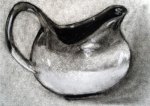
For years, I spent most of my time in thinking, writing, rethinking, spending free time in heady enterprises like deep conversations. But drawing allows me to rest my mind a bit and focus on a shadow, a bright speck of light, a curve of a line, or where two silhouettes intersect. Last Spring, I took an 8 week course at the UCAL. It was an enjoyable experience where I got to use a different part of my brain for once. In some ways, my new artist utensils remind me of opportunities lost and my own personal failures. Maybe this was a gift I that I let flounder and sadly I have to chalk it up to circumstance. Back then, gifted Black girls were never tracked to be artists or even deep thinkers. We were groomed to be engineers, by becoming funneled into programs like MESA.  Distracted, overwhelmed and the on the receiving end of my non-Black classmates discrimination in Physics and Trig, I knew I was destined to become a piss poor engineer.  I slipped into delinquency, high school fights, and general despair. Plus my mother thought I’d be a terrible teacher because I was impatient. I went from the who’s who list to the who’s who of students with multiple talents that didn’t live up to expectations.

School was a miserable place for me, ever since I moved from Trenton and began kindgergarten in a predominantly white schools in the South Bay. But I was curious and loved to write and draw. Ever since I was a toddler, I used to sketch and draw in my mother’s address books. My drawing and story telling in brought me to the attention of my fourth grade teacher. I don’t know if my mother still has the story I wrote, but it was my take on the “Lord of the Flies,” basically the survival techniques of a young Black girl on a desert Island. My teacher recommended that I get tested and following those results I got to escape the dreary loneliness of Kathryn Hughes Elementary school into a world where we played with different shapes and and embarked on odd and nonsensical projects. It didn’t matter that my classmates were socially awkward because they were nerds. I thought I went to this special place because I was different, Black and didn’t think like everybody else. I didn’t think I was so smart, just odd like the other students at GATE. Over time, my teachers expected me to achieve and often accused me of wasting my potential.

I can remember some of those drawings I did from second to sixth grade. I remember the picture I drew of what I hoped I would become when I grew up. I drew my long hair perfectly feathered like Heather Locklear’s on T.J. Hooker. Even though I had my father’s flat nose, I constantly drew an adult me with an aquiline nose with a strong bridge like my mother’s. I remember thinking back resenting my pictures that I drew and how they reflected the low self image I developed after moving into multi-ethnic Santa Clara where Black was a slim majority.

I continued to write stories and draw pictures, often pictures of people’s photographs from time to time. I’ve often regretted that my artistic talents were never really developed. I was tracked so early in high school and I struggled under the weight of science requirements for university admissions and the petty and sometimes deadly violence at a high school that was more like a volatile mix of working class Mexican Americans, Blacks, whites, bloods, mormons, nortenos, rogues, vietnamese gangs, republicans, stoners, jocks, track athletes, and debutantes. I was able to squeeze in one elective art class and an AP art history class. Eventually my college hopes dwindled, and I ended up finishing my last year at a continuation school only to walk triumphantly with my high school class.

I continued to draw things on my own during my community college years, but after a brief stint of being a hardcore Muslim, I burned all my pictures of people and animals. I didn’t pick up a pencil or a pen for years. Nearly a decade later, I took another art class as a return student at Santa Clara University in 2003. It was mostly still life. And my only Black American teacher there noted my work as I captured light and darks on a still life featuring a pineapple. With the help of a some engineering tips, my final project of a japanese garden turned out near perfect. I still consider it my best work to date. Sadly, most of my early work was lost between moves and the instability of being a wayfaring graduate student.

I don’t know why it is so hard for me to pick up the charcoal on my own. There’s something about a structured class and a place where you can let the dust fly everywhere without worrying about it staining the white walls and sullying the vacuumed carpet. I know I will never be a great artist, I think that window closed a long time ago somewhere when I was sketching distorted pictures of my classmates on junior high notebooks. But I enjoy it nonetheless. I hope you rediscover a love and reignite an old flame. You only fail if you never try,

Addressing a Real Social Need: Milati Islami

Addiction is a real problem, and believe me it is not limited to just converts and indigenous Muslims ( those whose families did not immigrate from Muslim majority societies).   Addiction is not limited to substance abuse, we have people with gambling addictions, sex addictions, shopping addictions, etc… Many Muslim communities have failed to develop programs to specifically address substance abuse, which is a real big problem that we often sweep under the rug.

I brought this up after reading about the Guantanomo guard,Terry Holdbrooks, who converted to Islam. He fell into a spiral of alcoholism that led to hospitalization after his experiences at Guantanomo, which included his conversion. At the time of the article, he had recently quit drinking and began attending classes at the mosque. I didn’t read anything about any treatment programs, no 12 steps, nothing, nor counseling sessions to deal with the emotional or psychological problems that plagued him. To me, it highlighted the assumptions that people make when you take shahadah or clean up your life after years of hard partying in your youth (I’ve known plenty of Muslim binge drinkers on college campuses).  Often Muslims are wracked with pyschological trauma from their past, and the emotional guilt from a fall from grace. When you take shahada, your sins are wiped clean. But your mind is not a clean slate, nor are your proclivities reset.   While there are many programs to provide services to inmates, and MANA is working on reentry programs, I still wonder if the assumption is that ex-convicts who had substance abuse problems and drug related offenses will be able to resist temptation once they are out in the the world of temptation. Reentry is not just about finding the brothers jobs and wives (in fact one brother did chastise the sisters at one MANA meeting for not stepping up and marrying the ex-cons).

Addiction is devastating on the individual, their family, and the entire community. It also creates an atmosphere of distrust. I remember years ago, a  Syrian family I knew  in the South Bay had spent a considerable amount of resources trying to help a new Muslim get his life together. They lent him money and tried to help him start a painting business. After some months, he began smoking crack and his life spun out of control. After being burned by that experience, they were less inclined to help converts. Another sister told me her previous husband was a crack head, it just took her a couple months after their marriage to learn of his addiction. And by that time it was too late, she was already pregnant. Well, crack addicted men aren’t the best father figures. On the other hand, I know of a success case, a former addict committed to a life of sobriety, found Islam, and is achieving great things including the highest level of education that one can attain. I appreciated the candor of this individual who openly talks about recovery. That candor is not something you see a lot of in the Muslim community. Instead, we try to hide it behind a veil of piety. And beneath that veil of piety is the heavy weight of self-loathing and fear of being discovered. My hope is that we  invest in our human capital, that we address our realities in America. Addiction, mental illness, and overall spiritual nihilism are things that our community should be equipped to address with trained counselors and skilled imams.  I am pleased to see that the Muslim community in Philadelphia  addressing this.

In the Name Of Allah, The Beneficent, the Merciful …
ATTENTION : BROTHERS and SISTERS
from
Millati Islami Groups of Phila.
{12 Step Recovery}

Millati Islami is a Twelve Step recovery program for
persons that experience problems associated with
addiction. The steps and traditions of Millati Islami
are based upon Islamic principles. With the traditional
Twelve Step program some principles have proven to be
in accord with our Islamic way of life. When Islamic
principles are included, they have proven to further
enhance the recovery process.

Come Join Us!
MONDAY MEETING

Time: 7:00 PM to 8:30 PM
@ The New Africa Center
4243 Lancaster Avenue
Philadelphia. PA

WEDNESDAY MEETING

Time: 7:00 PM to 8:30 PM
@ The Quba Institute
4637 Lancaster Avenue
Philadelphia, PA

FRIDAY MEETING
Time: 7:00 PM to 8:30 PM
@ Masjidullah, Inc.
7700 Ogontz Avenue
Philadelphia, PA

For More Information Contact:

Bro. Ameen Abdur-Rasheed: 215-514-6692
Bro. Abdur-Rahim Burton:347-578-0250
Bro. Naim Uqdah: 215-651-8501
Sis. Noor Doumbia: 267-261-3763
Sis. Hadiyah Najee-Ullah: 215-868-5286
Sis Miriam Sheppard: 215-873-3232

Comment Policy

This is a moderated blog. I will not approve comments that are anti-Islamic/anti-Black/anti-woman/anti-American/anti-anything diatribes, especially those that are full of falsehoods and misconceptions. I do not have time to debunk nonsense or argue with people who are convinced by their own self perpetuated ignorance. Nor is this blog a site for you to proselytize or promote your false universals here. Thank you and like Roxanne Shante said, “have a nice day!”

The Mahr (Bride Gift)

is a common problem for Black American Muslim women. Many never see it, especially if it something of any substance besides three surahs (short chapters of the Quran) and a iron ring. These same brothers will be the first to tell a sister off for going to “kafr” courts for spousal or child support. Brothers when you get married, you enter into a contract. That is not a debt that can be forgiven, it is not something that Muslim women (who are often left vulnerable by the traditional roles they take) can write off as an expense as some uncollectable debt. Sure, you can bust out that “I owe you one on youm al qiyama.” But is that one you can have hanging over your head? I think it is time that we develop a database for all masajid and community members to know if they can trust going into any business with a brother who refuses to pay an outstanding mahr to a sister he divorced. Also, sisters going into a marriage need to know if they their prospective has some outstanding debt, knowing she’ll likely be in the same wack situation.

Working While Muslim in America: The ‘Id shut Out

Last year, at Stanford my Arabic instructor at the time, who happened to be an Arab Muslim, didn’t think it was appropriate to cancel class. I remember being stuck in traffic coming from the ‘id prayers, stressed out about making it back to Palo Alto in time. Two of my sistah-sisters who rode with me were in the same predicament. I apologized for making them late and deep inside regretted my foul mood. After I finally found a parking space, I had to rush to locate the Arabic reading materials just before class started. This Arabic was supposed to be a class linked to Stanford’s burgeoning Islamic Studies program, yet there were no accommodations for Muslim students or faculty. Yet, on Yom Kippur even some of the most secular and liberal professors and students were notoriously absent and classes were canceled. Right now, I’m reeling over a boss who just shut out ‘id. It’s especially annoying knowing how much they value those Turkey Days and weeks off during X-mas break. It is experiences like these that make you feel out of place as a Muslim in America. Your boss or your professor can say: Screw you practicing Muslim, nobody cares about you or your holiday. It makes me question things, when enlightened places of America’s elite institutions of higher learning like UPenn and Stanford do little to create a space where Muslims can celebrate a day that is really holy for us, and not just a secularized day where we just buy stuff or eat stuff.

Psychological and Religious Ramifications of 9-11 on Muslims

I received this message from a listserv that I’m on. I think this is a worthwhile project on a subject that really needs to be studied. Please consider giving your 30 minutes to help the production of knowledge on the American Muslim community:

Brother/sister as salamu alaikum,
My name is Hisham Abu Raiya, PhD., a postdoctoral fellow in psychology
at the Counseling and Behavioral Health Services at New York University.
Drs. Kenneth Pargament and Annette Mahoney, well-known researchers in
this field of the psychology of religion, and I are currently conducting
a study that explores the psychological and religious ramifications of
the events that followed the September 11 attacks on Muslims living in
the United States. For the sake of this study, we are looking for Muslim
individuals living in the United States who are willing to complete a
survey that includes questions about the stressors they faced after the
September 11 attacks and their religious methods of coping with these
stressors. We are writing to ask you to complete our survey, which will
take about 30 minutes of your time. Your responses on the survey will
remain confidential and you will not be asked to provide any identifying
information. If you are interested in participating, you can access the
survey at:

http://psych.bgsu.edu/911survey.htm

Your help will contribute significantly in understanding the
psychological and religious ramifications of the September 11 attacks on
Muslims in the United States, and will be extremely appreciated.
Sincerely,
Hisham

Hisham Abu Raiya, PhD.
Psychology Fellow
NYU Student Health Center
Counseling & Behavioral Health Services
726 Broadway, Suite 471
New York, NY 10003
Phone: 212-998-4774
Homepage: www.hishamaburaiya.com