
Originally Published in Medium
Reading Frank Herbert’s classic Science Fiction Novel Dune as a Muslim is an entirely different experience than reading it as someone outside of the faith. How do I know? Well, I have read it from both vantage points. I had my first introduction to Dune at the age of 11 in the 1980s. That was when the term jihad (holy war) was not widely connected with terrorism. The book was full of strange words that I skimmed over only to discover the glossary at the end. In high school, I marveled at Herbert’s creativity in world-building and creating new vocabulary. By high school, Islam was a bit more familiar from history books and the Nation of Islam. The syncretistic future religions of Dune intrigued me, and names like Muad’dib and Mahdi stuck with me. Years later, my research on Saharan networks and Mahdist rebellions in Sudan would point me to the hidden Black roots of Dune.

I read Dune after embracing Islam during my first year of college in 1993. I took a hiatus when I couldn’t afford my tuition and hung out in the stacks of Santa Clara University. An Iraqi Shi’a student taught me to read and write Arabic twice a week. As I waited for my ride home, I read 19th-century Orientalists including Stanley Lane-Pool and Richard Burton and other more modern books by authors including Fatima Mernissi. I read about the Moors in Spain, the Ottomans, and skimmed through translations of texts and lexicons. Then I re-read Dune and exclaimed, “Wow, Herbert ripped so much from Muslims!” The whole text took on a different color and flavor for me. Lisan al Gaib, Padishah Emporer, Kitab al-Ibar were now part of historical and cultural legacies that I was immersing myself in as a convert. I felt parts of my identity imagined in the far-flung future, something I had never found a classic text before.
Haris Durrani writes, “ I am of the theory that if one is Muslim, or otherwise intimately aware of Muslim traditions, that person’s experience of Dune differs vastly from any other reader’s encounter with the saga.” He is right. With Denis Villeneuve’s Dune (2021) film, I felt it was important for Muslim perspectives to speak to the film and the source material. My organization MuslimARC put on two panels on September 22 and September 29 to explore the tropes and implications. There are valid critics around orientalism of the book, Herbert’s reification of the white savior trope, the erasure of Islamic influence in the film, and the lack of Middle East and North African actors with speaking roles in the film.
In the film, the Fremen were cast as multi-racial, Black, Brown, and swarthy natives in contrast to the whiteness of the Harkonnens and Paul Atreides and his mother (there is a spoiler about this). Some of us welcome the inclusion of Blackness amongst the Fremen. But some argue for cultural specificity, pointing to the film being made in Jordan and Dubai. Roxanne Hadidi writes, “Part One presents the Fremen as generic ‘people of color.’” Javier Bardem, a Spanish actor who always reads his lines like a Spaniard, plays the Naib leader Stilgar. Black British actress Sharon Duncan-Brewster plays Dr Liet Kynes, Imperial Planetolist and Zendaya is Chani, a Fremen native who Paul has prescient dreams about and who also happens to be Liet Kynes’s daughter. Gold Rosheuvel, a Guyanese-British actress plays Shadout Mapes and the Fremen fighter Jamis is played by Nigerian American Babs Olusanmokun. Does choosing actors who are of West African descent deny the cultural roots that are central to the source? This question may require some nuance, as many of the African Diaspora are descendants from regions with Saharan and Sahelian roots (myself included). Up to 20% of enslaved Africans were from Muslim and from Muslim regions. Nigeria has the largest Muslim population in Africa at 95,000,000 to 103,000,000, more than Egypt at 85,000,000–90,000,000.
I’d caution against erasing the Blackness from Arab and Indigenous cultures that traverse the Sahara. Several modern nation-states in the Sahara have significant and/or majority Black populations(Sudan, Chad, Niger, Mali, and Mauritania), in addition to Eritrea, Nigeria and Senegal also in the Sahel transition zone.
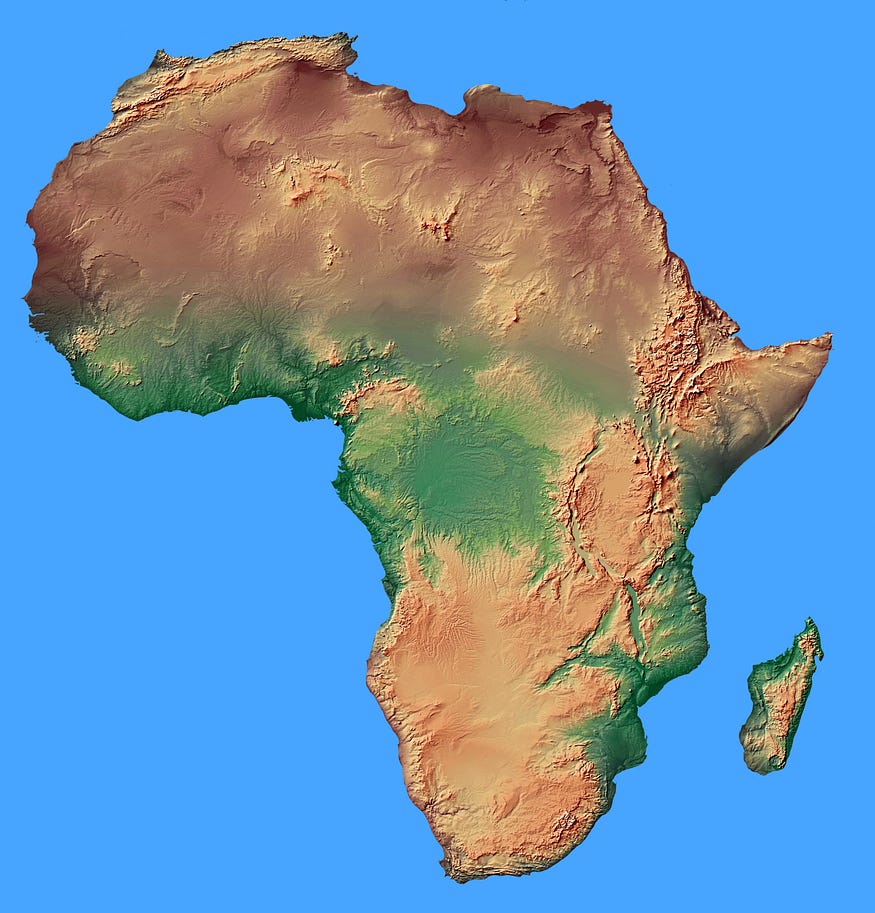
As I write, the nation of Sudan is experiencing an uprising against authoritarian rule. The name of the county Sudan means “Black” in Arabic. Had it not been for Mahdist/Messianic revolt against imperialism, Sudan could have still been in the grips of what Eve Troutt Powell calls A Different Shade of Colonialism. In the book Dune, the natives of Arrakis await the Mahdi. Some scholars have argued the roots of Frank Herbert’s use of Mahdi come from North African Fatimids of the 10th and 12th centuries. However, I would argue that Mahdi came to popular attention in more recent times for people like Frank Herbert. Frank Herbert didn’t have to become an archive rat or hang out in the stacks to find out about Mahdism as a political force. Four Feathers 1902 book has had such a cultural impact that several film adaptations have been made of it including Four Feathers(1915) (1921) (1929), ( 1939), (1978), (2002), and Storm on the Nile (1955).

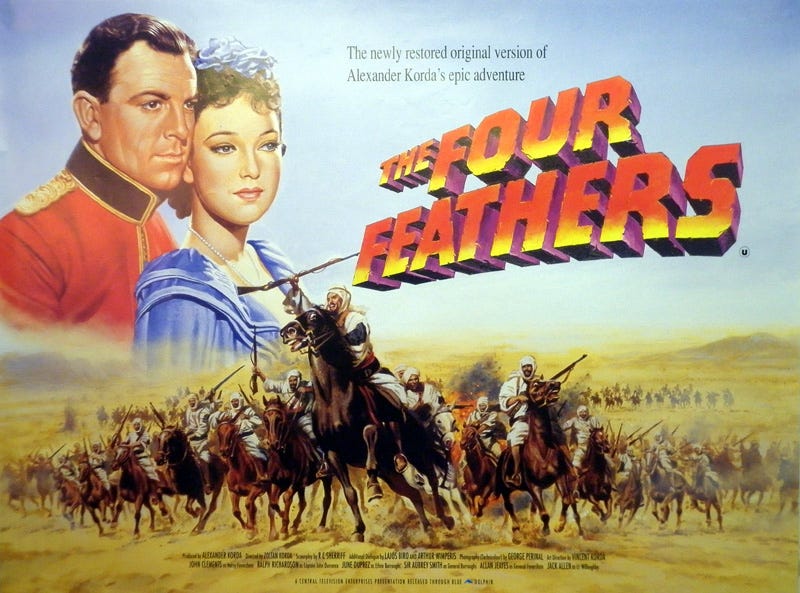
The story deals with General Kitchener’s forces who are leading a military campaign to avenge General Gordon, who has statues across the UK. It deals with cowardice and redemption and a white guy dying his skin to disguise himself as an Arab.

The setting of Four Feathers deals with the most successful messianic Muslim revolt, which occurred in Sudan during the late nineteenth century. Ahmad bin Abd Allah (1844–1885) was aNubian Sufi religious leader of the Samaniyya order in Sudan Muhammad who declared that he was the Mahdi in 1881. He began a religious movement that swept through Sudan and successfully ousted the foreign Turco-Egyptian government from Khartoum in 1885. He died shortly after the fall of Khartoum and his successor, Khalifa Abdullahi, led Mahdist forces against the British and Egyptian troops.

Although Anglo-Egyptian troops conquered Sudan in 1889, they had not defeated Mahdist ideologies. Western migrants increased in the Sudan after British forces conquered the Sokoto Empire in Northern Nigeria in 1903 and the Keira Dynasty in semi-autonomous Darfur in 1914. Mahdist and messianic outbreaks continually plagued the British colonial powers until the mid 1920s when Sudanese nationalism began to develop. There were numerous Mahdis in Africa, but the most successful was the Sudanese

His son, Sayyid Abd al-Rahman al-Mahdi remained an important religious and political figure during the colonial era in the Anglo-Egyptian Sudan. He remained a great authority as leader of neo-Mahdists even after Sudan became independent.
It is reasonable to think Frank Herbert aware of the Four Feathers films featuring swashbuckling adventures of British soldiers against the “evil” rebels in Sudan. It was, after all, the most influential depiction of Mahdism as a force to overthrow a stagnant empire. Did we have to skip over something that happened recently to the 10th to 12th century with the Fatimid dynasty to discover the Mahdi? I am a “yes and…” thinker. So I would argue that it is likely that the popular depiction of the Sudanese Mahdi’s anti-colonialism AND the mysticism of the Fatimids and Shi’ism in Orientalist texts were part of Herbert’s intertextual crafting of his vast universe and sprawling timeline. It is not so far-fetched to consider the inclusion of the most successful messianic revolt that led to the overthrow of imperialist troops that consisted of the corrupt Turko Egyptian and British troops, led by Black Arabs. To me, what makes the Missionaria Protectiva so nefarious is that it appropriates the Mahdi and makes him an outsider, the Lisan al Gaib “voice from the outer” world to protect a Bene Gesserit who might get stranded on Arrakis. It is an insidious twist of theology, historic memory, and longing for leadership rooted in faith that leads to a false messiah.

The ancestors of the Fremen were the Zensunni wanderers, whose earth home was called Nilotic al-Ourouba. De-Nile (denial) is not just a river in Egypt, it is a river in Africa that begins in Lake Vitoria (located in modern-day Uganda, Tanzania, and Kenya). But Black Fremen, though? Frank Herbert based the culture of the Fremen on Bedouin and the San People of the Kalahari bush. Nilotic Messianic convulsions against oppression originated in a country called Black- Sudan.
As a Black Muslim and historian, I have a different experience. The multi-racial Fremen reflect the historical and present realities of Black, Amizigh, and Arab identities. We must challenge the demarcation of North Africa and sub-Saharan Africa as a colonial and racist construct, as well as narrow constructs of race. Embracing of overlap of Blackness and Arabness works theologically for many Black Muslims, as it rejects a different shade of white savior.
Frank Herbert translated the term Ya hya chouhada as “long live the fighters.” We Muslims understand the term shuhada to mean, “long live the martyrs.” In our faith, martyrs are the ultimate witnesses to Truth. To the Sudanese martyrs who are rising up against corruption, we bear witness to your struggle for freedom.
 Margari Aziza