Anti-Black Islamophobia Tropes

Originally published on Medium

I stepped to the podium, and in front of an audience of world-famous researchers, scholars, and academics, I nervously opened my first conference paper by sharing my pre-9/11 experiences as a Black American Muslim college student. I wrote this paper without access to archives or even many journal articles. However, I had scores of personal histories, pop culture references, and news headlines. I used those sources to outline how Islamophobia and anti-Black racism overlap, causing notable racial disparities in the criminal justice, immigration, and national security systems. Black Muslims are often considered dangerous, illegitimate, rigid, violent, and promiscuous. When we analyze the tropes used to describe Black Muslims, we can see that the systemic oppression of Black Muslims is rooted in centuries-long discourses and policies.

This is a still image from the movie Dune (2021). The scene has brutalist beige and brown architecture wich geometric patterns on the ground. A Black woman with a black hooded cape and textured gown stands in the front. Her right hand clasps her left. She has a necklace with many rings that coverns her neck. There are three soldiers, two men with black uniforms and caps and a woman soldier with her hair in the bun in the background. There is a light in the background into the left.
Black Muslim convert in the Future: Liet Kynes in Dune (2021)

Whether through the lens of service or crime, Black Muslims face particular vulnerabilities. Over the past 15 years, there has been a growth of literature on the impact of Post 9/11 policies and systemic racism on Black Muslims. Dr. Su’ad Abdul Khabeer writes about the two facets of the facts of blackness: disavowal and instrumentalization. Black culture is seen as immoral or blackness is used as a tool of resistance. In her exploration of 100 years of Muslim tropes in film Dr. Maytha Alhassen writes that Black Muslims are framed as either haters or redeemers. Both scholars point to how the production of knowledge about Black Muslims reinforces stereotypes and marginalization.

Still image of the documetnary showing members of the nation of Islam with men in suits and women wearing white headcoverings.
American Islamophobia: The Hate That Hate Produced (1959)

While I knew that Black Muslims experienced Islamophobia differently, it was not until I wrote that paper that I could name our experiences. I found several tropes circulating in reports, blog entries, and articles, including Burqa BanditJailhouse JihadiCounterfeit AkhiSomali Shabab, and Militant Muslim. In 2015, I learned that I lived in a pilot city for Counter Violent Extremism programs and found racial disparities in Suspicious Activity Reports. After I wrote my article in the Islamic Monthly, civil liberties organizations, including the ACLU, Center for Constitutional Rights, and CAIR reached out to work with me for programming and education resources. I learned that West African and East African communities were particularly vulnerable. While the literature on the criminalization of Black Muslims was sparse, I took my initial research to write op-eds and turned them into a conference abstract. My creative writing professor advised us to steer clear of tropes. But after meeting Zienab Abdelgany, an organizer at CAIR Greater Los Angeles who introduced me to the Knowledge Power Chart, I knew starting with anti-Black tropes to mapping out the criminalization of Black Muslims would be an effective strategy.

Racist much?: Mid-Century Blackamoor Nubian Man & Women Porcelain Figure — A Pair

The ways that we think about people often justify their treatment or conditions. Dominant narratives can come from stereotypes, commonly held beliefs, or tropes. Anti-Black Islamophobia has deep roots in Arabic literature and western Orientalist art and literature. A trope is a powerful image, and it is an overused device that obscures truth. Blackamoor is a European visual trope of decorative art in furniture, jewelry, and paintings. During my travels in Egypt, I saw Blackamoor art left an imprint in colonized Southwest Asia and North Africa with a brass relief of a bare-chested Black woman on my landlord’s foyer and an orientalist painting depicting a Black woman scrubbing a white woman. They reinforced a racialized regime of Black people as servile and sexually suggestive.

Image of a light brown skinned North African woman with curly hair. Her chest is exposed to show cleavage. She has traditional jewelry, including silver hoop earrings, amber necklace, and face tatoos.
Dusky Venus: “Marocaine à la robe mauve”, by José HerrerillaCruz Herrera

Dehumanizing tropes don’t have to come in the form of slurs. Sometimes it can be in canonization. Black Muslims can take on saintly roles as martyrs, servants, wetnurses. And the modern iterations are the magical Black girl or Black woman savior (I will discuss these tropes in politics and science fiction). Four tropes help us better understand the systemic oppression of Black Muslims: the Magical Negro, Holy Hustler/Whore, Militant Muslim, and Muslimah Mammy.
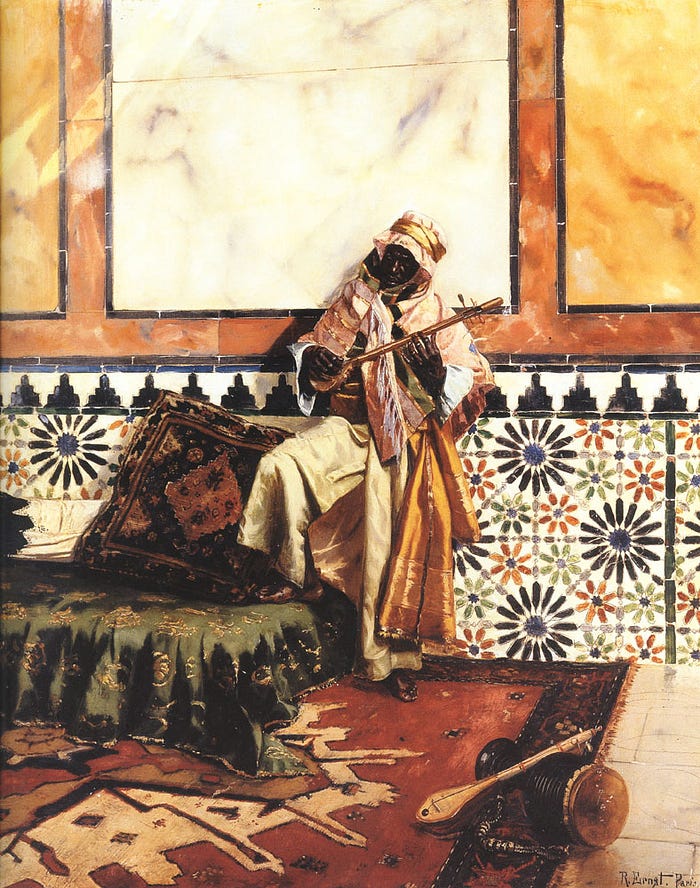
Soul of Black folks: Ernst Rudolf — Gnaoua in a North African Interior — Norwegian School — 19th Century

Magical Negro- The Magical Negro is a black character who is a wise mystic. Black characters often only exist to move the plot along by advising non-black characters with some esoteric wisdom. They may even have some special power or insight due to their status on the margins of society. Orientalist painters depict Black musicians or magicians. French and British colonial scholars and administrators also framed Black Africans as inherently superstitious, with an Islam that is corrupted by African practices. The Black Muslim version of Magical negro is often tied to mysticism, but not in the Rumi or IbnArabi way. Those are too scholastic. Instead, the Magical Muslim Negro is tied to suspect practices tied to animism or jinn. They may be the voices calling to prayer, but not the scholar. The Magical Black Muslim is often musical and mystical in film and popular culture. In many Muslim societies, descendants of Africans trafficked in the trans-Saharan or Indian ocean slave trade maintain some distinct spiritual practices. Religious syncretism and musical performances are often the only aspects of their cultural practices that ethnographers feature. Further, due to the marginalization of Africans in the Diaspora in the Mediterranean or South Asia, their role in society is often limited to serving as spiritual mediums often through music.

Sex trade: The Slave Market José Navarro y Llorens (Spanish, 1867–1923)

Holy Harlot/Hustler- These are two sides of the coin, as the hustler and whores are associated with illicit activity. Orientalist paintings feature turbaned Black men as pimps in slave markets. The Holy hustler corrupts society by selling sex. Either the virginal captive white slaves, an obsession in Orientalist paintings or tempting white men with corruption by selling a dusky venus. Colonial reports often called Black Muslim leaders as charlatans and tricksters. Another variation is the street preacher or vendor selling wares or incense in inner cities. The Black Muslimah Hustler is suspect because she has to leave her household to make a living. Historically, Black women’s femininity was not something to be protected or saved, unlike Brown women. Black Muslim women are not considered delicate feminine and deserve support and protection. When she demands respect in this gig economy for her work ethic, she is called a diva, which Beyonce tells us is another word for a hustler. The Black Jezebel trope has been used in western societies to depict Black women unrapable. In the SWANA region, Black women of all faiths experience the brunt of hyper-sexualization, rape, and African migrants are raped and trafficked into the sex trade.

Noble Savage: Deutsch Ludwig — the Palace Guard 1 1892

Militant Muslim. In Alexandre Dumas’s Count of Monte Cristo, Ali is an enslaved Nubian weapon master who also happens to be mute. Numerous orientalist paintings show Black warriors trampled upon by Matamoros (the killer of moors), fanatical troops, or as harem guards. Today, Black militant Muslims are revolutionaries who rail against the man. The militant Muslim is maladjusted, out of touch, and angry. During the interwar period in Northern Nigeria and Sudan, colonial authorities wrote about the fanaticism of Black Muslims. They believed that their racial makeup made them more prone to violence. The documentary The Hate that Hate Produced (1959) caused hysteria. Black Muslims that critique white supremacy are often framed this way. The only reform for the militant Muslim is the acceptance of the status quo and embracing Christianity.
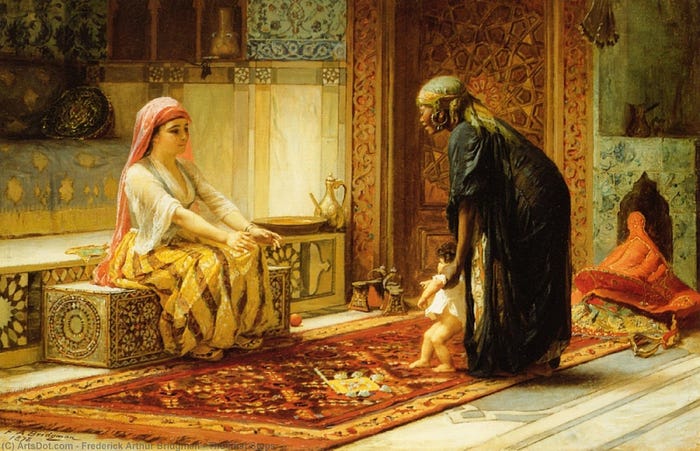
Black caretaker and saintly servant: Frederick Arthur Bridgman — Mother Child 1878

Muslimah mammy– In contrast to the holy whore, the Muslimah mammy is desexualized and non-threatening. Instead, she represents the permanent servitude of Black women to society’s whims. The mammy is a matronly figure who is the caretaker of others outside her household. She likely has to neglect her immediate family in service to white women. She cares for children and is known for their loyalty and selflessness. Orientalist paintings often depict Black women as servants in harems. Black women elders, especially African American Muslim women, are not respected for their experience, given titles in deference to their status and wisdom. Due to economic pressures, women of the African Diaspora migrate to Southwest Asia, North Africa, and the Gulf for work. They are often relegated to domestic work, even if they have various skills. Further, the kafalah system a rife full of exploitation. The Muslimah mammy in US contexts often overlaps with how Black mothers are depicted as domineering emasculators or saintly servants. Black women may be school teachers, nonprofit workers, or advisors with little institutional power. Instead, a Black Muslimah mammy is the caretaker of the people who benefit from institutions and systems of power.
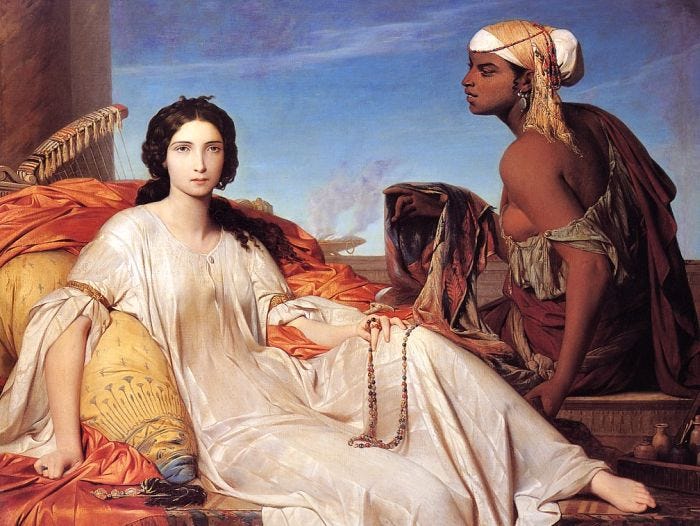
Adoring Black Supporting Character: François-Léon Benouville (French, 1821–1859)

I aim to explore these tropes further in the coming months as they intersect with popular culture. Whether intentional or unintentional, the perpetuation of these tropes continues to cause harm. Tropes minimize Black Muslims’ full humanity, contributions, and aspirations. It makes the world especially unsafe for Black Muslim women, even for one who runs an anti-racism organization. This is only the beginning of my exploration and contribution to the field. I push back against the boxes people try to put me in, whether they be the dusky venus, the sapphire, jezebel, or mammy tropes. We must interrogate these tropes and unpack how they appear in our daily interactions. By countering these tropes, I reclaim my story. Black Muslims are not objects but protagonists in our own stories.

The Hidden Black Roots of Dune

Originally Published in Medium

Reading Frank Herbert’s classic Science Fiction Novel Dune as a Muslim is an entirely different experience than reading it as someone outside of the faith. How do I know? Well, I have read it from both vantage points. I had my first introduction to Dune at the age of 11 in the 1980s. That was when the term jihad (holy war) was not widely connected with terrorism. The book was full of strange words that I skimmed over only to discover the glossary at the end. In high school, I marveled at Herbert’s creativity in world-building and creating new vocabulary. By high school, Islam was a bit more familiar from history books and the Nation of Islam. The syncretistic future religions of Dune intrigued me, and names like Muad’dib and Mahdi stuck with me. Years later, my research on Saharan networks and Mahdist rebellions in Sudan would point me to the hidden Black roots of Dune.

I read Dune after embracing Islam during my first year of college in 1993. I took a hiatus when I couldn’t afford my tuition and hung out in the stacks of Santa Clara University. An Iraqi Shi’a student taught me to read and write Arabic twice a week. As I waited for my ride home, I read 19th-century Orientalists including Stanley Lane-Pool and Richard Burton and other more modern books by authors including Fatima Mernissi. I read about the Moors in Spain, the Ottomans, and skimmed through translations of texts and lexicons. Then I re-read Dune and exclaimed, “Wow, Herbert ripped so much from Muslims!” The whole text took on a different color and flavor for me. Lisan al GaibPadishah Emporer, Kitab al-Ibar were now part of historical and cultural legacies that I was immersing myself in as a convert. I felt parts of my identity imagined in the far-flung future, something I had never found a classic text before.

Haris Durrani writes, “ I am of the theory that if one is Muslim, or otherwise intimately aware of Muslim traditions, that person’s experience of Dune differs vastly from any other reader’s encounter with the saga.” He is right. With Denis Villeneuve’s Dune (2021) film, I felt it was important for Muslim perspectives to speak to the film and the source material. My organization MuslimARC put on two panels on September 22 and September 29 to explore the tropes and implications. There are valid critics around orientalism of the book, Herbert’s reification of the white savior trope, the erasure of Islamic influence in the film, and the lack of Middle East and North African actors with speaking roles in the film.

In the film, the Fremen were cast as multi-racial, Black, Brown, and swarthy natives in contrast to the whiteness of the Harkonnens and Paul Atreides and his mother (there is a spoiler about this). Some of us welcome the inclusion of Blackness amongst the Fremen. But some argue for cultural specificity, pointing to the film being made in Jordan and Dubai. Roxanne Hadidi writes, “Part One presents the Fremen as generic ‘people of color.’” Javier Bardem, a Spanish actor who always reads his lines like a Spaniard, plays the Naib leader Stilgar. Black British actress Sharon Duncan-Brewster plays Dr Liet Kynes, Imperial Planetolist and Zendaya is Chani, a Fremen native who Paul has prescient dreams about and who also happens to be Liet Kynes’s daughter. Gold Rosheuvel, a Guyanese-British actress plays Shadout Mapes and the Fremen fighter Jamis is played by Nigerian American Babs Olusanmokun. Does choosing actors who are of West African descent deny the cultural roots that are central to the source? This question may require some nuance, as many of the African Diaspora are descendants from regions with Saharan and Sahelian roots (myself included). Up to 20% of enslaved Africans were from Muslim and from Muslim regions. Nigeria has the largest Muslim population in Africa at 95,000,000 to 103,000,000, more than Egypt at 85,000,000–90,000,000.

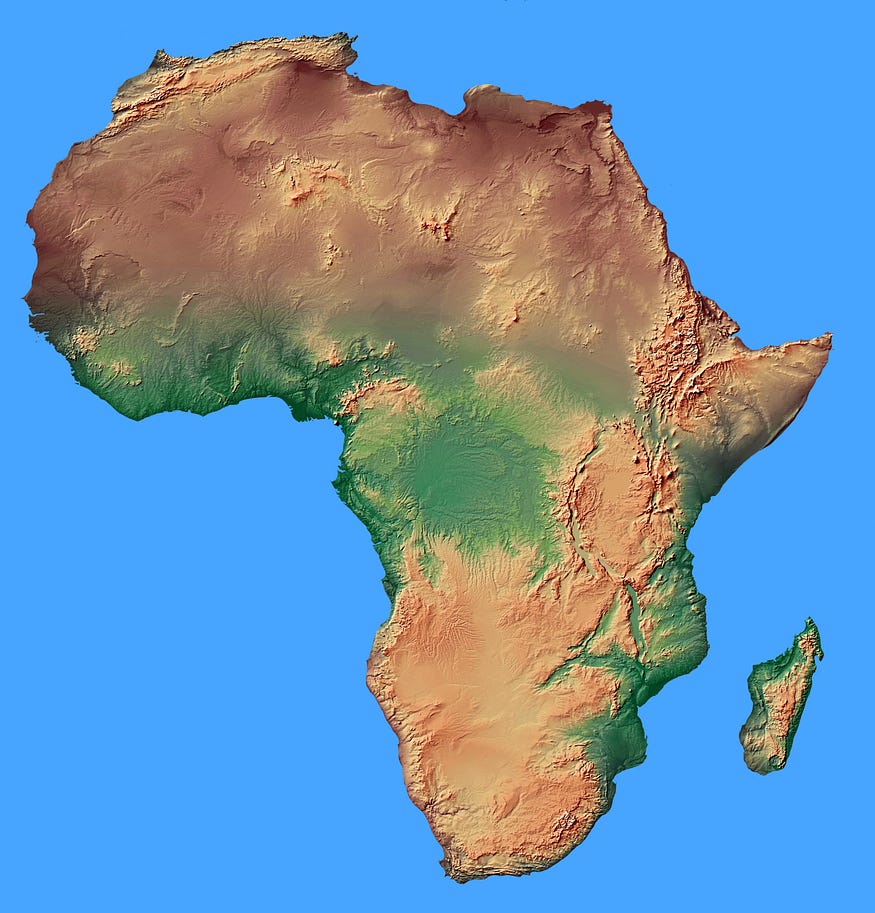
I’d caution against erasing the Blackness from Arab and Indigenous cultures that traverse the Sahara. Several modern nation-states in the Sahara have significant and/or majority Black populations(Sudan, Chad, Niger, Mali, and Mauritania), in addition to Eritrea, Nigeria and Senegal also in the Sahel transition zone.

Photo 68872964 / Africa Map © Peter Elvidge | Dreamstime.com

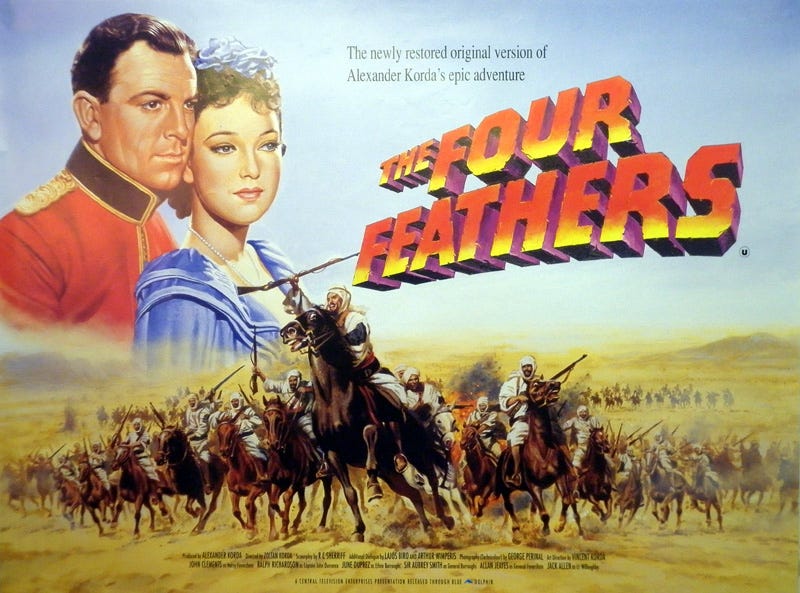
As I write, the nation of Sudan is experiencing an uprising against authoritarian rule. The name of the county Sudan means “Black” in Arabic. Had it not been for Mahdist/Messianic revolt against imperialism, Sudan could have still been in the grips of what Eve Troutt Powell calls A Different Shade of Colonialism. In the book Dune, the natives of Arrakis await the Mahdi. Some scholars have argued the roots of Frank Herbert’s use of Mahdi come from North African Fatimids of the 10th and 12th centuries. However, I would argue that Mahdi came to popular attention in more recent times for people like Frank Herbert. Frank Herbert didn’t have to become an archive rat or hang out in the stacks to find out about Mahdism as a political force. Four Feathers 1902 book has had such a cultural impact that several film adaptations have been made of it including Four Feathers(1915) (1921) (1929), ( 1939), (1978), (2002), and Storm on the Nile (1955).

A large picture man in red uniform and woman in a blue dress in the horizon to the left. The Four Feathers movie title. In the foreground, men wearing turbans riding horses carrying guys.

The story deals with General Kitchener’s forces who are leading a military campaign to avenge General Gordon, who has statues across the UK. It deals with cowardice and redemption and a white guy dying his skin to disguise himself as an Arab.

Storm over the Nile (1955)

The setting of Four Feathers deals with the most successful messianic Muslim revolt, which occurred in Sudan during the late nineteenth century. Ahmad bin Abd Allah (1844–1885) was aNubian Sufi religious leader of the Samaniyya order in Sudan Muhammad who declared that he was the Mahdi in 1881. He began a religious movement that swept through Sudan and successfully ousted the foreign Turco-Egyptian government from Khartoum in 1885. He died shortly after the fall of Khartoum and his successor, Khalifa Abdullahi, led Mahdist forces against the British and Egyptian troops.

Area from Nigeria to Sudan occupied by the Baggara, many of whom were supporters of the Mahdi

Although Anglo-Egyptian troops conquered Sudan in 1889, they had not defeated Mahdist ideologies. Western migrants increased in the Sudan after British forces conquered the Sokoto Empire in Northern Nigeria in 1903 and the Keira Dynasty in semi-autonomous Darfur in 1914. Mahdist and messianic outbreaks continually plagued the British colonial powers until the mid 1920s when Sudanese nationalism began to develop. There were numerous Mahdis in Africa, but the most successful was the Sudanese

Abdur Rahman Al Mahdi (posthumous son of Muhammad Ahmad Bin Abd Allah)

His son, Sayyid Abd al-Rahman al-Mahdi remained an important religious and political figure during the colonial era in the Anglo-Egyptian Sudan. He remained a great authority as leader of neo-Mahdists even after Sudan became independent.

It is reasonable to think Frank Herbert aware of the Four Feathers films featuring swashbuckling adventures of British soldiers against the “evil” rebels in Sudan. It was, after all, the most influential depiction of Mahdism as a force to overthrow a stagnant empire. Did we have to skip over something that happened recently to the 10th to 12th century with the Fatimid dynasty to discover the Mahdi? I am a “yes and…” thinker. So I would argue that it is likely that the popular depiction of the Sudanese Mahdi’s anti-colonialism AND the mysticism of the Fatimids and Shi’ism in Orientalist texts were part of Herbert’s intertextual crafting of his vast universe and sprawling timeline. It is not so far-fetched to consider the inclusion of the most successful messianic revolt that led to the overthrow of imperialist troops that consisted of the corrupt Turko Egyptian and British troops, led by Black Arabs. To me, what makes the Missionaria Protectiva so nefarious is that it appropriates the Mahdi and makes him an outsider, the Lisan al Gaib “voice from the outer” world to protect a Bene Gesserit who might get stranded on Arrakis. It is an insidious twist of theology, historic memory, and longing for leadership rooted in faith that leads to a false messiah.

Areas where Nilotic languages are spoken (Wikipedia)

The ancestors of the Fremen were the Zensunni wanderers, whose earth home was called Nilotic al-Ourouba. De-Nile (denial) is not just a river in Egypt, it is a river in Africa that begins in Lake Vitoria (located in modern-day Uganda, Tanzania, and Kenya). But Black Fremen, though? Frank Herbert based the culture of the Fremen on Bedouin and the San People of the Kalahari bush. Nilotic Messianic convulsions against oppression originated in a country called Black- Sudan.

As a Black Muslim and historian, I have a different experience. The multi-racial Fremen reflect the historical and present realities of Black, Amizigh, and Arab identities.  We must challenge the demarcation of North Africa and sub-Saharan Africa as a colonial and racist construct, as well as narrow constructs of race. Embracing of overlap of Blackness and Arabness works theologically for many Black Muslims, as it rejects a different shade of white savior.

Frank Herbert translated the term Ya hya chouhada as “long live the fighters.” We Muslims understand the term shuhada to mean, “long live the martyrs.” In our faith, martyrs are the ultimate witnesses to Truth. To the Sudanese martyrs who are rising up against corruption, we bear witness to your struggle for freedom.