Lessons in Misguided Attempts at Solidarity

Photo on 1-23-14 at 5.28 PM

For many Women of Color (WoC), Twitter allows them a platform to engage with thoughts and ideas. It is also a platform for activism, allowing people who would have been marginalized to bring certain issues to the fore, to respond to media coverage, and to engage with people who they might not reach otherwise. Twitter has allowed WoC and other marginalized women opportunities to call out their more privileged sisters. There has even been intense push back against elite White women and feminists because of their exclusion of different voices and perspectives.

I believe that people start out with the best intentions. Most people want to believe that they are inherently good. Most people want to believe that they are not exerted power in a way that has oppressed another. And most people who say the most racist stuff will preface it with, “I’m not racist, but…” Part of this has to do with our own biases about ourselves as people. The vast majority of people will do everything they can to protect their interests and maintain whatever advantages they earned or were given to them in life. When confronted with our privileges, most of us are defensive because we all want to believe that we are good, we are worthy, we are deserving, etc. Often people will wield their unequal advantage against those who may call to question their efforts or stances. And with that in mind, it is important for those in a position of authority,  influence, or power to be even more reflective about how they deal with others.

For awhile, I wondered why so many WoC were railing about White Feminists. Mistakenly, I thought that in the realm of ideas we were all equal. It just mattered who could present their ideas better, who had more articulate positions, and warrants to connect their facts to their argument. But, oh was I wrong. I witnessed power wielded in ways to silence dissenting marginalized women. I saw this happen over the past three days with the online discourse surrounding World Hijab Day (WHD 2014), founded by Nazma Khan. There are many beautiful and thoughtful accounts from non-Muslim participants.

My post is not about  WHD 2014. There are pros and cons to the event, and the jury was still out for me. I largely agreed that Muslim women’s experiences can’t be reduced to wearing a scarf on their head. At the same time, I do applaud their efforts at mobilizing support from non-Muslim women. I feel that others have been done better unpacking some of the problematic aspects of the campaign such as Yassmin Abdel-Magied, Ms. Muslamic, and NoorulannShahid  But what is important is that we, as Muslim women,  should have a  discussion and exploring what it means to be a Muslim woman. We should also think about solidarity and how to build bridges without becoming reductionist.

Today, I jumped into a debate the broadcaster and theologian, Vicky Beeching, a non-Muslim participant of World Hijab Day 2014.  What I found most troubling with her discussion was that she was completely oblivious to how she wielded her power and privilege to silence dissent about her participation. And she did this all the while claiming empathy for Muslim women and even going so far as to speak for us. In several discussions, she said that dissenters made libelous statements. She even told me that based on my curating the tweets on Storify was , that she would seek legal counsel. There was an uproar on Twitter and some of Vicky’s Muslim friends pointed out that our discussion was not benefitting anyone.

Please see the highlights of the exchange, reaction, and background readings in my first ever Storify

Even if we all were wrong, how can you claim to speak for Muslim women but threaten to use your litigious might and sue us? You would sue someone who observed your gas lighting techniques of argumentation? My little bit of research said that according to US law, that would be a difficult case to prove in US courts. Observation about uncited sources is grounds for libel?  Is this how you show solidarity? No, this is how you intimidate those who don’t have the same platform, who lack the financial resources, who don’t have access to five news sources, and who don’t carry as much symbolic capital.   Is this not an example of good will gone bad? Had the dissent just been dismissed or had she even addressed the Muslim women who were offended by hijab tourism with some iota of respect, I would assume good will. But instead, it just reeks of another opportunity to propel a career and become a victim at the hands of aggressive and angry brown women. The call of friendship and threat of litigation was a bit much to bear. In past discussions, some have argued that interfaith/intercultural conflicts like this are learning opportunities. So, what is the lesson we want to walk away from? No, not all elite White feminists are like this. But when they are, it is deeply hurtful and leaves a lasting impact on many of us who have had to experience these types of erasures throughout our lives
over and over again.

Taking Ourselves Into Account

A hadith in Riyadh al-Saliheen helps define what it means to be wise, intelligent, and astute  (كيس)  in Islamic terms.

 عن أبي يعلى شداد بن أوس رضي الله عنه عن النبي صلى الله عليه وسلم قال‏:‏ ‏ “‏ الكيس من دان نفسه، وعمل لما بعد الموت ، والعاجز من أتبع نفسه هواها، وتمنى على الله الأماني‏”‏ ‏(‏‏(‏رواه الترمذي وقال حديث حسن‏)‏‏)‏‏.

Shaddad bin Aus (May Allah be pleased with him) reported:

The Prophet (s.a.w.) said, “A wise man is the one who calls himself to account (and refrains from doing evil deeds) and does noble deeds to benefit him after death; and the foolish person is the one who subdues himself to his temptations and desires and seeks from Allah the fulfillment of his vain desires”.

Riyadh al-Saliheen  Sunnah.com

Taking ourselves into account is essential if we want to reflect Islamic ethics and the Prophetic example in how we educate members of our community. I have taught all ages, from kindergarten to senior citizens. No matter what level you teach, there are going to be triumphs and stumbles. Whether teaching a college class or first graders at a summer camp, the teaching profession is humbling.  Perhaps more than any other job that I ever had, teaching has made me take stock of all my shortcomings.  There are always things to improve upon. There are always new methods to learn, better ways to prepare, more techniques that can be used to refine one’s craft.

There seems to be two camps in the world: those who blame teachers for the failure in American education  or those who see all teachers as heroes. The truth is, teachers are human.  We are part of the problem; Likewise, we are part of the solution. But since we are human beings, we are not magical creatures that can solve all the personal problems that keep our students distracted from work or create infrastructure within a school administration that will prevent our talented students from falling between the cracks. From K-12, parents, administration, and teachers serve as a tripod to help hold up the students’ education process. For our young adults, professors collaborate with their students and administration to facilitate the education process.

Just like our students, we are critiqued and evaluated. Sometimes the candor hurts. I have read student reviews and some pulled no punches. Sometimes our feelings are hurt and when someone sits in our class to evaluate us, we get nervous too. I have had many conversations with teachers about some of the problems in Islamic schools, and often the teachers have pointed to lack of support or lack of student preparation. Without doubt, unprepared students and the lack of teacher support are major problems.

However, when we blame our students, our parents, our administration for our failures in the classroom, we miss important opportunities to refine our trade and our, importantly, character.  The support of parents and administration will help us be effective teachers, but when we fail to look at ourselves and our shortcomings, we are neglecting our duties as teachers and Muslims.

Looking back at my own experience, I can think of numerous times when I was overwhelmed with the workload and didn’t have enough time to prepare. I had minimum training and learned through trial by fire.  Better training would have enable me to be a better teacher. Often, I think about how I could have done things differently or  how I could connected with my students better.

I have to think about better ways to give timely feedback to help students improve. I need to be more organized and connect concepts better. I have  to take an honest look at myself and my past actions in order to better prepare for the next semester.

As someone who cares about community, I know that training is important. We have to promote a culture where our teachers can take stock of what works and what doesn’t work, without shaming. At the same time, we have to also encourage everyone involved in educating our community becomes more professional and thinks about how they are contributing to the problem. When we stop being defensive, and put our egos aside, we can take a look at the ways in which we may undermine the very work we are hoping to do.  We have to be able to look at our own lack of professionalism our own character flaws and find ways to improve them.

As educators, we cannot look for validation from our parents and students, but rather see this work as part of God consciousness “Taqwa.” We take ourselves into self account in order to improve our standing with our Lord. With that as the motivating factor, we can make a huge difference by promoting a culture of excellence.

Sister Intisar Shah: QAAMS

QAAMS

Intisar Shah is one of the most recognisable and respected members of the Philadelphia Muslim community. Born and raised in North Philadelphia, she accepted Islam in 1973. Some people have described Intisar Shah as a rock of the community, but she is more than that; she’s a gemstone who has been polished through perseverance, faith, and dedication to her community.

While small in stature, sister Intisar has a calm and commanding presence that is respected by everyone. Qasim Rashad highlights Intisar’s positive attitude, explaining, “She has an ability to make you feel the world cares about you while at the same time she is as candid and truthful as they come.” Perhaps it’s her mid-Atlantic dialect, with traces of Southern warmth, or that Philly swagger, which transcends age, that makes it so easy for people of all ages to relate to her. She acknowledges, “I work with both ends, the youth and elders, and the adults in between.”


For over 40 years, sister Intisar has worked with inner city youth. Keziah Ridgeway, educator, writer, and Philly fashionista, relates, “I still remember her work with the youth back when I was in high school and it doesn’t seem that she’s slowed down one bit as she grows older.” Intisar lives just one block from United Muslim Masjid in South Philadelphia, one of the city’s most active Muslim communities. Qasim Rashad, Amir of United Muslim Masjid, notes, “Everyone that knows sister Intisar knows she loves her community, her people and the youth.” She considers the Muslim community her family and the masajid across Philadelphia home. Intisar recounted her youth, “I came from a family of very motivated leaders. My mother fought for community rights and a clean neighbourhood. She always had an extra plate at the table for a stranger, for anyone that may drop by.” Intisar’s most meaningful work is linked to turning personal tragedy into blessings for the youth and Philadelphia Muslim community as a whole.


One of the great testaments to her faith and dedication to Islamic education is the life of her son, Qa’id Ameer Abdul-Majeed Staten. Like his mother and father, Sam Staten Sr., Qa’id devoted much of his time to volunteering in the community. Despite his youth, Qa’id inspired others around him and even began his own organisation. When I asked her what the key was to raising such a devout, thoughtful, and inspirational young man, Intisar stated that every child needs discipline and order. She said, “I am a believer in being firm, but first and foremost, I always tried to put Allah I in the front of our life.” Intisar, like her mother, opened her home to others and almost every night three to a half dozen of her son’s friends spent the night. She said, “Everything I did with our son and his friends was to always let them know the role that they played as men in our community. They should be God-fearing, make prayer, and call their families to prayer.” She also stressed the importance of her son’s Islamic education in shaping his character. Intisar highlighted how Clara Muhammad School was a safe haven compared to many public schools in Philadelphia, which are plagued by drugs and violence.

Qa’id had plans to attend Howard University on scholarship but on April 27, 2003, just a few weeks short of his graduation, he was fatally shot by a robber. During Qa’id’s funeral, a group of young adults who knew him decided to create an organisation that honoured his generosity and service to the community by also giving back to the community through a hajj fund. Intisar said, “My son and two of his friends made intention to make hajj the same year that he graduated. I went to perform the rites for my son and those two young men were the first recipients to hajj scholarship.” The youth formed The Qa’id Ameer Abdul- Majeed Staten (QAAMS) Hajj Foundation.


Sister Intisar Shah has been an integral part of QAAMS since its inception. This year, QAAMS celebrated its 10th anniversary and now has a youth council and senior council. The organisation seeks to preserve our youth through spirituality, education and recreation. Qasim Rashad says that there are over a dozen youth actively involved in the QAAMS youth council, which provides a healthy alternative to children who have outgrown the Jawaala (for boys 7 to 17) and Muslimah Scouts (for girls 6 to 16). QAAMS organises ski trips, hosts iftars during Ramadan and feeds the hungry with organisations, such as Feeding Philly. QAAMS also organises and sponsors Family Night at United Muslim Masjid and collaborates with the Muslim Students Associations in Philadelphia through events aimed at the youth, such as open mic poetry. QAAMS continues to sponsor hajj tours. About 11 members have performed hajj to this date. Many of the youth council members are currently starting college and are looking forward to performing hajj.


Most of the original members of QAAMS are now in their late 20s and have been involved with the organisation for about a decade. Intisar said that many are active in the community and restructuring the organisation. The youth who started QAAMS, she says, “ Are now married, husbands, wives, fathers, mothers, Bachelors, Masters, entrepreneurs, working in a variety of fields from health to social services.”


Organisations like QAAMS are so important for our community because they nurture and empower our youth, creating safe environments for them to flourish spiritually. Both Keziah Ridgeway and Qasim Rashad highlight how many of QAAMS’ members continue to give back to the community. At the QAAMS 10th anniversary gala, they didn’t need big name speakers. Instead, members inspired attendees by speaking about how their lives have been impacted by QAAMS and hajj. Intisar related that QAAMS is working on obtaining a building. She said, with a physical location “we can create safe quarters for the Muslim youth. So people can come and be educated about Islam, have social programs and be safe.” By working through QAAMS, Intisar is committed to building the Islamic community and creating opportunities for the youth, Muslim and non-Muslim alike.


This past May, Intisar received a Lifetime Achievement Award at the 15th Annual Sister’s Recognition Luncheon and Fashion Show, which is sponsored by United Muslim Masjid. Intisar was acknowledged for her work; she has given over 40 years of service to the private and public sectors. She is the Executive Director of QAAMS Hajj Foundation, active in Jewels of Islam (a comprehensive program and support network for women 50 years and older), a Board Member of Islamic Heritage Foundation, and Committee Member for the City-Wide Eid. In addition to her work with QAAMS, she has also coordinated countless youth and adult activities for the Philadelphia Muslim community. Keziah Ridgeway highlights Intisar’s involvement and abilities as a facilitator, explaining, “When I participated in the Islamic Heritage Foundation Youth Committee and attended related events I always remember how involved Sis. Intisar was with participating and being the glue to hold it all together.”


Sister Intisar’s community building is not limited to the Muslim community; she also works in the broader public sector as an active member of Mothers In Charge (for women who lost family and loved ones due to violence), Support Community Outreach Program, and the Equal Partners in Charge, Department of Human Services Community Prevention Services. She also researches and writes with a joint effort for the Office of Adolescent Pregnancy Prevention Program in the Department of Health and Human Services promoting abstinence programs.


Women like Intisar are the backbone of our community. It is clear that she does her work out of love and to please her Lord. Qasim Rashad notes, “I think the most important lesson that any person can learn from Intisar is consistency. Her undying love and commitment to our community has not permitted her to waiver one bit. “Through her dedication, she has become an effective and influential leader. Keziah Ridgeway explains, “As a result of seeing her hard work and dedication, it inspired me to continue to give back to my community in whatever way that I can whether that be through the students that I teach, the girls I mentor through Alimah Scouts or online through my website and social media!”


Intisar’s community work following her son’s tragic death is a perfect example of how we can find strength through hardship. We often go to lectures and hear about how we should be steadfast and not despair. In the past, I have often asked myself ‘how?’ We have so many inspiring reminders in the Qur’an, such as the following verse where Allah I tells us: “Oh you who have believed, persevere and endure and remain stationed and fear Allah that you may be successful” (Al Imraan: 200)


Looking to Intisar’s life and hearing accounts of how she remained steadfast, I am reminded of the follow verse: “But give glad tidings to the patient. Who, when afflicted with calamity, say: “Truly, to Allah we belong and truly, to Him we shall return.” (Al-Baqarah: 155-156)

Some recounted the strength Intisar demonstrated during her son’s funeral, and she continues to have so much patience and grace when faced with hardship or struggle. Intisar says, “I am thankful to Allah I to be His servant. I am thankful that my son accepted Islam as a way of life. And I pray that Allah I is pleased with him. I really want to please Allah I. So I pray that I can meet him in Jannat al Firdous.” Sister Intisar has shown me how I can better embody the Qur’an and Sunnah in my life; how I can turn whatever hardship I face into a lifetime of meaningful work.


You can find more information about Intisar Shah’s work by visiting QAAMS’ Facebook page, http://www.facebook.com/QAAMS2003, or their website, http://www.qaamshajjfoundation.blogspot.com.


Margari Aziza Hill is an adjunct professor, blogger, and writer who lives just outside of Philadelphia.


You can read the full article at SISTERS magazine, along with many other fabulous and thoughtful contributions from Muslim women across the globe.

Failing to Protect Our Young

swing-Sisters

On January 14, 2013, the Philadelphia Muslim community was shaken to its core when police sounded an Amber alert for a missing five year old girl. A non-Muslim woman donned niqab and pretended to be the girl’s mother in order to take her out of school. During her captivity, the child was sexually assaulted and later abandoned in a dark playground, wearing only an oversized tee-shirt in near freezing temperatures. While this was a stranger abduction, most cases of abuse are by family members or acquaintances. Our children are not immune to the ills of society. Muslims have to wake up and recognise that our children are vulnerable to outsiders, community members, and even members of our own families. According to the Together Against Grooming (TAG) website, hundreds of Muslim leaders across the UK read a sermon addressing sexual exploitation on June 28, 2013. Some, however, criticised the campaign as reactionary or apologetic. We as a community need to be proactive in order to protect children and the vulnerable from sexual exploitation and abuse.

Nabila Sharma’s Brutal: The Heartbreaking True Story of a Little Girl’s Stolen Innocence exposes the sad reality of sexual abuse and child abuse in our midst. Every one of us is outraged when we hear cases of child abuse. Yet, as a community, we have done little to address this widespread problem. The Khutba Against Grooming organised by TAG was an unprecedented campaign that addressed the issue of sexual exploitation. In the United States, I have not seen a talk organised by a Muslim organisation that addresses child abuse: how to recognise it, prevent it, or recover from it. We make victims more vulnerable by offering few faith-based social services that would help them. Rather, we live in a world of naïve ideals, assuming that either these things don’t happen to us or expecting other social agencies will solve our problems. So, in effect, we can become complicit.

Perhaps it is the idea of seventy excuses for one’s brother or sister, the fear of backbiting, or inability to produce enough witnesses that leads to covering up crimes against children. Lama Al-Ghamdi died in October 2012 after suffering a crushed skull,

broken ribs and arm. Her father Fayhan al-Ghamdi, a celebrity imam, admitted beating her. Reports that the father would be released after paying $50,000 blood money shocked the international community. A social worker at the hospital where Lama was admitted claimed the little girl was raped. When Muslims read news stories like this about a girl who died from her father’s brutal hand we often cringe knowing that Western media picked up this story because of its sensationalism. However, physical abuse is not uncommon in Muslim families. Muslims in the West are often embarrassed by news reports about honour killings. We often cry out explaining that honour killings have no basis in Islam. Yet, what is our response to serious cases of physical abuse?

Our schools and organisations that work with the youth are poorly equipped to deal with cases of domestic abuse. Mahreen*, a South Asian school teacher, explained “There was a lack of urgency in the response and a lack of seriousness of physical abuse. We are often discouraged from reporting on our own people.” Mahreen told a disturbing account:

A clear case of an incident that needed to be reported involved a student with a black eye and a dislocated shoulder. When it was just us Muslims behind doors, it was just like it was no big deal, she had ‘just got wacked’. I talked to the superintendent about the incident and she told me not to tell anyone. However, I talked to school nurse, who was a non-Muslim and a mandated reporter. To keep my job, I had to go to an outside agency because if I reported it, my job might have been in jeopardy. However, as a certified teacher, I could lose my license to teach without reporting it.

Mahreen pointed out that there need to be training and policies put in place to protect children. Rather than sweeping things under the rug to protect prominent families, we have to become more ethical in how we deal with these cases.

When I first became Muslim, someone explained to me that sexual harassment and molestation rarely occur because of the separation of the sexes. Muslim women are told if they dress appropriately they will not draw unwanted attention, but in many Muslim-majority cities modestly dressed women are harassed and even physically assaulted on the streets. And behind closed doors all over the world, Muslim women, girls, and boys are subject to sexual assaults at the hands of family members, close family friends, teachers, and religious leaders. Girls are told that they are a fitnah. However, sexual abuse is about power and not about physical attraction.

Rape victims are often punished, either by carrying the stigma or shame or by the very legal system that is supposed to protect them. In the Maldives, a 15 year old girl who was repeatedly raped by her stepfather has been sentenced to 100 lashes for premarital sex. Often, victims of sexual abuse are yoked with notions of honor and shame. Khadijah*, who was raised by a Sudanese mother and American father explained, “The shame of sexual abuse cuts across a lot of Islamic cultures.” Khadijah told her own harrowing story:

I was very small – three years old. My abuser was a teenage girl who babysat me. I felt shamed from the beginning. I just remember using the bathroom and bleeding on the toilet. I remember the look on my mother’s face and she looked so angry. I was too young to know it wasn’t directed at me.

Ultimately, there was a trial and the offender was sentenced. Khadijah explained how the effort to repress the memory led to even greater shame. Over time, the memories came back, despite her parents’ attempts to keep it silent in order for her to forget. She was even punished for telling her sister. Khadijah recounted, “No one told me that this happened to me and I did nothing wrong.” For victims of sexual abuse, the shame can lead to low self-esteem and self-destructive behavior.

It is important that people know that sexual abuse can happen to anyone. Hafsah,* a Palestinian American living in the Michigan area with a sprawling family residing on three continents explained, “No family and no community is invulnerable to human tendencies, such as violence or sexual perversion.” Hafsah pointed out that the main problem is our silence as a community. “If the person who has this tendency knows that there is no silence, then this can’t continue. Speaking out will deny them that power.” Hafsah told her own experience as a survivor and the stories that she pieced together from her aunt and cousins. “In my culture, we are ready to cast out the woman who had a child out of wedlock, but we let the molester carry on because it would be so shameful.”

Both Khadijah and Hafsah offer hope for victims to rise from the horrors of abuse. Both pointed out that victims speaking out can empower others to break free from the yoke of shame. Hafsah said, “We are in control of our narrative and we can make a choice in how something is significant. I am still angry and this is a way to fight back and not letting them win.” As a community, we have to fight the urge to sweep things under the rug and give voices to the voiceless. By not hiding, we can help those who have been damaged by those they have trusted, whether the abuse was sexual, physical, or psychological. Zerqa Abid, who works on Project Sakinah, has addressed a lot of issues surrounding domestic abuse. We must support the work of shelters and organisations such as Abid’s because it is our duty as Muslims to protect the weak and vulnerable.

*Names and some details have been changed to protect identities

Margari Aziza Hill is a writer, editor, and adjunct professor

You can read the full article at SISTERS magazine, along with many other fabulous and thoughtful contributions from Muslim women across the globe.

Need your Help: The Islamic School Experience

Salaam alaikum,

Attention Muslim parents!
I’m asking for parents of school age children to complete the following form. I need over a hundred respondents to provide valuable insight into the Islamic school experience. This data will be followed up with more in depth interviews with parents, teachers, students and administrators. Please share widely. Please take a few minutes to complete the survey below if you have school age children.

Muslim Youth are in the Crosshairs of a Culture of Violence

Margari Aziza Hill addresses our collective denial about the dangers Muslim youth face and create. soapbox

Media coverage of the mass shootings of Sandy Hook and Aurora Colorado theatre should make Muslims worldwide aware of the proliferation of guns and the culture of violence in America. These tragic events have sparked a national dialogue about gun control, the culture of violence, and mental health. But the American Muslim voice is surprisingly absent from the gun control debate. Muslims often think that they are immune to the problems in broader society. This has led to a magical thinking about our children’s safety and lack of support for policies that could curb gun violence.

Muslim youth in the inner city are just as vulnerable to street violence as non-Muslims. But, outside of honour killings and hate crimes, the issue of gun violence and its effects on inner city Muslim communities are rarely talked about. Most African American Muslims know a friend or family member who has been injured or killed in gunfire. Last semester, my young African American Muslim student asked me to excuse her absence so that she could help her family make arrangements for her brother’s janazah. The 19-year-old had been shot following a verbal altercation in West Philadelphia, an all too frequent occurrence. My cousin Ara Hayward, who is also Muslim, recounted the story of her husband who survived getting shot four times in front of her house. Their stories, as well as the many janazahs I have attended while working in the Philadelphia Muslim community, have raised my awareness that gun violence is a problem. As mums, we have to stop thinking that Arabic names, hijabs, and kufis will shield our children from danger.

According to the Philadelphia Police Department, there were 331 homicides and 1232 shooting victims in 2012. Although the police reports do not indicate the religious identities of the victims or perpetrators, it is clear that there are many Muslim names on both lists. In order to understand the effects of gun violence on the Muslim community, I began to survey Muslims and contact hospital chaplains and masajid. Several respondents to my survey stated that they know of as many as 10 to 15 Muslims killed since 2001. One mother has created QAAMS Hajj foundation, to help facilitate the Hajj for Muslim youth in honour of her son, Qa’id Ameer Abdul- Majeed Staten. He was gunned down in 2003. In the past five years in Philadelphia, I have seen a number of Muslim families devastated by gun violence. Some victims are caught in crossfire like Qa’id, including the young mother of four, Hafeezah Nuri-Deen or the 18 year old Shakuwrah Muhammad who had plans to attend college to become a forensic scientist. There are others who were shot in robberies, such as the newlywed from Morocco, Quadii Soulimani, who was shot just outside the masjid doors on his way to the morning prayer and the 40 year Egyptian America old store clerk, Mustafa Shaker.

Patterns of street violence are not limited to American inner cities or African Americans. Media reports have shown that South Asian and British Muslim gangs exist, scholars have pointed to the rate of Muslims in French prisons, and some Australian reports claim that Muslim immigrants are five times more likely to be involved in crime. Perhaps we need to look at the problem of disaffection of our youth, globally.

Sometimes the magical thinking results in parents overlooking their children getting involved in crime. Aliya Khabir, author of the Islamic Urban fiction novel, Just Be Still, points out that inner city Muslim communities are not addressing gun violence. She observed, “We walk around like it doesn’t exist. We pretend like we’re not the perpetrators either.” She noted, “Looking at my third grade class picture from Clara Muhammad School, only four out of all the guys in a class of 33 have never spent any time in jail.” Muslims have been involved in robberies, cop killings, and even one child kidnapping. Some parents restrict their daughters, but they are much more permissive with their boys. Mums forget how persuasive popular media and peer pressure can be. Many of our youth are not involved in crime or gangs, but because they want to be accepted they may find themselves in harm’s way by hanging out with gang members. This is why we have to be vigilant about our children’s peer groups, regardless of gender.

Our communities also have to move beyond magical thinking. Many inner city mosques are located in areas of high frequency gun violence and crime. Some Muslim leaders have taken a stand against violence, participating in interfaith peace walks. But some of our communities have developed an insular approach and assumed that these are the problems of the kuffar. Collectively, communities have not developed programmes to make streets safer for Muslims and non-Muslims alike. Instead, we long for the good old days when wearing Islamic garb would protect Muslims from harm. However, Muslims earned that respect from their commitment to developing the community and living exemplary lives. Our failure to address the social decay and blight surrounding our masajid in the past two decades has been the greatest blemish on our record.

We have to begin to think of programmes that can affect positive change in our communities, including economic development, neighbourhood watches and youth programming. This is where we need to think about programmes such as Cure Violence, which has been featured in the documentary The Interrupters. Ameena Matthews has courageously stood on the frontlines, positively impacting her community. Her work demonstrates that curbing violence is not simply pushing legislation, but also transforming the culture and communities in which we live. And this is the work we have to do to ensure the safety of our children and those who come after them.

Margari Aziza Hill is an adjunct professor, freelance writer, blogger and editor who resides just outside of Philadelphia.

You can read the full article and other great pieces in the May edition of SISTERS magazine.


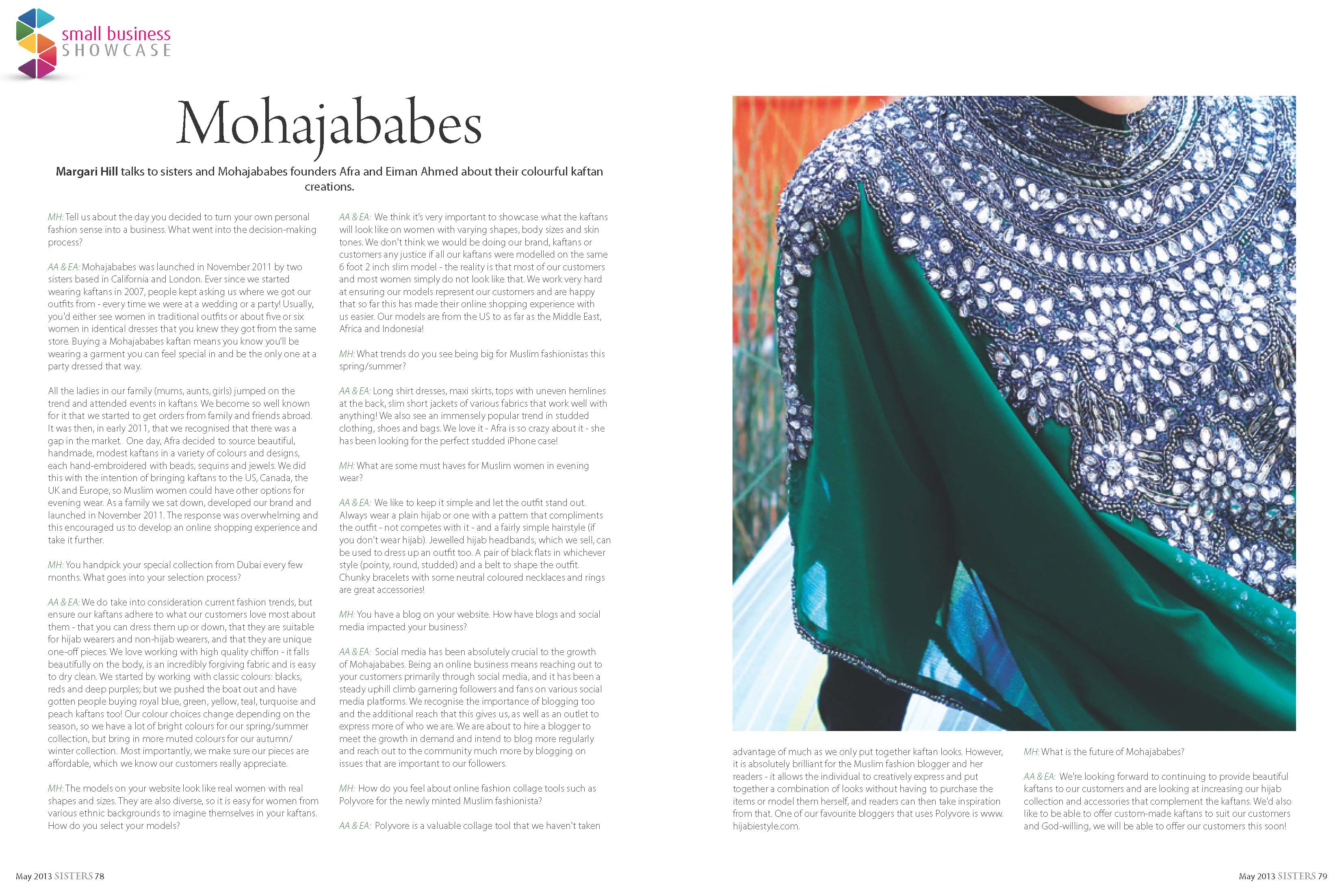
My Muslim Woman Owned Business Showcase: Mohajababes

Margari Hill talks to sisters and Mohajababes founders Afra and Eiman Ahmed about their colourful kaftan creations.

small business showcase

MH: Tell us about the day you decided to turn your own personal fashion sense into a business. What went into the decision-making process?

AA & EA: Mohajababes was launched in November 2011 by two sisters based in California and London. Ever since we started wearing kaftans in 2007, people kept asking us where we got our outfits from – every time we were at a wedding or a party! Usually, you’d either see women in traditional outfits or about five or six women in identical dresses that you knew they got from the same store. Buying a Mohajababes kaftan means you know you’ll be wearing a garment you can feel special in and be the only one at a party dressed that way.

All the ladies in our family (mums, aunts, girls) jumped on the trend and attended events in kaftans. We become so well known for it that we started to get orders from family and friends abroad. It was then, in early 2011, that we recognised that there was a gap in the market. One day, Afra decided to source beautiful, handmade, modest kaftans in a variety of colours and designs, each hand-embroidered with beads, sequins and jewels. We did this with the intention of bringing kaftans to the US, Canada, the UK and Europe, so Muslim women could have other options for evening wear. As a family we sat down, developed our brand and launched in November 2011. The response was overwhelming and this encouraged us to develop an online shopping experience and take it further.

MH: You handpick your special collection from Dubai every few months. What goes into your selection process?

AA & EA: We do take into consideration current fashion trends, but ensure our kaftans adhere to what our customers love most about them – that you can dress them up or down, that they are suitable for hijab wearers and non-hijab wearers, and that they are unique one-off pieces. We love working with high quality chiffon – it falls beautifully on the body, is an incredibly forgiving fabric and is easy to dry clean. We started by working with classic colours: blacks, reds and deep purples; but we pushed the boat out and have gotten people buying royal blue, green, yellow, teal, turquoise and peach kaftans too! Our colour choices change depending on the season, so we have a lot of bright colours for our spring/summer collection, but bring in more muted colours for our autumn/ winter collection. Most importantly, we make sure our pieces are affordable, which we know our customers really appreciate.

MH: The models on your website look like real women with real shapes and sizes. They are also diverse, so it is easy for women from various ethnic backgrounds to imagine themselves in your kaftans. How do you select your models?

AA & EA: We think it’s very important to showcase what the kaftans will look like on women with varying shapes, body sizes and skin tones. We don’t think we would be doing our brand, kaftans or customers any justice if all our kaftans were modelled on the same 6 foot 2 inch slim model – the reality is that most of our customers and most women simply do not look like that. We work very hard at ensuring our models represent our customers and are happy that so far this has made their online shopping experience with us easier. Our models are from the US to as far as the Middle East, Africa and Indonesia!

MH: What trends do you see being big for Muslim fashionistas this spring/summer?

AA & EA: Long shirt dresses, maxi skirts, tops with uneven hemlines at the back, slim short jackets of various fabrics that work well with anything! We also see an immensely popular trend in studded clothing, shoes and bags. We love it – Afra is so crazy about it – she has been looking for the perfect studded iPhone case!

MH: What are some must haves for Muslim women in evening wear?

AA & EA: We like to keep it simple and let the outfit stand out. Always wear a plain hijab or one with a pattern that compliments the outfit – not competes with it – and a fairly simple hairstyle (if you don’t wear hijab). Jewelled hijab headbands, which we sell, can be used to dress up an outfit too. A pair of black flats in whichever style (pointy, round, studded) and a belt to shape the outfit. Chunky bracelets with some neutral coloured necklaces and rings are great accessories!

MH: You have a blog on your website. How have blogs and social media impacted your business?

AA & EA: Social media has been absolutely crucial to the growth of Mohajababes. Being an online business means reaching out to your customers primarily through social media, and it has been a steady uphill climb garnering followers and fans on various social media platforms. We recognise the importance of blogging too and the additional reach that this gives us, as well as an outlet to express more of who we are. We are about to hire a blogger to meet the growth in demand and intend to blog more regularly and reach out to the community much more by blogging on issues that are important to our followers.

MH: How do you feel about online fashion collage tools such as Polyvore for the newly minted Muslim fashionista?

AA & EA: Polyvore is a valuable collage tool that we haven’t taken advantage of much as we only put together kaftan looks. However, it is absolutely brilliant for the Muslim fashion blogger and her readers – it allows the individual to creatively express and put together a combination of looks without having to purchase the items or model them herself, and readers can then take inspiration from that. One of our favourite bloggers that uses Polyvore is www. hijabiestyle.com.

MH: What is the future of Mohajababes?

AA & EA: We’re looking forward to continuing to provide beautiful kaftans to our customers and are looking at increasing our hijab collection and accessories that complement the kaftans. We’d also like to be able to offer custom-made kaftans to suit our customers and God-willing, we will be able to offer our customers this soon!

You can read this and other great articles in the May issue of SISTERS magazine.

Call for Muslim Men to Share Stories of Love, Sex, & Intimacy


Muslim Men on Love, Sex & Intimacy
SUPPLEMENTAL CALL FOR STORIES: Muslim Men on Love, Sex & Intimacy

You heard from the ladies in Love, InshAllah: The Secret Love Lives of American Muslim Women, now it’s time to hear from the men! Announcing a call for non-fiction, personal stories by American Muslim men on love & loss, sex & intimacy for publication by Beacon Press, February 2014.

This is our extended call for stories – in response to requests, we’ve opened this up to American Muslim men of all ethnic/racial backgrounds and perspectives.

NEW SUBMISSION DEADLINE: MAY 6, 2013 


WHY MUSLIM MEN?

For every stereotype about Muslim women, there are as many about Muslim men, lacking nuance, reflection or celebration. The search for romantic love impacts men’s lives deeply and yet there is little space for men to address these issues, share their experiences, or feel less isolated when it comes to affairs of the heart.

In the wake of Love InshAllah’s global success, continuing scrutiny of Muslims, and growing recognition in both the American and Muslim communities of the need to address the critical role of love, sex and relationships in men’s lives, it is the right time for Muslim men to share their intimate insights.

What does it mean to be a man? To love well? To be faithful and constant? What do you do if you fail at love? How do you move forward after you’ve broken someone’s heart or had yours broken? This anthology will explore the human heart and these universal and imperative questions from a Muslim perspective.

SUBMISSION GUIDELINES

Stories must be autobiographical and written by men who identify as both American and Muslim. We are looking for contributors who reflect a broad range of religious practice and perspectives, from orthodox to cultural to secular.

Write about a transformative episode that defined your dating/relationship/marital experience. Did factors such as religion, ethnicity, race, class, family, etc., play a role in your story? We want compelling real-life storytelling with dialogue and self-reflection, not essay-like commentary.

We prefer that authors write under their real names, but recognize that some topics are sensitive, so we are accepting a limited number of submissions under pen names.

DIVERSITY

Contributions are welcome from American Muslim men of all racial, ethnic, sectarian backgrounds, sexual orientation, ages, born and convert Muslims, disabled, single, engaged, married, divorced, or widowed.

DETAILS

Submissions should be between 1,500 – 4,000 words, double-spaced and paginated. Please send your submission as a Microsoft Word document attachment to stories@loveinshallah.com by May 6, 2013

Also include:

*Your full name & contact information

*Age

*Your geographic location

*Ethnic/racial background

*Sect

*Whether Muslim by birth or conversion

Stories will be selected for inclusion based on literary merit. You already know what makes good writing: humor, drama, irony, triumph, and focus. Bring your anecdote to life with vivid characterization, plot, and surprising real-life details.

PAYMENT

In accordance with publishing industry standards, writers selected for the anthology will be offered a TBD payment, 2 free copies of the book and the copyright of their story will revert to them one year after the book’s release to develop as they wish.

CONTACT

Feel free to email the editors, Ayesha & Nura at stories@loveinshallah.com with questions.

The ‘Yin’ of Mosque Leadership: Bringing in the Feminine Side

The Islamic Monthly published the preliminary findings of my research on women and mosque leadership:

How do women fair in American mosques? How do fellow worshipers treat them? Are mosques accommodating the multiple needs of the female community?

These questions have been on the minds of many in the American Muslim community for a long time. Many women have complained that they are not treated well in their houses of worship. Some concerned Muslim women have even taken to “shock and awe” tactics to change mosque culture by entering mosques, wearing hidden cameras to document their experiences, post these videos online and expose various types of discrimination.

Nearly a decade after the Islamic Social Services Association and Woman in Islam, Inc. released its pamphlet, “Women Friendly Mosques and Community Centers, ” which rated the friendliness of mosques, not much has changed for Muslim women.

To better understand how the American-Muslim community has faired in its treatment of women since this report was published, I decided to survey over 100 Muslim men and women and speak with female Muslim leaders, many of whom asked to remain anonymous. A number respondents argued that women have made only marginal gains in American mosques.   Female educators, scholars, activists, and community organizers are vital to the development of the American Muslim community. Yet, many mosques and community centersare not utilizing the intellectual and professional resources that Muslim American women have to offer.

Mosque attendance is optional for women, but so many women choosing to not attend raises some important issues.  I spoke with a female community leader who wished to remain anonymous about women-led organizations and traditional Muslim institutions. She highlighted what is at stake explaining, “When you lose women, you lose kids, and you lose the husbands as well. This is the crisis that we are in for the growth of Islam in America.” In addition, Ameena Jandali, a founding member, Content Director, and trainer of Islamic Network Group (ING) in the Bay Area, California, points out that not only women, but  “A lot of young people feel alienated by the mosque.”

Who could blame women for feeling alienated with the shabby carpet that is rolled out for them? Women’s accommodations are often cramped and poorly maintained. They enter through dirty back alleys, climb fire escape entrances, and navigate basement mazes to get to women’s sections. And many places do not prioritize women’s spiritual development or foster a healthy community life for women. “Women Friendly Mosques and Community Centers” estimated that one out of five mosques do not have programs for women at all and just over a quarter have only occasional activities. An anonymous interviewee raised the issue, “How am I going to be engaged in the mosque if there is nothing for me to do there?”

Mosques that do not accommodate women often do not encourage them to take leadership positions either. Since I began my research last year, I discovered that many are dissatisfied with the lack leadership and decision-making opportunities offered to women.   Several spoke about the dismissal of female voices on governing boards. One respondent put it succinctly, “Even if women are in leadership positions, male opinions tend to be dominant.” Another stated, “There is a general level of discomfort with women who are too vocal, too active, too opinionated.” While discouraging women from taking general leadership roles, many mosques encourage women to teach children at Islamic schools, sit on women’s committees, and volunteer for cooking and clean-up.  One respondent wrote:

There needs to be an overhaul on how we view women in Islam. I am sick of hearing how Islam gave women their rights and how we as Muslims value women but in reality we don’t. Once we see the need for women to be more than the assistant to people in leadership positions or the people behind the scene, we will have women want to do more in our communities.

Many felt that Muslim women’s contributions were not appreciated.  Lack of leadership opportunities, hostility towards female voices, and lack of appreciation is turning away many women who could make positive contributions on an organizational level.

Yet, some women have the passion, drive, and assertiveness overcome institutional barriers to contribute to their communities. Aliya Khabir, has played an active role at United Muslim Masjid (UMM) in South Philadelphia, which is under the helm of Imam Shadeed Muhammad. The imam has pushed for women’s programming and female education initiatives. While no women serve on the board at UMM, Aliya has carved out a sphere of influence in a non-official capacity. Aliya commented, “In their head, they are justifying it with ‘men are the protectors and maintainers.’ Nowhere does it [the Qur’an] say that men are better at decision-making and execution. Women possess these skills that are needed and necessary to properly operate a masjid and meet the needs of all attendees, me included.” She remarked that other professional women ask her why she invests so much time in a community that has not afforded women official roles. Aliya explained,  “It is because of my passion. It’s not about titles.” UMM is not alone, a significant portion of American mosques do not allow women to serve on their governing board.

The ADAMS center in Virginia, on the other hand, welcomes women in decision-making roles. Yasmin Shafiq, a board member of ADAMS, explains, “It was clear that the leadership at ADAMS values diversity in its membership and makes efforts to include the voices of young people, women, and otherwise underrepresented populations in the community.” Others have also looked to ADAMS as a model for encouraging female leadership and the community boasts an erudite female resident scholar, Dr. Zainab Alwani.

As a vibrant Islamic Center, ADAMS Center’s progressive approach indicates what Muslim communities could stand to gain from the expertise of Muslim women.

Women have led many successful Islamic organizations and initiatives outside the mosque. Yasmin acknowledged, “Unfortunately, I don’t think such traditional institutions usually have a well thought-out plan for utilizing highly educated women.” All of my conversations with female Muslim leaders emphasized women taking an active role in creating spaces for themselves, whether in the mosque or outside of it. Many people urged women to take initiative in their communities. Certainly, the success of communities that have welcomed women who are willing to step up to the plate makes a compelling case for mosques becoming a strong base for women’s empowerment. But we are not there yet, and more work needs to be done, by both men and women.

You can read the full article  and other thought provoking pieces at Islamic Monthly. Please post your thoughts in the comments section below.

The Relevance of Black American Muslim Thought

The Muslim American community is held together with the belief that there is no God but the One True God and that Muhammad is His prophet.  Muslims share daily patterns of worship, rituals of birth, marriage, and death. As one of the most diverse faith communities, Muslim Americans come from various ethnic, socio-economic, and cultural backgrounds.   Sometimes there are various articulations of Islam  due to different political, cultural, and religious orientations. Over the years, many Black American Muslims have been at the forefront of articulating Islamic thought for the growing American Muslim community. But this seems to have changed as a dominant narrative has taken over.

Some estimates go as far to say that there are 5 million Muslims in America. According to census data and information provided by mosques and community centers, Muslims in America make up .5% of the total population in America. Keeping it conservative, that equals just under two million. This still represents a significant number. CAIR reports that the ethnicities of mosque participants can be broken down to 33% South Asian, 30% Black American and 25% Arab, 3.4% sub-Saharan African, 2.1 European (i.e. Bosnia) 1.6% White American, 1.3% South-East Asian, 1.2% Caribbean, 1.1% Turkish, .7% Iranian, and .6% Latino/Hispanic. Other reports indicate the number of Black Americans may be even larger. Regardless of the numbers, there is no clear ethnic majority in American Islam. But these numbers raise some important issues: Who has the right to speak for American Muslims? Who are the real Muslims? Who will define the agenda for American Muslims? These questions have often been central to a debate that has emerged about the Black American/immigrant divide.

In America, there is fierce competition over resources which has led to some voices getting silenced in deciding the agenda for American Muslims. Within mainstream media, the Muslim American experience is about the immigration and assimilation experience. There is little press coverage or interest shown in the media on converts or the multi-generational Black American Muslim families. Sylvia Chan-Malik uses the term, “foundational blackness” to describe how contemporary Islam in America can best be understood by transnational affiliations that link gender, class, and religion, but also with its relationship with blackness.   However Black American Muslim foundations go back further, with memories of African Muslims enslaved in the America, even predating the formation of the United States. There are  also Sunni communities dating back to the 60s, such as Dar al-Islam movement. Some communities have origins much earlier, such as Quba Institute with roots in the 1930s Izideen village in New Jersey. Yet, consistently, there continues to be a portrayal of Islam as a foreign religion, with only internationalist interests. For over a century, some Black Americans have looked to African cultural legacies, addressed local issues, and have maintained transnational networks and ties, to articulate religious thought that is African, Islamic, and uniquely American.

While it is true that Black American Muslims were often drawn to Islam in an attempt to articulate their own cultural identity outside of the dehumanizing ascribed identity of Black inferiority, Black American Islam is thoroughly embedded in the American tradition. From the proto-Islam movements of the early 20th century, to the Black separatist movements of the 1960s, heterodox communities, and orthodox communities with leaders from or trained abroad, many Muslim communities sought to address social ills in America and globally. In particular, racism, economic and social inequality, economic exploitation, and family instability are on the main agenda of many Black American Muslim leaders. Before 9/11, some of the most prominent voices in American Islam were African Americans, including Warith Deen Muhammad and Siraaj Wahaj. Their status as citizens afforded them the privilege to critique American society and foreign policy, without compromising their Americaness. The protest tradition of many leaders helped forge a space for the next generation of immigrant and descendant of immigrant Muslims Americans to assert themselves in the public sphere. Following the events of 9/11, there has been an increasing silencing of Black American Muslim voices: a combination of little to no media acknowledgment of BAM’s as well as a systemic neglect on the part of immigrant Muslims. Over time, Black American spokespeople were gradually eclipsed as national Muslim organizations with strong immigrant interests sought to assert their agendas and provide the dominant narrative of immigrants assimilating to American values.

In contrast to the hegemonic narrative that has rendered them invisible, Black American Muslims are  vital to the health of this diverse Muslim community.  They have also continued to make great strides politically, socially, and culturally. This includes two Black Congressmen, Keith Ellison and Andre Carson, the growing prominence of intellectuals and scholars, most notably feminist scholar, Amina Wadud, and Aminah Beverly McCloud, who wrote African American Islam,  Sherman Abdul-Hakeem Jackson, and Zaid Shakir. There are also many young scholars, such as Jamilah Karim, Su’ad Abdul Khabeer, and Intisar Rabb. There is a large wave of Black American Muslim leaders who have demonstrated mastery of Islamic sciences and have graduated from Muslim institutions of higher learning, including Abdullah Ali, who earned a degree from  Al-Qarawiyin University of Fes. Black American Muslims have made cultural gains including a feature length film, “Mooz-lum,” and prominent Hip Hop artists, including but not limited to Lupe Fiasco, and Yasiin Bey (Mos Def).  The Abdullah brothers shared their story of taking time off from from the NFL to perform the annual Muslim pilgrimage (Hajj). The fencer,  Ibtihaj Muhammad, was the first Muslim woman to compete for the United States in an international competition and win a medal. Black American Muslims are very much part of the fabric of America and often play a daily role in interfaith dialogue, as many of them have family and loved ones who are non-Muslim.

Black American Muslims have used their social capital to critique American foreign policy, Islamophobia, and erosion of American civil liberties. As a group, Black American Muslims are far from nativists, as many identify with and relate to  numerous international and transnational Muslim communities. They are much more likely to attend a mosque in which another group dominates, showing their willingness to assimilate into an immigrant dominant mosque. Black American Muslims participate anti-war protests, critique extra-judicial killings through drone strikes in Chad, Mali, Yemen, and Pakistan, raise money for war refugees in Syria and alleviate suffering in natural disasters in Somalia and Pakistan. Yet  pressing social issues in their home communities, such as economic inequality, street violence, and family instability, play a large role in their everyday lives. Crime, poverty, and marriage are common issues raised in the Black American Muslim discourse from the minbar to the lecture hall. These issues also shape their outlook, which in turn causes them to be empathetic to the plight of others at home and abroad.

Perhaps the flexibility of thought can be tied to the Black American  Muslim identity, which is comprised of multiple intersections.  They are connected to many faiths and ethnic groups as part of this nation building project that we call United States of America. They are connected to many faiths and people who were either forcibly or willingly migrated to other lands  as part of the African Diaspora. They find connections with people on the African continent, and Black communities in South America and the Caribbean. They are also connected to people all over the world in  a multi-ethnic global community,  ummah. These connections have given Black American Muslims a unique juncture to relate to and speak on various issues and causes. Black American thinkers continue to be influential in defining American Muslim thought, as they connect their day to day lives with Muslims globally.

It seems to be willful ignorance on the part of the media, scholars, and some organizations to overlook these important contributions and connections.  The occlusion of Black Americans despite the continual relevancy of Black American Muslim thought makes it especially important to document this  intellectual heritage.  Indeed, we must go beyond documenting the life histories of major Muslim leaders and begin to study transformations in Muslim American thought. I look forward to the next wave of scholars who study Black American Muslims, such as Donna AustonZaheer Ali, and others who will shed light on roots of Black American Islam. These scholars can help us look at the ways in which Black American Muslims drew upon their intersecting identities in their interpretations of textual traditions in ways that address their global and local issues. I look forward to future studies of our rich intellectual traditions and the insights  that these brilliant scholars can bring to the discussion about American Islam.