Obama and the Discourse on Race in the Muslim Community

This post is a collection of ideas that developed elsewhere on blogs and in email exchanges.

Those who have mixed feelings about Barack Obama’s election are often focused on foreign policy issues, specifically Palestine. This victory has more to do with an internal change in American society, foreign policy issues. But it has everything to do with the place Black Americans have in American society. And for Black American Muslims, this also profoundly changes the defined roles we have in American society. The most famous and recognizable Black man is an intellectual and Head of State (considering the last presidency, I think it is important to point out both). The reality is, that the public image of Black Americans, and let us not forget Africans on the continent and in Diaspora, defines our role in the American Muslim community. How so? Our public image shapes the ways in which our fellow co-religionists see us. Barack Obama’s presidency inverts a number of stereotypes that many in the Muslim community in the US and abroad have about Black Americans. In much of Muslim world outside of sub-Saharan Africa, people associate Blackness with slavery and inferiority. I recognize that this might not change the fact that when I go to the masjid in America, some immigrant Muslims will assume I am uneducated, broke, and not as valuable of an asset to the Ummah as a white convert.

While his presidency might not change all their negative associations, most people never imagined that so many white Americans would vote for a Black man as head of state. It signals that we are part of the American fabric, not just waiting for the some outside force to raise us up from our undignified and destitute state. Muslim organizations that cater to immigrant communities may begin to see that it is politically expedient to align themselves with the Black community. Elected officials have to address the Black interest groups and political and community service organizations. We have two Black American Muslim congressmen, which I think is telling in light of the fact that associating with Muslims is still a political liability. Only recently have some Muslim organizations saw the importance of working to build coalitions with the Black political establishment, like the Black Caucus, and organizations that have addressed the needs and interests of Black Americans as well as other ethnic groups.

This reminds me of an event I sent to organized by ING, where I realized how Black American Muslims were rendered invisible in the discourse on Islam which was dominated by mainstream national Muslim organizations and the media. On that day I went to an ING event where the theme was the faces of American Muslim women. Although there are so many Black Muslim professional, student, and volunteer women, not one had been invited to speak. There were Arab women, white women, South Asian women, even East Asian women, but not one Black woman. Given that we are 40% of the Muslim population, I found that extremely odd and in fact insulting. They were saying, “We are just like you, Americans!” A number of organizations have marginalized Black voices in their attempts to portray Islam as an American religion. They have highlighted and celebrated white converts over Black converts, seeing the conversion of white Americans as a symbol that Islam was accepted by a mainstream American. I believe that Obama’s presidency will help show that our more backwards thinking brothers and sisters do the Muslim community a great disservice by trying to ignore the historical contributions of Blacks in America, and Black American Muslims in the Muslim American community.

Right now, the real tensions in the American Muslim community will be between those who wish to create their ethnic enclaves in order to insulate their children from becoming American and developing new hybrid cultural identities. The real tension is between those whose interests are geared more towards issues abroad and those who are concerned with transforming America into a more egalitarian society and thereby changing our policies abroad. People are already voicing expectation of disappointment even before he has been sworn in. Yes, he made a lot of problems, some will not be able to come to fruition in light of the political machine that he is operating in. This is not the same thing, or just a Black face on political power.

Obama’s victory is what can happen if we believe we can do it and work towards our goals. This is about how WE need to change things. American Muslims should be motivated to mobilize and be part of the political process in order for us to be a force to be reckoned with. For the most part we’ve taken ourselves out of the game. So how are we going to hold anyone accountable, let alone a president? The thing about democracy is that accountability is seen in the election process. Elected officials have to appease their main constituencies, as well as the interest groups that support their campaigns. The big constituencies and most powerful interests groups win out. That may not be right, but it’s pragmatic and that’s what politics is about. What lobby group do we have? Have we created any effective civil society institutions to help counteract the abuses of government? And for those few that exist, do we have a plan to support them? How many of us are trained to be on any advisory counsel or even qualified to be tapped as major advisor for policy making?

Two things seemed like a far off dream when I was a little girl: Mandela becoming president of South Africa and a Black man becoming president. Both happened in my lifetime. That leads me to imagine what types of changes can happen in the American Muslims community and the ultimate influence we can have in this society and eventually in the world scene (and not just Middle East).We need to move from ideals to move towards real action. This is our opportunity as Muslims to own this. American Muslims are largely affluent, have global ties in family and ethnic networks, a wide range of skill sets, and a country that affords us the opportunity to make the most of our material, spiritual, and intellectual assets. In light of what we do have in this country, what should Muslim Americans be doing 1 month from now? 6 months? 1 Year? 4 Years? What about in 20 years?
That’s Deep: A Racist Africa Lover?

My brother was insulted and threatened with arrest by an elderly white lady on Stanford’s campus after he tried to rescue me from a very difficult predicament. He came to look at my loaner car which got stuck in front of a residence hall on campus. The transmission failed and wouldn’t shift into reverse. It only went forward, and since the other end of the driveway was blocked off I was unable to get out. In an effort to get the car to shift and find a way out, I inadvertently slid it down a path way and partially on to the lawn. My friend who lived at the residence tried her luck and working the gears under her uncle’s phone directives. Things weren’t working, the situation went from bad to worse. I had to run to class to meet a student and show a film on the other side of campus by 7:30. I then met my brother at 8:30 and we drove back to my stuck car. As he got out of the car and tried to see what happened, she promptly opened her window and started launching insults and threats of calling the police. He immediately returned to his car, enraged. He informed me that the elderly white lady called him a nigger, among other things. We waited for the tow company but found that he didn’t have the proper equipment. So, I had to go back this morning at 8 and waited for an hour to get the car pulled out of its quagmire. The same woman recognized me from the many African studies events. She said, “Oh, it’s you! What are you doing you IDIOT! Bikes go up and down the pathway!” I tried to explain, but she shut the window. I was able to drive the loaner car home because I didn’t need to go in reverse. I’m hoping that my own car will be fixed soon and that I don’t have to deal with this anymore. My mother told me today to not ask my brother for help if I have car problems. I live in Palo Alto, which is still a ridiculous city where Blacks are often seen as oddities or looked at with suspicion. He didn’t need the legal problems and any confrontations with police.

I see this elderly lady all the time at Africa studies related events. I am incensed that she would insult my brother and threaten him over something that was not his fault. I am especially appalled that she would use the word nigger. I want to do something to expose her for the racist, mean spirit, phoney that she is. How could someone so fascinated by Africa turn to racial epithets and insults. Considering what generation she comes from, I guess it is not so surprising. So, in your opinion should I say something at the next Africa table. Should I ask her loud and in front of other people if she called my brother a nigger and to demand an apology?

Just Another Blog Entry About Our First Black President

This is a remarkable evening. I believe we are in the beginning of a new era as Americans. I’ve cried several times over-joyed by this historic moment. Fifty years ago this was unthinkable, parts of America denied Blacks the right to vote. Forty years ago, this was still unthinkable as America’s cities exploded in riots following the death of Martin Luther King Jr. Thirty years ago, this was unthinkable, as most Black Americans were still grappling with the legacies of Jim Crow and the disproportional effects of the deindustrialization of our inner cities. Twenty years ago, the idea of a Black man in the White house was a joke. It was a cruel joke about the pervasiveness of social inequality and racial prejudice in American society. Even when this campaign started, I thought it was a long shot. I was overseas when Barack Obama secured the nomination for the Democratic Party.

Obama’s victory is not just for the Black community, but all Americans. And it is clear that Americans from all walks of life believed in what he represented. But I wanted to focus on what he means for the Black community. I wanted to put his victory in the context of struggles my ancestors and the injustices experienced. I’m thinking about how Frederick Douglass, Sojourney Truth, George Washington Carvery, Booker T. Washington, W.E.B. DuBois, Clayton Powell, James Baldwin, Langston Hughes, Thurgood Marshall, Ida B. Wells, Martin Luther King, and so many other unnamed great Black thinkers and pioneers would feel about this moment. Without doubt, they would be overjoyed. This night would have likely seemed like a fantasy for them. I voted for Obama because he represents that legacy. I voted for him because I believed that he was the most capable of making the necessary changes within the political field. Don’t get me wrong, I do not think he is the messiah Nor do I think that the institutionalized racism that has been embedded in American society for so long will be erased due to his presidency. But rather, his presidency represents hope that we can overcome those boundaries.

We face many challenges to ensure that America makes good on her promises. Americans of all races, genders, orientations, faiths, and ages have been inspired. I believe the Black national anthem is true for all of us. If I could sing, I’d sing it celebrating the this victorious moment by singing the Black National Anthem.

Lift every voice and sing, till earth and Heaven ring,
Ring with the harmonies of liberty;
Let our rejoicing rise, high as the listening skies,
Let it resound loud as the rolling sea.
Sing a song full of the faith that the dark past has taught us,
Sing a song full of the hope that the present has brought us;
Facing the rising sun of our new day begun,
Let us march on till victory is won.

Stony the road we trod, bitter the chastening rod,
Felt in the days when hope unborn had died;
Yet with a steady beat, have not our weary feet,
Come to the place for which our fathers sighed?
We have come over a way that with tears has been watered,
We have come, treading our path through the blood of the slaughtered;
Out from the gloomy past, till now we stand at last
Where the white gleam of our bright star is cast.

God of our weary years, God of our silent tears,
Thou who hast brought us thus far on the way;
Thou who hast by Thy might, led us into the light,
Keep us forever in the path, we pray.
Lest our feet stray from the places, our God, where we met Thee.
Lest our hearts, drunk with the wine of the world, we forget Thee.
Shadowed beneath Thy hand, may we forever stand,
True to our God, true to our native land.

And still we rise…

Racial Profiling and Citizenship

Beyond maintaining a system of distinctions, narratives of crime create stereotypes and prejudces, and they separate and reinforce inequalities. In addition, inasmuch as the categorical order articulated in the talk of crime is the dominant order of an extremely unequal society, it does not incorporate the experiences of domianted people n(such as the poor, nordestinos, and women); rather, it criminalizes and dicriminates against them…Finally, the talk of crime is also at odds with the values of equality, tolerance, and respect for others’ rights. The talk of crime is productive, but it helps produce segregation (social and spatial), abuses by the institutions of order, contestations of citizens’ rights, and especially, ciolence itself. If the talk of crime generates order, it is not a democratic, tolerant egalitarian order but its exact opposite.

Teresa Caldeira, City of Walls: Crime, Segregation, and Citizenship in Sao Paulo, page 39
This morning I had my suspicions confirmed about how the Palo Alto police force would respond to a recent string of robberies nearby campus. Yesterday, a brief article by SFgate,Palo Alto police told to question blacks, reported:

Chief Lynne Johnson spoke to residents about the crime surge Thursday at City Hall.

She says she issued the instructions because several suspects in the robberies are African American and police lack detailed descriptions.

Johnson says she does not want to create an environment of fear for “people of color.” But she says authorities have to do their “due diligence” in catching the suspects.

She says people who are stopped have the right not to talk to police.
Palo Alto’s police chief has instructed officers to question African Americans in the city following a spate of recent street robberies.

ABC local has another version of the story here:

She said because several of the suspects are African-American and the descriptions are vague, she’s instructed her officers to make contact with African-Americans in Palo Alto.

“When our officers are out there and they see an African-American, in a congenial way, we want them to find out who they are,” said Chief Johnson.

I began to think about the ways Palo Altons talk of crime and the implications this has for Black residents and Black students on Stanford’s campus. This is the reality that Black residents from East Palo Alto, before most of them have been pushed out do to economic pressures and gentrification, have had to experience when they crossed segregating Highway 101 to stroll the pristine streets of University Ave. With this increased scrutiny, Black people from nearby areas feel even less inclined to visit Palo Alto for social events or boutique shopping.

While Palo Alto is an largely white space, Stanford’s undergraduate Black community is representative of national figures where they number at about 12 percent. When these future leaders step off campus and go to restaurants or run an errand on University or California avenue, not only are the under increased because it is clear that they are outsiders in this ethnically homogenous area, by default they are considered suspects. No white student at Stanford is subject to this type of scrutiny or form of institutionalized racism. But on they must make sure that the private security knows that they belong to the campus community. They are not just from across the highway, from East Palo Alto, crashing some party, invading some dorm. Off campus and on campus, they are denied a sense of belonging.

Can’t you smell the stench of irony of this crap, especially in light of Nov 4th? If Barack Obama was walking down University Avenue, would the police approach him with questions trying to figure out if he belonged? Would they try to sort him out, unable to distinguish whether he was a the good type of Black as opposed to the criminal sort? Young Black men in suburbia have just as high arrest rates as in high crime areas. That is because no matter where they go, they are always being suspected as criminals. Growing up, I remember my mother going down to the police station screaming at the officers who hauled my brother in after pulling him over for loud music and tinted windows. He sat in jail as a person of interest. For all the times he was pulled over and hand cuffed as a person of interest just because he fit the description, of what? When crimes are committed by whites, not every white male is stopped, questioned, and charged with minor infractions just for just cause. America continues to incubate injustice and the exclusion of its citizens based on race. Few Black people have encounters with the state, except in their encounters with the police. And often these encounters are shaped by Racial profiling. This form of institutionalized racism that equates crime with race. It targets Blacks not for protection as law abiding citizens, but assumes they they need to be monitored and screened because they fit. This, in and of itself, is a violation of citizen rights. It violates the rights of those who are targeted for racial profiling to move freely in public spaces and treated equally by the state. When the very institution that is meant to preserve order and rule of law singles you out, how can you feel like this nation sees you as a true citizen even if they are electing someone who “fits the profile?”

Update

The Stanford Black community responded swiftly. Kenneth Gibbs wrote the city council and mayor/city manager. They responded promptly with condemnations. Stanford African-American groups join chorus denouncing Palo Alto police chief

Immediately, community leaders — from the president of the NAACP, the mayors of Palo Alto and East Palo Alto, church leaders and legal advocates — condemned Johnson’s remarks, characterizing the police practice she described as racial profiling and suggesting Johnson should resign.
Monday night, City Manager James Keene told the city council that he had commissioned an auditor to review the department’s policy on racial profiling and that he had arranged to meet with city staff to hear their concerns.

Also Monday night, a coalition of black student groups asked city officials to review how the police department conducted its investigation into the robberies; to provide diversity training for all department employees; and develop an outreach program to improve race and community relations.
“I feel there needs to be an inquiry,” said Rodney Gateau, president of the Black Graduate Students Association, in an earlier interview with the Mercury News. “This needs to be scrutinized. This is more than a misstatement by a police official.”

This is an example of how students can make a difference. It still amazes me that Johnson said what she said so flippantly and matter of fact. I know I’m late on writing a letter. But I will write mine. We have to keep sending a message that we will not take injustice lying down. Good work!!

Random Thoughts on the Return

As I continue my extended procrastination session of checking email, I thought I’d put down some of my half developed thoughts about life back in America.

Theory and Praxis:
About ten years ago, I really struggled with the difference between Islam as an ideology and the ways Muslims lived it. I also began to doubt the ability of our generation to practice the spirit of this tradition. I never lost faith in the Message, but doubts about practice really wrecked havoc. The reality is that praxis and theory are intertwined, thoughts shape behavioral patterns and behaviors shape thought; belief influences practice and practice informs belief. I sat at a conference organized about a year and a half ago discussing African Muslim intellectuals and the archive. When Professor Butch Ware, now of University of Michigan, moved me as he talked about his research as a believer who practices his faith. Much in the same way, I admire and respect Sherman Jackson, and other scholars have are critically engaged with this tradition while at the same time embodying it. Initially, when I began my academic journey, I had hoped to build both worlds. By picking and choosing, operating within a framework that was not my own, I was loosing out. My strength as a young academic came from my own insights gained from my lived experiences as a Muslim and epistemological frameworks that were not entirely Western or Eastern. So, this leads to another one…

Fence Sitting
I’ve been gone for a year and a lot has changed since I’ve been away. A lot has changed in me and it reflects in the lifestyle changes I’ve made and my way of being in the world. What it really came down to was making a choice, to not be a fence sitter anymore. It was easy to be non-commital, but committing to something and failing was my worst fear. I kept trying to find a comfortable space without all the anxiety of being forced to grow. Over the years, I saw my potential for human development and fall ridiculously short as I regressed. I saw the same pattern in people I knew and cared about, and I saw the damage left in the wake. Before I left for Egypt, I wrote about my desire for inner grounding and personal transformation. I wrote with urgency to friends asking for prayers and well wishes as I knew this was make it break it time. And yes, sometimes we are broken only to be repaired and retrofitted to became a stronger edifice. My mentor told me that when we turn to or Lord for guidance on making decisions, it will be evident that the choice has been made when we have only one option to take. After about ten years of straddling both worlds, and one year in societies deeply infused with Islamic values and practices, during the final month before I left that world, I made my choice.

Obama
I received my ballot in the mail, and I cannot tell you how excited I am about being able to participate in this event. I am the first to admit that I’m not into politics too much. But I don’t buy that balderdash that some Muslims send out about it is haram to vote. Minus those fundamentalists (yes I will use the word), who cannot have something to say about this election? I was a skeptic at first, growing up the idea of a Black man in the White House was something we joked about. It was a dream, of course. I also thought maybe it was a set up, after two disastrous terms people would blame a Black man or a woman for not being able to clean up Bush’s mess. Regardless, l recognized this was a historic moment. I was abroad as the campaign picked up, and my perspective on the primaries and elections was filtered through Arab media and the majority of my interactions have been with Arabs and African Muslims living in Cairo. I realized that the entire world was electrified by Obama. Especially considering America’s dark history of slavery, Jim Crow, and institutional racism, Obama’s candidacy is truly phenomenal. He’s not Nelson Mandela, but Obama’s candidacy is nearly as symbolic. They see it, much in the way that I see it, Barack Obama’s candidacy symbolizes that America is truly a place where you can rise based on merit.So, it was strange coming back to the states and listening to our media. It was like the neocons lived under a rock somewhere, insulated from the rest of the world. I felt like I came home to a different country, but there still seems to be some sane people. Most of them are voting for Obama.

Blogistan: The Fate of Muslim Bloggers
Over the past year, Blogistan has lost some of its steam. But since I’ve been back, the entire map of blogistan has been redrawn as we lost so much territory. People are writing less, dissension has grown, ugly battles and physical threats have tarnished what could possibly develop into a republic of ideas, where scholars and lay people can discuss ideas democratically. I was saddened by the loss of several really amazing blogs, especially Sunni Sister and the numerous blogs that have gone to restrictive access. I know that commentors are not always civil, some get veiled death threats, and others bloggers are just socially ostracized. Before the whole string of shut downs and privatization, I thought about making a public call to all my sister bloggers. I still believe that blogging can change the future of writing. I think that it is one of the few ways that Muslim women can get their voices heard on the minbar. I hope that we can develop better standards to develop ideas and work towards positive change, or at least get us to think deeply about issues and reevaluate our institutions and traditions. What are some of the blogs that you miss?

Teaching Race and Islam

One of the best experiences in graduate school is teaching and this quarter I have the opportunity to teach my own historical sources and methods course on Race and Slavery in Muslim societies. Here are some snippets from my course:

Slavery, Race, and Society in the Middle East and Islamic Africa from the 7th century to the 20th century

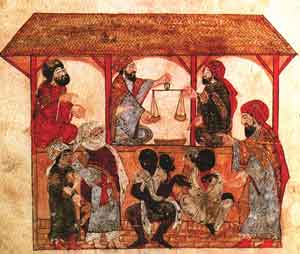
Why are there still reports of slavery in some Muslim majority countries? How does slavery and race overlap in Muslim societies? During the rapid expansion of Islam from the Arabian Peninsula to Asia, Africa, and parts of Europe, Islamic concepts of universal brotherhood at times united disparate ethnic groups and various social classes. Yet, the Muslim world experienced one of history’s most substantial slave revolts and numerous ethnic conflicts. This course broaches a number of questions involving slavery and community identity in the Middle East and sub-Saharan Africa.

COURSE DESCRIPTION
Students will have the opportunity to explore issues of slavery and ethnic-identity Muslim societies in the Middle East, as well as sub-Saharan Africa, through a close reading of primary sources. Students will analyze Islamic religious texts, epics, poetry, prose literature, Arab and European travel writings, slave narratives, polemics on slavery and race, inventory and manumission documents, colonial reports, and pictorial representations. As this is a comparative course covering a broad historical sweep, students will be required to compare and contrast periods and geographic regions. This course also allows students to examine the particularities of various Muslim societies keeping in mind universal Islamic principles. Throughout the quarter we will explore historiographical issues raised by studies of slavery and race in Middle Eastern and Muslim societies.

This is a thematic and comparative course examining several periods and locales. The course introduces Islamic principles of universal brotherhood and the Muslim community and examines how various Muslim societies dealt with social inequality, slavery, and ethnic boundaries. The chronological range stretches from the classical period of Islam (from the rise of Islam in the 7th century to the 10th century), African slavery including trans-Saharan slave trade until 1800 and Indian Ocean slave trade, trans-Atlantic slave trade, and the abolition of slavery in the Anglo-Egyptian Sudan during the early 20th century. The quarter concludes with an examination of slavery in the Muslim societies in 20th century.

 In the course, we examine various types of sources to try to explore themes of race and slavery over time and through space. One of the challenges is that you will find that there is no clear coherent narrative of slavery. The issues play out different depending on the society and historical circumstances. This is why I picked the following thematic approach:

Week 1. Islamic Traditions on Slavery and Race

9/22 Introduction to the Course

9/24 Islamic Traditions on Race and Slavery

Race: Quran Chapter 49 verse 13 3 translations; Prophet Muhammad’s Last sermon

Slaves: Primary: The Qur’an and Hadith on slaves in Hunwick 2-7

Week 2. Transformation in Slavery from Pre-Islamic Arabia to the Early Muslim community

9/29 Pre-Islamic  Traditions ‘Antar: From Slave To Knight (late 6th century)

10/1 The Caller: Islamic views on slavery and  Bilal ibn Rabah (7th century)

Week 3 Islamic Dynasties and Slavery

10/6 Berbers and the Islamic Conquest of North Africa (7th and 10 century)

10/8 The Abbasids: The Zanj  (10th century Iraq)


Week 4. Muslim Civilization and Cultural Encounters

10/13 The Shuubiya: High culture and  Controversy between Arabs and Persians (10th and 11th century Iraq and Persia)

10/15 Discovery of Europe (10th century Iraq)


Week 5 Medieval Arab views of Africa

10/20 Blacks in Arabic Literature

10/22 Sociology and Travel literature: Ibn Battuta and Ibn Khaldun


Week 6 Concubines and Royal Soldiers until the Early Modern Period

10/27 Mamlukes and Ottomans

10/29 Inside the Harem: Concubines and Eunuchs


Week 7. The African Slave Trade

11/3 Trans-Saharan Slave Trade

11/5 Indian Ocean Slave Trade


Outside Film Viewing : Prince Among Slaves, Preliminary Dates Week 11/5 or 11/6


Week 8 African Slave Narratives

11/10 Slavery in Africa

11/12 African Muslims in the Americas


Week 9 Islamic Slavery and the West

11/17 Barbary Pirates and White Slaves

11/19 Islamic Slavery and the European Lens


Week 10 Slavery in the 20th Century

Readings on Slavery Sudan and Mauritania


I have the privilege of a small class with a group of sharp and motivated students. My class is multi-cultural with students from various backgrounds and majors. As the texts get richer, they are contributing critical insight into the texts themselves. So far, we have examined the Qur’an, the hadith, the Prophet’s Last Sermon, one of the seven hanging verses written by ‘Antara, early biographical literature, al-Tabari’s account of the Zanj Salve revolt (one that he lived through), Ghazali’s text on the rights of slaves, al-Jahiz’s humorous essay on the “Glory of the Blacks,” and this quarter we have still more to come. Some of what we find in the text is jarring, at times it confirms our assumptions.

By the end of this course, I hope to write a scholarly article on teaching race and Islam. There are many challenges and problems in teaching slavery and race. There is no clear historical narrative linking all the case studies we are exploring. But what we do have in each case is the acceptance of slavery and inequality as a given. The course is not polemical, we often refrain from making judgments, at the same time we try to not overly historicize and overlook the brutality of human bondage. But by looking at the ways we can reconstruct the voices of the enslaved, understand how Muslim elites and literati thought about slavery and race, and explore the debates and contestations that centered around servitude and community identity, we can better understand these societies. Looking at slavery does not tell us everything about a particular society, but it provides an important view into the ways in which people saw themselves, the ways they asserted their power over their lives and/or over others, and the relationship that individuals had with power. Through this type of critical engagement my students will be better equipped to dialog about race and inequality both in Muslim majority societies and within Muslim minority communities in the West.

Charles Catchings lent his support by providing a rare edition of the al-Jahiz text. We spoke of doing some collaborative work to make the text more available, as well as many of the insights we’ve explored this quarter. I encourage you to be on the lookout for this upcoming project. In the meantime, I am working on a short reading list of primary and secondary sources for those who are interested. Please email me if you are interested, I’d love to hear your thoughts on these texts also.

Eid Gifts for Needy Children at Granada school


A good friend asked me to distribute this worthy cause in honor of her mother Madeha Lashin (Allah Yarhumha), for the needy children at Granada school. Because I was asked to forward this on to friends and family and I consider you all friends, I decided to pass this on:

Asalam Alaykum

Ramadan Kareem
Hope this letter finds you and your loved ones in good eman and health.
An email was just sent out for the children abroad. Hope you have a little more generosity left. Many of you have been so helpful in aiding us to provide eid gifts, clothing, and supplies for needy children at Granada. They have kindly asked us to carry on. Hope you have it in your heart to give a little for these community kids. This is a tradition that my mother has passed on and we’d like to keep it going.


Ramadan is moving fast and I’m sure we all hope for forgiveness and mercy. It’s always a good time to give saddaqa especially now in this blessed month. Please send your contributions. We all know that finances are tight for most people now. May our eman and bank accounts all be expanded for the better by helping others who are in need. Honestly, even $5 can help. Everybit counts.
You can send your contributions to 315 Bagshaw Ct, San Jose, Ca 95123. Barak Allah feekom. May Allah be pleased with your efforts and multiply your rewards. Please distribute to your friends and family.

The American Muslim community has made tremendous inroads by the tireless work and dedication of people like Madeha Lashin. So many of us were saddened by her long illness. But she has contributed to an important legacy. In this short time, I really cannot convey the impact that she and her family has made in my life. I owe Madeha Lashin for giving me the chance to find myself. Years ago, I used to substitute teach at Granada school and served as a teaching assistant volunteer while attending Santa Clara University. It was in this environment that I discovered my love for teaching.

Madeha Lashin: Pharmaceutical degree from Cairo, Egypt. She worked at Granada Islamic School for ten years, first as a substitute teacher and then teaching Arabic and Biology. She went on to serve as principal for four years providing the strong leadership that helped the school advance and achieve a new professionalism, team spirit among the staff, and a love of Islam and learning among the students.

As stated in the email, one of the traditions Madeha passed on was collecting funds to help needy children with gifts and supplies. May Allah have mercy on Madeha, bless and reward her for her efforts and contributions to the Muslim community and humanity in general. She was like so many women in our community, the very backbone that helped it hold its head up straight. Please honor the mothers, daughter, aunts, sisters, cousins, and friends who volunteer and work so hard to egive our children a solid foundation and ensure a bright future. You can make it a little brighter and put a smile on a young child’s face. It is not too late to give, please consider doing so as Ramadan comes to a close and you celebrate Eid al-Fitr.

African-American/Muslim-American Dialogue: Building an Interfaith Movement

Over at the I Love Dar al Hijrah site, there are some great pics of the first ever national forum focusing on Muslim and African Americans (hat tip to Tariq Nelson). Yesterday, the Congressional Black Caucus held a panel titled, “African-American/Muslim-American Dialogue: Building an Interfaith Movement.” Representative Keith Ellison sponsored and moderated the panel and the panelists included Representative Andre Carson, Mahdi Bray, Reverend Jesse Jackson, and Dawud Walid. I am very pleased to hear about this type of dialog and we need more of this on a local, state, and national level. It is especially pertinent with this upcoming election.

Here’s some information about the Congressional Black Caucus foundation

In January 1969, newly elected African American representatives of the 77th Congress joined six incumbents to form the “Democratic Select Committee. The Committee was renamed the Congressional Black Caucus and the CBC was born in 1971. Founding Members were Representatives Shirley Chisholm, William Clay, George Collins, John Conyers, Ronald Dellums, Charles Diggs, Augustus Hawkins, Ralph Metcalfe, Parren Mitchell, Robert Nix, Charles Rangel, Louis Stokes, and DC Delegate Walter Fauntroy. Their goals were to positively influence the course of events pertinent to African Americans and others of similar experience and situation, and to achieve greater equity for persons of African descent in the design and content of domestic and international programs and services. While the CBC has been primarily focused on the concerns of African Americans, the Caucus has also been at the forefront of legislative campaigns for human and civil rights for all citizens.

For more information visit the Congressional Black Caucus Foundation. I encourage every to visit Dawud Walid’s blog for the audio of this timely panel. I was only able to listen to a portion of it, but I’d love to hear back from participants, commentators, and audience members. What are your thoughts? What are some of the ideas and plans going forward? How are we going to make sure that this country moves in a more positive direction for the next four years.

Is it Me

…or is this year’s Ramadan kicking a lot of people’s butts? Is it the heat? I mean, I fasted in 115 degree Fahrenheit. But that doesn’t count, I was doing that with a much more relaxed pace while I was in Kuwait. We had lots of air conditioning too. I was excited that I’d spend a few days of Ramadan in Egypt. But I had I had no idea what I was in for during those first few days. I first moved across town in Cairo, then across the world. You wouldn’t believe how much stuff you collect in 7 months. I got rid of most of my stuff and some of the stuff was apartment stuff that I hope helped my roommate settle in comfortably in the new pad. Then I headed off hauling a giant dufflebag and broken suitcase thousands of miles. Within hours of arriving in California, I was working. I hit the ground running, school, work, catching up, and of course, Ramadaning. I fasted on top of the most extreme case of jet lag and ridiculous sleeping schedule. Then there was the culture shock. No Ramadan lights and no special Ramadan hours (well those can be annoying if you need to get anything done because everything is closed). Nothing slows down for us during Ramadan in the U.S.

Sometimes it is hard to feel the magic in the US when the people you love aren’t sharing the hunger and anticipation of eating with you. I have one of those grueling schedules that makes it near impossible to go iftar hopping, go to taraweh prayers at the mosque, go to any talks, let alone increase worship and self reflection. I guess for me it was hard because I felt the loneliness of being a Muslim convert, especially one that has not been embraced by a community. I’m not saying I don’t have friends, I have lots of them. But we are all now pretty dispersed and immersed in our own lives. My roommate threw a welcome back dinner during my first weekend back, and two of my Muslim friends showed up. But the tone of the event wasn’t very iftar-like. With transportation issues, I didn’t get to break fast with Muslims until dang near the last ten days. It made me kind of sad. I even teared up a bit, wondering where was the Ramadan spirit. This wasn’t just the Grinch who stole Ramadan! I landed in Who-ville where if you say Muslim, they’ll say, “Who?”

Ramadan during the heat was kind of hard. In San Jose, it was 106 the first weekend I got back. I thought I left Cairo’s heat behind. After the first week, Ramadan began to slowly run me down. It was that waking up at 4 for suhoor, the long parched days with your throat feeling like sandpaper, stomach gnawing itself into knots. I get light headed, forgetful, short tempered, fatigued… I spend all day walking around like a zombie, only to become comatose after eating. And then the indigestion! But still through all that, I realize I have it good. There are people who have nothing, they are breaking fast on some on contaminated water, on stale moldy bread, no meat for days…No I don’t think I should be complaining at all. People are really suffering and I’ve seen it, I walked past it, trying to numb myself to my own guilt, my inability or unwillingness to do something to help someone poor and begging, my own inadequacies.

As this Ramadan comes to a close, I have a bunch of resolutions brought on by some serious self reflection over this past long year. If all the shayatin are locked up, all we have is ourselves. We are exposed raw, to the shortcomings we have, our own frailties, our own foibles, our own limitations. As Ramadan comes to a close I am always filled with regret, wishing I had done more, hoping that Allah will accept my meager attempts at stepping up. This is such a pitiful offer, my days of hunger and thirst, in exchange for His bounty. Ramadan this year has not been easy for me, but there are many blessings, many lessons, many self discoveries. I wish I was much stronger to take it all on and knock at all those extra sunnah prayers, all those make-up prayers, all those readings, all that dhikr, all those hours in the masjid, etc. Instead, I feel like I’ve been given a good roughing up this Ramadan. But I can’t really look back with regret about how I fail short or look to the future with too much worry wondering if I will fall short. I hope next Ramadan I will have the strength to offer more to serve my Lord and His creation much better than I have done in the past. I know I have a long way to go, but I keep looking at each step in front of me. For me, that is the best way to travel down this road. I’m in no place to feel like I have anything on lock. No self righteousness here. Ramadan kicked my butt and handed me a big serving of humble pie. And that checking of the ego, no doubt, is a good thing.

Shameless Plug: Muslims in Love

Sorry for the late post, but I still wanted to squeeze in a shameless plug for an article I wrote for The Western Muslim, titled “Muslims in Love: Muslim women balance tradition and romance in their search for spouses”

For over 1400 years, love has lived on in Muslim societies, as evidenced by the large body of poetry and belles lettres. These works have always been popular because they resonate with so many of us who experienced love and heartbreak and long for fulfilling lifelong relationships. While the roles and expectations in marriage have changed over time, many Muslims in the West aim to balance their Islamic traditions with their Western sensibilities.

Read more here.