FOUR STATEMENTS BAM CONVERTS MAKE THAT UNDERMINE THEIR FINANCIAL SECURITY

Sorry for the long delay. It is not just that teaching is overwhelming, but I avoid writing when I feel negative about the current condition of the American Muslim community. I can’t even begin to talk about the abysmal state of Muslims abroad. I know there are hopeful stories and inspiring people, but sometimes I’m left speechless. I didn’t want to sound like a whining Muslim; on the flip side, I didn’t want to sound like a braggart by publicly taking stock of my accomplishments. My reticence is beside the point of this article. So, I’m going to go just for it and make a major splash back into blogging. I can foresee this causing some major problems, however I will refrain from wasting time in back and forth debating. I just have to speak my mind because we have to address our dire condition.

I see many bright young African American Muslims struggle finding their place in the community. Often, our place in a community is determined by how others see our contribution. Our Ummah is not color blind, nor is it class blind. And many of our immigrant brothers and sisters come from societies where class plays perhaps a larger role than ethnicity. So our relative position on the social economic scale factors into the respect that our brethren afford us. So, if we, as a community, are a destitute group, we will have little clout in the discussion on Islam in America. In our brethren’s minds, we are bringing nothing to the table. Many Black American Muslims are struggling economically, unable to finish school or find financial security. The common perception is that most African American Muslims come from impoverished backgrounds or are ex-cons struggling with reintegration in society. But this is not solely the case.

Contrary to popular perception, it is not only White American Muslims who have everything to lose by converting. Many Black American converts who come from Middle Class backgrounds are financially worse off than their parents. Many Muslim American converts, in reality, have made personal, economic, and career choices that have undermined their financial security. There are even second generation Black American Muslims who are worse off than their convert parents. But without an honest look, we may be doomed to repeat the same mistakes. First, we should understand that several of the people who were promised paradise were wealthy. There is nothing wrong with wealth, in and of itself. What matters is how we use it. Islam is not the new socialism. And perhaps some people read or misread Ali Shariati. Two, we should understand that secular education is important in our upward mobility. In fact, education is the primary reason why Muslims immigrated to America. So why should indigenous Muslims give up on America’s promise and become ineffectual? Why is it so few Black American Muslims are attending college for professional, advanced degrees, growing businesses, or finding financial security? And importantly, why have so many Black American Muslim initiatives faltered?
After almost 20 years, some of us are looking back at the choices we made in our personal lives and communities? What led us to make certain choices in our education and professional development? Where did we let others down? Where did we let ourselves down? What resources did we have to achieve important milestones in life? What networks and social ties did we fail to tap into? What sacrifices have we made in becoming Muslim. Did we make any misguided decisions? How can we repair the damage and create a better future for children and ourselves?

I developed a list to begin to explore these questions. This list is not to argue whether something is haram or not, but to discuss the influence of certain religious positions on our lives. What sacrifices are converts making that have a detrimental effect on our financial security? In the next few weeks, I plan on tackling some of these issues. I will show the fatwas that Western Muslims have received from scholars abroad. I will then try to find alternative positions that allow for some flexibility, or endeavors that, at minimum, try to address the challenges we all face in this society.

1. Don’t Deal non-Muslims (Kuffar), even Your Family and Childhood Friends.
This faulty thinking leads many young Muslims astray and alienates their family. Not only do we fail to listen to our family’s advice, thinking that they don’t have our best interest at heart, but we don’t build stronger ties of interdependence. You are not supposed to break family ties, but maintain them whether or not you share the same religion. How you treat your family and friends can have a huge impact on the so many people’s perception of Islam. But self-isolating ourselves can lead our family and friends to think we joined a Jonestown style al-Qaeda group. Importantly, while there are generous Muslims who are willing to provide a lending hand, your family is bound to sacrifice much more, offer you a place to live, or take care of you if your health falters.

Not only do they no longer have social networks that they can tap into such as fraternities, lodges, and professional organizations for contacts, but their old college and friendship networks become frayed due to lifestyle choices that our religions demands (i.e. no cocktail receptions or happy hour networking parties and mixers for networking events). Sometimes their classmates just don’t relate. Converts may even suffer strained relationships with their immediate and extended family. This can lead to them losing family financial support in school, marriage ceremonies, or business endeavors.

Second, we fail to form solid alliances with non-Muslims to achieve the greater good. Without a relationship of reciprocity, we find ourselves isolated an alone. Third, we often hire incompetent Muslims and foster paternalism. Some Muslims have an “I only patronize Muslims” policy. Meaning that they hire Muslim contractors who do shoddy jobs or rip them off. Out of aversion to taking your co-religionist to a kaffir court, many Muslims will just eat the loss, as opposed to making these businesses accountable. Also, our fear of backbiting will also keep us from slandering that Muslim who did a poor job or did us dirty by reporting them to the Better Business Bureau.

2. Your Education Will Corrupt You.
Basically, the only real education is sacred knowledge. Time and time again I have heard tales of bright Muslims not encouraged to finish school, but become students of knowledge. You can end up in a dusty place for a few months or wander aimlessly for a about a year. Unlike some of your Arab and Desi American friends who spend their year abroad, you likely did #1 and your family probably won’t help you out and get back on your feet. Honestly, we do need more scholars of Islam, and to be honest, Muftis and Fuqaha with a strong knowledge of minority fiqh and American society. However, does the community need thousands of young men and women with the equivalent of an elementary degree from a Muslim institution of learning abroad?

The irony is that many converts are discouraged from completing their secular education by foreign scholars and immigrants who are largely educated with college degrees. Immigrant children go to college. They become doctors, engineers, business professionals, executives, and doctors. Most African Americans don’t come from families with enough money to foot college tuition. Nor do many of us get a full on scholarship. The primary way that many African Americans finance their education is to take a student loan. And look online at the fatwa’s. Student loans are haram. The immigrant Muslim community in America is largely affluent. So, many have an option of not taking student loans. Very few Muslim organizations offer scholarships to off set the education costs. And Muslim lending institutions are primarily geared towards wealthy Muslim purchasing homes, not student loans. So, many Muslims shut the door to education
The reality is that we need men and women who have the skills and capital to help build our communities. We need skilled labor, infrastructure building, and strategic planning from people who are trained and educated. A higher education can help alleviate some of the greatest challenges our community faces. It will lead to better earnings, which will lead to stable living. Stable living leads to viable marriages, which will help build better neighborhoods. With the rubber stamp of “denial” Black American Muslims are left to flounder, unable to become contributing members of their community and society.

3. Don’t Plan Your Family or Get to Know Your Future Spouse, Because Allah is the Best of Planners
Black American Muslims suffer some of the worst divorce rates. Perhaps we should thank Allah that many of the marriages are religious, and not civil marriages, because if we knew the real statistics, we’d lose our minds. My rough estimate would be that 75% or more of African American marriages end up in divorce. The sad thing is that many of these broken marriages produce children who become scarred in the process.
Many converts have an idealized version of stranger marriages, arranged marriages, and even the marriage match. Depending on if the Muslim comes from a cultish community or not, he or she may be pressured into making an insane marriage choice. I have heard of a college age young woman pressed to marry a recently released ex-con. I have heard of a teenage girl forced to marry Middle Aged destitute man only to be a divorcee by the time she’s 17. I have heard of young men pressed to marry women they don’t know and have 3 kids by the time he realizes that his wife is mentally deranged. There are lots of crazy anecdotes. Many American Muslims marry really young, derailing their emotional and financial development. My young students are all proponents for youth marriages; however if they knew the challenges that they would face, they’d think twice.

Converts also come with our own cultural norms, which are contrary to the American Muslim norms of love and relationships, and emotional baggage. Some communities have a sit down. Others may organize marriage meet and greet, or even large conventions. There are online matrimonials, myspace, facebook, etc. But more often than not, the process of meeting someone is a nightmare. American Muslims have not yet developed the network to create opportunities for single Muslims getting to know each other. Also that baggage. It is impossible to just throw away our notions of love and marriage. Americans are used to a honeymoon period of dating and getting to know each other. Those wonderful memories of courtship and fun times create, at minimum, some nostalgia about those romantic moments. Even more destructive than our notions of love and romance is the greatest baggage African American converts bring into their Islam. And that is their promiscuity. This stems from our own insecurities, notions of manhood or femininity, and egos tied to sexual conquests. Few of us grew up with two happy, married parents. So, we don’t even know what to look for in a spouse. Many American Muslim marriages suffer from intimacy problems and love doesn’t always develop between the couple.

Muslims are sometimes discouraged form practicing birth control. With a tanking marriage and 7,8, 9, 10 kids, there are some serious financial implications.

4. Don’t Focus on the Dunyah, but the Hereafter.
Many see wealth building or social climbing as a worldly endeavor and they begin to make irrational economic decisions. There are two roots to this version of Black American asceticism: the first, stemming from the Black American protest tradition and the second stemming from abroad. In the protest tradition, middle Class values of education and career are White values. Some Black American Muslims transfer the notions of whiteness or “the man” into the unbelievers, “kuffar.” The motivation to reject this world and take on a life of poverty becomes a political choice, tied closely to identity politics. The second root of the Black American aversion towards higher education or professional careers is a foreign import. Some forthcoming studies show how the imposition of these ideas is both unintentional and intentional. Basically, some scholars who have little understanding of the social, economic, and historical condition of Black Americans discourage them from taking the one path to social mobility. These two factors combine to drive many African American Muslims into a faulty notion of asceticism. This form of asceticism, rejecting “worldly education” and “worldly careers,” is often a detriment to many Black American families.

The other problem with this statement is that it channels some of the most talented and charismatic, but maybe not so pious, members of our community into becoming religious professionals. Islam becomes the new hustle. Many of our brightest minds go into careers such as imam, public speaker, religious scholars, or teacher at an Islamic school, when maybe they would have been better as professionals, who donated their wealth and fundraising ability to create community centers and institutions. Instead of giving to the community, they are drawing an income from the community. Further, if we, as a community, discouraged our members from attaining a college degree, then we will have board members with no education, management, or organizational skills. Finally, while non-profit work is honorable, many Muslim non-profits pay a pittance. I’ve heard of Muslims going six weeks without pay from Islamic Institutions.

This list is not limited to African American converts. I know that other converts, and even children of immigrants, who get caught in this cycle. I hope that by bringing up these points we can begin to address these problems and come with some solutions. I work full-time in the Muslim community, and I may be rough and gruff sometimes, but I am solution oriented. My goal is to empower us to work for a positive change. Just like everyone else, I am tired of bemoaning the fate of Muslims in America. It is time we do something about it. While I think I have a few good ideas, I know many of you have many more. So, let’s get to work!

Post-Racial America, Yahoo News, and White Angst


Santiago Matamoros (Saint James the Moor Slayer)

America’s not so post racial, as evidenced by the nasty comments on Yahoo News whenever the subject matter features anything about Blacks, Africans, Arabs, Muslims, Pakistanis, Iranians, etc. I’ve spent years arguing with some of my white associates that the racism Black Americans encounter is not a figment of our imagination. It’s funny how some of the most anti-Black Americans are insistent that we just “Get over it!” Reflective of Dr. Laura’s racial tirade, many white Americans claim that Black people’s grievances about racism are about power and control. That’s why Sarah Pailin told Dr. Laura to not quit but reload. And I’m sure that Dr. Laura’s brand has struck a cord with many Americans who hold the same view. With a Black President, many white Americans are rising against what they see as the hegemony of political correctness. They claim it is alright to stereotype, crack offensive black jokes and call somebody a N$@&% because ignorant Black people have appropriated the N-word and call themselves niggas. But really it is a veiled attempt to dehumanize, demean, belittle, generalize, and stereotype anybody who has a different perspective because our differences arise from our cultural and social backgrounds and the ethical principles that guide our social life and political beliefs.


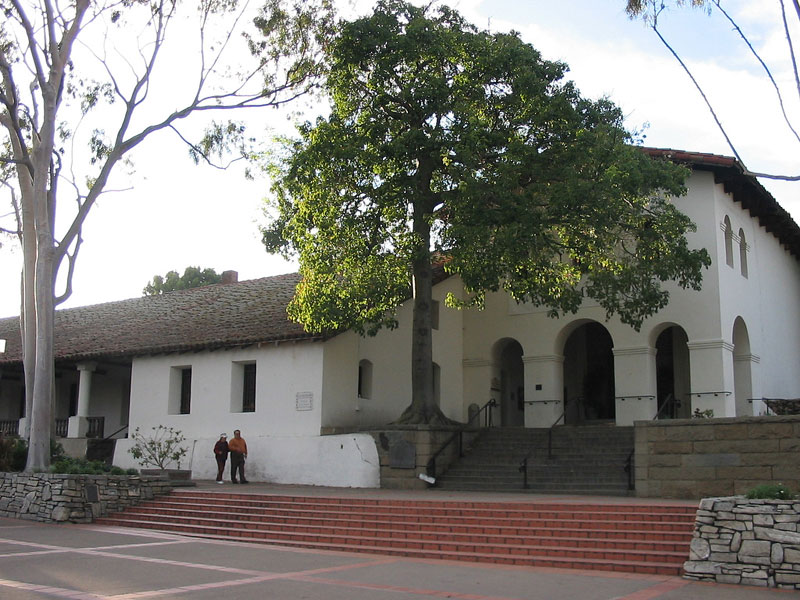
San Luis Obispo, Spanish Mission

But how does religion fit into this, when faith is not about skin color? The reality is that some religions are racialized, and this is especially the case with Islam in America today. In fact, much of the anti-Muslim sentiment is linked to the resurgence of racism in the country. The Park51 debacle is a case in point. This controversy exposes much of the fragmented racial/religious logic in America today. Compare the hollowed ground of 9/11, which is is in reality the burial ground of the thousands who perished that day to those who perished a few hundred years ago in the name of Christianity. In California, we often call missions (i.e. Santa Barbara, Santa Clara, San Luis Obispo), Indian concentration camps because so many Native Americans were forced to live, work, and die on them. None of the people protesting Park51 are arguing that my alma mater, Santa Clara, move its church elsewhere because it is disrespectful to the burial grounds of native Americans. White American Christians have selective memory when it comes to remembering atrocities committed in the name of white Christiandom (i.e. the Crusades, The Reconquest, the Spanish Inquisition, trans-Atlantic slavery, Native American removal acts, the Herero genocides, the Holocaust, and Bosnian ethnic cleansing). There is even more hypocrisy in the dominant racial logic. While crying about how they are tired of being guilted about slavery (while ignoring the legacy of Jim Crow and decades of institutional racism), many white Americans have no problem trying to make every Muslim in the world do penance for 9/11. With that logic, I should get a reparations check and an apology from all White Christians for slavery. After I cash my reparations check and sow some seeds on the land my short changed ancestors were supposed to receive, then I’ll say sorry for what the hijackers did in the name of my religion. Long shot, no? While I condemn terrorism in all its forms, similar to one billion other Muslims, I’m not responsible for the actions of a few nuts.

American Muslims and Black Americans have to bear with generalizations and the racist vitriol with dignity and grace. But checking the daily headlines shouldn’t have to ruin my day or make me paranoid that many Americans want to see me either convert or relocate to an “Islamic” country. So, I’ll stop reading articles from Yahoo News and other online publications that allow people to post offensive, virulently racist, sexist, and Islamophobic comments. I’m doing in order to restore my faith in humanity. I’d like to hold on the belief that most Americans are decent people. I don’t want to think that most white Americans hate me because I’m Black and I’m Muslim. That’s why I never watch Fox News and I’m changing my homepage from Yahoo News to a respectable news source that has shut off non-productive comments from anonymous readers.

The Problem with Muslim Greetings

وَإِذَا حُيِّيْتُم بِتَحِيَّةٍ فَحَيُّواْ بِأَحْسَنَ مِنْهَا أَوْ رُدُّوهَا إِنَّ اللّهَ كَانَ عَلَى كُلِّ شَيْءٍ حَسِيبًا
4:86 But when you are greeted with a greeting [of peace], answer with an even better greeting, or [at least] with the like thereof. Verily, God keeps count indeed of all things.

I’ve had the experience of traveling abroad, living in Arab societies, and staying in Arab homes both abroad and in America. I am particularly fond of three families that played important roles in the formation of the community that grew from masjid an-noor to the MCA. The Arab Americans I came to know in the Bay Area are some of the most hospitable and honorable people I know. Over the years I developed friendships and bonds with Arab, Black American, African, South Asian, Indonesian, Pacific Island, Eastern European, Vietnamese, Chinese, Latino/Chicano, and White American Muslim women with the start of a simple greeting. That greeting is the universal greeting that Muslims exchange by saying, “Salaam alaikum!” (Peace be upon you) and the return, “Wa ‘alaikum salaam” (And upon you be Peace).

As a religious minority in America, everyone I know who wears hijab, including myself, gets excited when someone greets them with respect and honor. It especially means a lot in this society where you get a lot of Americans cutting their eyes, looking at you with pity or apprehension because your outer garments displays your religion. Some ethnic groups are more enthusiastic about their salaams, while other times it is really about the fervor of an individual Muslim.

Arabs are known for elaborate and long personal greetings and farewells. They are also very polite in their speech, with honorific terms denoting class and gender. In Muslim societies, people don’t salaam everybody they encounter on the street. If they did, you wouldn’t get anywhere. Maybe it is possible in the village, but in large cities, you go about your business and only give greetings in personal encounters. But often, a person arriving into a small store, shop, class, or gathering will give salaams, and everyone returns it. Everyone returns it because they have at least the requisite knowledge that the return of the greeting is their religious duty.

In Philadelphia, and especially in the area where I live there are a lot of Muslims. Black American Muslim men occasionally greet me on the street. Muslim men don’t always greet each other and vice versa because it may seem inappropriate to talk to the opposite gender. But that problem doesn’t exist whenever I see Black American Muslim women, where they often give me warm enthusiastic salaams. The White American Muslim women I encounter within stores will break a small and offer salaams. I’ve seen women from South East Asia whose faces have brightened with wide smiles as gave me the universal greetings of peace. But there is a big problem with Muslim greetings in one high profile group, immigrant Arab women who happen to wear hijab. Perhaps it is a Philadelphia thing, but I have heard of similar things in places like Chicago and Detroit. I’d further this by saying that the problem is not with Arab men. I may be wrong, but I haven’t heard of Arab men refusing to greet Black men in this city. The other day, I was walking with my husband and an Arab cab driver honked, waved, and gave us the fist. I see this problem as gender specific. Nor do I don’t think it is is an immigrant women versus Black American women thing. Little South Asian aunties will return salaams too. And on college campuses, such as UPenn and Temple, Muslim girls from all backgrounds are all happy to give salaams and even break out in a smile when they see a Muslim. I’ve experienced it and have spoken with some Black American Muslim women in Philadelphia who have noticed the reluctance of some Arab women to give greetings and the refusal of some to even return someones greetings and salutations.

My personal experience brought it home. On our way back home from errands in Center City a few weeks ago, my husband and I decided to stop by the Trader Joe’s which was right by the trolley stop. As we walked to get the front door, an Arab women in hijab came out and I said out loud, “Salaam alaikum.” She just walked straight past me without acknowledging we existed. My husband said maybe she didn’t hear me. As he went to get a cart he repeated the greeting. She acted like he was invisible. We are supposed to make seventy-something excuses, right? Let me think of some: 1. she was deaf, 2. she was blind, 3. she was mentally disabled, 4. she never read the Qur’an all the way through, 5. she never read a book about how to be a Muslim, 6. she never picked up a hadith book in her life, 7. we scared her by saying salaam alaikum too loud, 8. she must have saw me and thought I was one of those hijabi bandits 9. ummmm, I am running out of legitimate excuses… The reality is, my cousin who is Muslim and has lived in Philly all her life has had several occasions where Arab women have refused to return the greeting. One woman in a halal store refused on three separate occasions. One time, the woman saw my cousin from behind and mistook her for someone else and said, “Salaam alaikum!” When my cousin turned around and returned the greeting the woman looked in disgust that a Black woman gave her the greeting.

As I run my social experiment, I am still waiting for my hypothesis to be verified or falsified. But for the most part, whenever I’ve encountered immigrant Arab women–no matter how piously dressed–rarely initiate greetings. Since I’m trying to avoid confrontation or feelings of anger, I tend to pass them by without giving them salutations and greetings. I have either two options, to woman up and nurse my wounded feelings as I get dissed on a regular. Or I can tighten up my Arabic so I can give them a mini khutbah on the rights of their brothers and sisters.

The irony of this is that the above mentioned verse in the Qur’an states that you are required to return greetings in kind, but it is better to extend them. The reality is, even if you had a major dispute with another Muslim if they were to give the greeting, you return it because it is their right. The refusal to return greetings is a sheer sign of arrogance and prejudice. To me, it is a major sign of hypocrisy. It also sows seeds of discord and mistrust within our community. I think it should be addressed by the imams and religious leaders because this is not a way for any Muslim woman to conduct herself. This is why I hope that this post trickles up, that people read it, that they remind their moms, wives, daughters, sisters, aunts, and friends that this is their brothers’ and sisters’ right.

Innercity Boundaries

I love my old school hip hop. I have so many amazing memories are attached to the songs from 1987 to about 1996. Song from 1993 hold a special place for me. That was the year I graduated high school (I shocked a lot of folks when I was able to walk with my class), the year I became Muslim, the year I began re-discovering who I was. It has been a journey and I continue to develop my consciousness. A week before my 18th birth, I got tickets to go to this hip hop show. I was so hype: Pharcyde, Souls of Mischief, Freestyle Fellowship, and some others. My homeboys all worked in College radio and we were all pretty pumped about the show in South San Jose. But that same night, we learned that Freestyle Fellowship broke up. I never got to see them in concert.

Artist: Freestyle Fellowship
Album: Innercity Griots
Song: Innercity Boundaries [Featuring Daddy-O]
Release: 1993

[Featuring Daddy-O]
Once we have the knowledge of self as a people then we could be free
and no devil could ever enter the boundaries
I stand in the center around all these sounds I see
Blessin’ Allah that I found the key
That’s how we be
We are by no means ashamed of our cultural background
Not a tad bit ‘fraid of change
Look around, it’s the same ol’ same ol’ thang
(Hey, what’s goin’ on man? How you doin’, man?)
Ahh, you know, I can’t call it
Try to maintain, overlooking these boundaries
I gotta be righteous, I gotta be me
I gotta be conscious, I gotta be free
I gotta be able, I gotta attack
I gotta be stable, I gotta be black
Who is that surrounding me?
Enemy enemy you crossed the wrong boundary, poof!
Wicked witness wizardry
Disappear from here and end up in a tree
Crossed the wrong boundary
[Daddy-O]
The sharp shooting wizard but not a Grand Dragon
A chop off the block but my pants ain’t saggin’
Got a strong ass grip but my name ain’t Money Grip
Liked Gladys better when she sang with The Pips
And when it comes to strength I’m surely of the stronger
And when it comes to death I pray my children live longer
Payback’s a bitch, that’s why I never borrow
If the push come to shove I’d do a stick-up tomorrow
With the group thing over and my flat top gone
I’m livin’ kinda lovely, only Allah above me
Provin’ that old time axiom – birds of a feather flock together
Know where I’m coming from?
[Aceyalone]
I see, I saw, I’m the future, the past, I’m me, I’m y’all
I’m the enemy, friend, and the law
The beginner then end-all
The Final Call, the raw
The win, the loss, the draw
The summit, the peak, the wall, the downfall
The energizing uprising black nigger
The wise, the eyes, the dirt
The overall ball, the earth
And most importantly the birth of a new generation of blackness
And we’re forced to set our boundaries

I gotta be righteous, I gotta be me
I gotta be conscious, I gotta be free
I gotta be able to counterattack
I gotta be stable I gotta be black
I gotta be open, gotta be me and
I gotta keep hopin’ we’re gonna be free
Gotta be able to counterattack
Gotta be stable gotta be black

Getting by Within and Without Innercity Boundaries

I’ve been in a number of conversations about Black identities, Islam, and the broader society. Not all Muslims are amenable to these conversations, others seek to define the limits of the discourse on race and Muslim identity. As sister Safia from Safiyya Outlines noted in a recent comment:

Whenever a Black Muslim mentions Blackness or the Black community in a positive way, a non-Black Muslim will swiftly chastise them for it and usually drop the ‘k’ word while they’re at it.
Just another train that is never late

There are non-Black Muslims who feel entitled to speak as authorities in their critiques of Black culture despite their lack of scholarly credentials or understanding of Black intellectual and cultural traditions. Some take many liberties in their efforts to weigh in on every issue that effects Black American Muslims. There are some who have the audacity to even try to define what is and who is truly Black, even though their exposure to Black culture is within a limited segment of the community. I suppose they feel entitled to define terms of the discourse. In an effort to create boundaries, I will not engage in nonsensical debates. Nor do I feel that I must respond to every misrepresentation that floats around in the blogosphere. Instead, I have decided to try to be proactive in my writings rather than my earlier reactive writings.

Some of the conversations I’ve recently engaged in have explored the challenges Black American Muslims face in innercity Muslim communities compared to those they may experience in suburbia (Let us not forget the situation of those Muslims who live in isolated rural areas). There seems to be two major models for masajid in America: the innercity masjid and the suburban masjid. The innercity model is predominantly Black American, and is usually cash strapped with a large portion of working poor brothers and sisters. The suburban model is predominantly first and second generation immigrant and a bit less cash strapped because a large portion of its members are middle class or affluent. In the innercity Masjid, a professional Black American Muslim may get frustrated because there are no funds to enact certain initiatives, members may have ambivalent attitudes towards intellectuals, or the programing board may be more interested in re-integrating ex-cons than providing scholarships for college age kids, or any number of issues. Within an immigrant run community, an educated professional Black American Muslim may feel invisible. They may exhaust themselves at rallies and fundraisers that support overseas causes, but find no support for things of immediate concern to them such as a trying to buy a car without going into serious riba debt, student loans, or even scholarships for their kids to attend the expensive Islamic school. Looking at the pros and cons of each choice, Black American Muslims can either cast their lot with the innercity community, the suburban community , or to opt out of community life and be a down-low-Muslim.

Black American Muslims like myself are often obsessed with these questions because we have the precedent of integration following the civil rights movement. While we all enjoy the freedom to live where we want to live, many of us look back at the ghettos of the 1950s with some sense of nostalgia. When Black Americans were no longer restricted by discriminatory housing policies upwardly mobile Blacks assimilated into broader society. We see the erosion of vibrant communities and growing underclass and zones of urban abandonment. Integration meant the loss of a viable Black communities, where lawyers and doctors lived next door to carpenters and mechanics, shop owners lived down the block from teachers and artists. Integration created opportunities and losses. It can lead to tensions and conflicts like in my high school and neighborhood in East San Jose, an occasional race riot or shooting.

Of course, the integration of Muslim communities will lead to different dynamics and (a’oothu billah, no shooting). But I have often wondered how my kids (insha’Allah) will see themselves in a Muslim community. I have also worried that my children would be subjected demeaning treatment by children of less than enlightened parents, or that the school administration ill equipped and uninformed by diversity training will contribute to a racially hostile environment (like the one that I grew up in Santa Clara). While I have argued against the development of ethnic enclaves, I still hope that my children will have a healthy sense of their Black identity. I still hope that they can be a bridge continue to care about issues in the Black community, as well as the broader society. In a so-called-post-racial world, would they be just-muslim-kids?

I cannot predict the future, but the decisions Black American Muslim families make will have some serious consequences on second generation Muslims (the children of converts). One of my friends noted that finding an 18-25 Black American who was born Muslim is like finding Waldo. I’ve often worried about the ability of the Black American Muslims’ ability to reproduce itself, as opposed to an entire generation of folks with Arabic names. Could it be that they come from parents exhausted by the social pathologies, some failed movement, or the non-stop fitnah (discord and mischief) our communities seem to be embroiled in? Like all Muslims everywhere, they try as best as they can to chart a course that would give their children a healthy balance of religious and ethnic identity.

I know of a number of Black American Muslims who have divorced themselves from the Muslim community. They are tired of the social and cultural pathologies that run rampant in both immigrant and Black American communities. Many of the Black American Muslims who have left active community life, and often open identification with Muslims, are upwardly mobile professionals. Their issues and concerns aren’t addressed by innercity masajid, nor immigrant run masajid. They often feel like they are in a quagmire. So they opt out.

I don’t have all the answers, but I believe that educated and professional Black Muslim Americans who opt out do themselves and the entire community a disservice. I am not saying that they have to change the entire world, but by doing nothing they will not only fail to create a space for their own healthy community and spiritual development, but they will fail to open doors for others as well. We have to look at our past successes and failures in our history to draw important lessons. I see professional and educated Muslims who can operate in multiple contexts, whether on the streets or in academia, as being able to bridge between the innercity and suburbia. If the city and its suburban outlying areas are linked in the real world, why are they disconnected in the American Muslim community?

Obama and the Discourse on Race in the Muslim Community

This post is a collection of ideas that developed elsewhere on blogs and in email exchanges.

Those who have mixed feelings about Barack Obama’s election are often focused on foreign policy issues, specifically Palestine. This victory has more to do with an internal change in American society, foreign policy issues. But it has everything to do with the place Black Americans have in American society. And for Black American Muslims, this also profoundly changes the defined roles we have in American society. The most famous and recognizable Black man is an intellectual and Head of State (considering the last presidency, I think it is important to point out both). The reality is, that the public image of Black Americans, and let us not forget Africans on the continent and in Diaspora, defines our role in the American Muslim community. How so? Our public image shapes the ways in which our fellow co-religionists see us. Barack Obama’s presidency inverts a number of stereotypes that many in the Muslim community in the US and abroad have about Black Americans. In much of Muslim world outside of sub-Saharan Africa, people associate Blackness with slavery and inferiority. I recognize that this might not change the fact that when I go to the masjid in America, some immigrant Muslims will assume I am uneducated, broke, and not as valuable of an asset to the Ummah as a white convert.

While his presidency might not change all their negative associations, most people never imagined that so many white Americans would vote for a Black man as head of state. It signals that we are part of the American fabric, not just waiting for the some outside force to raise us up from our undignified and destitute state. Muslim organizations that cater to immigrant communities may begin to see that it is politically expedient to align themselves with the Black community. Elected officials have to address the Black interest groups and political and community service organizations. We have two Black American Muslim congressmen, which I think is telling in light of the fact that associating with Muslims is still a political liability. Only recently have some Muslim organizations saw the importance of working to build coalitions with the Black political establishment, like the Black Caucus, and organizations that have addressed the needs and interests of Black Americans as well as other ethnic groups.

This reminds me of an event I sent to organized by ING, where I realized how Black American Muslims were rendered invisible in the discourse on Islam which was dominated by mainstream national Muslim organizations and the media. On that day I went to an ING event where the theme was the faces of American Muslim women. Although there are so many Black Muslim professional, student, and volunteer women, not one had been invited to speak. There were Arab women, white women, South Asian women, even East Asian women, but not one Black woman. Given that we are 40% of the Muslim population, I found that extremely odd and in fact insulting. They were saying, “We are just like you, Americans!” A number of organizations have marginalized Black voices in their attempts to portray Islam as an American religion. They have highlighted and celebrated white converts over Black converts, seeing the conversion of white Americans as a symbol that Islam was accepted by a mainstream American. I believe that Obama’s presidency will help show that our more backwards thinking brothers and sisters do the Muslim community a great disservice by trying to ignore the historical contributions of Blacks in America, and Black American Muslims in the Muslim American community.

Right now, the real tensions in the American Muslim community will be between those who wish to create their ethnic enclaves in order to insulate their children from becoming American and developing new hybrid cultural identities. The real tension is between those whose interests are geared more towards issues abroad and those who are concerned with transforming America into a more egalitarian society and thereby changing our policies abroad. People are already voicing expectation of disappointment even before he has been sworn in. Yes, he made a lot of problems, some will not be able to come to fruition in light of the political machine that he is operating in. This is not the same thing, or just a Black face on political power.

Obama’s victory is what can happen if we believe we can do it and work towards our goals. This is about how WE need to change things. American Muslims should be motivated to mobilize and be part of the political process in order for us to be a force to be reckoned with. For the most part we’ve taken ourselves out of the game. So how are we going to hold anyone accountable, let alone a president? The thing about democracy is that accountability is seen in the election process. Elected officials have to appease their main constituencies, as well as the interest groups that support their campaigns. The big constituencies and most powerful interests groups win out. That may not be right, but it’s pragmatic and that’s what politics is about. What lobby group do we have? Have we created any effective civil society institutions to help counteract the abuses of government? And for those few that exist, do we have a plan to support them? How many of us are trained to be on any advisory counsel or even qualified to be tapped as major advisor for policy making?

Two things seemed like a far off dream when I was a little girl: Mandela becoming president of South Africa and a Black man becoming president. Both happened in my lifetime. That leads me to imagine what types of changes can happen in the American Muslims community and the ultimate influence we can have in this society and eventually in the world scene (and not just Middle East).We need to move from ideals to move towards real action. This is our opportunity as Muslims to own this. American Muslims are largely affluent, have global ties in family and ethnic networks, a wide range of skill sets, and a country that affords us the opportunity to make the most of our material, spiritual, and intellectual assets. In light of what we do have in this country, what should Muslim Americans be doing 1 month from now? 6 months? 1 Year? 4 Years? What about in 20 years?

Racial Profiling and Citizenship

Beyond maintaining a system of distinctions, narratives of crime create stereotypes and prejudces, and they separate and reinforce inequalities. In addition, inasmuch as the categorical order articulated in the talk of crime is the dominant order of an extremely unequal society, it does not incorporate the experiences of domianted people n(such as the poor, nordestinos, and women); rather, it criminalizes and dicriminates against them…Finally, the talk of crime is also at odds with the values of equality, tolerance, and respect for others’ rights. The talk of crime is productive, but it helps produce segregation (social and spatial), abuses by the institutions of order, contestations of citizens’ rights, and especially, ciolence itself. If the talk of crime generates order, it is not a democratic, tolerant egalitarian order but its exact opposite.

Teresa Caldeira, City of Walls: Crime, Segregation, and Citizenship in Sao Paulo, page 39
This morning I had my suspicions confirmed about how the Palo Alto police force would respond to a recent string of robberies nearby campus. Yesterday, a brief article by SFgate,Palo Alto police told to question blacks, reported:

Chief Lynne Johnson spoke to residents about the crime surge Thursday at City Hall.

She says she issued the instructions because several suspects in the robberies are African American and police lack detailed descriptions.

Johnson says she does not want to create an environment of fear for “people of color.” But she says authorities have to do their “due diligence” in catching the suspects.

She says people who are stopped have the right not to talk to police.
Palo Alto’s police chief has instructed officers to question African Americans in the city following a spate of recent street robberies.

ABC local has another version of the story here:

She said because several of the suspects are African-American and the descriptions are vague, she’s instructed her officers to make contact with African-Americans in Palo Alto.

“When our officers are out there and they see an African-American, in a congenial way, we want them to find out who they are,” said Chief Johnson.

I began to think about the ways Palo Altons talk of crime and the implications this has for Black residents and Black students on Stanford’s campus. This is the reality that Black residents from East Palo Alto, before most of them have been pushed out do to economic pressures and gentrification, have had to experience when they crossed segregating Highway 101 to stroll the pristine streets of University Ave. With this increased scrutiny, Black people from nearby areas feel even less inclined to visit Palo Alto for social events or boutique shopping.

While Palo Alto is an largely white space, Stanford’s undergraduate Black community is representative of national figures where they number at about 12 percent. When these future leaders step off campus and go to restaurants or run an errand on University or California avenue, not only are the under increased because it is clear that they are outsiders in this ethnically homogenous area, by default they are considered suspects. No white student at Stanford is subject to this type of scrutiny or form of institutionalized racism. But on they must make sure that the private security knows that they belong to the campus community. They are not just from across the highway, from East Palo Alto, crashing some party, invading some dorm. Off campus and on campus, they are denied a sense of belonging.

Can’t you smell the stench of irony of this crap, especially in light of Nov 4th? If Barack Obama was walking down University Avenue, would the police approach him with questions trying to figure out if he belonged? Would they try to sort him out, unable to distinguish whether he was a the good type of Black as opposed to the criminal sort? Young Black men in suburbia have just as high arrest rates as in high crime areas. That is because no matter where they go, they are always being suspected as criminals. Growing up, I remember my mother going down to the police station screaming at the officers who hauled my brother in after pulling him over for loud music and tinted windows. He sat in jail as a person of interest. For all the times he was pulled over and hand cuffed as a person of interest just because he fit the description, of what? When crimes are committed by whites, not every white male is stopped, questioned, and charged with minor infractions just for just cause. America continues to incubate injustice and the exclusion of its citizens based on race. Few Black people have encounters with the state, except in their encounters with the police. And often these encounters are shaped by Racial profiling. This form of institutionalized racism that equates crime with race. It targets Blacks not for protection as law abiding citizens, but assumes they they need to be monitored and screened because they fit. This, in and of itself, is a violation of citizen rights. It violates the rights of those who are targeted for racial profiling to move freely in public spaces and treated equally by the state. When the very institution that is meant to preserve order and rule of law singles you out, how can you feel like this nation sees you as a true citizen even if they are electing someone who “fits the profile?”

Update

The Stanford Black community responded swiftly. Kenneth Gibbs wrote the city council and mayor/city manager. They responded promptly with condemnations. Stanford African-American groups join chorus denouncing Palo Alto police chief

Immediately, community leaders — from the president of the NAACP, the mayors of Palo Alto and East Palo Alto, church leaders and legal advocates — condemned Johnson’s remarks, characterizing the police practice she described as racial profiling and suggesting Johnson should resign.
Monday night, City Manager James Keene told the city council that he had commissioned an auditor to review the department’s policy on racial profiling and that he had arranged to meet with city staff to hear their concerns.

Also Monday night, a coalition of black student groups asked city officials to review how the police department conducted its investigation into the robberies; to provide diversity training for all department employees; and develop an outreach program to improve race and community relations.
“I feel there needs to be an inquiry,” said Rodney Gateau, president of the Black Graduate Students Association, in an earlier interview with the Mercury News. “This needs to be scrutinized. This is more than a misstatement by a police official.”

This is an example of how students can make a difference. It still amazes me that Johnson said what she said so flippantly and matter of fact. I know I’m late on writing a letter. But I will write mine. We have to keep sending a message that we will not take injustice lying down. Good work!!

Support Masjidul Waritheen

Flyer

I got word of this event from an ING newsletter. This look promising, since it is drawing people from various communities (Black American Muslim, White American Muslims, and Immigrants and others) to support the continued development of masjid Waritheen (a predominantly BAM community in Oakland). Over the years many Muslim student groups in and around the Bay Area have asked Imam Faheem Shuaibe to speak on numerous topics and represent Islam in interfaith dialogues. He is still eloquent and able to touch upon a number of issues that we face in American society. I encourage those in the area to attend or at least support the community by making a donation.

Please support Masjid Waritheen, a historic community in Oakland. You can go the website here to order your tickets or if you can’t attend, make an online donation .

Here’s more info from the website:

Masjid Waritheen Annual Supporters Dinner
SUNDAY, JUNE 15, 6 PM – 9 PM
CHANDNI RESTAURANT – NEWARK, CA

$25/PERSON DONATION – RESERVE YOUR SEAT NOW (click here)

We invite you to join us for a special fundraising event for Masjid Waritheen, one
of the oldest and most active masajid in the Bay Area. As immigrant communities
have grown and prospered in the U.S., it is vital that we ensure that our African
American brothers and sisters are also growing and prospering in their
communities. Following in the footsteps of our beloved Prophet (saws), who
forged an unprecedented bond between the Muhajireen and Ansar, local
immigrants and the children of immigrants are joining hands with their indigenous
brothers and sisters to help support a group that has worked tirelessly to serve
and provide programs for the greater community. Muslim immigrants and their
children have directly benefited from the struggles, sacrifices, and achievements
of the civil rights movement; it is time that all of us acknowledge this debt and
play our part in giving back and putting into practice the principal that charity
begins at home. Join us in this worthy effort by contributing any amount online at
masjidulwaritheen.org and attending our event in June to learn more about the
growing African American Muslim community in Oakland which houses both a
mosque and a full-time Islamic School, the Clara Mohammed School.

This event is sponsored by every major Islamic organization in the Bay Area and
the following individuals:

Sponsors: Hesham & Diana Alalusi Foundation & Javed & Shaheena Khan
Foundation

Organizers: Imam Anwar Tahir, Javed Ellahie, Adeel Iqbal, Uzma Husaini,
Waseem Sufi, Ayesha Mattu, Atif Qureishi, Omar Ahmed, Ifetkhar Hai, Shafi Refai,
Shafath Syed, Ameena Jandali, Imran Maskatia, Farhan Syed, Maha Elgenaidi,
Shahed Amanullah, & Irfan Rydhan

We are associated with the Leadership and Ministry of Imam Warith Deen
Mohammed.

Here is some more information from the website.

Sunday June 15, 6 pm – 9 pm
Chandni Restaurant
$25 donation – reserve your seat now at masjidulwaritheen.org

Speakers include:
Shaykh Hamza Yusuf, Zaytuna Institute (invited)
Shareef Abdur Raheem, NBA Star Forward, Sacramento Kings
Imam Faheem Shuaibe, Imam, Masjidul Waritheen
Saafir Raab II, Strategic Planning Consultant, Managing Opportunity, Inc.

This is a special fundraising event for Waritheen mosque, one of the oldest and most active mosques in the Bay Area. As immigrant communities have grown and prospered in the US, it is vital that our African American brothers and sisters are also growing and prospering in their communities. Immigrants and their children have directly benefited from the struggles, sacrifices, and achievements of the civil rights movement; it is time that all of us acknowledge this debt and play our part in giving back and putting into practice the principal that charity begins at home. Join us in this worthy effort by contributing any amount online at http://www.masjidulwaritheen.org and attending the dinner in June to learn more about the activities of the African American Muslim community in Oakland.

Am I Just a Muslim?

While my heart is at home, some things right now seem more real to me than some of the things that are preoccupying my friends and loved ones.   I am not saying that I’m not interested in this historic moment. There is something amazing about a Black man making it this far in a presidential election.  But, the lack of nuance in media representations of race and gender in the presidential election is not as real to me as making sense of being a Black woman in the Middle East. I know everyone is a buzz in the US. But being in a predominately Muslim society puts a lot of Muslim issues to the forefront. I am constantly wondering if there is a spot for me in this imagined community of ours, as a Black American Muslim woman.

There are times when I felt like there wasn’t room for me and that my experiences were dismissed. Two recent pieces have reminded me of the pressures I experienced as an early Muslim. But at the time of the articles, the country’s internet was either down or I was in transition. Since these pieces were published, I have had some time to reflect on how a Black American Muslim identity causes a lot of dissonance in an Arab Muslim society. Abdur Rahman wrote a very insightful and historically grounded piece called, I’m Just A Muslim Muslim Tariq Nelson also contributed to the discussion with his take on, Just A Muslim. He wrote:

It is this understanding of being “just a Muslim” that I reject. You must – like the brother in the meat store – become a pseudo-foreigner of some type and adopt a hodge-podge of immigrant cultures rather than adopting Islamic values. Being “just a Muslim” has essentially come to mean running away from one’s family, and history in some attempt to “pass” into “non-blackness”. In addition they adopt a parochial and reactionary attitude and a paralyzing suspicion of all things American or Western.

Years ago,  a young Arab American woman was pretty upset with me. She was mad because of the paper I wrote in a sociology class on inequality and social stratification. The paper was about multiple identities. Much to my suprise, the title upset her.  I had felt it was a pretty inocuous title. I don’t even think she really read too far into my paper. Besides at that time, I was still pretty new to the religion. I was naive and wet behind the ears. So, my paper definitely didn’t have the sharp critique you might find in my writing today. But still, the following bothered this young woman enough for her to tell me how much I sucked:

“My Multiple Identities as an African American Muslim Woman”

It got under her skin. To her, it showed where my loyalties were. “You didn’t put Muslim FIRST!” She said in a distressed and judgmental voice “The Most IMPORTANT thing is that we are MUSLIM!” This kind of bothered me. Because at the time, of almost all the Muslims in this little circle, I was the most identifiably Muslim Muslim. I wore hijab at the time. I participated in the Muslim Student Association, as well as the Black Student Association. Despite my efforts, my loyalty as a Muslim was constantly called into question by my Arab and Desi peers.

Someone called me a nationalist because I still participated in the Black Graduate Student Union. When I used to point out that they go to ethnic picnics, Lebanese iftar, Egyptian Day, Libyan picnic in the park, Bangladeshi dinner, Pakistani gathering, not to mention the ethnic after-eid-after parties. These were places I was never invited to. I pointed out that they all these ethnic functions. The argument someone made was that the people in their closed ethnic gatherings were all Muslim. For them, their ethnicity was intrinsicly tied to being Muslim. They were preserving their culture and language because one day, they hoped to go back home. Their functions or fundraisers could be completely secular and or for some nationalistic. But they were helping other Muslims.

Me, on the other hand, I was encouraged to divorce myself from the Black community. At the same time, I was told to give dawah. In fact, I was encouraged to give dawah. But dawah basically meant repesenting some Muslim issue overseas in some campus event. I’m not saying that no immigrant Muslims cared about African Americans. There was one who took an active interest in supporting the cause of a young Black man who happened to be Student Body president was arrested for showing up to a Senate meeting on campus.Many of the people who put those pressures have since changed their views. In many ways they too had utopian visions of what the Ummah looked like. Their own cultural practices were illegible to them, because for them they operated within an Islamic cultural matrix.

While some Muslims were mad because I didn’t claim I was just a Muslim-Muslim. I was never really allowed to be just a muslim-muslim. I was constantly referred to as “The Black” sister in a community that was diverse, but Black American were underrepresented. I was sort of relegated to Black things, like marrying ex-cons and being broke all the time. I was even told that I wasn’t just a Muslim indirectly in some not so nice ways.

Perhaps I felt pressures more intensely because of the relative isolation. But the pressure I experienced raised some important questions. Does participation in a community entail that you give up who you are? Should we end our participation in other communities, our ties with family, friends, neighbors, co-workers, associates, sorority or fraternity brothers and sisters. Do we give up affiliations, inclinations, cultural tastes and affinities and adopt others? How do we talk about who we are? What are we? Can I be just a Muslim, while holding on to those descriptors that make me unique? I think my stance on some of these questions is quite clear. I also believe that these broad communities and categories do not make a human. But they are a part of who we are and our being in this world. At times I feel like a composite of many different things and experiences. Some of them intersect and and reinforce what I feel is the true person inside. At times my experiences and things conflict. But never once have I felt like a Muslim divorced from my cultural context as a Western woman of African descent who became Muslim as an adult. Once I become Just a Muslim, I lose my voice and am lost to some authoritarian dogma.

Obsessions: Religion, Race, and Sex

Yes I admit it, I’m more than preoccupied by Religion, Race, and Sex. We have been told to avoid these three topics in polite dinner conversation. In fact, I often do not take to heated discussion about religion, race, and sex in polite dinner conversation. This is why I have a blog.

While my major field is the history of Islam in Africa, my research and studies go beyond Africa. I examine the African Diaspora in the Middle East. I have a deep interest in Islam as a global religion. My career was inspired by my personal conviction as a Muslim. I am obsessed about Islam and can talk about it for hours, days on end. I also study race and talk about race. I have written numerous papers and articles on race relations, racial passing, community identity, and the African Diaspora in the Middle East. Importantly, my discussion about race is often personal. I talk about race in that it affects me and a number of people I care about.I talk about sex, women, and gender relations. Who doesn’t think about sex?    I talk about relationships, how Muslim men and women relate to each other, how Black men and women relate to each other, how Black women relate to men and women from various Muslim communities. I talk about women’s gendered roles, men’s gendered roles. I talk about marriage. I talk about free-mixing and gender segregation. I talk about hijab, niqab, and physical attraction.

I’m obsessed with Religion, Race, and Sex.  I am building a career on it. I want to write articles about these topics, explore dusty libraries digging for books about it,  spend sleepless nights researching and editing articles about it, travel around  the world to talk with other scholars and experts about it. I  even want to teach a class about it. We’ll see how receptive university students are to this topic. I’m pretty sure I’ll have a full roster because people can’t say enough about religion, race, and sex. And it is sure to fire up some heated dialog.

This blog is an intellectual and personal exploration of these same themes that have informed my career choice. If you read the title of my blog closely analyzing why I chose certain words, it should become evident that I wanted to talk about Islam, the African Diaspora, and Gender. I haven’t really seen someone from my perspective, as a Black American Muslim, explore these themes. This is why I made my intervention. Some people have written me directly telling me I should get over talking about religion. Others say I should get over race. Even  once someone who expressed ambivalence towards my discussion of FGM. If I were to stop talking about religion, race, and sex then this blog would not have a purpose. Or maybe I could just post cute pictures of flowers, kittens, and bunnies and peppered with my own personal reflections as Just Another Muslim. No, my blog is not polite dinner conversation nor is it designed to make us all feel uplifted. I just want my readers to think. I also want to validate an experience that is forged in struggle.  I try to not present a doom and gloom scenario. Nor am I trying to be a polemic or write entries for shock value. At the same time I think that we as Muslims still need to look at a number of issues. The American Muslim community still needs to examine how race, class, and gender intersect in order to understand how to move forward.