
Post-Racial America, Yahoo News, and White Angst


Santiago Matamoros (Saint James the Moor Slayer)

America’s not so post racial, as evidenced by the nasty comments on Yahoo News whenever the subject matter features anything about Blacks, Africans, Arabs, Muslims, Pakistanis, Iranians, etc. I’ve spent years arguing with some of my white associates that the racism Black Americans encounter is not a figment of our imagination. It’s funny how some of the most anti-Black Americans are insistent that we just “Get over it!” Reflective of Dr. Laura’s racial tirade, many white Americans claim that Black people’s grievances about racism are about power and control. That’s why Sarah Pailin told Dr. Laura to not quit but reload. And I’m sure that Dr. Laura’s brand has struck a cord with many Americans who hold the same view. With a Black President, many white Americans are rising against what they see as the hegemony of political correctness. They claim it is alright to stereotype, crack offensive black jokes and call somebody a N$@&% because ignorant Black people have appropriated the N-word and call themselves niggas. But really it is a veiled attempt to dehumanize, demean, belittle, generalize, and stereotype anybody who has a different perspective because our differences arise from our cultural and social backgrounds and the ethical principles that guide our social life and political beliefs.
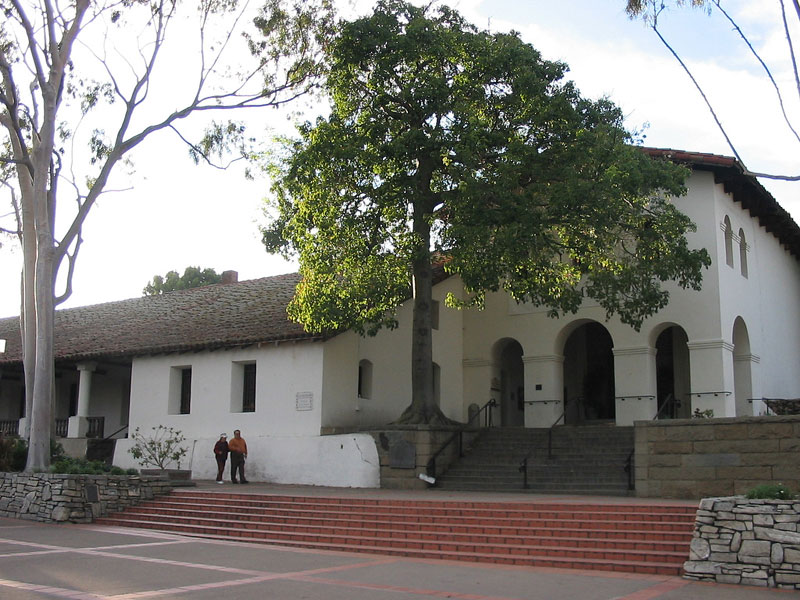

San Luis Obispo, Spanish Mission

But how does religion fit into this, when faith is not about skin color? The reality is that some religions are racialized, and this is especially the case with Islam in America today. In fact, much of the anti-Muslim sentiment is linked to the resurgence of racism in the country. The Park51 debacle is a case in point. This controversy exposes much of the fragmented racial/religious logic in America today. Compare the hollowed ground of 9/11, which is is in reality the burial ground of the thousands who perished that day to those who perished a few hundred years ago in the name of Christianity. In California, we often call missions (i.e. Santa Barbara, Santa Clara, San Luis Obispo), Indian concentration camps because so many Native Americans were forced to live, work, and die on them. None of the people protesting Park51 are arguing that my alma mater, Santa Clara, move its church elsewhere because it is disrespectful to the burial grounds of native Americans. White American Christians have selective memory when it comes to remembering atrocities committed in the name of white Christiandom (i.e. the Crusades, The Reconquest, the Spanish Inquisition, trans-Atlantic slavery, Native American removal acts, the Herero genocides, the Holocaust, and Bosnian ethnic cleansing). There is even more hypocrisy in the dominant racial logic. While crying about how they are tired of being guilted about slavery (while ignoring the legacy of Jim Crow and decades of institutional racism), many white Americans have no problem trying to make every Muslim in the world do penance for 9/11. With that logic, I should get a reparations check and an apology from all White Christians for slavery. After I cash my reparations check and sow some seeds on the land my short changed ancestors were supposed to receive, then I’ll say sorry for what the hijackers did in the name of my religion. Long shot, no? While I condemn terrorism in all its forms, similar to one billion other Muslims, I’m not responsible for the actions of a few nuts.

American Muslims and Black Americans have to bear with generalizations and the racist vitriol with dignity and grace. But checking the daily headlines shouldn’t have to ruin my day or make me paranoid that many Americans want to see me either convert or relocate to an “Islamic” country. So, I’ll stop reading articles from Yahoo News and other online publications that allow people to post offensive, virulently racist, sexist, and Islamophobic comments. I’m doing in order to restore my faith in humanity. I’d like to hold on the belief that most Americans are decent people. I don’t want to think that most white Americans hate me because I’m Black and I’m Muslim. That’s why I never watch Fox News and I’m changing my homepage from Yahoo News to a respectable news source that has shut off non-productive comments from anonymous readers.

The Problem with Muslim Greetings

وَإِذَا حُيِّيْتُم بِتَحِيَّةٍ فَحَيُّواْ بِأَحْسَنَ مِنْهَا أَوْ رُدُّوهَا إِنَّ اللّهَ كَانَ عَلَى كُلِّ شَيْءٍ حَسِيبًا
4:86 But when you are greeted with a greeting [of peace], answer with an even better greeting, or [at least] with the like thereof. Verily, God keeps count indeed of all things.

I’ve had the experience of traveling abroad, living in Arab societies, and staying in Arab homes both abroad and in America. I am particularly fond of three families that played important roles in the formation of the community that grew from masjid an-noor to the MCA. The Arab Americans I came to know in the Bay Area are some of the most hospitable and honorable people I know. Over the years I developed friendships and bonds with Arab, Black American, African, South Asian, Indonesian, Pacific Island, Eastern European, Vietnamese, Chinese, Latino/Chicano, and White American Muslim women with the start of a simple greeting. That greeting is the universal greeting that Muslims exchange by saying, “Salaam alaikum!” (Peace be upon you) and the return, “Wa ‘alaikum salaam” (And upon you be Peace).

As a religious minority in America, everyone I know who wears hijab, including myself, gets excited when someone greets them with respect and honor. It especially means a lot in this society where you get a lot of Americans cutting their eyes, looking at you with pity or apprehension because your outer garments displays your religion. Some ethnic groups are more enthusiastic about their salaams, while other times it is really about the fervor of an individual Muslim.

Arabs are known for elaborate and long personal greetings and farewells. They are also very polite in their speech, with honorific terms denoting class and gender. In Muslim societies, people don’t salaam everybody they encounter on the street. If they did, you wouldn’t get anywhere. Maybe it is possible in the village, but in large cities, you go about your business and only give greetings in personal encounters. But often, a person arriving into a small store, shop, class, or gathering will give salaams, and everyone returns it. Everyone returns it because they have at least the requisite knowledge that the return of the greeting is their religious duty.

In Philadelphia, and especially in the area where I live there are a lot of Muslims. Black American Muslim men occasionally greet me on the street. Muslim men don’t always greet each other and vice versa because it may seem inappropriate to talk to the opposite gender. But that problem doesn’t exist whenever I see Black American Muslim women, where they often give me warm enthusiastic salaams. The White American Muslim women I encounter within stores will break a small and offer salaams. I’ve seen women from South East Asia whose faces have brightened with wide smiles as gave me the universal greetings of peace. But there is a big problem with Muslim greetings in one high profile group, immigrant Arab women who happen to wear hijab. Perhaps it is a Philadelphia thing, but I have heard of similar things in places like Chicago and Detroit. I’d further this by saying that the problem is not with Arab men. I may be wrong, but I haven’t heard of Arab men refusing to greet Black men in this city. The other day, I was walking with my husband and an Arab cab driver honked, waved, and gave us the fist. I see this problem as gender specific. Nor do I don’t think it is is an immigrant women versus Black American women thing. Little South Asian aunties will return salaams too. And on college campuses, such as UPenn and Temple, Muslim girls from all backgrounds are all happy to give salaams and even break out in a smile when they see a Muslim. I’ve experienced it and have spoken with some Black American Muslim women in Philadelphia who have noticed the reluctance of some Arab women to give greetings and the refusal of some to even return someones greetings and salutations.

My personal experience brought it home. On our way back home from errands in Center City a few weeks ago, my husband and I decided to stop by the Trader Joe’s which was right by the trolley stop. As we walked to get the front door, an Arab women in hijab came out and I said out loud, “Salaam alaikum.” She just walked straight past me without acknowledging we existed. My husband said maybe she didn’t hear me. As he went to get a cart he repeated the greeting. She acted like he was invisible. We are supposed to make seventy-something excuses, right? Let me think of some: 1. she was deaf, 2. she was blind, 3. she was mentally disabled, 4. she never read the Qur’an all the way through, 5. she never read a book about how to be a Muslim, 6. she never picked up a hadith book in her life, 7. we scared her by saying salaam alaikum too loud, 8. she must have saw me and thought I was one of those hijabi bandits 9. ummmm, I am running out of legitimate excuses… The reality is, my cousin who is Muslim and has lived in Philly all her life has had several occasions where Arab women have refused to return the greeting. One woman in a halal store refused on three separate occasions. One time, the woman saw my cousin from behind and mistook her for someone else and said, “Salaam alaikum!” When my cousin turned around and returned the greeting the woman looked in disgust that a Black woman gave her the greeting.

As I run my social experiment, I am still waiting for my hypothesis to be verified or falsified. But for the most part, whenever I’ve encountered immigrant Arab women–no matter how piously dressed–rarely initiate greetings. Since I’m trying to avoid confrontation or feelings of anger, I tend to pass them by without giving them salutations and greetings. I have either two options, to woman up and nurse my wounded feelings as I get dissed on a regular. Or I can tighten up my Arabic so I can give them a mini khutbah on the rights of their brothers and sisters.

The irony of this is that the above mentioned verse in the Qur’an states that you are required to return greetings in kind, but it is better to extend them. The reality is, even if you had a major dispute with another Muslim if they were to give the greeting, you return it because it is their right. The refusal to return greetings is a sheer sign of arrogance and prejudice. To me, it is a major sign of hypocrisy. It also sows seeds of discord and mistrust within our community. I think it should be addressed by the imams and religious leaders because this is not a way for any Muslim woman to conduct herself. This is why I hope that this post trickles up, that people read it, that they remind their moms, wives, daughters, sisters, aunts, and friends that this is their brothers’ and sisters’ right.

A Wake Up Call: Muslim Advocates Against Violence (MAAV) Condemns the Murder of Aasiya Hassan and Urge All to Do More

I was asked to distribute this far and wide. Please spread the word:

A Wake Up Call: Muslim Advocates Against Violence (MAAV) Condemns the Murder of Aasiya Hassan and Urge All to Do More

PRESS RELEASE
February 19, 2009

Muslim Advocates Against Violence (MAAV) condemns the gruesome murder of Aasiya Hassan. We join Muslim advocates and organizations around the country in conveying our deepest sympathies to the family and community members of Ms. Hassan. We urge everyone to learn more about domestic violence within Muslim communities, to become fierce advocates for people who speak out about violence in their lives, and to hold the perpetrators of violence accountable for their actions.

After securing an order of protection against her husband and filing for divorce, Aasiya Hassan, 37 years old, was brutally beheaded and found dead in her hometown of Buffalo, New York on Thursday, February 12, 2009. Two children survive her, ages 4 and 6. After the murder, Ms. Hassan’s husband Muzzammil, directed police to his Bridges TV office where her body was found. He is now charged with second-degree murder.

The irony that a well-respected Muslim leader, the founder and CEO of a Muslim television channel, is an abuser proves how prevalent abuse is despite ones standing within a community and society. It shows how insidious and hidden this problem truly is. We urge the Muslim community to hold their leaders to the highest ethical standards, and to speak out when incidence of domestic violence occurs.

The media is reporting the murder of Ms. Hassan as both an honor killing and the fatal result of domestic violence. However, in the effort to understand how we can prevent future incidents from escalating to this point, the label of this heinous act is not significant. Domestic violence is a problem that plagues women, children, and yes – men, regardless of their religion, ethnicity, orientation or economic status. In a study conducted by the late Sharifa Alkhateeb, 1 in 10 American Muslim women experienced physical abuse. This number does not reflect victims of other equally damaging forms of violence such as verbal, emotional, psychological, sexual, economic and spiritual abuse.

It takes tremendous courage for victims of violence to reach out, to finally ask for help, and to admit that violence is occurring in their lives. For many, it takes years to break the cycle of power and control before seeking help. When any one of us becomes aware of violence in someone’s life, we absolutely must act, and take the matter seriously. We must realize the emotional courage it takes to speak out, and respect the experiences and decisions of the survivor. The question is NOT, “why didn’t she leave before?” rather, “why did all of us let this go on for so long?” and, “how can I prevent this from happening again?”

Despite prevailing stereotypes of Muslims, domestic violence is not an Islamic value, nor is it permissible or condoned within the Muslim community. Many women, men and children continue to be killed as a result of domestic violence; Aasiya Hassan is an unfortunate name on a list too long and too preventable.

We urge all to take this event as wake up call to learn more about domestic violence, and to find out how we can prevent such tragedies. There are state coalitions against domestic violence, community-based organizations, policy think tanks, international programs and faith-based organizations dedicated to ending the pervasive issue of violence against women.

We encourage all domestic violence programs to take a committed step towards learning about and engaging in outreach to Muslim communities, and ensuring their services are culturally and religiously sensitive to all survivors. Similarly, without community support and awareness, efforts and sustainable results of domestic violence programs are limited.

We also caution against diverging away from the justice Ms. Hassan and her family deserves by framing her death within a xenophobic lens that only enforces negative imagery of Muslims. This was not an act of terrorism perpetrated by or penetrating American-Muslim communities, nor was it inflicted due to extremist religious politics and beliefs. Aasiya Hassan’s tragic death joins the innumerable acts of domestic violence committed around our globe that terrorize women, men and children in every community.

For additional information regarding domestic violence, and for technical assistance, please contact the Peaceful Families Project (PFP) at info@peacefulfamili es.org, or visit http://www.peacefulfamilie s.org. PFP is a national domestic violence organization that facilitates awareness workshops for Muslim leaders and communities, provides cultural sensitivity trainings for professionals, and develops resources regarding abuse in Muslim communities.

About MAAV
Muslim Advocates Against Violence (MAAV) is a national network of advocates committed to ending violence against women and supporting healthy communities. MAAV’s mission is to raise awareness, foster dialogue and strengthen advocacy.

For additional information about MAAV, email: maav.info@gmail.com

How Lack of Accountability Led to Rise of a Monster

Zerqa Abid wrote a very important post that highlighted some of the issues and concerns that I have with accountability in our Muslim communities. How could we have allowed someone like Muzzammil Hassan, a Muslim man of questionable moral character with legal documentation of a history of abuse, to rise to such a position of leadership?

It’s been five days now that my family along with the whole American Muslim community has been in shock. The fact that Muzzammil was married to my first cousin before marrying the victim still horrifies us. Ms. Zubair was his third wife. Both of his earlier wives filed divorce on the same grounds of severe domestic violence and abuses.

My cousin lived with him for only a year. Yet, it took her several years to get rid of the fear of living with a man in marriage. He was known as violent and abusive in the community. He had nothing to do with Islam. He had changed his name from Syed Muzzammil Hassan to Mo Steve Hassan. He had no background of community service or involvement in the Mosque or in any other organization. Neither his character and nor his faith were sound. In addition, he had no background or expertise in TV production or media.

But it did not matter. Even with this bad reputation, horrible background and lack of experience in media market, he still got the stage at the most reputable American Muslim conventions. Our leaders and established organizations did not bother to vet him. No questions or flags were raised about him. He was introduced at these conventions with huge respect and the Muslim community was told to give him generous funds for Bridges TV.


The surprise was changed into shock and worry when I learned that Bridges TV was owned and operated by the same Muzzammil Hassan who I knew as a serious criminal. To me domestic violence is a serious crime and a person’s character must be judged by the way he deals with his family. At my return, I warned some community leaders, but the response was not encouraging. People told me that his personal life may be messed up, but he is doing a good job so we should support him no matter what.

The Vice President of Islamic Society of North America, Imam Mohamed Hagmagid Ali, has posted an open letter on ISNA’s website. He writes, “Our community needs to take strong stand against abusive spouses and we should not make it easy for them to remarry if they chose a path of abusive behavior.”

What about making community leadership easy for them, Imam?

Shouldn’t Islamic organizations also take responsibility of vetting new comers before presenting them on the stage? Common people rely on organizational leadership and judgment.
Vetting of community leader has been established since the time of Prophet Muhammad (may peace be upon him) and is now in practice within the conscious communities all over the world….

Clearly, this is a rare case that has ignited the nation’s imagination. It is fodder for Islamaphobes and Muslims throughout the country are scrambling trying to deal with the PR damage. While I do not feel that I have to go around apologizing for every wrong action a Muslim does, I decided to write about this case because it brings to light some underlying issues that are poorly addressed in our community. There is little accountability in our communities. Every media report reminds us that Muzzammil was a respected and influential member of the Muslim community. This is why it is absolutely imperative that we not shield abusers and turn a blind eye when we see something funky go on even with the most promising and prized leaders.

My friend recounted in horror about a case a few years back in the Bay Area where a South Asian Muslim man had beaten his wife so badly that she had to be hospitalized. Both of us were hurt and angered when we found out that a number of people in the community came out to support the abuser. It is this type of backwards thinking that not only infects immigrant communities, but it is prevalent in convert communities where the jailhouse Islam and criminal culture is prevalent. Sometimes communities will give shelter to convicted sexual offenders and violent criminals. On rare occasions those communities get raided by the FBI. Before we lend some material support, let alone marry off some hapless new convert sister to sketchy Muslim man, do we do any background and criminal reports? And women, when you are marrying someone who has been divorced, has it ever occurred to you to have an honest and upfront conversation with the ex-wife? Do you think you can do it better than she did? Or are you afraid that you may hear something you don’t want to hear? Why didn’t Aasiya’s family contact the first two wives? Why did everyone fail to look into the divorce cases?

I’ve heard cases where a Muslim leader used his wife’s work, treated her poorly, was booted out of one community to only cross the country and set up shop somewhere else. On several occasions I’ve heard stories from the mouths of women that really shocked me. Too often the women refuse to identify the leaders who abuse their power in an effort to not backbite. Often these stories are dismissed as gossip. Our Muslim communities need to start listening to women a lot more. A large part of it lies in what Tariq Nelson calls “the culture of denial pretense,” the one where we are always trying to cover up our bad deeds and our brothers’ (but not so much the sisters’).

Letter From a Brother

For a long time, I’ve wanted to post a link to Charles Catching’s post titled, A Letter From a Brother.

It should be easy for me to close my eyes and ears, to ignore all the problems BAM women and men are having with one another but I have daughters. One sister responded to me being concerned about my daughters by saying other brothers are simply disconnected, that they do not relate their objectification and mistreatment of BAM women to their daughters, and if she is right then woe to us.
….

In the past year I’ve read numerous blogs and articles about the suffering hearts of Black women. I have heard countless conversations depicting the atrocious acts of Black men against women. Keep in mind here, I’m talking about Black Muslim women, women who came to the religion for God and a good man! If you haven’t read, and you probably haven’t because you’re a guy, you should read a book called Engaged Surrender: African-American Women and Islam along with some critiques, questions, and concerns from other Muslim women about the book. Women have absolutely no problem reading the latest from a male scholar/author/activist/blogger about issues in the community. But hey, if women are championing mens’ causes don’t you think you need to take a second look at theirs?

Just the other day egg was thrown on my face by a co-worker. The African-American woman praised Black Muslim men stating that the reason she loved us so much was because of our respect and love for “the Black Woman”. I wanted to receive her praise as a truth but no longer had I started puffing out my chest when I got an horrible email, a story I will share in a moment. Seeing as though this woman is 50+ years old, I gathered that she was speaking more about the men in the Nation of Islam and not of Muslim men in America at large and that was sad. At that very moment, I felt my obligation went beyond informing her of any differences between the Nation of Islam and others to factually stating that many African-American Muslim women are well beyond fed-up, sick-and-tired, and too-through with brothers because of our shady ways. These women came to Islam hoping to find protection and security in addition to monotheism and have been struggling to accept the prophetic message against the backdrop of criminals, deadbeats, cheaters, liars, bigots, and bootleggers posing as lovers of Allah.

Lastly, as you read this there are others doing the same, wondering if I have any solutions or if I am even qualified to talk to African-American Muslim men about marriage. I have two answers; first, it’s time for those of us who have decent marriages to help others cultivate the same for it is so easy to read about horror stories all day. I know single sisters who have never been married swearing off men because of these stories. They need happily married Muslim women to look up to and brothers need solid examples, not charlatans. Secondly, I have daughters, and there is just no way on this earth I’m going to subject them to the kind of nonsense present today so over time, as it permits itself, I will continue this letter of sorts to my brothers, hoping that someone out there heeds the call to be more and do more without wanting more.

I frankly, was shocked by the treatment of women in the sunni Muslim community. A number of womanizers use their Muslim celebrity status and their close relationship with leaders in the community to prey on women and misuse their position to garner free services. I’ve written before about pathological narcissists and as I stated they are often charismatic. I am not saying that we should start gossiping to uncover everybody’s dirt or create the religious police with some gestapo like investigation capacities, but our leadership should take active steps to ensure that the brothers in their circle are upstanding members of the community. If they have some dirt in the past, they should repent and be currently living upstanding lives. I believe we should forgive our brothers and sisters who make honest efforts to clean up their acts. At the same time, anybody with some nefarious dealings, should be checked. The sad thing is, the women who have been preyed upon and subject to multiple sham marriages is seen as damaged goods. Women who have even been in legitimate marriages, but are divorced are often seen as damaged goods. However, a man who leaves a trail of broke-up women is never seen as damaged. Rather he is a pimp, and a lot of young brothers celebrate him.

I had a conversation with a man from the Nation of Islam who commented that sunni Muslims often show very little respect for their women. He said, “Sunni brothers are just HARSH with their women.” He believed that some of it was the misogyny that is now prevalent in our culture, but also due to the adoption of some foreign attitudes towards women. In some ways I agree, its like a number of convert men adopted the misogyny from the BAM movement and Hip Hop culture and combined it with the structures of gender relations from the Middle East and South Asia. It is as if they gained the worst of both cultures when it comes to dealing with women–misogyny and patriarchy. The same man recounted a story about how a brother who was going to jumu’ah made his wife drop him off at the door and she had to go part the car and walk a long distance in the rain to get into the crummy women’s section. He also commented that there was nothing in place in the sunni Muslim community to protect convert women from predators.

Not all of us are wallowing in misery. And there are a number of men, like Charles, who are appalled by the current state of affairs. Simply put Charles is calling all the ethical brothers, especially the married brothers, to provide examples. There are countless examples of good men who are striving to be good to their wives, daughters, sisters, mothers, cousins, associates, friends, neighbors, and co-workers. Please check out the site and respond to the brother’s call.

Getting by Within and Without Innercity Boundaries

I’ve been in a number of conversations about Black identities, Islam, and the broader society. Not all Muslims are amenable to these conversations, others seek to define the limits of the discourse on race and Muslim identity. As sister Safia from Safiyya Outlines noted in a recent comment:

Whenever a Black Muslim mentions Blackness or the Black community in a positive way, a non-Black Muslim will swiftly chastise them for it and usually drop the ‘k’ word while they’re at it.
Just another train that is never late

There are non-Black Muslims who feel entitled to speak as authorities in their critiques of Black culture despite their lack of scholarly credentials or understanding of Black intellectual and cultural traditions. Some take many liberties in their efforts to weigh in on every issue that effects Black American Muslims. There are some who have the audacity to even try to define what is and who is truly Black, even though their exposure to Black culture is within a limited segment of the community. I suppose they feel entitled to define terms of the discourse. In an effort to create boundaries, I will not engage in nonsensical debates. Nor do I feel that I must respond to every misrepresentation that floats around in the blogosphere. Instead, I have decided to try to be proactive in my writings rather than my earlier reactive writings.

Some of the conversations I’ve recently engaged in have explored the challenges Black American Muslims face in innercity Muslim communities compared to those they may experience in suburbia (Let us not forget the situation of those Muslims who live in isolated rural areas). There seems to be two major models for masajid in America: the innercity masjid and the suburban masjid. The innercity model is predominantly Black American, and is usually cash strapped with a large portion of working poor brothers and sisters. The suburban model is predominantly first and second generation immigrant and a bit less cash strapped because a large portion of its members are middle class or affluent. In the innercity Masjid, a professional Black American Muslim may get frustrated because there are no funds to enact certain initiatives, members may have ambivalent attitudes towards intellectuals, or the programing board may be more interested in re-integrating ex-cons than providing scholarships for college age kids, or any number of issues. Within an immigrant run community, an educated professional Black American Muslim may feel invisible. They may exhaust themselves at rallies and fundraisers that support overseas causes, but find no support for things of immediate concern to them such as a trying to buy a car without going into serious riba debt, student loans, or even scholarships for their kids to attend the expensive Islamic school. Looking at the pros and cons of each choice, Black American Muslims can either cast their lot with the innercity community, the suburban community , or to opt out of community life and be a down-low-Muslim.

Black American Muslims like myself are often obsessed with these questions because we have the precedent of integration following the civil rights movement. While we all enjoy the freedom to live where we want to live, many of us look back at the ghettos of the 1950s with some sense of nostalgia. When Black Americans were no longer restricted by discriminatory housing policies upwardly mobile Blacks assimilated into broader society. We see the erosion of vibrant communities and growing underclass and zones of urban abandonment. Integration meant the loss of a viable Black communities, where lawyers and doctors lived next door to carpenters and mechanics, shop owners lived down the block from teachers and artists. Integration created opportunities and losses. It can lead to tensions and conflicts like in my high school and neighborhood in East San Jose, an occasional race riot or shooting.

Of course, the integration of Muslim communities will lead to different dynamics and (a’oothu billah, no shooting). But I have often wondered how my kids (insha’Allah) will see themselves in a Muslim community. I have also worried that my children would be subjected demeaning treatment by children of less than enlightened parents, or that the school administration ill equipped and uninformed by diversity training will contribute to a racially hostile environment (like the one that I grew up in Santa Clara). While I have argued against the development of ethnic enclaves, I still hope that my children will have a healthy sense of their Black identity. I still hope that they can be a bridge continue to care about issues in the Black community, as well as the broader society. In a so-called-post-racial world, would they be just-muslim-kids?

I cannot predict the future, but the decisions Black American Muslim families make will have some serious consequences on second generation Muslims (the children of converts). One of my friends noted that finding an 18-25 Black American who was born Muslim is like finding Waldo. I’ve often worried about the ability of the Black American Muslims’ ability to reproduce itself, as opposed to an entire generation of folks with Arabic names. Could it be that they come from parents exhausted by the social pathologies, some failed movement, or the non-stop fitnah (discord and mischief) our communities seem to be embroiled in? Like all Muslims everywhere, they try as best as they can to chart a course that would give their children a healthy balance of religious and ethnic identity.

I know of a number of Black American Muslims who have divorced themselves from the Muslim community. They are tired of the social and cultural pathologies that run rampant in both immigrant and Black American communities. Many of the Black American Muslims who have left active community life, and often open identification with Muslims, are upwardly mobile professionals. Their issues and concerns aren’t addressed by innercity masajid, nor immigrant run masajid. They often feel like they are in a quagmire. So they opt out.

I don’t have all the answers, but I believe that educated and professional Black Muslim Americans who opt out do themselves and the entire community a disservice. I am not saying that they have to change the entire world, but by doing nothing they will not only fail to create a space for their own healthy community and spiritual development, but they will fail to open doors for others as well. We have to look at our past successes and failures in our history to draw important lessons. I see professional and educated Muslims who can operate in multiple contexts, whether on the streets or in academia, as being able to bridge between the innercity and suburbia. If the city and its suburban outlying areas are linked in the real world, why are they disconnected in the American Muslim community?

AmericanEast

Habib's Cafe
Hat tip to Tariq Nelson for pointing out the DVD release of AmericanEast, a film about Arab Americans. Because touches upon Islam in America, it should be of interest to all Muslim Americans. However Arabs and South Asians are viewed, it effects all of us. At the same time, this film clearly is about Arab Americans and recent immigrants and their struggles in America. Within the media, most people think Muslim equals immigrant. As Tariq Nelson notes, trying combat the stereotype that Islam is a foreign religion is like fighting an uphill battle.

Very few films in the West are going to show the nuanced lives of Muslim American men and women, who manage to balance their religious traditions and American culture. I haven’t seen the film, but often films about Arab or South Asians immigrants in the West depict Islam in a negative light. They often feature a story arch where a character liberates themselves by distancing themselves from their faith and practice. In very few stories have I seen Islam as being depicted as something that gives meaning, richness, or even frees a character. To me, that shows that many writers and filmmakers aren’t able to capture the spirit that has moved hundreds of thousands of Americans to convert to Islam. Nor are they able to articulate, with any creative license, the passion of a Muslim coming into a deeper spiritual awakening. Since I haven’t viewed the film, I’m not going to make any pre-judgments. Instead, I am going to look at this film as a step in the right direction.

Here’s a synopsis from the film website:

“AmericanEast” is a timely, poignant drama about Arab-Americans living in post-9/11 Los Angeles. The story examines long-held misunderstandings about Arabic and Islamic culture, and puts a human face on a segment of the U.S. population whom most Americans know nothing about, but who today are of particular interest to them, either from curiosity or suspicion. The story highlights the pressures under which many Arab-Americans now live by focusing on the points-of-view of three main characters.

I.

Mustafa (Sayed Badreya) is a widowed Egyptian immigrant and the owner of Habibe’s Café, a popular hang-out for Los Angelenos with Middle Eastern backgrounds. He is devoted to providing his children with a moral upbringing despite the pressures of contemporary American urban life. He also finds himself cast in the role of protector to his unwed sister Salweh, for whom, by family and tribal custom, he is responsible for finding a traditional suitor. But his respect for tradition comes up against his own aspirations to adapt to the American Dream when he decides to open a new restaurant with a Jewish partner – his friend Sam (Tony Shalhoub). This “unholy alliance” is unpopular amongst the habitués of his café and the insular Arab community in which Mustafa resides. It is one of several personal points of tension that gradually build against the backdrop of larger, national events affecting the Arab-American community and lead to the explosive denouement of the story.

II.

Salwah, Mustafa’s sister (Sarah Shahi), must also reconcile her traditional values and familial obligations with new American realities. Although she is grateful to Mustafa for bringing her to America when she was young, and allowing her to pursue an education, conflict arises between them when Mustafa insists upon fulfilling his duty of finding her a traditional, arranged-marriage partner from Egypt. The arrival of this arranged suitor, her older cousin Saber (Al Faris), throws her life into turmoil and makes her question her own beliefs and faith. Secretly, she is attracted to an American, Dr. John Westerman (Tim Guinee), a young and attractive non-Muslim. Any caution she feels toward him, however, is thrown to the wind by the abrupt arrival of Saber and a possible impending marriage that she does not want. She becomes sorely tempted to experience intimacy with the young doctor outside of marriage, a taboo. While she undergoes this internal conflict, her suitor Saber is staying as a guest at the home she shares with Mustafa and his children, and the incompatibility between this traditional man, her future “husband,” and Mustafa’s Americanized family is another source of irritation adding to the mounting tensions underlying the story.

III.

Mustafa’s friend Omar (Kais Nashif) is a struggling actor and Habibi’s Cafe regular, a young Egyptian man who supports his dream of becoming a movie star by working as a part-time cab driver for Mustafa’s ragged, one-car taxi company. Because of his Middle Eastern looks and accent, however, he is constantly cast in the role of a terrorist in American TV shows that portray only a shallow understanding of Arabs and their culture. When an opportunity for a non-racially-designated role arrives, Omar feels his chance for success — to be seen as an actor first and not a Muslim — has finally arrived. It is the break he has been waiting for on many levels: a chance at the financial freedom necessary to marry and support his pregnant American girlfriend Kate (Amanda Detmer), and a chance for him, and his future child, to be embraced as an American, in the same way that he has embraced America.
But misunderstandings and prejudices related to his Arabic background conspire against him once again and his opportunity is lost, pushing Omar to make a drastic, unreasoned decision that sets off a chain of events leading to a violent conclusion that affects the lives and conflicts of all the other characters – an explosive reminder of the simmering pressures under which Muslims live in the United States today. Will their American Dreams be shattered by a climate of distrust and suspicion, or will their hopes and aspirations be embraced by their fellow Americans?

You can check out the trailer here.

Obama and the Discourse on Race in the Muslim Community

This post is a collection of ideas that developed elsewhere on blogs and in email exchanges.

Those who have mixed feelings about Barack Obama’s election are often focused on foreign policy issues, specifically Palestine. This victory has more to do with an internal change in American society, foreign policy issues. But it has everything to do with the place Black Americans have in American society. And for Black American Muslims, this also profoundly changes the defined roles we have in American society. The most famous and recognizable Black man is an intellectual and Head of State (considering the last presidency, I think it is important to point out both). The reality is, that the public image of Black Americans, and let us not forget Africans on the continent and in Diaspora, defines our role in the American Muslim community. How so? Our public image shapes the ways in which our fellow co-religionists see us. Barack Obama’s presidency inverts a number of stereotypes that many in the Muslim community in the US and abroad have about Black Americans. In much of Muslim world outside of sub-Saharan Africa, people associate Blackness with slavery and inferiority. I recognize that this might not change the fact that when I go to the masjid in America, some immigrant Muslims will assume I am uneducated, broke, and not as valuable of an asset to the Ummah as a white convert.

While his presidency might not change all their negative associations, most people never imagined that so many white Americans would vote for a Black man as head of state. It signals that we are part of the American fabric, not just waiting for the some outside force to raise us up from our undignified and destitute state. Muslim organizations that cater to immigrant communities may begin to see that it is politically expedient to align themselves with the Black community. Elected officials have to address the Black interest groups and political and community service organizations. We have two Black American Muslim congressmen, which I think is telling in light of the fact that associating with Muslims is still a political liability. Only recently have some Muslim organizations saw the importance of working to build coalitions with the Black political establishment, like the Black Caucus, and organizations that have addressed the needs and interests of Black Americans as well as other ethnic groups.

This reminds me of an event I sent to organized by ING, where I realized how Black American Muslims were rendered invisible in the discourse on Islam which was dominated by mainstream national Muslim organizations and the media. On that day I went to an ING event where the theme was the faces of American Muslim women. Although there are so many Black Muslim professional, student, and volunteer women, not one had been invited to speak. There were Arab women, white women, South Asian women, even East Asian women, but not one Black woman. Given that we are 40% of the Muslim population, I found that extremely odd and in fact insulting. They were saying, “We are just like you, Americans!” A number of organizations have marginalized Black voices in their attempts to portray Islam as an American religion. They have highlighted and celebrated white converts over Black converts, seeing the conversion of white Americans as a symbol that Islam was accepted by a mainstream American. I believe that Obama’s presidency will help show that our more backwards thinking brothers and sisters do the Muslim community a great disservice by trying to ignore the historical contributions of Blacks in America, and Black American Muslims in the Muslim American community.

Right now, the real tensions in the American Muslim community will be between those who wish to create their ethnic enclaves in order to insulate their children from becoming American and developing new hybrid cultural identities. The real tension is between those whose interests are geared more towards issues abroad and those who are concerned with transforming America into a more egalitarian society and thereby changing our policies abroad. People are already voicing expectation of disappointment even before he has been sworn in. Yes, he made a lot of problems, some will not be able to come to fruition in light of the political machine that he is operating in. This is not the same thing, or just a Black face on political power.

Obama’s victory is what can happen if we believe we can do it and work towards our goals. This is about how WE need to change things. American Muslims should be motivated to mobilize and be part of the political process in order for us to be a force to be reckoned with. For the most part we’ve taken ourselves out of the game. So how are we going to hold anyone accountable, let alone a president? The thing about democracy is that accountability is seen in the election process. Elected officials have to appease their main constituencies, as well as the interest groups that support their campaigns. The big constituencies and most powerful interests groups win out. That may not be right, but it’s pragmatic and that’s what politics is about. What lobby group do we have? Have we created any effective civil society institutions to help counteract the abuses of government? And for those few that exist, do we have a plan to support them? How many of us are trained to be on any advisory counsel or even qualified to be tapped as major advisor for policy making?

Two things seemed like a far off dream when I was a little girl: Mandela becoming president of South Africa and a Black man becoming president. Both happened in my lifetime. That leads me to imagine what types of changes can happen in the American Muslims community and the ultimate influence we can have in this society and eventually in the world scene (and not just Middle East).We need to move from ideals to move towards real action. This is our opportunity as Muslims to own this. American Muslims are largely affluent, have global ties in family and ethnic networks, a wide range of skill sets, and a country that affords us the opportunity to make the most of our material, spiritual, and intellectual assets. In light of what we do have in this country, what should Muslim Americans be doing 1 month from now? 6 months? 1 Year? 4 Years? What about in 20 years?

Support Masjidul Waritheen

Flyer

I got word of this event from an ING newsletter. This look promising, since it is drawing people from various communities (Black American Muslim, White American Muslims, and Immigrants and others) to support the continued development of masjid Waritheen (a predominantly BAM community in Oakland). Over the years many Muslim student groups in and around the Bay Area have asked Imam Faheem Shuaibe to speak on numerous topics and represent Islam in interfaith dialogues. He is still eloquent and able to touch upon a number of issues that we face in American society. I encourage those in the area to attend or at least support the community by making a donation.

Please support Masjid Waritheen, a historic community in Oakland. You can go the website here to order your tickets or if you can’t attend, make an online donation .

Here’s more info from the website:

Masjid Waritheen Annual Supporters Dinner
SUNDAY, JUNE 15, 6 PM – 9 PM
CHANDNI RESTAURANT – NEWARK, CA

$25/PERSON DONATION – RESERVE YOUR SEAT NOW (click here)

We invite you to join us for a special fundraising event for Masjid Waritheen, one
of the oldest and most active masajid in the Bay Area. As immigrant communities
have grown and prospered in the U.S., it is vital that we ensure that our African
American brothers and sisters are also growing and prospering in their
communities. Following in the footsteps of our beloved Prophet (saws), who
forged an unprecedented bond between the Muhajireen and Ansar, local
immigrants and the children of immigrants are joining hands with their indigenous
brothers and sisters to help support a group that has worked tirelessly to serve
and provide programs for the greater community. Muslim immigrants and their
children have directly benefited from the struggles, sacrifices, and achievements
of the civil rights movement; it is time that all of us acknowledge this debt and
play our part in giving back and putting into practice the principal that charity
begins at home. Join us in this worthy effort by contributing any amount online at
masjidulwaritheen.org and attending our event in June to learn more about the
growing African American Muslim community in Oakland which houses both a
mosque and a full-time Islamic School, the Clara Mohammed School.

This event is sponsored by every major Islamic organization in the Bay Area and
the following individuals:

Sponsors: Hesham & Diana Alalusi Foundation & Javed & Shaheena Khan
Foundation

Organizers: Imam Anwar Tahir, Javed Ellahie, Adeel Iqbal, Uzma Husaini,
Waseem Sufi, Ayesha Mattu, Atif Qureishi, Omar Ahmed, Ifetkhar Hai, Shafi Refai,
Shafath Syed, Ameena Jandali, Imran Maskatia, Farhan Syed, Maha Elgenaidi,
Shahed Amanullah, & Irfan Rydhan

We are associated with the Leadership and Ministry of Imam Warith Deen
Mohammed.

Here is some more information from the website.

Sunday June 15, 6 pm – 9 pm
Chandni Restaurant
$25 donation – reserve your seat now at masjidulwaritheen.org

Speakers include:
Shaykh Hamza Yusuf, Zaytuna Institute (invited)
Shareef Abdur Raheem, NBA Star Forward, Sacramento Kings
Imam Faheem Shuaibe, Imam, Masjidul Waritheen
Saafir Raab II, Strategic Planning Consultant, Managing Opportunity, Inc.

This is a special fundraising event for Waritheen mosque, one of the oldest and most active mosques in the Bay Area. As immigrant communities have grown and prospered in the US, it is vital that our African American brothers and sisters are also growing and prospering in their communities. Immigrants and their children have directly benefited from the struggles, sacrifices, and achievements of the civil rights movement; it is time that all of us acknowledge this debt and play our part in giving back and putting into practice the principal that charity begins at home. Join us in this worthy effort by contributing any amount online at http://www.masjidulwaritheen.org and attending the dinner in June to learn more about the activities of the African American Muslim community in Oakland.

The Condition of a Thinking Muslim…

…is a lonely condition. That seems to be the overriding theme of all the thinking Muslims I’ve encountered over the years. It is not so much that we have withdrawn from society to stacks of books and hours of reflection. Instead, it is that we are in intricately linked in a global society that seems to lack human connection. Some scholars have pointed to the break down of communities as a result of western modernity. The growing isolation due to modernization, urbanization, break down of traditional family and community structure has actually given rise to fundamentalist (Christian, Muslim, Jewish, and everything else beneath the sun) and New Age movements. Despite their allure, many of us have not abdicated our minds and free choice to join some organization or community that imposes group-think. Even though others like myself have chosen to be autonomous thinkers, we still feel the absence of real communities and suffer from various degrees of loneliness and isolation.

A lot of people I have spoken with have a general sense of disconnection from this thing that we call Ummah. I have had lengthy conversations with some Muslims where we all questioned the meaning of community and even Ummah. Some went so far to say that the concept of Ummah was now a pie in the sky. As for the American Muslim community, we didn’t see community, instead we saw a mass of lectures, meetings, boards, committees, and numerous individuals imposing their views on the ways in which we should live our lives. The complaints about the lack of community remind me of another friend’s insight. He used to talk about a tension between the individual’s desire to feel connected to others in a community and a desire to be free from the social censoring of the community that robs you of your individuality. It is some food for thought. Being that I love words, I decided to look up community to reflect on its most solid and agreed upon meanings:

1: a unified body of individuals: as a: state, commonwealth b: the people with common interests living in a particular area; broadly : the area itself c: an interacting population of various kinds of individuals (as species) in a common location d: a group of people with a common characteristic or interest living together within a larger society e: a group linked by a common policy f: a body of persons or nations having a common history or common social, economic, and political interests g: a body of persons of common and especially professional interests scattered through a larger society
2: society at large
3 a: joint ownership or participation b: common character : likeness c: social activity : fellowship d: a social state or condition

Reflecting on these definitions of community, it is not entirely clear that being part of one will actually rid us of loneliness. For some people, the only way of assuaging the loneliness is by getting involved in real change. I’m happy about some initiatives that are aimed at solving problems that affect Muslim communities. They are social problems and I believe that they will help a number of individuals. But at the same time, all this work obscures the fact that the people who are disconnected and socially isolated will likely be the ones most tapped to do this work.

I used to attend one of the largest multi-ethnic communities, but at times experienced intense loneliness. In fact, these feelings have erupted in the middle of crowded rooms in gatherings or talks. In fact, I used to be extremely active in the Muslim community and at the end of the day, retreat to my isolated corner. I felt like I was doing meaningful work, but at the same time I suffered from the lack of real human connection. Even when I met and spoke to amazing people, I got a sense of the ephemeral quality of my relationships.

I have witnessed a general mood shift occuring within a growing number of Muslims over the past few years. Perhaps it is due to age, changing life phases, increased responsibilities, or even disillusionment, but many of my friends have phased out of going to Islamic events, like lectures, halaqas, conferences, and for women, even jumuah. Most of my friends graduated from college nearly a decade ago. The days of dawa committees and MSA conferences are long past. Our circles have tightened, often drawn closer to family networks and long time friends. Even those with families and who have maintained childhood friends experience loneliness. Perhaps this is the fate we face in the post modern age-increased isolation and disconnection. The only way we seem connected is through facebook where I read their favorite quotes, see links to youtube videos that amused them, and look at pictures of their kids. While my married friends seem to have busy lives, producing the next generation of American Muslims, my single friends are juggling a lot too. Many are overworked in their careers or in some demanding academic program.

The general sense I get is a growing isolation, especially if you don’t fit into one neat category or box. I personally don’t think that the solution this condition is in building more community centers or some initiative. Rather, I think it is in individuals. What people desire is fellowship and companionship. And that is developed over time as we create ethical friendships of mutual exchanges and trust. I think it is important for our spiritual and religious leaders to teach us to be better companions and friends. We can foster a sense of fellowship and through that, have actual communities that address the spritiual need to be connected, as opposed to being purely based on political and social interests.