Advice to Converts to Islam and those new to discovering their faith

bridge

“We’ll cross some bridges when we get to them…”

القرآن
۞ قَالَتِ الْأَعْرَابُ آمَنَّا ۖ قُلْ لَمْ تُؤْمِنُوا وَلَٰكِنْ قُولُوا أَسْلَمْنَا وَلَمَّا يَدْخُلِ الْإِيمَانُ فِي قُلُوبِكُمْ ۖ وَإِنْ تُطِيعُوا اللَّهَ وَرَسُولَهُ لَا يَلِتْكُمْ مِنْ أَعْمَالِكُمْ شَيْئًا ۚ إِنَّ اللَّهَ غَفُورٌ رَحِيمٌ
Al-Quran 49:14

THE BEDOUIN say, “We have attained to faith.” Say [unto them, O Muhammad]: “You have not [yet] attained to faith; you should [rather] say, ‘We have [outwardly] surrendered’ – for [true] faith has not yet entered your hearts.1 But if you [truly] pay heed unto God and His Apostle, He will not let the least of your deeds2 go to waste: for, behold, God is much-forgiving, a dispenser of grace.”
–Translation by Muhammad Asad

So, you are full of zeal and excitement. Everybody wants you to pray for them because your slate has just been wiped clean. This is your rebirth, your new start.  It is not just a new chapter, but a new book, and in fact a new series. Now the community has a vested interest in your success. You have just crossed a bridge to find that you are not only in a new land, but a new world and possibly an alternate universe.   This faith has so many layers and oceans so deep that you feel you can implode from all the pressure.   There are the prayers, the rules, the regulations, the language, the culture,  the disciplines to master,  the 1400 years of scholarship to study. Everyone is telling you this or that and you’re trying to figure it all out. You feel like you’re in a vacuum. It is all mind blowing.

My advice is to take your time, because you have a long road ahead.  I’ve seen some converts full of anxiety because of all the things they needed to learn. You’ll cross some bridges when you get to them. And some of us were once full of zeal,  so super excited to discover this tradition, and  so excited to proclaim that we believe. But the verse quoted above is to point out that like the Bedouin, we should rather accept that developing faith is a difficult journey. Rather, we should say that we submit to God’s will. By obeying God and the guidance given to His Messenger (s.a.w.), faith can enter our hearts. In some ways, this is bringing us back to a certain humility about our relationship with our Lord. In this stage of newness and zeal, we can be easily mislead into some destructive things. Remember, many people are misguided and will capitalize on your naiveté in their own misadventures. I’ve learned a lot from my mistakes and the mistakes that others have made. I’m still learning.

So here is a brief list of some pitfalls to avoid. The  list is in no particular order.

  1. If you are in college, stay in college. Do not drop out of school, travel to some dusty village to learn the basics of your faith. You can learn a lot of stuff by reputable online classes and institutions or by attending a class at your local Muslim community center. Complete school. Do not listen to somebody who is slanging oils on the street corner or a privileged kid who has had his college bankrolled by affluent parents tell you to drop out because of student loans. Those same people will not be able to support you when you are unemployed.
  2. If you have a job, do not quit. Unless  you are a stripper or bartender, but even then, you probably need to make a gradual transition to halal gains. But if you work in corporate America, do not let some zealot make you feel guilty because you work for “the man.”
  3. Your parents have known you for nearly two decades  or more by one name. Do not force them to call you by your new Muslim name, especially one they cannot pronounce. It will weird them out.
  4. Don’t start debating your family members and chastising them about their “mushrik,” “kafir” faith. It is better to live by example and if they have questions answer them to the best of your ability. But maintain respect for your family ties.
  5. Don’t dress like you’re going to a costume party. Even if you choose to wear hijab (which has nothing to do with Middle Eastern culture), you may want to start out with western-style modest clothes. But if you  wear shalwar kameezes or long all black chador as a woman  or pajama outfits or what appears to be man gowns as a guy, your parents will think you’ve joined some commune or have gone all Lawrence of Arabia on them.
  6. Don’t act like you’ve joined a cult. Maintain ties with your non-Muslim friends and family. It may also be a good idea to keep saying praises and thanks to God in English. If you get all weird and stop talking to people, your family may want to send a specialist deprogram you.
  7. Don’t take it all on. Pace your learning so that your practice matches your knowledge.  This is not a race. Don’t know or feel like you have to memorize the Quran and become a muhaddith tomorrow. Look for creative ways to contribute to your community that doesn’t overburden you, but gives you a sense of place.
  8. Avoid hypercritical analysis of everything around you. Just because you found God, doesn’t mean that the whole world has gone to pot. The Prophet (s.a.w.) said that people’s faith ebbs and flows. Just because you’re on a spiritual high now and willing to give up all your material possessions and become a dervish, doesn’t mean that in 15 years all you’ll be thinking about is how you’ll finance your kids’ braces.
  9. Don’t adopt delusions of grandeur. Chances are, you are not the Mahdi or savior for all Muslims. There were a lot of people who came before you and many  who will come after you that wanted to challenge the established order. It is not your job to start the Caliphate. In fact, you may find yourself frustrated by dealing the board of your local masjid and your own break away group will probably run our of funds before you can kick start your movement. But,  you can do your part to help make the world a better place, by being a good person with a moral compass.
  10. Avoid rushing into marital decisions. Nothing will freak out your parents more than a stranger marriage. But above all, it can be very damaging to you as a new Muslim. Some people will rush to marry a new shahadah because you don’t know anything.  Take your time to develop yourself both as a Muslim and as a human being. You should be prepared to take on all the religious and real world responsibilities of being a Muslim partner. Also, you should make sure that your potential partner knows his/her responsibilities and is willing to be a supportive partner.  You want this decision to be one of the best decisions you’ll ever make and it will determine the course and direction that your Islam will take. Even if you became Muslim through the process of marriage, you need to take ownership of your faith and your religious development.

Well, that is my list of ten. I am sure there are many others. Feel free to offer your advice in the comments.

Gun Violence and the Philadelphia Muslim Community

Philly Muslims kill each ova
Are Philly Muslims involved in gun violence? How many Muslims are getting killed? How many Muslims in Philly have had friends and family members killed? What is the impact of street violence on the lives of Philly Muslims and their families? I need your help in answering these questions and help in creating some solutions.

I am doing some preliminary research on gun violence and the Philadelphia Muslim community. I am looking for respondents in the Philadelphia metropolitan area. You can also be a commuter from Jersey or Delaware or from the Philadelphia area and living elsewhere. Please take five minutes to fill out this important groundbreaking work.

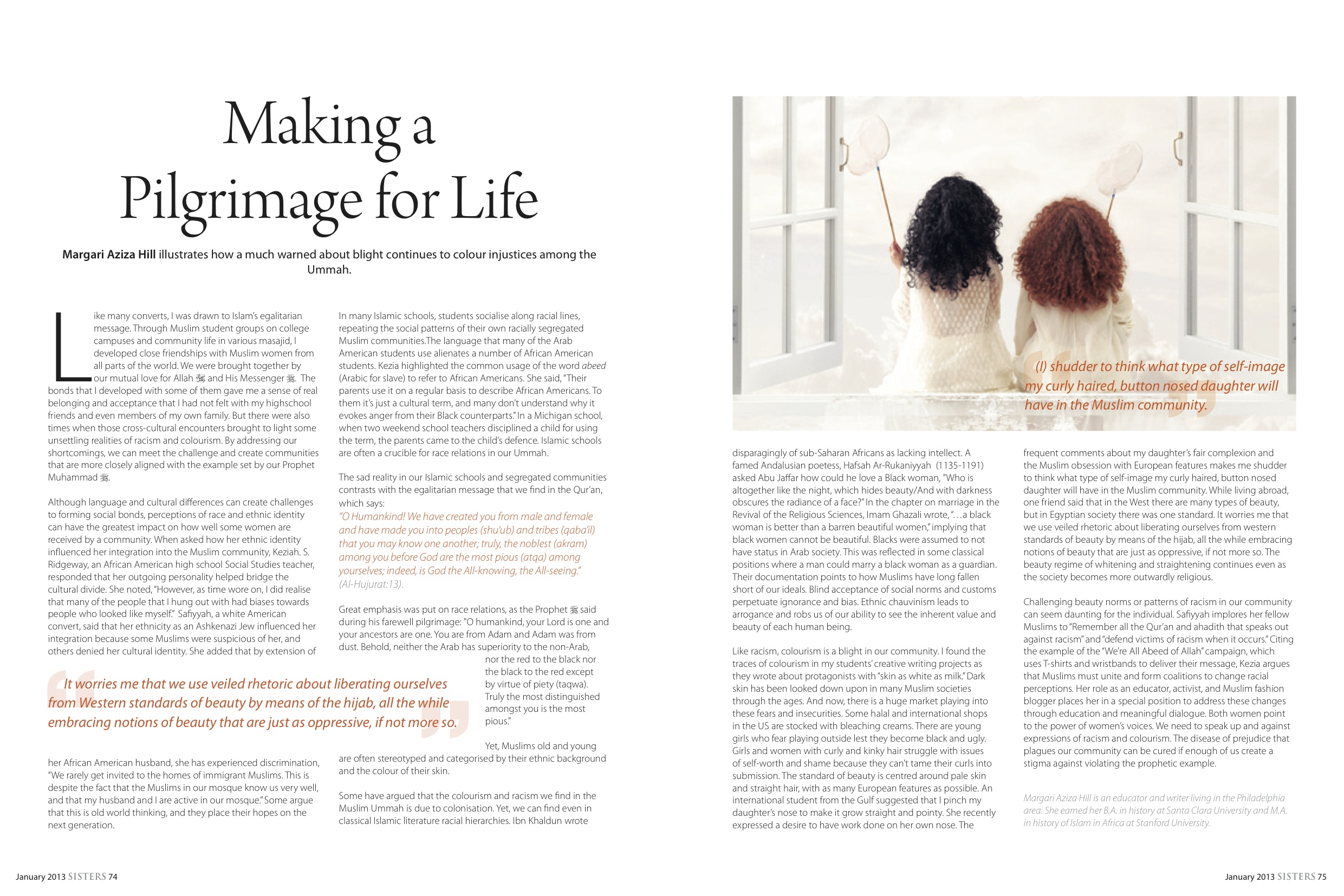
Pilgrimage for Life

Pilgrimage for life
Like many converts, I was drawn to Islam’s egalitarian message. Through Muslim student groups on college campuses and community life in various masajid,  I developed close friendships with Muslim women from all parts of the world. We were brought together by our mutual love for Allah and His Messenger.  The bonds that I developed with some of them gave me a sense of real belonging and acceptance that I had not felt with my high school friends and even member of my own family. But there were also  times when those cross cultural encounters brought to light some unsettling realities of racism and colorism. But by addressing our shortcomings we can meet the challenge and create communities that are more closely aligned with the example set by our Prophet Muhammad (peace and blessings be upon him).

Although language and cultural differences can create challenges to forming social bonds, perceptions of race and ethnic identity can have the greatest impact on how well some women are received by a community.  When asked how her ethnic identity influenced her integration into the Muslim community, Keziah. S. Ridgeway, an African American  high School Social Studies teacher, responded that her outgoing personality helped bridge the cultural divide. She noted, “however, as time wore on I did realize that many of the people that I hung out with had biases towards people who looked like myself.”  Safiyyah, a white American convert, said that her ethnicity as an Ashkenazi Jew influenced her integration because some Muslims were suspicious of her and others denied her cultural identity. She added that by extension of her African American husband, she has experienced discrimination. “We rarely get invited to the homes of immigrant Muslims. This is despite the fact that the Muslims in our mosque know us very well, and that my husband and I are active in our mosque.” Some argue that this is old world thinking and they place their hopes on the next generation.

In many Islamic schools, students socialize along racial lines,   repeating the social patterns of their own racially segregated Muslim communities. The language that many of the Arab American students use alienates a number of African American students. Kezia highlighted the common usage of the word abeed (Arabic for slave) to refer to African Americans. She said,  “their parents use it on a regular basis to describe African Americans. To them it’s just a cultural term and many don’t understand why it evokes anger from their Black counterparts.” In a Michigan school, when two weekend school teachers disciplined a child for using the term, the parents came to the child’s defense. Islamic schools are often a crucible for race relations in our ummah.

The sad reality in our Islamic schools and segregated communities contrasts with the egalitarian message that we find in the Qur’an, which says:

“O Humankind! We have created you from male and female and have made you into peoples (shu‘ub) and tribes (qaba’il) that you may know one another; truly, the noblest (akram) among you before God are the most pious (atqa) among yourselves; indeed, is God the All-knowing, the All-seeing.” (49:13).

The Prophet (PBUH) said during his farewell pilgrimage:

Oh humankind, your Lord is one and your ancestors are one. You are from Adam and Adam was from dust. Behold, neither the Arab has superiority to the non-Arab, nor the red to the black nor the black to the red except by virtue of piety (taqwa). Truly the most distinguished amongst you is the most pious

Yet, Muslims old and young are often stereotyped and categorized by their ethnic background and color of their skin.

Some have argued that the colorism and racism we find in the Muslim ummah is due to colonization. Yet, we can find even in classical Islamic literature racial hierarchies. Ibn Khaldun wrote disparaging of sub-Saharan Africans as lacking intellect. A famed Andalusian poetess, Hafsah Ar-Rukaniyyah  (1190-1191) asked Abu Jaffar how could he love a Black woman, ”Who is altogether like the night, which hides beauty/
And with darkness obscures the radiance of a face?” In the chapter on marriage in the Revival of the Religious Sciences,  Imam Ghazali wrote, “a black woman is better than a barren beautiful women,” implying that black women cannot be beautiful. Blacks were assumed to not have status in Arab society. This was reflected in some classical positions where a man could marry a black woman as a guardian. Their documentation  points to how Muslims fall short of our ideals. Blind acceptance of social norms and customs perpetuate ignorance and bias. Ethnic chauvinism leads to arrogance and robs us of our ability to see the inherent value and beauty of each human being.

Like racism, colorism is a blight in our community.  I found the traces of colorism in my students’ creative writing projects as they wrote about protagonists with skin as white as milk. Dark skin has been looked down upon in many Muslim societies through the ages. And now, there is a huge market playing into fears and insecurities.  Some halal and international markets in the US are stocked with bleaching cream. There are young girls who fear playing outside lest they become black and ugly.   Girls and women with curly and kinky hair struggle with issues of self worth and shame because they can’t tame their curls into submission. The standard of beauty is centered around pale skin and straight hair, with as European features as possible. An international student from the Gulf suggested that I pinch my daughter’s nose to make it grow straight and pointy. She recently expressed a desire to have work done on her own nose.  The frequent comments about my daughter’s fair complexion and the Muslim obsession with European features makes me shudder to think about what type of self image will my curly haired, button nosed daughter have in the Muslim community. While living in abroad, one friend said that in the West there are many types of beauty, but in Egyptian society there was one standard. It worries me that we use veiled rhetoric about liberating ourselves from western standards of beauty with hijab, all the while embracing notions of beauty that are just as oppressive, if not more. The beauty regime of whitening and straightening continues even as the society becomes more outwardly religious.

Challenging beauty norms or patterns of racism in our community can seem daunting for the individual.  Muslim womanSafiyyah said to “Remember all the Qur’an and ahadith that speaks out against racism” and “defend victims of racism when it occurs.” Citing the example of the “We’re All Abeed of Allah” campaign, which uses T-shirts and wristbands to deliver their message, Kezia argued that Muslims must unite and form coalitions to change racial perceptions. Her role as an educator, activist,  and Muslim fashion blogger places her in a special position to address these changes through education and meaningful dialogue.  Both women point the power of women’s voices. We need to speak up and against expressions racism and colorism. The disease of prejudice that plagues our community can be cured if enough of us create a stigma against violating the prophetic example.

You can read the full article and other thoughtful pieces at Sisters Magazine  January 2013 edition “All the Colours of the Ummah”

Politically Incorrect pre-Ramadan post

Before Ramadan begins, I want to get something off my chest. Whether we like to admit it or not, we all have felt excluded at some point during Ramadan.  However, there are some things that should be left unsaid about our friendships, especially during Ramadan. For example, if you hear that one of your friends is getting together with a some other folks, you shouldn’t say, “Why wasn’t I invited?” Here is where you should give your co-religionists 75 excuses, as opposed to harboring ill feelings during this blessed month. Besides, how many get togethers have you organized without inviting your whole address book? If you really want to hang out with said friend, invite them for an iftar. Maintain contact throughout the year, build closer bonds, and next year they will remember you. Stop worrying about whether or not you were included. There could have been  a myriad of reasons why you weren’t invited this time around: budgetary concerns of the host (it is expensive and the economy sucks); numbers (room may be full to capacity); crowd (it may not be your scene); organizer (perhaps the host is not even your friend or the event was to bring together certain people for a specific purpose); perhaps you don’t extend invitations yourself; perhaps they just forgot.  Ramadan is not a time to harbor bad feelings or develop envy over someone getting invited to an event that you were not invited to.

Contrary to our family’s face, our social world is very limited. As a recent transplant and new mother it can be isolating and challenging. There have been many a Ramadan when I received a scarce invitation outside the community events that are open to the public. The daily iftars at Stanford were great. I didn’t have to worry about stuff like that. But here, in Philadelphia, at my first public iftar, I felt like I was just an object in all the sisters’ way.  I didn’t feel very welcomed, so I understand.  Outside of a handful of friends that I run into at public functions, I get the warm smile and the I-recognize-you-and-and-your-husband-but-I’m-too-busy-to-talk-to-you interactions from most. During my first year in Philadelphia, we received two invitations to people’s homes. One ended badly when a guest turned out to be confrontational because many guests weren’t in his particular sect. My second Ramadan, we didn’t receive many personal invites either. Those that did invite us were recent transplants to the Philadelphia. My third Ramadan was similar, even as I was very heavily pregnant and majorly tired, I think some people complained about last year when we didn’t invite them. And once again, not many personal invites outside the usual transplants and public events.

A lot of people we know and have been close to have not invited us over to their homes for whatever reason. At times do I feel left out when they write about their functions and close ties in public forums like facebook? Yes. But do I put it in perspective and keep on moving? I try to and focus on what I can do to not feel so isolated while not breaking my bank or neglecting myself or my family. I know that Ramadan is not about being part of the in crowd or showing up at the who’s who event to eat up all of somebody else’s food. Nor is it about creating popularity contests. These are things we shouldn’t bother ourselves with because we should be focused on higher things. Okay, breath deep, now to focus on my pre-Ramadan jitters! Stay blessed all!

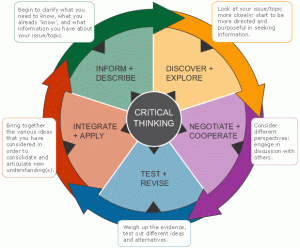
The Critical Thinking Muslim

                                                                                                —Image from ModDB 

“Knowing a great deal is not the same as being smart; intelligence is not information alone but also judgment, the manner in which information is collected and used.” – Carl Sagan

The Muslim world possesses a wealth of knowledge, especially in regards devotional literature, theology, and jurisprudence, yet we have not transformed our knowledge into thoughtful and well-executed ways of addressing our most pressing needs. Muslim communities throughout the world face a plethora of problems: poverty, authoritarianism, civil war, neo-colonialism, occupation, sectarianism, sexual exploitation, corruption, social inequality, civil war, natural disasters, etc. Even American Muslims, who are largely shielded from these perils, are challenged. We face a number of issues: cronyism, crime, domestic violence, poverty, ineptly run institutions, sexism, tribalism, infighting, isolationism, Islamophobia, and an inability to address the needs of marginalized members of our community. The American Muslim community is increasingly literate, with unprecedented access to traditional scholarship and information. Islamic institutions of learning are filled to the brim. Although the American Muslim community is predominantly middle class and highly literate, we somehow still seem ill equipped and are stuck in a quagmire (Pew). We are unable to talk to each other, work together, and develop a common vision. That special something is missing and that something is Critical thinking.

As Muslims, the command to “seek knowledge” is almost like a mantra. But how often are we encouraged to think on a higher level, let alone think critically? This is especially important to think about considering how God speaks of comprehension and thinking in the Quran. Tafakkur تفكر is the reflexive form of the root فكر, which means to reflect, meditate cogitate, ponder, muse, speculate. Tafakkur means to reflect, meditate cogitate, ponder muse speculate revolve in one’s mind, think over, contemplate, and consider. It is mentioned in the Quran 17 times. In Surah A-Rum verse 8 Allah says:

Do they not contemplate within themselves? Allah has not created the heavens and the earth and what is between them except in truth and for a specified term. And indeed, many of the people, in [the matter of] the meeting with their Lord, are disbelievers. (Sahih International)

The word for “Intellect” is ‘Aql عقل, meaning sense, sentience, reason, understanding, comprehension, discernment, insight, rationality, mind, intellect, intelligence. The verb form that we will see commonly used in Qur’an is عقل to be endowed with (the faculty of) reason, be reasonable, have intelligence, to be in one’s senses, be conscious, to realize, comprehend, and understand. In the 49 references of the word in the Qur’an, God often speaks of the disbelievers who do not comprehend.
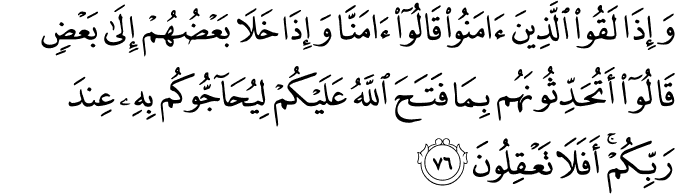
In Surah Baqarah verse 276, Allah says:
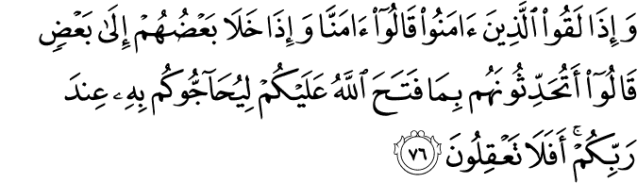
And when they meet those who believe, they say, “We have believed”; but when they are alone with one another, they say, “Do you talk to them about what Allah has revealed to you so they can argue with you about it before your Lord?” Then will you not reason? (Sahih international)

Another important Arabic word that corresponds to critical thinking is the word for logic, منطق which means the faculty of speech, manner of speech, eloquence, diction, enunciation, logic. All three terms, are important to consider when we think of critical thinking. And, I will discuss later, we will see how Muslim scholars employed critical thinking in their struggle to determine what God intended for us to do when an issue was not explicitly stated in the Quran or Hadith literature. Critical thinking implies:

  •  that there is a reason or purpose to the thinking, some problem to be solved or question to be answered.
  • analysis, synthesis and evaluation of information (CTILAC)

Without these two, we were seriously hamstrung. While having the faculty for critical thinking, our community has either ignored its tradition of critical thinking or underdeveloped due to reactionary thinking. As a result, we are a bit hamstrung by our own intellectual deficiencies. I say this with all respect, because we have many knowledgeable people, but they are not good problem solvers and their analysis and evaluation of information is lacking.
As a result, we hit a number of roadblocks. Many Muslims see Islam as a monolith and try to impose their rigid and authoritarian models on others. Our leaders are unable to come up with solutions to problems that were never imagined by classical or early modern legal and religious scholars. Individuals with little experience in non-profit development or leadership, build institutions with little understanding of how to meet social needs. And lay members of our community lock horns in heated theological and juristic debates that take away from a sense of fellowship and coherent communities. Our communities are fragmented by endless polemics where labels and plastic words substitute for real engagement with our differences and our commonalities. All of these problems come about because critical thinking in Islamic studies and devotional education is not something that is valued within our community. Despite our undervaluing of it, there is a great need for critically thinking Muslims, from your average lay member of the community, leaders, and scholars.

If we understand our own legacy of critical thinking and continue to develop critical thinking at all levels of devotional and Islamic education, Muslims will be better equipped to deal with our most daunting challenges. Before going into our legacy of critical thinking, it is important to understand how the term is currently used. The term “Critical Thinking” encompasses a wide array of ways of thinking and processing information. Scriven and Paul write, “Critical thinking is the intellectually disciplined process of actively and skillfully conceptualizing, applying, analyzing, synthesizing, and/or evaluating information gathered from, or generated by, observation, experience, reflection, reasoning, or communication, as a guide to belief and action.” In my experience of teaching, from a high school to college level classes, the most important tool I have tried to help my students develop has been critical thinking. One of the best ways of seeing critical thinking in action was to have students write research papers with sound arguments. That is because “in essence, critical thinking is a disciplined manner of thought that a person uses to assess the validity of something (statements, news stories, arguments, research, etc.)” (Adsit). But I often found that most students lacked not only discipline and curiosity, but also an interest in developing their higher order thinking abilities. Instead, they often focused on trying to get the right answer, rather than learning to analyze, synthesize, and evaluate information. When students don’t think well, they don’t write well. Writing is a higher order level of thinking, but anyone can write without thinking, just as someone can speak without thinking on a subject. But eloquent and logical speeches and well written papers reflect disciplined critical thinking. And both can be subject to critique by others who are keen to see logical fallacies, misuse of sources, or failure to include other factors.

Critical thinking is something that develops with practice. It is something we have to train for. Scriven and Paul write that critical thinking is a set of skills that help us “process and generate information and beliefs.” They also a “habit,” or inclination based on intellectual commitment, “of using those skills to guide behavior.” Critical thinking helps an individual recognize the following:

i. patterns and provides a way to use those patterns to solve a problem or answer a question
ii. errors in logic, reasoning, or the thought process
iii. what is irrelevant or extraneous information
iv. preconceptions, bias, values and the way that these affect our thinking. that these preconceptions and values mean that any inferences are within a certain context
v. ambiguity – that there may be more than one solution or more than one way to solve a problem.” (CTILAC)

Critical thinking is not limited to subjects, so religious thinking has also benefited from critical thinking and in fact, our own tradition of scholarship shines due to our classical medieval scholars’ commitment to critical thinking. One very insightful friend of mine reminded me that we go to college and pay for the skills that our classical scholars had developed. While people outside of the academy have natural inclinations towards certain aspects of critical thinking, often those skills are sharpened and refined during the process of learning a discipline. There is a stark difference between the ways someone like Suhaib Webb discusses a topic, drawing on his years of study and a lay member of the community. People recognize disciplines such as astrophysics and medicine, but often experts on subjects involving in the human experience are not as respected. And people will delve into these subjects without the requisite critical skills or mental rigor to truly engage with them. I found this out as I went into graduate school and developed my field of expertise on Islam in Africa and African History. Friends and family members would discuss a subject and if somehow my view did not agree with theirs and I explained my stance, I would experience their resentment. I learned to be quiet for the sake of peace, even if a loved one was speaking on an issue they were largely ignorant about. Our own willful ignorance in our community is especially detrimental to developing critical thinking. This is especially the case in terms of how some groups of Muslims overlook the 1400 year legacy of critical thinking and scholarship that has allowed our tradition to maintain continuity without a central body or leader to guide it.

Before I took my first course on Fiqh (Islamic Jurisprudents) at Zaytuna in the late 90s, I had no idea about the rich legacy of critical thinking in Islam. I learned about the skills qualified jurists needed to draw on the Quran, Sunna (Prophetic traditions), scholarly consensus, and qiyas (analogy) to come up with rulings on new issues. That basic class whet my appetite on the study of Usul al-Fiqh (Sources of Islamic Jurisprudence), which I later studied a bit in graduate school. Usul al-Fiqh is concerned with the source of Islamic law and methodology in which legal rules are deduced. Kamali explains that the process by which scholars use to deduce sources to try to understand Shariah, Holy Law, is ijtihad. (1). The rules of fiqh use various methods of reasoning, including “analogy (qiyas), juristic preference (istihsan), presumption of continuity (istishab), and rules of interpretations and deduction.” In essence, Kamali points out that Usul al-Fiqh provides standard criteria for deriving correct rulings from the sources (2). However this standard of criteria is now overlooked by many who use ijtihad to come up with convenient rules that can lead to one of two extremes: ultra-liberal positions based on Western inclinations and not on Quran and Sunnah or ultra-conservative positions that purport to be derived strictly from Quran and Sunnah but violate the spirit of Islam.

Before delving further into this discussion, I must admit that I feel woefully ill equipped to engage in any Usuli debate on some religious issue. However, I find that many Muslims will become locked into debates that were never solved by our most gifted jurists. Often lay Muslims, with access to translations of the Quran and volumes of hadith, in addition to treatises and polemics, will derive their own rulings on religious matters based on their understanding of a Quranic verse or a hadith. According to Kamali, historically “the need for methodology became apparent when unqualified persons attempt to carry out ijtihad, and the risk of error and confusion in the development of Shari‘ah became a source of anxiety for the ‘ulama” (4). As a champion of inquiry and free thinking, it is difficult for me to openly admit that I understand their anxiety. But the reality is that our community is struggling with a crisis of authority, and that is mainly who has the authoritative voice in interpreting Islamic law.

The independent, thinking Muslim may feel like he/she is engaging in critical thinking when approaching the highest sources. However, a critical piece is missing. Ebrahim Moosa writes “… untrained in the various exegetical and interpretive traditions, lay people are not aware that a complex methodology is applicable to materials dealing with law, even if these are stated in the revelation” (121). Most lay Muslims are not trained in the language or historical context to know whether a verse was a commandment to a specific group of people at a specific time or to all Muslims of all times. Nor do they always know whether a verse was simply a statement of fact at a historical moment. Similarly, Muslims will use a statement of the Prophet (s.a.w.) without any context or understanding if it was a religious injunction and apply it to their lives. While ignoring aspects of that scholastic tradition, they will draw on it to reject a hadith and say it is da’if (weak). Or they might draw on the polemical writings of a classical author to dismiss the ideas of another tradition. Yet, they often draw on these traditions in sloppy ways that result in more confusion. Sadly, this is because many of the polemical books were written, not for lay people, but for other people who have the requisite skills and training in evaluating and analyzing sources and discipline in reason and logic.

This does not mean that a lay member of the community solely rely upon someone else’s critical thinking, rather that we recognize our own limitations in our knowledge and training and leave open some room for ambiguity. Perhaps we shouldn’t be so willing to condemn others if we don’t have the skills to even assess the validity of their stances. This requires humility which many, me included, often lack. Humility is an important part of sincerity, which is an important component of purifying our intentions before going about any endeavor. When I first converted to Islam and read my few dozen books, I felt a lot more sound in my knowledge than I do now. I didn’t know how much I didn’t know or my deficiencies in training. The more I learn, the more I realize how much I don’t know. The less arrogant I feel about my own knowledge and the more in awe I feel of those scholars who wrote without laptops and cut and paste. Even as we have unprecedented levels of literacy in our community, we must fight narrow mindedness and gathering up of information without being able to judge and assess or use that information for the greater good. And through developing our critical thinking, that Islam is more expansive, rather than restrictive and reactionary. Our greater comprehension through this intellectual struggle will be a truly enriching and humbling experience.

[Note: In order to keep this article digestible, I will continue to develop the themes in later posts to explore other aspects of critical thinking in our community. So, please consider this a part 1 of a longer series. ]

References
Adsit, Karen I. “Teaching Critical Thinking Skills”
http://academic.udayton.edu/legaled/ctskills/ctskills01.htm
retrieved August 13, 2011

CTILAC Faculty Critical Thinking & Information Literacy Across the Curriculum http://bellevuecollege.edu/lmc/ilac/critdef.htm11/18/98. Retrieved from Internet August 13, 2011

Foundation for Critical Thinking “Critical Thinking Professional Development for K-12” http://www.criticalthinking.org/professionalDev/k12.cfm
retrieved from the internet August 20, 2011

Kamali, Mohammad Hashim. Principles of Islamic Jurisprudence. Islamic Texts Society, Cambridge, UK, 2003

Moosa, Ebrahim. “The Debts and Burdens of Critical Islam” Progressive Muslims: On Justice, Gender, and Pluralism. One World Publication, 2003

Pew Research. “Muslim Americans: Middle Class and Mostly Mainstream.” May 22, 2007

The Quran: Sahih International Almunatada Alislami; Abul Qasim Publishing House http://quran.com

Scriven, Michael and Paul, Richard. “A Working Definition of critical thinking by Michael Scriven and Richard Paul” http://lonestar.texas.net/~mseifert/crit2.html
Retrieved August 10, 2010


Towards Thinking of the New Imam

IMAM noun, often capitalized \i-ˈmäm, ē-ˈ, -ˈmam\ 1: the prayer leader of a mosque 2: a Muslim leader of the line of Ali held by Shiites to be the divinely appointed, sinless, infallible successors of Muhammad : any of various rulers that claim descent from Muhammad and exercise spiritual and temporal leadership over a Muslim region

This definition provides us with the meaning of imam within three contexts. Within the sunni tradition, imam  means a political successor to Muhammad, a synonym to Caliph. But most of us American Muslims use imam to refer to the Muslim who leads congregational prayers. Any man can lead prayer, but it is often preferred that the person who can recite the Quran correctly. Women can lead other women in prayer, so in this sense any woman can become an imam.   It is also the honorific title we give to someone who leads a community and this is the meaning of imam that I am talking about. I’m primarily concerned with the current state and future of American Muslim leadership. While there may be a rare woman led community, most are run by a Muslim man who has either been hired by a masjid board or self-appointed in a break away community. An imam functions much in the same way as a rabbi or a parish priest, however there are no qualifications set for the training of imams. There are many knowledgeable and skilled imams;there are some who have limited or training. Some communities have imported imams from overseas who may have memorized the Quran and studied Islamic sciences but have very little knowledge of American society. And within the Black American community, a number of imams are charismatic leaders who are able to gather a large following and are effective mobilizers. While each has their merits, both models still fail at serving the needs of the Muslim community. And both tend to alienate large sections of their congregations, particularly women.

Several Muslim thinkers have argued that an imam needs to understand the social context of America. They have argued that some formal school in fields such as sociology would help.  I want to move beyond the intellectual understanding to what’s going on and look at the training that would go not into intellectualizing the American Muslim community, but serving the American Muslim community. So as I think about the future of our community leadership, in an ongoing conversation, I wanted to point out some skills or training that would improve our masjid leadership. The following list are skill sets that an American imam should have:

1. Enough religious training to teach the congregation and  maintain authority as an imam.

An imam does not have to be a member of the ulema, but he should have enough skills to be effective. This means that the imam should be able to properly recite Quran and have a firm foundation in devotional education  to teach his congregation and maintain his authority. This means that he should have spent considerable time dedicated to formal and informal religious study. And this does not entail spending years abroad kicking rocks, but rather some time  gaining ijazat (permissions to teach from qualified scholars) or shahadah (certificates testifying to competency). Or some other religious authorities can ascertain the imam’s mastery of certain subjects such as Usul al-Fiqh (roots of Islamic jurisprudence), Tajweed (Quranic phonetics), etc. Perhaps in the future, we can have an imam certification process and basic tests to ascertain whether an imam can functionally lead others. But, as I said, the imam doesn’t have to be a major scholar. He can defer the most challenging questions to specialists. The imam should also be able to quickly find resources or resourceful people who he can turn to whenever he doesn’t know something.

2. Spiritual Guidance and Counseling/ Marriage Counseling training

A good imam should not only understand religious and spiritual issues, but he should be well equipped to deal with people coming to them to help them solve their personal problems.  But many imams do not understand the emotional or psychological states that affect the religious life of many of their congregants. An imam should be concerned with developing the moral and ethical conduct of his congregation and not just lecturing people or making them feel bad. Muslims need action programs, improvement programs, and if the community is unable to provide it the imam should be able to refer an individual to the proper resources to get the help that he/she needs. Also, imams are often bombarded with marriage and family problems, as marriage is one of our biggest challenges. There are some imams who are excellent at dealing with marriage crises, but most communities fail at addressing marital disputes. In many ways, there needs to be ongoing training in couples counseling to help develop communication skills and increase intimacy and happiness in marital life.

3. Critical Thinking skills

Basically, the imam should have enough formal education so that he not only  reads and writes well, but thinks well too.  He should be able to interpret Islamic texts and practices in ways that are meaningful for the congregation. We suffer from imams who are reactionary or do not have the requisite skills to address the needs of the community. The imam should be able to develop positions based on authoritative texts and clear logic, rather than on emotions or the daleel of shame (i.e. “AstaghfurAllah”).  The imam should also be able to take in various positions and understand the nuance of broader issues that face the community. An  imam should be able to deal with contemporary issues and communicate with the broader population in a way that would be effective.

4. Leadership training

There is more to leadership than being able to captivate an audience. Instead, leadership is a complex set of skills, including but not limited to the list below:

  • Language and ability to inspire
  • Teamwork building
  • Goal Setting and Project management
  • Communication skills (not just speaking but listening)
  • Problem solving and decision making skills
  • Conflict Resolution and Conflict Management
  • Task Delegation
  • Ethics
  • Financial planning
  • Organizational development
  • Group psychology/dynamics
  • Self discipline and awareness of leadership principles

With these four points, we can find possible areas to develop an effective Muslim American leadership. When I was in New Haven in January, I spoke with some brothers and sisters who were interested in developing a Muslim seminary. Right now we have a problem with funding, so a brick and mortar operation may be costly. But there are alternative programs that we can consider that may include summer intensive classes and online and distance study. What we need are people who are experts in their field to contribute to a joint project to develop our leadership with the highest of standards. And we need more institutions of learning that will help raise the overall Islamic literacy of Muslims. So, let us be creative and think of moving towards a new model of Muslim leadership. Our focus should not be on  creating a rock star imams or reproducing drones who have memorized traditional texts, but creating leaders who will guide have the skills to deal with the daily problems we face today and lead us into a productive and blessed future.

Self Inventory- al-Muhasabah

I sat on a conference panel a few months back where we talked about the current state and future of the American Muslim community. As one of the speakers offered commentary focusing on institutions, my mind sparked. There was so much focus on institutions, but yet people weren’t instituting Islam. People were focused on edifices, but there was little edifying Islam in our daily lives. When my time came to speak, I focused on character building. Our communities seem to lack not only ethos, but ethics. There is too much dissension within our leadership, and many of them are not trained in basic leadership skills. Everybody wants to be a leader, but few people want to be good followers.  And people within the community don’t know how to work well with others to support our mutual goals.  This includes within our families, because our interpersonal skills are so lacking that we are destructive. Combined, the instability of our families and constant political fighting, have created an environment where Muslims are not getting the guidance and resources they need to be successful. Many Muslim leaders have good intentions and I have seen some great strides in institutional building,  but at the same time I see recurrent problems that are not adequately addressed.

As Muslims, we are taught to focus on two aspects of our devotional lives: 1. the laundry list approach to developing practices and habits or 2. increasing our intellectual knowledge through both exoteric and esoteric books, lectures, and articles. We assume that using both approaches we can better ourselves. Often, we are puzzled by why things go wrong.  How can we, as outwardly devout people, end up falling so short of our lofty goals? The truth is that we are missing pieces of the puzzle.  There is a strong disconnect between our own spiritual aspirations and  how we move about in the world for many of us. And that is what jams  up so many of us. Imam Ghazali writes:

O disciple, how many nights have you spent rehearsing your learning, reading books, and depriving yourself of sleep? I do not know what the motive was in this–if it was winning the goods of the world, the allure of its vanities, getting its honours, and vainglory to the debit of your associates and peers, woe to you and woe again! But if your objective in it was the revival of the Prophet’s Law (God bless him and give him peace), the cultivation of our character and breaking  the ‘soul that inciteth to evil,’ blessing upon  you and blessing again!”  (14) [1]

Because many of us are not self-aware, but reactionary, we don’t truly cultivate our character or battle our inner demons. Instead, we look to others for our affirmation, hence the cycle of expectations, entitlement, and ego.  Many of us do not reflect at the end of the day, thinking about why something made us angry or sad. Nor do we question why we do things that are hurtful to either ourselves or someone around us. Rarely do we look at our motivations for certain actions, therefore we hardly ever check our intentions. And that is a dangerous thing because actions are but by intention. This is why we need to constantly assess ourselves.

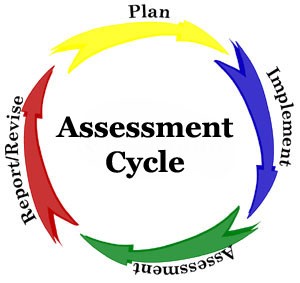
Ramadan is a perfect time for assessing our relationship with our Creator. In order to be truly honest with ourselves, we have to lift certain veils that block us from being able to look in the mirror. Unfortunately, many of us are busy blaming others, remaining trapped in resentment, or feeling entitled, which causes us not to take an unflinching look at ourselves. One of the first steps entails forgiving others, or at least not letting the pain rule us, and taking ownership for how we have wronged ourselves, others, and our Creator. We need to be able to honestly assess our strengths and weaknesses as individuals and develop real strategies  that draw on our strengths for overcoming our personal blockages. And since that is difficult, and many of us don’t have mentors, guides, and sheikhs who really know us, we have to sort of muddle through. Despite our lack of resources, I think that it is possible to draw on an Islamic tradition of al-Muhasabah or self-inventory, modern psychology, and a bit of self-help to begin that process. I will use self-inventory and self-assessment interchangeably.  First let us look at the definition of self-assessment

self-assessment n

1. an evaluation of one’s own abilities and failings

2. (Economics, Accounting & Finance / Banking & Finance) Finance a system to enable taxpayers to assess their own tax liabilities [3]

In an article, Al-Muhasabah on being honest with oneself, the author states:

Self-criticism seems like a fairly straightforward concept. The activity that makes it possible, however-namely, honesty with oneself-is exceedingly hard to come by, for it requires admission of our wrongdoings whenever such actions escape us.  It means acknowledgement within ourselves that we have committed a sin, whether against our own souls or others, be it our Creator or anyone or anything in creation. For most of us, such a confession is an incredibly tough thing to do. [2]

I think this is really helpful, but only focusing on our wrongs can be demoralizing. I have used self-assessments in the classroom and often they focus on finding strengths. In fact, there are many kinds of self assessments and personal inventories. The most common ones we will find are career and personal interest inventories and the second most common are those we find in motivation literature. There are two aspects of self-inventory, taking an assessment of our character flaws and acknowledging our wrongs and mistakes. A few readers might be familiar with the rigorous self inventory process of programs like Alcoholics Anonymous [4]. I do suggest looking at the moral inventory list because it is a useful tool. Only through acknowledgement of our wrongs, can we perform true tauba (repentance) and make changes. But, in many ways our sins are merely symptoms of an illness. And since most of us don’t have a guide, we have to do some serious self diagnosis. This is where we can use tools to do a real self inventory. The most powerful tool a believer has in the path to Ihsan (Perfecting Faith) is self inventory.  It is important to remember a few principles when it comes to self inventory:

1. Honesty- we must be fully honest and not delude ourselves when we are taking self inventory. We cannot make excuses for our actions or try to sugar coat things.

2. Faith- while acknowledging our flaws, we should have faith that our Lord will forgive our sins and shortcomings. .

3. Hope- We have to accept that we are human and these shortcomings are part of our nature, yet we can overcome them with help from God

One of the reasons why a personal inventory is important, even if you have a spiritual guide, is that only the individual has access to his or her own heart, memories, and thoughts. Confession is not part of Islam, as each person is accountable for his or her actions and no one else can expiate sins. In addition, exposing one’s sins can cause greater harm than good. Finally, the self reckoning is a personal journey and it is dangerous for our souls to take pride in the steps we are making towards improvement. Many people put on an act for others, especially if we admire them and want to impress them. Would I want to tell someone I admire that deep inside I am a fickle person, easily flattered and easily hurt by criticism? Imam Ghazali writes, “travel on this path should be by way of self-exertion, severing the ego’s appetite and killings its passions with the sword of discipline, and not by way of  and useless statements” (24) [1]While someone can observe from the outside and see certain character defects and strengths, they are unlikely to know the full contours. The guide can be just that, a guide on our journey. Each individual must exert themselves, with determination, to walk that path.

I believe that our development will become apparent to those around us, especially those we love. It will improve the quality of our lives, help us adjust to challenges, and allow us to come closer to our Creator. I do think it is worth it to look for means to honestly assess ourselves, come up with strategies to deal with our weaknesses, implement them, and assess our progress constantly. If we do that in a continual cycle, with honesty, faith, and hope, we can be more successful in both this life and the hereafter.

But don’t just take my word for it, I included a really nice video that deals with this subject below:


Resources:

[1] Al-Ghazali Letter to a Disciple. Islamic TExts Society, Cambridge UK, 2005

[2] http://www.aljumuah.com/straight-talk/40-al-muhasabah-on-being-honest-with-oneself

[3] Dictionary.com

[4] http://www.rc-rc.info/Content/MoralInventoryChecklist3p.pdf


Feeding America and Fidya for Ramadan

“Alms are for the poor and the needy; and those employed to administer (the funds); for those whose hearts have been (recently) reconciled (to truth); for those in bondage and in debt; in the cause of Allah; and for the wayfarer: (thus is it) ordained by Allah, and Allah is full of knowledge and wisdom.” (Al-Qur’an, 9: 60)

Whether they assume that state agencies will take care of America’s poor or the poor in America are not deserving of charity, giving to charitable organizations in America is often not the top of the list in many national Muslim organizations. Many Muslims think that in America, Land of the Plenty, that people are not starving. But according to Feeding America, there are over 50 million Americans who suffer from hunger, that is 1 in 6 adults and 1 in 4 children. Many people often blame those who have found themselves reduced to begging in the street or finding a cot in shelters for their condition. This is the land of opportunity, right? However, natural disasters like Hurricane Katrina and the recent wave of tornadoes, in addition to the tanking economy, have shown that people have been reduced to poverty through forces outside their control. Islamic Relief has some America-based programs, but I have only seen a few mosque sponsored soup kitchens and food pantries.   This is a most unfortunate situation that serves to undermine us as a community and, I believe, our faith. This is especially important when we think about the chapter 107  of the Quran Ma’un (Alms or Small kindness):

Seest thou one who denies the Judgment (to come)?

Then such is the (man) who repulses the orphan (with harshness),

And encourages not the feeding of the indigent.

So woe to the worshippers

Who are neglectful of their prayers,

Those who (want but) to be seen (of men),

But refuse (to supply) (even) neighbourly needs.

Suhaib Webb has a powerful tafsir (explanation)  of this chapter in “Explanation of Surah al-Ma’un,” showing how this small chapter is packed with so much meaning. It shows how our actions towards the poor is really a reflection of our state of faith. How can we truly believe in the Day of Recompense, when we face human wretchedness and do nothing to alleviate suffering? We do it all the time, as we are desensitized to it or fear that giving will decrease our wealth. And we hold on to our wallets and pocketbooks, forgetting that the money have is not really our own, but a loan from God. He gives sustainance, and if we have true faith we wouldn’t worry about giving Him back what He is due by offering charity.

Other well meaning Muslims ignore poverty in America because of, what I believe, are  misplaced priorities. Many Muslims say that people overseas are suffering more, so they are more deserving. Yet, the order of giving charity is first to our families, neighbors, and then to needy. What good is our religion, if we are not able to affect those closest to us? And, importantly, what kind of message are we sending our American neighbors about our commitment to being contributing members of our community and good citizens?  How are we handing someone da’wah pamphlets, yet refusing to give them a helping hand? Many Americans see our community as parasitic, enjoying the economic benefits of this society while working to undermine it. And sad to say, the anti-establishment rhetoric of some Muslims in America has served to support those perceptions.  The us-versus-them rhetoric has also led many to turn their backs on suffering Americans. Or the insular ethnic communities with an emphasis to ties back home has also caused many of us to ignore the immediate needs of our neighbors, whether Muslim or non-Muslim. And so, we are seen  by our neighbors building our masajid, but not making any positive impact on society. At best, we become tolerated, but not welcome neighbors, at worst we are seen as an existential threat to America. We have to take ownership of how neglectful we have been in providing a positive example.

Surah Ma’un reminds us  that are neglectful of our prayers because we ignore feeding the poor, the orphans, and being kind to our neighbors in need. This is especially important during Ramadan. While our fast is for God alone, we have an increase in public acts of worship, with mosques filling up to capacity. There are more opportunities for showing off because of the supererogatory taraweh prayers each night. While I am in 100% support of those who spend time in the mosque and believe this is a great opportunity rejuvenate our faith, we have to make sure we are not just doing things for show. And how does this Surah Ma’un show the correlation? By doing kind acts we can avoid falling into the category of hypocrites or those who deny the Day of Recompense.

Further, our charity as Muslims should increase and it should be to alleviate suffering, not just to feed ourselves. While paying for an iftar is a commendable thing, as we get reward for feeding a fasting person, we should not limit our charity to that. We should take care of the orphans, feed the needy, and do kind acts for those around us. In essence, we should have some social impact. The Muslim footprint should especially be felt during Ramadan in this society. There is so much evidence that shows that Ramadan is not just about fasting.

Evidence for this can be seen in what serves as expiation for those who are unable to fast. For those who  are unable to fast, those who have a chronic disease or are elderly, it is important to pay the compensation, fidya, for missed days. The Hidaya Foundation writes on their page:

  • The price of Fidya for each day of missed fasts is either to feed a poor person two meals in a day, or to give whole wheat, which is enough to feed a poor person twice in a day (1/2 Saa per Hanafi school of thought, or 1 Saa per Shaafi and other schools of thought). (1 Sa = 3 Kilograms approx.)
  • The Fidya price for one who has to pay it should be calculated based on the local prices of whole wheat in the place the person resides.
  • The price for Fidya in the USA is $3.50 by the Hanafi school of thought, and $7.00 according to the Shaafi and other schools of thought.

Scholars have disagreed on whether or not fidya applies for someone who either broke a fast for a certain period or missed a day because of menses, pregnancy, nursing, or 40 days after childbirth, but does not fall into the category of the elderly or individual has a chronic disease and therefore can no longer fast. Faraz Rabbani explains in Who can pay my fidya +make up fasts, “In the Hanafi school, there is no fidya for delayed making up of missed fasts. Rather, one simply makes up the missed fasts themselves–and it is recommended to hasten to do so. [ Shurunbulali, Maraqi al-Falah; Ibn Abidin, Radd al-Muhtar.” Other schools take a different opinion, saying  that for those who can one day make up a fast, should still pay the fidya for each day they missed.  Shaykh Hamza Karamali answers in Payment (fidya) for not making up days from last Ramadan:

According to the Shafi`i school, if one does not fast some days during Ramadan, it is obligatory to make up these missed fasts before the next Ramadan arrives, regardless of whether these fasts were missed with a valid excuse (e.g. menstruation, travel, sickness, etc.) or without a valid excuse.  If one does not make them up before the next Ramadan, one is sinful and must pay a “mudd” (a volumetric measure defined below) of food to someone poor (faqeer) or short of money (miskeen) in addition to making up the missed fasts (I`anatu’l-Talibin, 2.242;Tuhfat al-Muhtaj, 3.445-446).


A “mudd” is the amount one can hold in both hands when cupped together. It is estimated in the Reliance as 0.51 liters (Reliance, i1.33). The type of food one gives varies from place to place. One must pay whatever food is considered the main staple in the area where one lives. This could be wheat, barley, rice or something else (al-Minhaj al-Qawim + al-Hawashi al-Madaniyya, 2.194).

Feeding (it`am) a poor person, as Imam Bajuri (Allah have mercy on him) explains in the section on expiating (kaffara) for fast days that one has invalidated, means giving him ownership (tamleek) of the food. It is not sufficient to cook the food and then invite him to one’s house for lunch or dinner (Hashiyat al-Bajuri, 1.319). Rather, the poor person must be given possession of the food (e.g. a bag of wheat) and then he can do what he wants with it (e.g. eat it, sell it, give it away to someone else, give it back to you and ask you to cook it for him, etc.). As such, it would not be sufficient to invite the people to a feast. One would have to give them the actual staple food.

A number of women I talked to, to be on the safe side are giving the fidya for the days that they cannot fast with the intention of one day making up the days.  However one mistake many of us often make is by sponsoring an iftar or inviting a friend over for dinner with the idea that we are fulfilling the fidya. Regardless of the price, it is clear that the qualification for who gets the fidya should be someone who is qualified to be a recipient of zakat. The poor and the needy are people who cannot pay zakat themselves because they don’t have enough money. And I think these technicalities are important to remember as we are nearing the Blessed month of Ramadan. Are we feeding the poor, helping organizations that distribute money to the poor, helping new converts (for that is what it means of “those reconciled [to truth]),” helping those crippled by debt, giving to God’s cause, or taking care of the travelers? For those of us who need expiation for missed fasts or whether we want to simply increase our charity, our kindness should not just be based on geo-politics or ethnic ties.  This Ramadan, we should move our focus away from lavish feasts at iftars and work towards alleviating  suffering and hunger locally and globally.

**Update **

Islamic Relief USA inaugurated a summer food service program to feed working class children in Maryland healthy meals.  You can read more about it here. Good job Islamic Relief! We need more of this.

FOUR STATEMENTS BAM CONVERTS MAKE THAT UNDERMINE THEIR FINANCIAL SECURITY

Sorry for the long delay. It is not just that teaching is overwhelming, but I avoid writing when I feel negative about the current condition of the American Muslim community. I can’t even begin to talk about the abysmal state of Muslims abroad. I know there are hopeful stories and inspiring people, but sometimes I’m left speechless. I didn’t want to sound like a whining Muslim; on the flip side, I didn’t want to sound like a braggart by publicly taking stock of my accomplishments. My reticence is beside the point of this article. So, I’m going to go just for it and make a major splash back into blogging. I can foresee this causing some major problems, however I will refrain from wasting time in back and forth debating. I just have to speak my mind because we have to address our dire condition.

I see many bright young African American Muslims struggle finding their place in the community. Often, our place in a community is determined by how others see our contribution. Our Ummah is not color blind, nor is it class blind. And many of our immigrant brothers and sisters come from societies where class plays perhaps a larger role than ethnicity. So our relative position on the social economic scale factors into the respect that our brethren afford us. So, if we, as a community, are a destitute group, we will have little clout in the discussion on Islam in America. In our brethren’s minds, we are bringing nothing to the table. Many Black American Muslims are struggling economically, unable to finish school or find financial security. The common perception is that most African American Muslims come from impoverished backgrounds or are ex-cons struggling with reintegration in society. But this is not solely the case.

Contrary to popular perception, it is not only White American Muslims who have everything to lose by converting. Many Black American converts who come from Middle Class backgrounds are financially worse off than their parents. Many Muslim American converts, in reality, have made personal, economic, and career choices that have undermined their financial security. There are even second generation Black American Muslims who are worse off than their convert parents. But without an honest look, we may be doomed to repeat the same mistakes. First, we should understand that several of the people who were promised paradise were wealthy. There is nothing wrong with wealth, in and of itself. What matters is how we use it. Islam is not the new socialism. And perhaps some people read or misread Ali Shariati. Two, we should understand that secular education is important in our upward mobility. In fact, education is the primary reason why Muslims immigrated to America. So why should indigenous Muslims give up on America’s promise and become ineffectual? Why is it so few Black American Muslims are attending college for professional, advanced degrees, growing businesses, or finding financial security? And importantly, why have so many Black American Muslim initiatives faltered?
After almost 20 years, some of us are looking back at the choices we made in our personal lives and communities? What led us to make certain choices in our education and professional development? Where did we let others down? Where did we let ourselves down? What resources did we have to achieve important milestones in life? What networks and social ties did we fail to tap into? What sacrifices have we made in becoming Muslim. Did we make any misguided decisions? How can we repair the damage and create a better future for children and ourselves?

I developed a list to begin to explore these questions. This list is not to argue whether something is haram or not, but to discuss the influence of certain religious positions on our lives. What sacrifices are converts making that have a detrimental effect on our financial security? In the next few weeks, I plan on tackling some of these issues. I will show the fatwas that Western Muslims have received from scholars abroad. I will then try to find alternative positions that allow for some flexibility, or endeavors that, at minimum, try to address the challenges we all face in this society.

1. Don’t Deal non-Muslims (Kuffar), even Your Family and Childhood Friends.
This faulty thinking leads many young Muslims astray and alienates their family. Not only do we fail to listen to our family’s advice, thinking that they don’t have our best interest at heart, but we don’t build stronger ties of interdependence. You are not supposed to break family ties, but maintain them whether or not you share the same religion. How you treat your family and friends can have a huge impact on the so many people’s perception of Islam. But self-isolating ourselves can lead our family and friends to think we joined a Jonestown style al-Qaeda group. Importantly, while there are generous Muslims who are willing to provide a lending hand, your family is bound to sacrifice much more, offer you a place to live, or take care of you if your health falters.

Not only do they no longer have social networks that they can tap into such as fraternities, lodges, and professional organizations for contacts, but their old college and friendship networks become frayed due to lifestyle choices that our religions demands (i.e. no cocktail receptions or happy hour networking parties and mixers for networking events). Sometimes their classmates just don’t relate. Converts may even suffer strained relationships with their immediate and extended family. This can lead to them losing family financial support in school, marriage ceremonies, or business endeavors.

Second, we fail to form solid alliances with non-Muslims to achieve the greater good. Without a relationship of reciprocity, we find ourselves isolated an alone. Third, we often hire incompetent Muslims and foster paternalism. Some Muslims have an “I only patronize Muslims” policy. Meaning that they hire Muslim contractors who do shoddy jobs or rip them off. Out of aversion to taking your co-religionist to a kaffir court, many Muslims will just eat the loss, as opposed to making these businesses accountable. Also, our fear of backbiting will also keep us from slandering that Muslim who did a poor job or did us dirty by reporting them to the Better Business Bureau.

2. Your Education Will Corrupt You.
Basically, the only real education is sacred knowledge. Time and time again I have heard tales of bright Muslims not encouraged to finish school, but become students of knowledge. You can end up in a dusty place for a few months or wander aimlessly for a about a year. Unlike some of your Arab and Desi American friends who spend their year abroad, you likely did #1 and your family probably won’t help you out and get back on your feet. Honestly, we do need more scholars of Islam, and to be honest, Muftis and Fuqaha with a strong knowledge of minority fiqh and American society. However, does the community need thousands of young men and women with the equivalent of an elementary degree from a Muslim institution of learning abroad?

The irony is that many converts are discouraged from completing their secular education by foreign scholars and immigrants who are largely educated with college degrees. Immigrant children go to college. They become doctors, engineers, business professionals, executives, and doctors. Most African Americans don’t come from families with enough money to foot college tuition. Nor do many of us get a full on scholarship. The primary way that many African Americans finance their education is to take a student loan. And look online at the fatwa’s. Student loans are haram. The immigrant Muslim community in America is largely affluent. So, many have an option of not taking student loans. Very few Muslim organizations offer scholarships to off set the education costs. And Muslim lending institutions are primarily geared towards wealthy Muslim purchasing homes, not student loans. So, many Muslims shut the door to education
The reality is that we need men and women who have the skills and capital to help build our communities. We need skilled labor, infrastructure building, and strategic planning from people who are trained and educated. A higher education can help alleviate some of the greatest challenges our community faces. It will lead to better earnings, which will lead to stable living. Stable living leads to viable marriages, which will help build better neighborhoods. With the rubber stamp of “denial” Black American Muslims are left to flounder, unable to become contributing members of their community and society.

3. Don’t Plan Your Family or Get to Know Your Future Spouse, Because Allah is the Best of Planners
Black American Muslims suffer some of the worst divorce rates. Perhaps we should thank Allah that many of the marriages are religious, and not civil marriages, because if we knew the real statistics, we’d lose our minds. My rough estimate would be that 75% or more of African American marriages end up in divorce. The sad thing is that many of these broken marriages produce children who become scarred in the process.
Many converts have an idealized version of stranger marriages, arranged marriages, and even the marriage match. Depending on if the Muslim comes from a cultish community or not, he or she may be pressured into making an insane marriage choice. I have heard of a college age young woman pressed to marry a recently released ex-con. I have heard of a teenage girl forced to marry Middle Aged destitute man only to be a divorcee by the time she’s 17. I have heard of young men pressed to marry women they don’t know and have 3 kids by the time he realizes that his wife is mentally deranged. There are lots of crazy anecdotes. Many American Muslims marry really young, derailing their emotional and financial development. My young students are all proponents for youth marriages; however if they knew the challenges that they would face, they’d think twice.

Converts also come with our own cultural norms, which are contrary to the American Muslim norms of love and relationships, and emotional baggage. Some communities have a sit down. Others may organize marriage meet and greet, or even large conventions. There are online matrimonials, myspace, facebook, etc. But more often than not, the process of meeting someone is a nightmare. American Muslims have not yet developed the network to create opportunities for single Muslims getting to know each other. Also that baggage. It is impossible to just throw away our notions of love and marriage. Americans are used to a honeymoon period of dating and getting to know each other. Those wonderful memories of courtship and fun times create, at minimum, some nostalgia about those romantic moments. Even more destructive than our notions of love and romance is the greatest baggage African American converts bring into their Islam. And that is their promiscuity. This stems from our own insecurities, notions of manhood or femininity, and egos tied to sexual conquests. Few of us grew up with two happy, married parents. So, we don’t even know what to look for in a spouse. Many American Muslim marriages suffer from intimacy problems and love doesn’t always develop between the couple.

Muslims are sometimes discouraged form practicing birth control. With a tanking marriage and 7,8, 9, 10 kids, there are some serious financial implications.

4. Don’t Focus on the Dunyah, but the Hereafter.
Many see wealth building or social climbing as a worldly endeavor and they begin to make irrational economic decisions. There are two roots to this version of Black American asceticism: the first, stemming from the Black American protest tradition and the second stemming from abroad. In the protest tradition, middle Class values of education and career are White values. Some Black American Muslims transfer the notions of whiteness or “the man” into the unbelievers, “kuffar.” The motivation to reject this world and take on a life of poverty becomes a political choice, tied closely to identity politics. The second root of the Black American aversion towards higher education or professional careers is a foreign import. Some forthcoming studies show how the imposition of these ideas is both unintentional and intentional. Basically, some scholars who have little understanding of the social, economic, and historical condition of Black Americans discourage them from taking the one path to social mobility. These two factors combine to drive many African American Muslims into a faulty notion of asceticism. This form of asceticism, rejecting “worldly education” and “worldly careers,” is often a detriment to many Black American families.

The other problem with this statement is that it channels some of the most talented and charismatic, but maybe not so pious, members of our community into becoming religious professionals. Islam becomes the new hustle. Many of our brightest minds go into careers such as imam, public speaker, religious scholars, or teacher at an Islamic school, when maybe they would have been better as professionals, who donated their wealth and fundraising ability to create community centers and institutions. Instead of giving to the community, they are drawing an income from the community. Further, if we, as a community, discouraged our members from attaining a college degree, then we will have board members with no education, management, or organizational skills. Finally, while non-profit work is honorable, many Muslim non-profits pay a pittance. I’ve heard of Muslims going six weeks without pay from Islamic Institutions.

This list is not limited to African American converts. I know that other converts, and even children of immigrants, who get caught in this cycle. I hope that by bringing up these points we can begin to address these problems and come with some solutions. I work full-time in the Muslim community, and I may be rough and gruff sometimes, but I am solution oriented. My goal is to empower us to work for a positive change. Just like everyone else, I am tired of bemoaning the fate of Muslims in America. It is time we do something about it. While I think I have a few good ideas, I know many of you have many more. So, let’s get to work!